October Hacks: Out of the Dark (dir by Michael Schroeder)


In 1989’s Out of the Dark, a man dressed in a clown costume is killing phone sex operators.  He lurks in the darkness and jumps out of the shadows to commit his dastardly crimes.  Especially during the first hour or so, the film has its share of both suspense and gruesome moments.  In the style of Italian giallo and pre-Halloween American slasher pics, the film actually tries to create some mystery about who the killer could be.  Lt. Frank Meyers (Tracey Walter) suspects that the killer might photographer Kevin Silvers (Cameron Dye).  Kevin and his girlfriend, Kristi (Lynn Danielson-Rosenthal), think that the police should be taking a closer look at David Stringer (Bud Cort), an accountant who has an office in the same building as the phone sex company.  Meanwhile, Detective Langella (Divine) thinks that the murders might be linked to a serial killer who is targeting prostitutes.

The main problem with Out of the Dark is that it’s pretty obvious from the start who the killer is and it’s hard not to judge the people who can’t figure it out for themselves.  The movie doesn’t really offer up enough viable suspects to keep you guessing and than it spends so much time trying to make it look like one of the suspects is guilty that any experienced film watcher will automatically know that he isn’t.  The viewers are supposed to be shocked by the killer’s identity but there’s nothing shocking about it.  It’s pretty obvious.

On the plus side, Out of the Dark does have a one-of-a-kind cast.  Divine and Tracy Walter play detectives.  Bud Cort is intense and nerdy as the bitter accountant.  Cameron Dye is vacuously handsome as the photographer.  Geoffrey Lewis shows up as an alcoholic.  Lainie Kazan plays an aging prostitute.  Tab Hunter drives a car.  Paul Bartel manages a motel and gets upset when he sees the blood pooling in one of his rooms.  And finally, Karen Black plays the owner of the phone sex company and gives a far better performance than the material actually deserves.  Black brings some much needed emotional reality to the film.

As I said at the start of this review, Out of the Dark has its moments.  The clown costume is truly creepy and the opening murder is all the more disturbing because it happen outside and in a public park.  (You do have to wonder how no one noticed a weirdo dressed like a clown wandering around.)  A scene in which the clown attacks a phone sex operator who has agreed to serve as bait is also well-done and genuinely frightening.  The story moves at a quick and steady pace and it deserves some credit for ending on a definitive note as opposed to trying to copy the ambiguity that was so popular with other slasher films of the era.

If only the identity of the killer had actually been a surprise, Out of the Dark would probably be considered a classic.  As it is, it’s just another well-made slasher film.
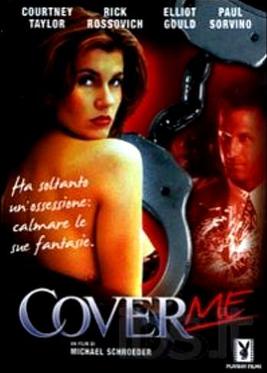
Cover Me (1995, directed by Michael Schroeder)


A serial killer is stalking Los Angeles, killing the models who have appeared in an adult magazine. Because they’re not very good at their jobs, neither Sgt. Bobby Colter (Rick Rossovich) nor Detective J.J. Davis (Paul Sorvino!) have come up with any leads that could lead them to the murderer. Facing a dead end, they come up with a brilliant idea. Maybe a cop could go undercover as an erotic model! Fortunately, Bobby just happens to be dating a surprisingly attractive cop named Holly (Courtney Taylor). You have to love it when a plan comes together.

At first, Holly is hesitant but, realizing that there’s no other possible way to get the killer off the streets (because it’s certainly not like Bobby or J.J. could actually do any police work on their own), she agrees to pose for some pictures. Soon, she’s appearing in the magazine, working as a stripper, and discovering that she enjoys her new uninhibited lifestyle. Meanwhile, the killer has noticed her. The killer, by the way, is Dimitri (Stephen Nichols), who frequently disguises himself as a woman and who is driven to kill by his mother. Dimitri’s identity is revealed early on in the film so this doesn’t count as a spoiler. Cover Me is a mystery but it’s a mystery where everyone figures it all out except for the people who are supposed to be figuring it out.

Cover Me was one of the many direct-to-video films that found a home on late night Cinemax in the 90s. These films were advertised as being “erotic thrillers,” though there was usually little about them that was either erotic or thrilling. Cover Me was produced by Playboy and distributed by Paramount, which means that Hugh Hefner probably used to show up on set, wearing his sea captain’s hat and asking the strippers if they wanted to come back to the mansion and help him look for his Viagra. Because it’s a Playboy film, Cover Me has higher production values than the typical 90s erotic thriller but it’s still interesting that a company best known for publishing an adult magazine would produce a film about a killer targeting nude models. In the 70s, Playboy produced things like Roman Polanski’s adaptation of MacBeth, a cinematic triumph regardless of how one feels about Polanski as a human being. By the time the 90s rolled around, they were producing slightly less classy versions of Stripped to Kill.

Still, Cover Me is better than many of the other erotic thrillers that came out during the direct-to-video era. That doesn’t mean that it was a good movie, of course. There’s a reason why “Skinemax” was go-to punchline during the 1990s. As opposed to many of the other movies of the era and the genre, Cover Me has a talented cast that tries to make the best of the material that they’ve been given. I don’t know how Rick Rossovich went from appearing in The Terminator and Top Gun to starring in something like Cover Me but he delivers his lines with a straight face, which could not have always been easy. Paul Sorvino, Elliott Gould, and Corbin Bernsen are also on hand, all playing their parts like pros. (Between L.A. Law and Psych, Bernsen was a mainstay in these type of films, almost always playing either a pimp, a pornographer, or a strip club owner.) Finally, there’s Courtney Taylor, who is actually pretty good in the role of Holly. Though the role really only calls for her to be sexy, Taylor still plays it with a lot of conviction. Taylor’s performance is natural and likable and she sells even the most clichéd dialogue. Just as when she starred in the fourth Prom Night film, Taylor is always better than her material. Unfortunately, Courtney Taylor appears to have stopped acting around 2000.

Cover Me was shot at the same time as an early CD-Rom game called Blue Heat, where I guess the player would step into Holly’s shoes and try to solve the case. Because the company that developed the game went out of business before the game was published, Blue Heat didn’t come out until two years after Cover Me. I’ve never played the game but, from what I’ve read online, it was a point-and-click game where you could go to various places in Los Angeles and search for clues and interrogate suspects. The game came with multiple endings, depending on the decisions you made. Did anyone ever play this game? Let me know in the comments!

As for Cover Me, it’s not great but it’s also not terrible, which is high praise when it come to late night CInemax.


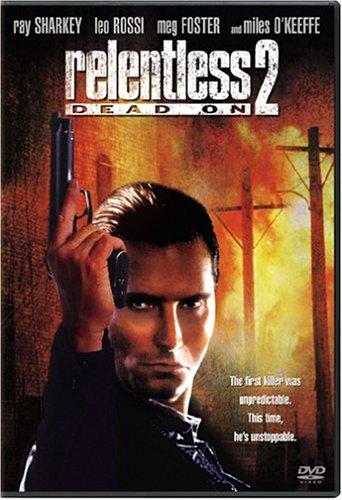
Dead On: Relentless II (1992, directed by Michael Schroeder)


Still struggling to recover from having to act opposite Judd Nelson in the previous Relentless film, Los Angeles homicide detective Sam Deitz (Leo Rossi) finds himself investigating another string of seemingly random murders.  This time, the killer is Gregor (Miles O’Keeffe), a master of disguise who hangs his victims, decorates the crime scene with Satanic graffiti, and takes a lot of ice baths.  Deitz is forced to team up with a condescending FBI agent named Kyle Valsone (Ray Sharkey), who has his own reasons for wanting to capture Gregor and who might not have the best interests of the case in mind.  As if having to deal with killer Russians and crooked FBI agents isn’t bad enough, Deitz is also having to deal with the collapse of his married to Meg Foster and the everyday irritations of being an intense New York cop in laid back Los Angeles.

Relentless II is a better than the first Relentless, mostly because Miles O’Keeffe is a better villain than Judd Nelson.  Whereas Nelson was too twitchy to be taken seriously in the first Relentless, O’Keeffe is cold as ice and believably dangerous.  He’s a worthy opponent for Rossi and Sharkey.  How much Keeffe was in this movie?  Just enough to make it work.

Whenever O’Keeffe isn’t doing his thing, the movie focuses on Deitz and Valsone.  To a certain extent, their relationship mirrors the relationship that Deitz had with Malloy in the first Relentless except, this time, the mentor turns out to be just as bad the killer.  Ray Sharkey was a good actor whose career nosedived because of his own addictions.  He was always at his best playing streetwise bad guys, like Sonny Steelgrave in Wiseguy.  He’s good as Valsone, giving a performance that indicates that, even if mainstream Hollywood wasn’t willing to take a chance of him, he could have carved out a direct-to-video career as a poor man’s Michael Madsen.  Unfortunately, Sharkey contracted HIV as a result of his heroin addiction and he died of AIDS just a year after the release of Relentless II.

Leo Rossi gives another good performance as Sam Deitz.  Rossi was usually cast as abusive boyfriends and low-level mobsters and it’s obvious that he enjoyed getting to play a hero for once.  Meg Foster may not get to do much as Deitz’s wife but her otherworldly eyes are always a welcome sight.

Relentless II was the high point of the Relentless films.  It made enough money to lead to a sequel.  Sam Deitz’s days of hunting serial killers were not over.