4 Shots From 4 Films is just what it says it is, 4 shots from 4 of our favorite films. As opposed to the reviews and recaps that we usually post, 4 Shots From 4 Films lets the visuals do the talking!
Today, we celebrate the birthday of Chuck Norris. It’s time for….
4 Shots From 4 Chuck Norris Films
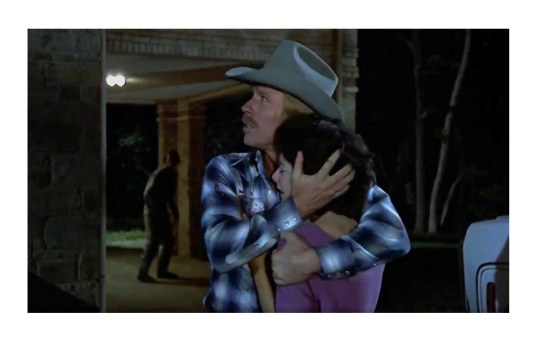
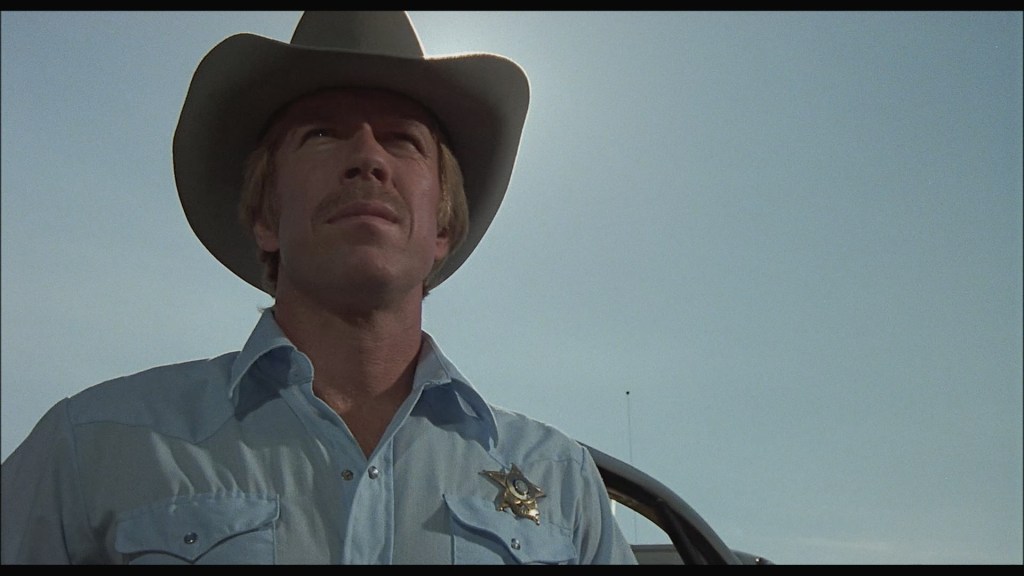
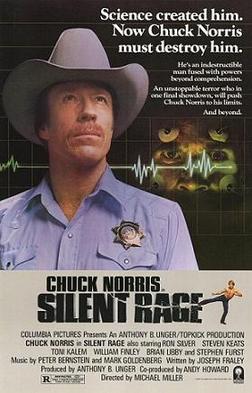
Silent Rage (1982, dir by Michael Miller, DP: Robert Jessup and Neil Roach)
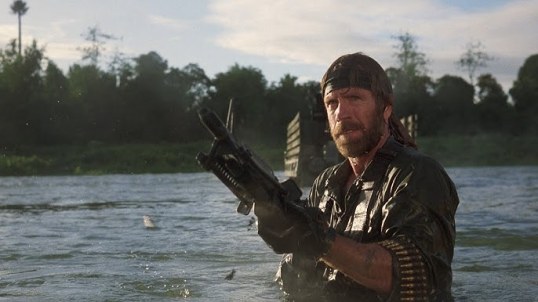
Missing In Action (1984, dir by Joseph Zito, DP: João Fernandes)
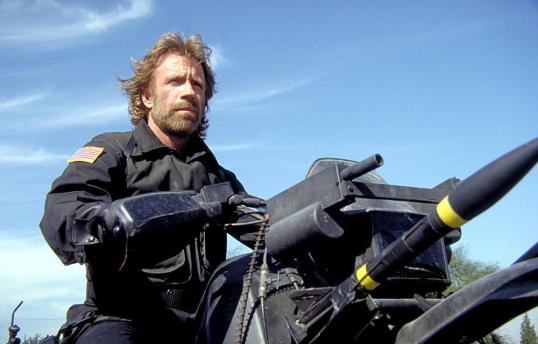
The Delta Force (1986, dir by Menahem Golan, DP: David Gurifinkel)
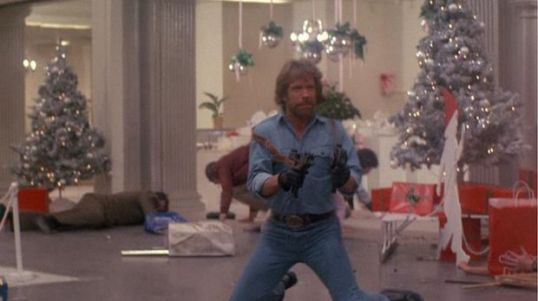
Invasion USA (1985, dir by Joseph Zito, DP: João Fernandes)
Today, everyone knows the origins of the Doctor. We know that the Doctor is a Time Lord and a native of the planet Gallifrey. We know that the Time Lords had a policy of not interfering with other civilizations. They could travel through time but they were never to change history. We know that the Doctor, even after stealing the TARDIS, remained true to that belief while other renegade Time Lords did not.
It wasn’t always like that. During the show’s early years, the Doctor was meant to be a very mysterious figure and it was implied that he himself had invented (rather than stolen) his TARDIS. It wasn’t until nearly two years into the show’s original run that we met anyone else from the Doctor’s home planet and that we finally got to see a TARDIS that could actually change shape.
All of that happened in The Time Meddler, a four-episode serial the originally aired from July 3rd, 1965 to July 24th. In this episode, the Doctor’s TARDIS materializes in Northumbria in 1066. With Ian and Barbara having recently returned to their own time, the Doctor (William Hartnell) is now traveling with Vicki (Maureen O’Brien) and Steven Taylor (Peter Purves), both of whom come from the future and who are much less argumentative than either Ian or Barbara. Finally, the Doctor has companions who are not only happy to be there but who are willing to do whatever he says. Though the Doctor tells Vicki that he will miss Ian and Barbara, he does seem much more relaxed in this serial than in previous ones.
The Doctor’s arrival is observed by The Monk (Peter Butterworth), a mysterious figure who doesn’t seem to be surprised at all to see a blue police call box materialize in 1066. A time meddler who it is implied has met the Doctor before, the Monk is plotting on changing the course of history by wiping out King Harald Hardrada’s Viking invasion fleet, therefore leaving Harold Godwinson and his troops fresh and fully armed so that they can then defeat William The Conqueror at the Battle of Hastings. The Doctor is captured early on by the Monk, leaving Steven and Vicki to deal with the suspicious locals.
The Meddling Monk was truly a great creation. As played by Peter Butterworth, he wasn’t so much an evil-doer as he was just someone who thought it would be fun to change history. (I’ve always disliked the theory that the Meddling Monk was an early incarnation of The Master. The Master was always evil while the Monk was basically a prankster.) Peter Butterworth gives an amusing and energetic performance as the Monk and the highlights of the serial are the scenes between him and Hartnell. They both bring out the best in each other and Hartnell, who could often seem testy while acting opposite the younger actors who played his companions, truly seems to enjoy playing opposite an actor who was basically his equal in both skill and experience.
This episode is best-known for being the first episode to introduce another member of The Doctor and Susan’s race. It was also the first episode to feature a TARDIS other than the Doctor’s. (The Monk’s TARDIS works, which reminds the viewer of just how broken-down the Doctor’s vehicle actually is.) It is often overlooked that it was also one of the better “historical” episodes. Doctor Who was originally envisioned as a show that would teach younger viewers about history. Unfortunately, the purely historical episodes were often dry and uninvolving. This episode teaches about the Battle of Normandy but it also livens things up by giving the Doctor a worthy adversary.
It can be difficult to judge Hartnell’s time as the Doctor, just because so many of his serials are either incomplete or totally missing. For viewers who are used to a younger and friendlier Doctor, Hartnell’s Doctor can seem rather grouchy. The Time Meddler, though, features William Hartnell at his best and is one of the highlights of Doctor Who‘s early years.
SILENT RAGE is one of those movies that I watched quite a bit as a kid, and I thought it was pretty scary. Fox-16 out of Little Rock played it quite often. We didn’t have cable in Toad Suck so I’d watch whatever movies that were playing, especially if they had action. I’d say my initial interest and appreciation for Chuck Norris began with this film, and I still watch Chuck quite a bit to this day. With that said, I’m not sure I’ve watched SILENT RAGE again since I was a teenager. If I’m going to watch Chuck, I’ll generally watch CODE OF SILENCE, LONE WOLF MCQUADE, MISSING IN ACTION, INVASION USA, THE DELTA FORCE, or even FIREWALKER or HERO AND THE TERROR. But this week, I was browsing through Tubi and saw my childhood friend SILENT RAGE and decided to give it another spin.
SILENT RAGE opens in a wild household. John Kirby (Brian Libby) is awakened from his sleep by a kid wearing a Stormtrooper mask and shooting him with a laser gun. The kid tells Kirby he’s got a phone call. Kirby is clearly not doing well. He’s making strange sounds and his body movements are as funky as hell. Add to this situation, wild kids running around the house and a woman, who I’m guessing is their mom, screaming at them. To say this woman’s voice is annoying as she screams at the kids would possibly be my understatement of 2024. When Kirby answers the phone he tells the unseen doctor on the other end of the line, “I’m losin’ it, Doc! I’m not gonna make it” and he hangs up. I have to admit I’m understanding of Kirby at this point. I’ve only witnessed the activities of that house for a couple of minutes and I’m losin’ it! So in what seems like a reasonable move at the time, Kirby goes outside to the woodpile, grabs an axe, and then walks back into the house and confronts the loud lady. She immediately begins screaming in fear and runs upstairs and locks herself into the bedroom. Her fear scream is probably twice as annoying as her “screaming at kids” voice. Prior to Kirby chopping down the door with his axe, she’s able to scream out the window to a passing mailman for help. Soon after this message to the mailman, Kirby puts the lady, and the audience, out of our collective misery.
In what is possibly the fastest response time in law enforcement history, a blazer immediately pulls up front and sheriff Dan Stevens (Chuck Norris) emerges from the passenger side. From this point forward, I will disregard his character name and refer to him as Chuck Norris. Every other person will be referred to as their characters’ names. I thought Norris was cool in SILENT RAGE when I was a kid, and I must admit I still think he’s pretty awesome as he calmly walks into the house where John Kirby has just committed multiple murders. After a few minutes, Kirby attacks Norris. The two men scuffle, but Kirby is able to break free and jump out the upstairs window onto the ground and run into the woods. Norris follows and is immediately almost shot by his deputy, Charlie (Stephen Furst). Quick tangent – it may seem strange at first to think of Stephen Furst (Kent Dorfman from ANIMAL HOUSE) as Norris’ deputy, and after watching the film again, I’ll go ahead and agree that it is a strange choice. He basically plays a goofy guy who has no business in law enforcement and that is made abundantly clear throughout the film. Back to the woods we go where Norris, after barely escaping being shot in the head by Charlie, engages in an additional fight with Kirby. He’s able to subdue the murderer and handcuff him. Now in the back of the cop car, Kirby breaks out of his handcuffs, kicks open the door and begins attacking various men with guns. It’s at this point that he’s shot about 14 times. He should be dead at this point, but I do understand for the sake of running time, that there will be additional plot developments.
These additional plot developments arrive in the form of doctors operating on John Kirby to try to save his life. Fortunately, nature takes its course and Kirby dies, or so we think. It seems that Dr. Phillip Spires (Steven Keats) has a god complex and administers an experimental serum that brings Kirby back to life. Not only that, at the dosage he’s being given, it turns him into an indestructible killing machine. Dr. Tom Halman (Ron Silver) is the voice of reason who tries to convince Dr. Spires to let him die, but to no avail. Dr. Spires is doing this for science and mankind and secretly keeps Kirby alive with Doctor Paul Vaughn (William Finley). The two men think they can control him, but of course they’re wrong. Alive, and now superhuman, Kirby escapes to wreak havoc. And only one man can stop the indestructible, superhuman killing machine, and that man’s name is Chuck Norris.
Just a few additional thoughts before I close. First, Toni Kalem plays Chuck’s love interest, Alison, in the film. His relationship with her does slightly take away from his cool factor as they make love at one point to the cheesiest, corniest 80’s song called “A Time for Love.” She also has an extremely annoying scream voice herself when Kirby comes after her at the end. Second, the cool factor is almost completely restored when Chuck takes on a bar full of drunken, violent bikers and single-handedly destroys them. I think it’s nice of the 22 bikers to come at Chuck one at a time. It would have been a lot harder for him to take on 22 people diving on him at the same time. Third, I stated earlier that the power-crazed Dr. Phillip Spires was played by actor Steven Keats. For those who follow the film career of Charles Bronson like I do, you will immediately recognize Keats as the same actor who played Paul Kersey’s son-in-law in DEATH WISH. In SILENT RAGE he’s a narcissistic jerk, in DEATH WISH he’s a whiny wuss. That’s a solid 1-2 fist-punch of un-likability, Steven!!
I did enjoy the nostalgia factor of re-watching SILENT RAGE after many years. And Chuck Norris getting out of that blazer to go after John Kirby at the beginning of the film was still cool. There were a few things already mentioned above that bothered me more now than they did when I was a kid, but at the end of the day, Chuck Norris is still Chuck Norris. And I will always enjoy Chuck Norris!
The 1982 film, Silent Rage, takes place in a small town in Texas.
John Kirby (Brian Libby) is the town troublemaker, an obviously mentally disturbed man with a violent and unpredictable temper. As the film starts, Kirby is murdering the members of the latest family to offer him a home. John is strong, fierce, and determined to create chaos. However, he’s about to face someone who is just as strong and determined. Sheriff Dan Stevens is a tough, tight-lipped western lawman who happens to be an expert in kung fu. Dan is such a badass that he’s played by Chuck Norris!
Dan is able to eventually slap the cuffs on Kirby but Kirby is so strong that he manages to break free from them and grab a shotgun. The other policemen are forced to gun him down. Barely clinging to life, Kirby is rushed to a secret institute where three scientists — Tom Halman (Ron Silver), Philip Spires (Steven Keats), and Paul Vaughn (William Finley) — are working on a process that they think will help cells to repair themselves. Philip and Paul think that Kirby will be the perfect test subject. Tom, whose sister (Toni Kalem) is dating Dan — mentions that it might not be a good idea because Kirby was a psychotic murderer and stuff. Philip decides to experiment on Kirby, regardless.
While the scientists are breaking the laws of God, Dan and his comic relief deputy (played, in a charming performance, by Stephen Furst) are dealing with local problems, like the bikers who hang out at a nearby roadhouse. (Apparently, it’s not a Chuck Norris film without a fight in a roadhouse.) However, Dan soon has more than just bikers to deal with. The experiments have succeeded. John Kirby has come back to life. He can’t speak and it’s debatable whether he even knows who he is. But he is now virtually immortal and super-strong and soon, he’s killing scientists and going on a rural rampage. Can even Chuck Norris stop him!?
That question is not just hyperbole. One reason why Silent Rage works as well as it does is because Chuck Norris has been established as America’s premiere fighting badass. There is an entire internet culture that has been built around the idea of Chuck Norris being the man who cannot be defeated. The world, we’re told, lives in fear and awe of a Chuck Norris roundhouse kick. And yet, when Sheriff Dan faces the resurrected Kirby, he finds himself fighting an opponent who is not intimidated or easily knocked down. The film establishes early on that Kirby will kill anyone, even the most likable characters in the film. Watching Dan fight Kirby, the stakes feel real and you don’t know who is going to win. Both Chuck Norris and Brian Libby deserve a lot of credit for their fight scene at the end of the movie.
Silent Rage is often described as being a slasher film because Brian does spend a lot of time stalking people and killing them in different ways. Personally, I would not call it a slasher film. Because it hinged on scientists who overlooked the obvious dangers to achieve their goals, I would refer to this as being a sci-fi horror film, with John Kirby becoming the human equivalent of the Xenomorph from Alien. There’s nothing scarier than a monster who can challenge Chuck Norris.
After you watch enough independent, low-budget, and semi-amateur films, you really do come to appreciate the value of a good sound crew.
I mean, seriously, film audiences often take clear sound for granted. They make the mistake of assuming that it’s easy to clearly capture all of the dialogue or to recreate the sound of a gunshot or an explosion. It’s only when you see a film that doesn’t feature a clear soundtrack that you start to appreciate just how much you take for granted.
Take the 2012 film, Seventy Times Seven. Now, in the film’s defense, the dialogue is clear in every scene. You can hear when people are talking and you can understand the words that are coming out of their mouth. Still, this film features a lot of scenes that were shot outdoors. Some scenes were shot noticeably close to a highway. You can hear every bird chirping, every car driving by, every insect buzzing nearby, and every gust of wind that hits the microphone. On the one hand, one could argue that the film is capturing the authentic sounds of reality. On the other hand, it does get to a bit distracting.
The film is all about the importance of forgiveness, which is something that I happen to feel pretty strongly about. I think most of the problems in the world are due to the fact that people have not only forgotten how to forgive but also they’ve forgotten why it was important to forgive in the first place. So, I can’t complain about the film’s message. The execution, on the other hand….
David Anderson (Josiah David Warren) appears to have it all. He’s got a nice house. He’s got a nice ranch. He’s got a beautiful new wife, Jacqueline (Tina Ballerina). And Jacqueline’s pregnant! David, who hopes to eventually become a father to seven children, is excited! (It’s easy to say you want seven children when you’re not the one who has to actually give birth to them.) Everyone’s excited, except for David’s sister-in-law Jenny (Erica Lloyd) and David’s somewhat sketchy best friend, Brayden (Timothy McGrath). Jenny is upset because she’s been unsuccessfully trying to get pregnant for over a year. Brayden is upset because he used to date Jacqueline and he’s never really gotten over her.
One day, David comes home to discover that someone has broken into the house and murdered Jacqueline! Convinced that the police don’t know what they’re doing (and this film does take place in Denver so it’s totally possible that David is right about this), David becomes determined to track down the murderer and get his own revenge. Even though Jacqueline once touched his heart with a story about how she forgave a man who once mugged her, David is convinced that the time for forgiveness is over.
So, who could the murderer be? Is it Jenny, who is just upset because she desperately wants to have a child of her own? Or is it Brayden, who spends his time smirking and talking about how he doesn’t believe in any of that God stuff. Jenny is the one who is eventually arrested but, from the moment Brayden refuses to take part in a prayer circle, we pretty much know who the guilty party is.
As I said, the film’s execution leaves a lot to be desired. The performances are stiff, the film is full of slow spots, and the dialogue is often awkwardly didactic. It’s the type of film where someone notices that David’s father still looks young and healthy and someone else earnestly responds, “He looks that young because of God.” It doesn’t help that the film makes Brayden’s guilt so obvious that it actually diminishes David as a character when David doesn’t automatically figure that Brayden killed his wife. Brayden might as well be wearing a scarlet M on his chest.
That said, the film’s overall message isn’t bad. Embrace forgiveness and refuse to allow hate to dominate your life. We should all give that a try.
4 Shots From 4 Films is just what it says it is, 4 shots from 4 of our favorite films. As opposed to the reviews and recaps that we usually post, 4 Shots From 4 Films lets the visuals do the talking!
Today is the 80th birthday of the greatest living American, Chuck Norris! For those who doubt that power of Chuck, consider this: Chuck Norris is a year older than Bernie Sanders and he could still beat him in a fight.
In honor of Chuck’s birthday, here are 4 shots from 4 of his best.
4 Shots From 4 Films
An Eye For An Eye (1981, directed by Steve Carver)




 Through the Shattered Lens