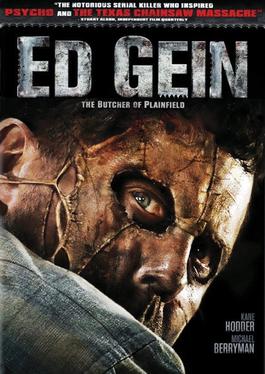
October True Crime: Ed Gein: The Butcher of Plainfield (dir by Michael Feifer)


Ed Gein was a farmer who lived in Plainfield, Wisconsin in the 1950s.  Everyone in town agreed that Ed was a bit of an eccentric.  He had been something of a recluse ever since the death of his mother in 1945.  Having never married, he spent most of his time on his farmhouse, where he had a collection of pulp magazines and literature about Nazi war crimes.  Ed supported himself by doing odd jobs around town.  He was quiet and a little weird but he was considered to be harmless enough.

Or, at least, he was until November of 1957.

That was when Bernice Worden, the owner of the local hardware store disappeared.  Her son told the police that Ed Gein has been the last person to talk to her the night before she disappeared and that Gein had specifically said that he would return to the store the next morning.  When the police searched Gein’s property, they discovered that Gein’s house was full of body parts.  Among other things, they found several skulls, a trash can made out of human skin, bowls made out of skulls, leggings made out of skin taken from human legs, nine vulvae in a shoe box, four noses, masks made from the skin taken from human heads, a corset made out of human skin, a pair of lips on a window shade drawstring, and the bodies of Bernie Worden and tavern owner Mary Hogan.  The police who discovered Gein’s home were reported to have been haunted by nightmares for years afterwards.  The officer who interrogated Gein later died of heart failure when he was informed that he was going to have to testify at Gein’s trial and relive the experience of hearing Gein’s story.

Gein confessed that he had started digging up graves after the death of his mother, collecting recently deceased women who he thought resembled her.  Gein also confessed to murdering both Bernie Worden and Mary Hogan, though most observers felt that Gein had killed many more.  Judged to be legally insane, Gein spent the rest of his life in a mental hospital, where he was said to be a polite and friendly patient.  He died of cancer in 1984.

The story of Ed Gein has inspired many writers and filmmakers.  Psycho was inspired by Gein’s crime, with the book’s version of Norman having far more in common with the real Gein.  The Texas Chainsaw Massacre’s house of horrors was also inspired by Gein and so was The Silence of the Lambs‘s Buffalo Bill.  The 1974 film, Deranged, featured Roberts Blossom in the role of Ed Gein, whose name was changed to Ezra Cobb.

In 2007’s Ed Gein: The Butcher of Plainfield, Kane Hodder plays Ed Gein.  Best-known for playing Jason Voorhees in several Friday the 13th films (and for providing a great DVD commentary for Friday the 13th Part VII: New Blood), Hodder plays Gein as being a hulking and awkward farmer who, after losing his mother, comes to believe that death is the only thing that’s real in life.  With his friend Jack (Michael Berryman), Gein digs up bodies from the local graveyard.  When Jack finally says that he’s tired of digging up bodies and that he thinks Gein needs to get professional help, Gein responds by murdering Jack and dragging the body behind his pickup truck.  Interestingly enough, Gein drives by Deputy Bobby Mason (Shawn Hoffman) who doesn’t even notice the body being dragged because he’s too busy fooling around with his girlfriend, Erica (Adrienne Frantz).

Bobby, in short, is a bit of a dumbass and that’s unfortunate for the people of Plainfield because Ed Gein is about to go on a rampage.  First, he abducts the owner of the local tavern.  Then, he abducts Bobby’s own mother, Vera (Priscilla Barnes)!  And, to top it all off, he abducts Erica just a few hours later.  This leads to a lot of scenes of Bobby running around, searching for his mother and then his girlfriend and managing to screw up just about everything that he attempts to do.  Bobby being a total idiot wouldn’t be a problem except for the fact that Bobby is also supposed to be the hero of our story.

Ed Gein: The Butcher of Plainfield features a lot of gore and discarded body parts, to the such an extent that I had to actually look away from the screen more than a few times.  That said, the story itself is only loosely based on the facts of the case.  (For instance, Ed Gein never kidnapped the girlfriend of a deputy and instead, he reportedly never even tried to flee once it became obvious that the police were on to him.)  The film is so haphazardly edited that it’s often difficult to keep track of how many days or night have passed from one scene to another and there’s quite a few scenes that feel as if they’ve been included to pad out the running time.  That said, Kane Hodder gives a good performance as this film’s version of Ed Gein, proving that he can be just as intimidating when wearing a mask of human skin as when wearing a hockey mask.
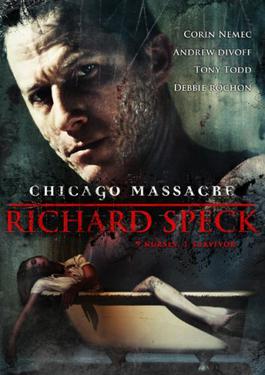
October True Crime: Chicago Massacre: Richard Speck (dir by Michael Feifer)


Richard Speck was the worst of the worst.

A petty criminal-turned-drifter, Richard Speck fled Texas to avoid being sentenced to prison for his part in a grocery store robbery.  He eventually ended up in Chicago, where he lived with his sister and her husband and found occasional work as a seaman.  When he couldn’t get work on a boat, the alcoholic Speck supported himself by mugging and burglarizing.  It’s not known when he committed his first murder, though it is suspected that it occurred back in Texas.  It is known that, in July of 1966, Speck’s sister and brother-in-law finally got sick of dealing with him as a houseguest and Speck ended staying in a series of rooming houses and homeless shelters.  On July 13th, the 24 year-old Speck mugged and raped at 53 year-old woman before then breaking into a townhouse that was occupied by nine student nurses.  Over the course of the night, he raped and murdered eight of nurses.  The only survivor hid underneath a bed until Speck left.  She later told police that Speck spoke with a soft Southern accent, had an acne-scarred face, and a tattoo that read Born to Raise Hell.

It was the tattoo that led to his capture.  Two days after the murders, with the city of Chicago in an uproar and the police launching a city-wide manhunt to catch the killer, Richard Speck attempted to kill himself by slitting his wrists.  He was taken to Cook County Hospital, where Dr. LeRoy Smith saw Speck’s tattoo and called the police.

Though protesting his innocence, Speck was convicted of the murders and sentenced to die.  He was spared the death sentence when the Supreme Court briefly outlawed capital punishment.  From prison, Speck eventually admitted that he had killed the nurses but he claimed that he was so drunk and high that he had no idea what he was doing.  After Speck died of heart failure in 1991, a videotape would emerge of a cocky Speck telling his fellow prisoners that he knew exactly what he was doing and he never felt a bit of guilt.  “Just wasn’t their night,” was Speck’s explanation for why the murders happened.  Speck also said that if the public knew how much fun he was having in prison, they would have released him for sure.  Richard Speck is the type of evil specter who seems to exist to specifically challenge those of us who are opposed to the death penalty.  If anyone has ever deserved to be executed in the most painful way possible, it was Richard Speck.

The 2007 film Chicago Massacre stars Corin Nemec as Richard Speck and the film’s makeup department deserves a lot of credit for transforming the handsome and normally quite personable Corin Nemec into the horribly poc-marked Richard Speck.  Sometimes, monsters truly do look like monsters and that was definitely the case of Speck.  Nemec plays Speck as being a natural-born deviant, a soulless sociopath who has no control over his impulses and who never seems to understand why the world is so disgusted by his crimes.  It’s a truly frightening performance.

The rest of the film is a flawed and heavily fictionalized account of Speck’s crimes, imagining that Speck was actually a casual acquaintance of one of the nurses that he killed and suggesting that she was the main reason why he broke into the townhouse to begin with.  The history nerd of me cringed when a police chief (Tony Todd) announced that his lead detective (Andrew Divoff) only had two days to solve the murders because the Democratic Convention was coming up.  (Speck committed the murders in 1966, two years before the Democrats came to Chicago for their ill-fated convention.)  Todd’s police chief says that he’ll be forced to sweep the murders under the rug if they’re not solved quickly but I’m not really sure how that would happen, given the enormity of the crime and the panic that reportedly swept through Chicago as a result.  As much as I hate to single out any one performer for criticism (because I usually assume that a bad performance has more to do with the director and the editor than the actor), Joanne Chew, cast in the role of the sole survivor of Speck’s rampage, delivers her dialogue so awkwardly that it sabotages what should have been some of the strongest moments of the film.  (Then again, even the best actress would perhaps be challenged by a line like, “I will look the devil in the eye.”)

Filled with flashbacks to both the murder of the nurses and Speck’s life as Texas criminal, Chicago Massacre is an undeniably icky film but given that it’s about Richard Speck, it really should be.  When it comes to a criminal like Richard Speck, it’s always tempting to try to look at his life for clues as how to prevent a future Richard Speck from committing a similar crime.  But, with Speck, there’s little to be learned beyond the fact that he did what he did because he had no conscience or sense of guilt to mitigate his impulses.  Speck had a terrible childhood but many people have had terrible childhoods without turning into mass murderers.  Speck was mentally unwell but many people deal with their mental health without turning into mass murderers.  In the end, he was a monster.  Thankfully, he was also enough of a dumbass to get a tattoo that made it impossible for him to hide from his crimes.

October True Crime: Drifter: Henry Lee Lucas (dir by Michael Feifer)


In 1983, a one-eyed, illiterate drifter named Henry Lee Lucas was arrested by the Texas Rangers.  Lucas was arrested for unlawful possession of a firearm but, once in custody, he confessed to murdering 82 year-old Kate Rich and his 15 year-old girlfriend, Becky Powell.  Upon being transferred to the Williamson County Jail, Henry Lee Lucas confessed to one murder and then another and then another and then …. well, soon, ol’ Henry Lee Lucas had confessed to over 300 murders.  According to Lucas, he had spent the past decade traveling the country with his friend and lover, Ottis Toole, and killing just about everyone they met.  (Ottis, who was already in prison in Florida, was Becky’s uncle.)  He claimed that he was a member of a nationwide Satanic Cult.  At one point, he even confessed to killing Jimmy Hoffa.

Soon, cops from across the county were traveling down to Texas and asking Lucas if he had killed anyone in their state.  Lucas’s confessed to almost every murder that he was asked about and often times, he provided details that were considered to be close enough to what happened that his confessions were considered to be credible.  The police were happy because they got to take a lot of unsolved murders off the books.  Lucas was happy because he was getting to travel the country, he was getting a lot of media attention, and he was being kept out of the general prison population.  Indeed, many of the Texas Rangers who escorted Lucas from crime scene to crime scene would testify that, the murders aside, Henry Lee Lucas was usually polite, soft-spoken, and genial company.  They would buy him a milkshake.  He would confess to a murder.

It was only after Lucas had confessed to so many murderers that he had gained a reputation for being the most prolific serial killer in history that people started to take a good look at all of Lucas’s confessions.  What quickly became apparent was that it would have been next to impossible for Lucas to have been everywhere that he claimed to be when he claimed to be there.  Many of Lucas’s confessions fell apart under closer investigation.  Lucas may have dropped out of the sixth grade but he was very good at picking up on details and manipulating people.  He told the police what they wanted to hear.  Even worse, it soon turned out that some of the cops were letting him look at their case files before getting his formal confession, allowing Lucas to learn details that only the killer would know.  When confronted with this, Lucas recanted all of his confessions.

How many people did Lucas kill?  It’s know that he killed his abusive mother when he was a teenager.  And, even after he recanted, most legal observers agreed that he killed Kate Rich and Becky Powell.  While some continue to insist that Lucas killed hundreds, it’s actually more probable that Lucas, as sick as he was, only killed three people.  That didn’t stop Henry Lee Lucas and his confessions from serving as the basis of John McNaughton’s terrifying classic, Henry: Portrait of a Serial Killer.

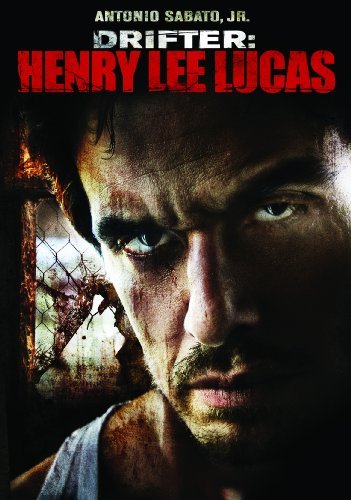
2009 saw the release of another film loosely based on the confessions of Henry Lee Lucas.  Drifter: Henry Lee Lucas opens with Lucas (played by Antonio Sabato, Jr.) being interrogated as to why he confessed to so many murders that he didn’t commit.  The movie then flashes back to Lucas killing Becky Powell (Kelly Curran) before then flashing forward to Lucas confessing to a murder and asking for a milkshake in return and then, once again, it flashes back to Lucas’s Hellish childhood in West Virginia.  That’s a lot of time jumps for just the start of the movie and it’s an early indication of just how jumbled the narrative of Drifter turns out to be.  To a certain extent, the jumbled narrative is appropriate.  It captures the feeling that, in many ways, Lucas is simply making up his life story as he goes along.

Physically, Henry Lee Lucas and Ottis Toole were two incredibly ugly people.  Drifter casts Antonio Sabato as Henry and Kostas Sommer as Ottis, both of whom are notably better-looking than the two men that they’re playing.  Sommer, in particular, is a hundred-time more handsome that Ottis Toole.  (The real Toole looked like one of the toothless hillbillies from Deliverance.)  Even if one overlooks their looks, both Sabato and Sommer are a bit too articulate to be believable as two backwoods murderers.  Sabato does a good job of capturing Lucas’s one-eyed squint but never once do you buy that he’s someone who grew up in the backwoods of West Virginia.  Meanwhile, as Becky, Kelly Curran is shrill and a bit annoying.  A lot of that is due to how Becky is written but still, it doesn’t make any easier to deal with her character.

Narratively, the film avoids taking a firm position on whether or not Lucas was lying.  We do see Lucas commit a few murders but they’re all told as a part of his narration, leaving open the possibility that Lucas could be lying.  Unfortunately, Henry’s stories aren’t that interesting.  What was interesting was that so many people chose to believe his stories, despite the fact that the majority of them fell apart under even the slightest amount of scrutiny.

In the end, Drifter reminded me that Henry Lee Lucas is far less interesting than how people reacted to Henry Lee Lucas and his willingness to confess to every crime that he was asked about.  There’s a great film to be made about the people who enabled Henry Lee Lucas’s lies.  Henry, himself, was far less interesting.

Lifetime Film Review: My Daughter’s Psycho Friend (dir by Michael Feifer)


My Daughter’s Psycho Friend aired in March of 2020 on the Lifetime.  I DVR’d it.  I’m not sure why I didn’t watch it when it aired.  I’d have to go back and look through all my journals to piece together what I was doing on that date in March and, quite frankly, I’m feeling a little bit too rushed to take the time to do that.  I’ve got a lot of movies to watch and review of the next few days and, in the end, it really doesn’t matter.  What does matter is that I DVR’d it and I finally sat down and watched it earlier tonight.

Now, before anything else, I should point out that My Daughter’s Psycho Friend is a brilliant title.  You see a title like that and you automatically have to watch, which makes it all the stranger that it took me so long to get around to it.  It’s not just a good Lifetime title but it’s a good title period.  I think anytime when you include the word “psycho” in the title, you’re going to catch someone’s attention.  Psycho is just such an extreme term.  The full title, “My Daughter’s Psycho Friend,” links it to what I assume would be every parent’s nightmare.  What if your child’s best friend did turn out to be a psycho?  What if they led them astray or, even worse, put them in danger?

Unfortunately, the title isn’t quite accurate.  While Lexi (Avery Kristen Pohl) does invite Sierra (Taylor Blackwell) to hang out with her after Sierra transfers into Lexi’s high school, it’s a bit of a stretch to really call Lexi and Sierra friends.  From the start, Sierra seems to be somewhat weary of Lexi and Lexi seems to know that eventually, she’s going to end up having to frame Sierra for all sorts of misdeeds.  Also, though Sierra does have a mother, she’s really not that important to the plot.  The film pretty much revolves around Sierra.  A more proper title for the film would have been My Psycho Acquaintance.

However, the title does get the psych part right.  Lexi has some definite issues that go far beyond just being a mean girl in high school.  She lives in a nice, big house and she had a glamorous mother (albeit one who makes a big deal about always having to “clean up” after Lexi’s mistakes) and everyone at school wants to be her friend but Lexi still can’t be happy unless she’s playing a cruel joke on someone.  For instance, at one party, Lexi drugs someone’s drink and then has a good laugh as that person stumbles away.  Of course, once he turns up dead in Lexi’s swimming pool, it’s time for a cover up!  And if Sierra is determined to discover the truth about what happened at the party …. well, Lexi’s just going to have to take care of that, as well.

Anyway, this was a typical Lifetime film about teenagers gone wild.  Lexi’s house was nice and Avery Kristen Pohl did a good job playing up the whole psycho part of Lexi’s personality.  If you’re into Lifetime melodrama, you should enjoy this one.

Lifetime Film Review: Sinister Stalker (dir by Michael Feifer)


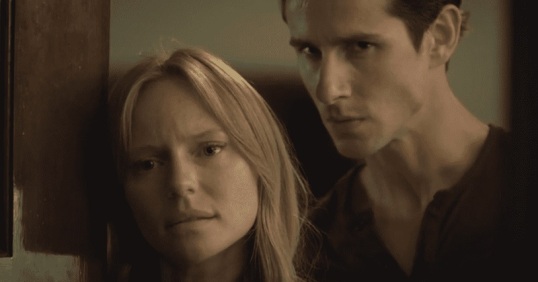
Also known as Sinister Savior, this film tells the story of Karen (Marci Miller), an emergency room doctor and a recovering alcoholic.  One night, as she’s leaving an AA meeting, she’s attacked by an apparent mugger.  Fortunately, for her, Daniel (Kelly Blatz), just happens to be walking by the scene.  He steps forward and fights off Karen’s attacker, probably saving her life in the process.  However, during the fight, Daniel’s arm gets slashed with a knife.

Being a doctor (and, according to her best friend, also being way too trusting), Karen takes Daniel back to her house so that she can take a look at his wounded arm.  Daniel seems friendly-enough.  He says that he’s in real estate and that the reason he was in the neighborhood was because he was checking out potential properties to buy and sell.  Daniel also tells Karen that he’s never been in a real fight before.

Daniel, it turns out, already has several scars.  When Karen notices them and asks about them, Daniel says that he got them in a bar fight.  But …. uhmm, Daniel ….. you said you’d never been in a real fight before.  Daniel quickly explains that he wasn’t actually in the fight, he just got stabbed accidentally.  That may make sense but, even if Daniel isn’t lying about his past history, why does he have pictures of Karen’s house on his phone?

For those of us watching, red flags start to go up as soon as Daniel shows up.  That’s because this is a Lifetime film and, if you’ve seen enough of these films, you know better than to trust any good Samaritans.  The fact that this movie is called Sinister Stalker gives us another reason not trust Daniel.  When Daniel starts to talk about how much he and Karen have in common and makes a rather awkward joke about how they must have a connection, those of us in the audience are like, “Get out of there!”

But, of course, if Karen did that, there wouldn’t be a movie.  So, instead, Karen does stuff like take a shower while there’s a complete stranger hanging out in her home.  Meanwhile, Daniel is walking around the house and basically invading her space.  Various friends of Karen come by to check on her and Daniel tries to send them all away.  We know that there’s something not right about Daniel.  It’s just a question of how long it’s going to take Karen to figure that out as well.

Though the story may be familiar, Sinister Stalker does experiment a little with the typical Lifetime format.  As opposed to most Lifetime films, which usually take place over several days and typically feature a lot of visits to the neighborhood coffeeshop and at least one yoga class, the action in Sinister Stalker takes place in one location and over the course of just one night.  The film almost seems to play out in real time, which actually pays off surprisingly well.  The film actually does a petty good job of generating some suspense as to how long it’s going to take Karen to figure out that Daniel’s motives are not exactly pure.

Kelly Blatz is perhaps a little bit too obviously sinister as Daniel but Marci Miller does a great job in the role of Karen.  She plays up Karen’s hesitation just enough to suggest that she had her doubts about Daniel from the beginning but, at the same time, she also feels that she has an obligation — as both a doctor and someone whose life was saved by Daniel — to check out the wound on his arm.  In the small but important role of an alcoholic who keeps calling Karen for help, Lew Temple makes a good and sympathetic impression.

Sinister Stalker plays with the typical Lifetime format and, for the most part, it pays off.  Watch it the next time you’re tempted to let a complete stranger hang out in your house for a few hours.

Lifetime Film Review: My Stepfather’s Secret (dir by Michael Feifer)


Bailey (Paris Smith) comes home from college and discovers that things have changed since she left.

For instance, her mother, Tina (Vanessa Marcil), is now a vegetarian!  Also, Tina’s suddenly really into exercise and yoga and stuff.  In fact, Tina seems to be happier than she’s ever been and that’s a good thing since Tina previously had some issues with alcohol.  Of course, that’s understandable when you consider that her husband was mysteriously murdered a few years ago.

So, why is Tina so happy now?

Meet Hugo (Eddie McClintock)!  Hugo is some sort of weird New Age massage therapist person and it turns out that he and Tina are going to get married!  They’ve known each other for like two weeks and they’re totally in love!  Bailey is like, “Mom, don’t you think things are moving too fast!?” and the previously cautious Tina is all like, “I love him!”

However, Bailey is convinced that her new stepfather has some secrets and it turns out that she’s right!  But what exactly are those secrets?  Why has he been using Bailey’s computer without permission?  Why is he using her webcam to spy on her?  Why is he constantly getting strange calls and why does he often seem to be distracted by something that only he sees?  Even more importantly, why is Tina acting so weird?  Whenever Bailey tells her about Hugo’s strange behavior, Tina just shrugs it off.  Has Tina been drugged or brainwashed and what, if anything, does that have to do with Hugo’s secrets!?

I have to admit that, as I was watching this movie, I kind of related to Bailey.  After my parents got divorced, I went out of my way to chase off any new guy who thought he was going to be my stepfather.  It wasn’t that I wanted my parents to get back together because I knew they were better off separated.  Instead, it was more that I resented the idea of some stranger suddenly showing up and expecting me to care about what he had to say or anything else.  For a few years, “You’re not my father” was my mantra.  You’re going to be stepfather?  No way!  Of course, for the most part, I was just being an immature brat and, eventually, both my mom and my sisters told me to grow up and knock it off.  Unlike me, Bailey has good reason to be suspicious of her stepfather.

In fact, you could argue that she has a few too many reasons to be suspicious of Hugo.  This film doesn’t leave much doubt that Hugo is a bad guy.  From the minute that he first appears, he might as well be carrying a sign that reads, “I’m Evil, pass it on.”  Amazingly, no matter how obviously evil Hugo may be, Bailey seems to be the only person capable of noticing.  In fact, everyone else seems to be so oblivious to Hugo’s evil that I suspect that the film was meant to be at least a little bit satirical.  With the exception of Bailey, everyone in the film is so incredibly dense that it’s hard not to believe that we’re not really meant to take any of them that seriously.

Anyway, we do eventually learn Hugo’s secret and it’s all pretty silly.  Hugo is not only evil and creepy but he also apparently has a thing about coming up with ludicrously overcomplicated schemes.  Fortunately, the action concludes at a cabin in the woods because it’s a Lifetime film and all true Lifetime films conclude at a cabin in the woods, or at least they should.

Anyway, My Stepfather’s Secret is an almost prototypical Lifetime film, with its untrustworthy male interloper threatening to tear apart an otherwise perfect mother/daughter relationship.  Usually, in these films, it’s the mother who knows best but, in this case, the role are reversed.  Enjoy it while you’re watching it and don’t worry about it afterwards.

Lifetime Film Review: Saving My Baby (dir by Michael Feifer)


Poor baby Lilly!

She’s only a few weeks old and her life is already all drama all the time!

First off, Lilly was born slightly premature, shortly after her mother, Sarah (Brianne Davis), was involved in a serious and suspicious auto accident.  Then, while her mother is still in a coma, her father, Travis (Jon Prescott), decides to take Lilly and run off to Palm Springs with her.  Accompanying Travis is his overprotective mother, Virginia (Kathleen Quinlan) and Jessica (Tonya Kay), who just happens to be the friend who introduced Sarah to Travis in the first place.  Speaking of just being friends, that’s what Travis swears that he and Jessica are but we all know that’s not the case.  We know this because this is a Lifetime film and it’s rare that anyone’s ever just a friend in the world of Lifetime.  Of course, Sarah’s parents and her sister object to Travis taking the baby to Palm Springs but what can they do?  He’s the father.

Of course, eventually, Sarah wakes up and she’s like, “Where’s my baby?”  When she hears that Lilly has been taken to Palm Springs, she quickly calls up Travis and demands to know what’s going on.  Travis assures Sarah that his mother is looking after Lilly and promises that they’ll return the following morning.  Sarah then hears Jessica talking in the background.

“IS JESSICA THERE!?”  Sarah asks.

Travis, not surprisingly, doesn’t have a quick answer for that.

As should already be obvious, there was a lot more to Sarah and Travis’s whirlwind romance than just love.  Unlike the attempted murder, the baby was never a part of the plan.  However, now that Lilly’s been born, Travis definitely wants to keep her.  Jessica, meanwhile, is concerned about how much Sarah and her family are willing to pay for the return of Baby Lilly….

Kidnapped children are pretty much a staple plot point when it comes to Lifetime movies.  That really shouldn’t be surprising.  The most effective Lifetime films are the ones that deal, however melodramatically, with real-life fears and what could be more scary than the thought of losing your baby?  Whereas other mothers in Lifetime kidnapping films at least get to spend some time with their child before the abduction happens, Sarah wakes up to discover that her baby has been taken to another city.  When she desperately asks her sister for information of how the baby looked before she was taken away, it’s a moment of intense emotional honesty.

Saving My Baby is a bit unique among Lifetime kidnapping films in that it actually spend more time with the kidnappers than with the family of the kidnapped.  Don’t get me wrong.  Sarah is a sympathetic character and Brianne Davis does a good job playing her but the film is far more interested in Jessica, Travis, and Virginia.  As played by Jon Pescott, Travis spend most of his screentime wearing the haunted expression of someone who knows that he’s made the biggest mistake of his life.  Not only does he have his wife angry at him but his mother won’t stop telling him that he’s a terrible father and his girlfriend keeps demanding that he get rid of both his mother and his daughter.  Kathleen Quinlan does a great jon, keeping you guessing about Virginia.  You’re never quite sure how much she knows about what Travis and Jessica are planning.  However, the film is totally stolen by Tonya Kay, who is like a force of destructive nature in the role of Jessica.  Jessica may be evil but you can’t help but sympathize with her frustration at times.  I mean, everyone around her is just so incompetent!

Saving My Baby is an entertaining Lifetime kidnapping film.  Wisely, the film eventually moves the action to Las Vegas, which is the perfect location for the movie’s melodrama.  For the film’s finale, Saving My Baby makes good use of the Nevada desert, with the desolation perfectly capturing the feeling of hopelessness that Sarah’s been feeling ever since the disappearance of her daughter.  It all leads to gunfire and tears and hopefully, a lesson learned about letting your no-good son-in-law take your granddaughter to Palm Springs.  We can only hope.

Cleaning Out The DVR: Party Mom (dir by Michael Feifer)


(I recorded Party Mom off of the Lifetime Movie Network on March 30th.)

Party Mom tells the story of two moms who live in Los Angeles.

Jackie (Krista Allen) is a party mom!  She has a nice house in Beverly Hills, where the party never ends.  She’s always quick to point out that she looks young enough that she could pass for being Ashley’s sister instead of her mother.  For her part, Ashley (Amber Frank) kinda wishes that her mother would be a little more traditional.  Of course, Jackie’s usually too busy trying to get Ashley’s friends drunk to really worry about what her daughter wants.

Caroline (Megan Ward) is definitely not a party mom.  Instead, she’s a hard-working, no-nonsense mom who lives in the Valley with her husband, Gary (Brian Krause), and her two daughters, Brittany (Elise Luthman) and Emma (Savannah Judy).  Caroline just can’t understand today’s teenagers, with their social media and their iPhones and their lack of interest in hanging out with their boring parents.  In Caroline’s day, teens would have loved a chance to spend a night watching TV and eating popcorn with mom and dad!  Now, they just want to sneak out of the house and take selfies.

Brittany thinks that Jackie is the best, though Caroline isn’t quite sure that she wants her daughter hanging out in a mansion where all of the adults are just as stoned and drunk as the kids.  Caroline even attempts to put her foot down and ground her daughter.  Of course, that doesn’t really work.  Instead, Brittany simply sneaks out of her bedroom window and heads for Beverly Hills!

Of course, since this is a Lifetime film, it all leads to the usual combination of underage drinking and tragedy.  When Brittany and a group of drunk friends leave the mansion, a terrible car accident leaves only one survivor.  Jackie finds herself on trial for involuntary manslaughter.  Caroline and Gary are determined to see Jackie pay for being a party mom but Jackie’s rich enough to afford a slick attorney.  In fact, Jackie doesn’t even seem to feel that bad about the car accident or almost anything that happens afterward.  As she explains it, all of the tragedy is due to people from the Valley coming into Beverly Hills, where they don’t belong.  It all leads to murder, arrests, and one final confrontation.

I liked Party Mom, largely because, in high school, my best friend’s mom was a party mom and watching this movie brought back a lot of memories.  At the time, it was always fun going over to my friend’s house and literally getting to do anything that I wanted to do.  Looking back now, of course, it’s easy to say that my friend’s mom was incredibly irresponsible and probably should have been forced to go on Dr. Phil or something.  But, at the time, I was a lot like Brittany.  I just thought it was cool that there was an adult around who refused to care what was being done in her house.

Krista Allen does a really good job in the role of Jackie, tearing through the film like an irresponsible, perpetually drunk tornado.  She especially does well towards the end of the film, when Jackie really goes off the deep end.  Like all good Lifetime film, the melodrama in Party Mom is over-the-top and we’re all the better for it.

Cleaning Out The DVR: The Bachelor Next Door (dir by Michael Feifer)


(Hi there!  So, as you may know because I’ve been talking about it on this site all year, I have got way too much stuff on my DVR.  Seriously, I currently have 182 things recorded!  I’ve decided that, on January 15th, I am going to erase everything on the DVR, regardless of whether I’ve watched it or not.  So, that means that I’ve now have only have a month to clean out the DVR!  Will I make it?  Keep checking this site to find out!  I recorded The Bachelor Next Door off of Lifetime Move Network on December 2nd, 2017!)

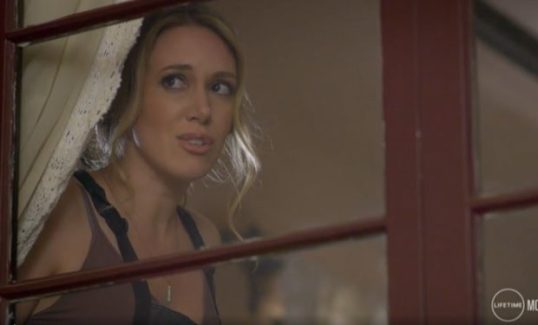
It’s time for yet another Lifetime film featuring Haylie Duff as a woman being menaced by a neighbor!

In this one, Haylie plays Alex.  Alex is a painter who lives with her boyfriend, Gavin (Stephen Bruns).  Alex hasn’t found much success as a painter but, fortunately, Gavin has one of those financial jobs where he spends all of his time talking about when the markets in London close.  So, even though Alex hasn’t sold a painting in forever, she still gets to live in a really big and pretty house.

But then one day, that house nearly burns down!  Fortunately, the new neighbor, Donnie (Michael Welch), just happens to notice that a fire has broken out in the kitchen so he runs over and he saves the day.  Or, at the very least, Donnie claims that he just happened to notice the fire.  Donnie seems to have some issues.  He’s way too nice and way too quick to want to help out around Gavin and Alex’s house.  Plus, sometimes he goes back to his own house and he throws a screaming fit.  Again, Donnie would appear to have some issues.  Still, Alex goes ahead and sets Donnie up with her sister, Sage (Brittany Underwood).

And for a while, it seems like everything’s just perfect.  Sage and Donnie make for a really cute couple.  Or at least they do until Donnie accidentally calls Sage by her sister’s name.  Uh oh!

Meanwhile, Gavin keeps asking Alex to marry him and Alex keeps saying no.  Alex says that she’s worried that, if she gets married, she’ll become complacent and boring and she’ll lose her edge as an artist.  I have to say that this part of the movie was handled very well.  Alex and Gavin seemed like a “real” couple and Haylie did a good job capturing all of Alex’s fears about commitment.  I could relate to Alex and, as a result, I was more emotionally invested in her story than I am in the typical Lifetime movie.

Anyway, Gavin refuses to give up.  He keeps asking her to marry him and when Alex finally says yes, everyone’s overjoyed.  Except for Donnie…

And why should Donnie care?  It all goes back to something that happened years ago.  Donnie is not as much of a stranger as everyone initially thinks that he is…

The Bachelor Next Door was actually pretty good.  I’ve gotten to the point where I really look forward to these Haylie-Duff-In-Danger Lifetime films.  Haylie always does a really good job in these movies and, in The Bachelor Next Door, she ably supported by Michael Welch, Steve Bruns, and Brittany Underwood.  The Bachelor Next Door has suspense, flashbacks, a great ending, and two great houses.  What more could you ask for?


Cleaning Out The DVR: Cradle Swapping (dir by Michael Feifer)


(Hi there!  So, as you may know because I’ve been talking about it on this site all year, I have got way too much stuff on my DVR.  Seriously, I currently have 186 things recorded!  I’ve decided that, on January 15th, I am going to erase everything on the DVR, regardless of whether I’ve watched it or not.  So, that means that I’ve now have only have a month to clean out the DVR!  Will I make it?  Keep checking this site to find out!  I recorded Cradle Swapping off of Lifetime on May 7th, 2017!)

This year, there was a surprisingly large number of Lifetime films about babies either getting kidnapped or switched at birth.  If Lifetime films tend to use to melodrama to bring to life the fears of its audiences, 2017 was a year when everyone was scared about who or what their baby would grow up to be.

In Cradle Swapping, Grandma (played by Patrika Darbo) takes one look at the baby that her daughter has brought home from the hospital and announces that it doesn’t look anything like her supposed parents.  Needless to say, neither Alicia (Amanda Clayton) or Ray (Brandon Barash) are happy to hear this.  They argue that all babies look the same.

No, Grandma says, all of her babies looked exactly like her.

Of course, that’s not the only time that Grandma points this out.  Later, after Alicia and Ray have just returned from the hospital with their baby, Grandma takes another look at it and announces that the baby still looks nothing like her mother or father.  This time, Alicia gets even more upset about it.  “Way to go,” everyone tells Grandma.

Grandma actually has a pretty good point but it’s understandable why Alicia doesn’t want to hear it.  Alicia already has a lot to deal with.  Baby Hannah refuses to look her in the eye.  Baby Hannah refuses to breastfeed.  Baby Hannah is always crying.  When Alicia and Ray take Hannah to the hospital, a doctor demands to know if Alicia has ever used drugs.  “Just in college,” Alicia replies, “experimenting.”

It turns out that Hannah is going through opioid withdrawal!

At first, Ray blames Alicia for taking prescription medication.  Alicia blames Ray for not being supportive.  Maybe they should be redirecting their blame at hospital…

See, it turns out that Hannah is not their baby.  Instead, their baby was taken by the incredibly sleazy Tony (Tyler Johnson), who left another baby in her place.  Getting little help from the hospital or the authorities, Alicia and Ray take matters into their own hands, setting out to track down Tony and find their baby.  However, what they don’t know is that Tony is involved in a much bigger conspiracy than they even suspect….

I have to admit that I liked Cradle Swapping more than I thought I would.  Amanda Clayton and Brandon Barash were sympathetic as the parents and they were easy to relate to.  I appreciated the fact that they started the movie in over their heads and they were still in over their heads when the movie ended.  They never turned into action heroes or superhuman investigators.  Instead, they were just two ordinary parents trying to find their baby.  You want them to succeed and the end result is an above average Lifetime film.