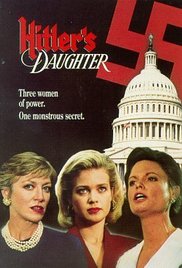
 Ted Scott (Patrick Cassidy), a White House press aide, is contacted by his former professor, Dr. Bauman (Donald Davis). Bauman gives Ted a file that he claims will prove that not only did Adolf Hitler have a daughter but she was subsequently smuggled into America and is now on the verge of occupying the White House. Ted thinks that Bauman’s crazy but then Bauman is murdered and Ted is framed for the crime. With both the police and the bad guys after him and with time running out, Ted must now figure out who is Hitler’s daughter. Is it Sharon Franklin (Melody Anderson), the famous TV anchorwoman who is having an affair with a Senator? Is it Patricia Benedict (Veronica Cartwright), the wife of the Vice President? Or is it Senator Leona Crawford Gordon (Kay Lenz), who has just been put on the opposition party’s presidential ticket?
Hitler’s Daughter was originally made for the USA Network and, throughout the 1990s, it would frequently air late at night. As far as the film’s quality is concerned, Kay Lenz was beautiful as ever but otherwise, Hitler’s Daughter was a typically forgettable low-budget made-for-tv thriller, complete with bad guys who can shoot everyone but the main character, exploding cars, and villains who carefully explain their plans before trying to kill the heroes. It does end on a down note, with almost everyone dead. This probably seemed edgy in 1990 but it seems predictable today. Exactly ten years after this otherwise forgotten movie aired, Hitler’s Daughter was briefly again in the public spotlight a group of online conspiracy nuts claimed that Hillary Clinton was trying to suppress the movie’s release on video would harm her chances of getting elected to the Senate.
Far better than the movie is the novel on which it was based. Written by Timothy B. Benford, the literary Hitler’s Daughter is an entertaining and enjoyably pulpy page turner. Benford was the former police commissioner of Mountainside, New Jersey when he wrote Hitler’s Daughter in 1983 and the book touched with an nerve with at least a few readers. According to a story in The New York Times, shortly after the novel was published, Benford woke up to discover a wooden swastika burning on his front lawn. The movie stick closely to the book’s plot but never translates what worked on the page to the screen.
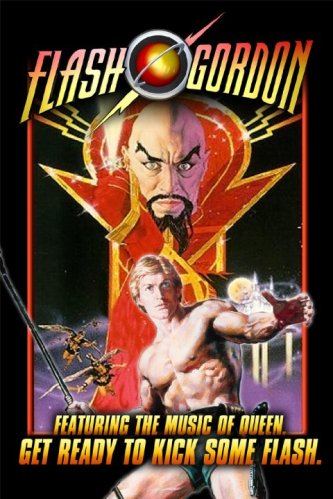 Life on the planet Mongo is not easy. Aided by Darth Vader wannabe Klytus (Peter Wyngarde) and the sadistic General Kala (Mariangela Melato), the evil Emperor Ming (Max Von Sydow) rules with an iron fist. All of the citizens are heavily taxed and kept in a state of perpetual war in order to keep them from joining together and rebelling. Those who attempt to defy Ming are executed.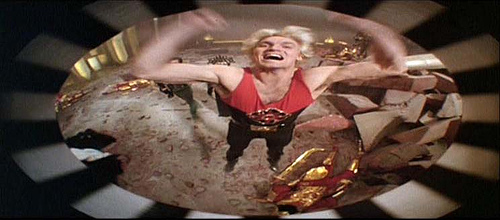
 Through the Shattered Lens