Film Review: Patriots Day (dir by Peter Berg)


On April 15th, 2013, a terrible crime was committed.

Two brothers, Tamerlan and Dzokhar Tsarnaev, bombed the Boston Marathon.  I can remember the exact moment when I looked up at the television and I saw the footage of the bomb going off as a group of runners ran across the finish line.  Instinctively, I found myself hoping that the explosion looked worse than it actually was and that no one had been seriously injured.  However, I was then flooded with images of people running in fear while other lay injured and bleeding on the ground.  A photograph of  man who had lost his both his legs was seared into my mind, the nightmarish image of those exposed and shattered bones coming to represent the pure evil that was unleashed on that day.

At first, there was a lot of speculation about who was responsible for the bombing.  Despite the fact that it had all the earmarks of an al-Qaeda operation, many people on the news insisted that the bomb had been set by their favorite boogeymen, the right-wing militias.  (The initial theory was that it was a tax day protest, which is one of the dumbest things I’ve ever heard.)  Three days after the bombing, the first photographs of the Tsarnaev Brothers were released.  Looking at the security footage of Tamerlan placing a bomb on the ground right next to a child who was subsequently killed in the blast, I started to rethink my opposition to the death penalty.

Boston was shut down until the Tsarnaev brothers were tracked down and, along with hating the Tsarnaevs, I found myself fearing that the search for them would normalize the idea of suspending civil liberties.  Tamerlan was gunned down in a fight with police and hopefully, he felt each bullet.  Dzokhar was captured after he attempted to hide in a homeowner’s boat while whining like a little bitch.  Dzokhar is one of three people on the Federal Death Row.  He also has a truly creepy fan club online, though they haven’t been as active as they were in the past.

2016’s Patriots Day is about that tragic day and the subsequent manhunt for the Tsarnaev brothers.  This is another one of Peter Berg’s films about professional, no-nonsense men who have a job to do and who do it well.  Mark Wahlberg plays a cop.  Kevin Bacon plays the FBI agent who heads up the investigation.  John Goodman plays the Boston police commission while Michael Beach makes an appearance as Deval Patrick, the then-governor of Massachusetts who ran a bizarrely overlooked presidential campaign in 2020.  Just as he did with Deepwater Horizon, Berg emphasizes the human cost of the tragedy along with the official efforts to track down the men responsible.  The ensemble comes together impressively, recreating those scary few days and also paying tribute to a city that refused to allow itself to be defeated.  Patriots Day follows the common, blue collar citizens of Boston as they deal with a horrific act of evil.  Even though we all know how the story turned out, the film manages to create a decent amount of suspense as the authorities search for the Tsarnaevs.  As for the brothers themselves, the film portrays them as being initially cocky and eventually pathetic.  To the film’s credit, it doesn’t ask us to consider things from the point of view of the terrorists.  There’s no moral relativism here.  The film knows who deserves to be heard.

Patriots Day is a tribute to the first responders and the citizens of Boston who refused to allow the Tsarnaevs to win.  With so many people now making excuses for terrorism, Patriots Day is a powerful reminder of the human cost of such actions.  The Tsarnaevs through they were striking a blow for their ideology.  Instead, they just reminded us how strong people can be.
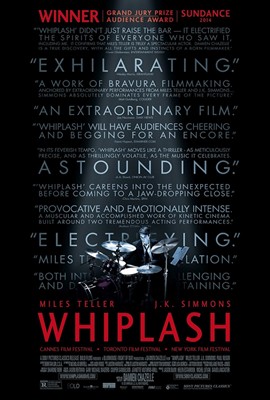
 

Film Review: Whiplash (dir by Damien Chazelle)


Whiplash_poster

I really only need five words to review Whiplash:

J. K. Simmons kicks ass.

He so seriously does.  The deep-voiced character actor, beloved by fans of Allstate Insurance, Spider-Man, Jason Reitman, and the Coen Brothers alike, has been memorable so many times in the past that it’s easy to take him for granted.  However, with Whiplash, he proves himself to be not just a distinctive screen presence but to be a brilliant actor as well.  There’s a lot of good things about Whiplash but, ultimately, it’s Simmons who makes the film something more than just another promising indie film.

Simmons plays Terrence Fletcher, the legendary and feared conductor of the Schaffer Conservatory jazz band.  (We’re told that Shaffer Conservatory is the best music school in the country.  Of course, in a real life, the best music school in the country is located at University of North Texas, where I studied Art History but still enjoyed occasionally listening to the One O’Clock Lab Band.)  As played by Simmons, Fletcher is both a genius and a sadist.  When he talks about music, he does so with a passion that makes it impossible not share his love for all that jazz.  When he conducts his band, he does so with a cruelty that makes you question if the music is worth the cost of the emotional stability of the people playing it.  When he hears that someone is out of tune, he responds by reducing a musician to tears.  When he says, “Not my tempo,” it’s both a critique and a threat.  The fact that he’s creative and quick-witted with his insults does nothing to lessen the pain that they cause.

Fletcher’s latest protegé/victim is a talented 19 year-old drummer named Andrew (Miles Teller).  Andrew shares Fletcher’s love for jazz but nothing can prepare him for the lengths that Fletcher will go to manipulate him.  Whether it means insulting Andrew’s father (Paul Reiser) or casually threatening to give Andrew’s spot away to another drummer, Fletcher’s nonstop and often viscous criticism makes Andrew a better drummer but also threatens to destroy his sanity.

Director and screenwriter Damien Chazelle understands that those of us in the audience have seen literally hundreds of films about intense teachers and the students that they teach.  Chazelle cleverly manipulates all of our expectations.  The minute that we expect Fletcher to say something encouraging or to reveal himself to actually be a compassionate mentor, Simmons instead barks out another insult or regards Andrew with a withering glare.  And, as we wait for Andrew to stand up to Fletcher or prove his mentor wrong, we are instead forced to admit that Fletcher’s approach does seem to be working.

When, towards the middle of the film, Andrew crashes his car while rushing to a jazz competition and then attempts to play the drums with both blood on his suit and a broken hand, you can’t help but both admire his determination and fear where that determination is going to take him.

As I said at the beginning of this review, there’s a lot of good things about Whiplash.  As you might expect for a film about jazz, it has a great soundtrack.  Miles Teller gives a great lead performance, one that may be overshadowed by J.K. Simmons but which — along with his work in The Spectacular Now — indicates that Teller is an actor to watch.  (We’ll just forget the fact that he was also in Project X.)  Some of the film’s best moments don’t even involve J.K. Simmons, instead they’re just scenes of Teller obsessively drumming until his hands are bloody.

But, ultimately, it is J.K. Simmons who truly elevates this film.  Simmons makes Fletcher into a truly fascinating villain, one who constantly leaves you guessing.  By the end of the film, you may not like Fletcher but you definitely can not get him out of your head.

Ultimately, the success of Whiplash stands as a tribute to the talent of J.K. Simmons.