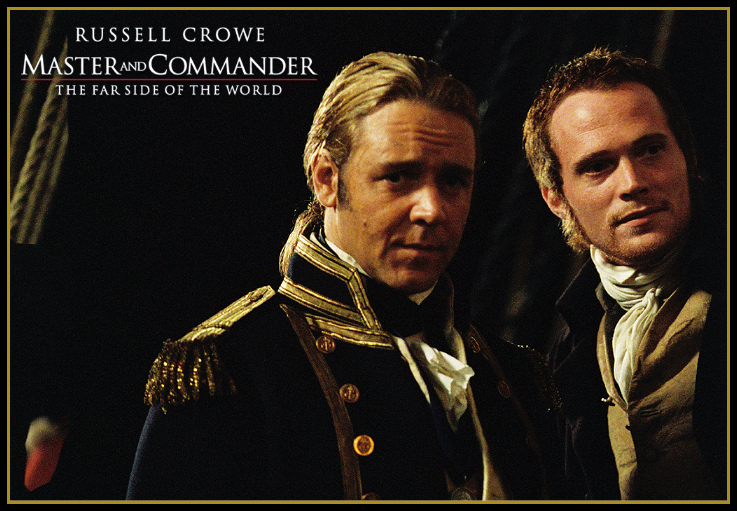
If there was a film which deserved better when it first came out in 2003 it would be Peter Weir’s epic adaptation of the Patrick O’Brian seafaring novels starring the character of Capt. Jack Aubrey. It was just bad luck on the part of Weir’s film that it came out the same year and month as the juggernaut that would sweep through not just the box-office for the 2003 holiday season, but all through the award-season. If Master and Commander: The Far Side of the World had only come out a year later there’s a great chance it would’ve been the frontrunner for 2005 Academy Awards for Best Picture, Best Director, Best Adapted Screenplay and many more. But the juggernaut that was Peter Jackson’s Lord of the Rings: The Return of the King would not be denied after two previous years when Jackson and his magnum opus were passed over.
To say that Peter Weir was at the top of his game with Master and Commander would be an understatement. Working from a script written by Weir himself and John Collee, the film would take several episodes from the Patrick O’Brian Aubrey-Maturin novels and combine them to make a coherent and thrilling period piece that rarely ever get made anymore. This was epic filmmaking at its finest with Weir’s direction keeping the long-running time of the film from becoming too tedious. Yet, he was also able to keep the film from becoming one battle setpiece following another. There was enough of a balance between the quiet storytelling, especially between the characters of Capt. “Lucky” Jack Aubrey (played by Russell Crowe in what had to be his best role ever) and his close friend and ship’s doctor Stephen Maturin (Paul Bettany matching Crowe scene for scene) to keep the film grounded in reality.
Master and Commander is set during the Napoleonic Wars when France and England battle it out on land and in the high seas. On one side is the HMS Surprize captained by Jack Aubrey which patrols the sea lanes from French privateers looking to attack and loot the rich English whaling ships to help fund Napoleon’s ambitions. The film is actually a cat-and-mouse thriller wrapped around a character piece as Aubrey’s ship and crew, outgunned and less armored than the French frigate Acheron it has come across during its patrol, must not just try and survive but find a way to beat it’s larger opponent. It’s during the quiter scenes in-between sea engagements that the film actually becomes stronger. We see life onboard the HMS Surprize as being quite harsh and primitive and not so glamourous as past films about sailing life would have audiences believe. The film shows how this harsh life for volunteers and press-ganged crew ratings creates a strong bond of fellowship amongst the crew members that when they believe someone is jeopardizing their lives they quickly turn on that individual. But it’s through the near-dictatorial handling of his crew which keeps both ship and crew from devolving into mutiny. Crowe does a great job of giving Jack Aubrey that balance of ruthless taskmaster whose word is law onboard, but also gives his captain that bon vivant flair which when used accordingly makes Aubrey a hero to the very men he has to lord over.
This benevolent dictator was balanced out by Bettany’s Dr. Maturin who acts not just as the scientific counter to Aubrey’s militaristic personality, but also as the conscience of the ship who looks first to the crew’s well-being. This dynamic between Crowe and Bettany kept the film anchored and stabilized as we see the long-standing friendship between these two get tested not just by the crisis they find themselves in but also the vast ideological differences between the military man and the scientist. Yet, despite all their problems and difference when things became rough the two would settle it amicably and concentrate on their shared task with their bond of friendship intact and much stronger after.
The film doesn’t shirk it’s thrills as Master and Commander provides audiences with some of the most thrilling and accurate portrayal of naval combat during the Napoleonic era. There are no steel-hulls or rapid-fire guns. The engagements between the HMS Surprize and the Acheron were all brutal affairs from the first time the latter ambushes Aubrey’s ship early in the film to the final battle which sees not just ship-to-ship fighting but boarding actions as the crew of the Surprize attempt a desperate gamble to take the fight to the bigger French privateer. It’s a testament to Weir’s direction that even through the chaotic nature of each battle he’s able to keep each scene easy to follow and allow for main characters to stand out for audiences to recognize.
It’s a shame that the film didn’t succeed in the box-office more than it did. Master and Commander: The Far Side of the World showed that there was still old-school epic filmmaking left in Hollywood with filmmakers willing to tell a grand story with bigger-than-life characters on a broad canvas. The fact that it took an even more epic film to surpass Peter Weir’s film shouldn’t detract from this film’s accomplishments.
 Through the Shattered Lens