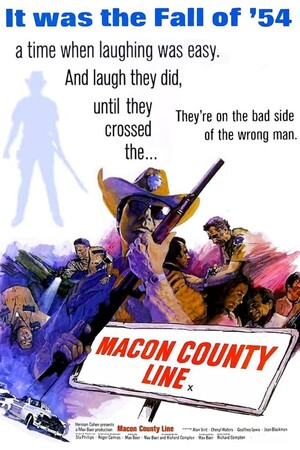
Max Baer, Jr. co-wrote, co-produced and co-starred in this southern fried thriller about a couple of good ‘ole boys (brothers Alan & Jesse Vint) who break down in the wrong county. The sheriff (Baer), who’s somewhat suspicious of the boys, goes after them with fierce vengeance when his wife is murdered.
I’m a big fan of this classic drive-in film. For one, I think it’s cool that Max Baer Jr., so well known as Jethro Bodine in the classic sitcom THE BEVERLY HILLBILLIES, took on this role of the somewhat racist sheriff who goes mad with rage in this movie. I enjoyed his performance very much. I also like these ‘70’s drive-in films. You get exactly what you expect in this tale, and it’s very entertaining. Finally, I like the Vint Brothers. Alan had an important role a year after this film was made in the Charles Bronson film BREAKOUT. And what can I say about Jesse. Over the last few years, he’s actually become a friend in real life. He’s such a great guy, and he’s very proud of this movie. He told me one day that Tarantino had said it was one of “the best stories in cinema!” In the first season of his Video Archives podcast, I’ve personally heard Tarantino really brag on Jesse’s performance in the movie THE FORBIDDEN WORLD. I love it when good things happen to good people.
Welcome to Retro Television Reviews, a feature where we review some of our favorite and least favorite shows of the past! On Tuesdays, I will be reviewing the original Fantasy Island, which ran on ABC from 1977 to 1986. Almost entire show is currently streaming is on Youtube!
(Dir by Gene Nelson, originally aired on November 17th, 1979)
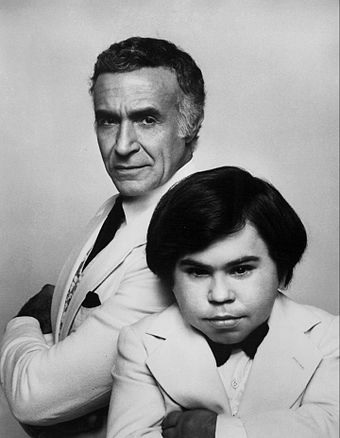
For the third week in a row, this episode of Fantasy Island features Mr. Roarke and Tattoo heading straight to the docks so that they can meet their guests without making any time for any Roarke/Tattoo banter. On the one hand, the scenes where Tattoo would tell Roarke about his latest scheme were always a bit awkward because of the obvious bad feelings between Ricardo Montalban and Herve Villechaize. On the other hand, they did reveal that Tattoo had a life outside of just following around Mr. Roarke. I will be a little bit sad if they’re gone forever.
As for this week’s fantasies, neither one adds up too much.
Big Jake Farley (Max Baer, Jr.) is a big, strapping cowboy who will tell anyone who will listen that he’s from “Big D.” (“It’s a mite south of Heaven.”) I’m from Big D too and I will admit that I’m a bit sensitive when it comes to the whole “All Texans are cowboys” stereotype so I pretty much spent this entire fantasy in cringe mode. Big Jake wants to meet Valeska de Marco (Carol Lynley), the ballerina whose hard work and perfectionism inspired him when he was just a penniless cowpoke. Now that Big Jake is a wealthy rancher and oilman, he wants to marry Valeska and take her back to the ranch. Unfortunately, Valeska is already engaged to Stuffy Q. Borington III (Howard Morton). When Valeska suffers a career ending injury, will Big Jake be able to convince her to come open an acting school in Big D and will Mr. Roarke help everyone’s fantasy come true?
You already know the answer. Everyone gets a happy ending on Fantasy Island, except for that time Mr. Roarke got married.
Eh. Considering that this fantasy combined several of my favorite things — ballet, Texas, tropical islands — it’s a bit of a shock just how boring it turned out to be. The main problem was that there was zero chemistry between Baer and Lynley. Both of them came across as if they would rather be anywhere but on Fantasy Island.
As for the other fantasy, it featured Toni Tennille as Betty Foster, a former fast food worker turned private investigator. Her fantasy was to solve a big case. With Roarke’s help, Betty was hired by Contessa Christina Kastronova (Stepfanie Kramer) to accompany the Contessa to the reading her cousin’s will. The Contessa felt her cousin had been murdered and she feared she might be next. Betty pretended to be the Contessa during both the reading of the will and the subsequent night spent in a scary, dark house with all of the Contessa’s relatives. Anyway, Dick Sargent turned out to be the murderer and Betty realized that she’d rather marry one of the Contessa’s relatives than continue on as a private eye.
As far as this fantasy went, I liked the scary house and I found the scene where Roarke and Tattoo debated which one of them should stay behind with Betty to be amusing. (Tattoo, of course, ended up having to stay.) But the mystery didn’t add up too much. To be honest, as soon as Dick Sargent showed up, I knew he was going to be the bad guy. I mean, I’ve seen Clonus.
Especially when compared to the previous two episodes, this episode was fairly forgettable. Everyone got their fantasy but no one made much of an impression.
Why, on June 3rd, did Billie Joe McAllister jump off of the Tallahatchie Bridge in Mississippi?
That was the question that was asked in Ode to Billie Joe, a 1967 country song by Bobbie Gentry. In the song, the details were deliberately left inconclusive. Why did Billie Joe commit suicide? No one knows. All they know is that he was a good worker at the sawmill and, the weekend before jumping, he was seen standing on the bridge with a teenage girl and apparently, they dropped something down into the river below. The song suggests that the girl and the narrator are one in the same but even that is left somewhat vague.
Ode to Billie Joe was a hit when it was first released, largely because it’s story could be interpreted in so many different ways. Why did Billie Joe kill himself? Maybe it was because he didn’t want to be drafted. Maybe it was because he and his girlfriend had killed their baby and tossed it off the bridge. Maybe it was because he was hooked on Dexedrine and his doctor wasn’t available to renew his prescription. It could be any reason that you wanted it to be.
However, in 1976, when Ode to Billie Joe was turned into a movie, ambiguity would not do. As opposed to the song, Ode To Billy Joe had to answer the question as to why Billy Joe jumped into that river. In the movie, 18 year-old Billy Joe (Robby Benson) works at the sawmill and spends his time courting 15 year-old Bobbie Lee Hartley (Glynnis O’Connor). Bobbie Lee’s father (Sandy McPeak) says that she’s too young to have a “gentleman caller,” even though Bobbie Lee insists that she’s “15 going on 34 … B cup!” Bobbie Lee warns Billy Joe that her father is liable to shoot his ears off but Billy Joe insists that he doesn’t need ears because he’s in love with her. That’s kind of a sweet sentiment, even though I don’t think Billy Joe would look that good without ears.
(Whenever I complain about how Southerners in the movies always seem to have two first names, my sister Erin replies, “Yeah, that’s really annoying, Lisa Marie.” So, I won’t make a big deal about it this time…)
One night, Billy Joe and his friends go out and Billy Joe ends up getting drunk. He disappears for several days and when he shows up again, something has definitely changed. After unsuccessfully trying to make love to Bobbie Lee, Billy Joe tells her what happened that night he got drunk. Billy Joe had sex with a man, something that he has been raised to view as being the ultimate sin. When Billy Joe is later pulled out of the river, the entire town wonders why he jumped off the bridge and how Bobbie Lee was involved…
Ode to Billy Joe, which aired last Tuesday on TCM, is a better-than-average film, one that I was surprised to have never come across in the past. That doesn’t mean that it’s a perfect movie. Robby Benson, in the role of Billy Joe, gives an absolutely terrible performance. You can tell that Benson was trying really hard to do a good job but, often, he goes totally overboard, making scenes that should be poignant feel melodramatic. Though it probably has more to do with when the film was made than anything else, the film is also vague about Billy Joe’s sexuality. Is Billy Joe in denial about his identity? Is he deeply closeted or was he in such a drunken stupor that he was taken advantage of? Ode to Billy Joe does not seem to be sure. By committing suicide, Billy Joe joins the ranks of gay movie characters who would rather die than accept their sexuality. Obviously, he had to jump off that bridge because that’s what the song said he did but there’s a part of me that wishes the movie had featured someone commenting that they never actually found Billy Joe’s body and then the final scene could have taken place 16 years later, with Bobbie Lee living as a hippie in San Francisco and just happening to spot Billy Joe walking down the street, hand-in-hand with his boyfriend.
Here’s what does work about the movie. Glynnis O’Connor gives a great and empathetic performance as Bobbie Lee. The scenes with her father and her mother (played by Joan Hotchkis) have a very poignant and wonderful realness to them. Though I’ll always be a city girl at heart (well, okay — a suburb girl), I spent some time in the country when I was growing up. And while I was never quite as isolated as Bobbie Lee (who lives in a house with no electricity or plumbing) and the film took place in the past, I could still relate to many of Bobbie Lee’s experiences. The film may have been made in 1976 and set in 1952 but life in the country hasn’t changed that much.
For instance, there’s this great scene where Bobbie Lee’s father is trying to drive across the bridge. The only problem is that there’s a bunch of drunk shitkickers on the bridge, sitting in their pickup truck and blocking his way. It’s a very tense scene, one that I found difficult to watch because, when I was growing up in Arkansas, Oklahoma, Louisiana, and South Texas, I saw the exact same thing happen more times than I care to admit. In the country, no one backs down. Scenes like that elevated Ode To Billy Joe to being something more than just another movie based on a song.
Finally, there’s a beautiful scene towards the end of the film, between Bobbie Lee and a character played by an actor named James Best. I won’t spoil the scene but it’s a master class in great acting. (Best also played one of the sadistic villains in Rolling Thunder, another good 70s film about life and death in the country.)
Though I wasn’t expecting much from it, Ode to Billy Joe was a pleasant surprise. It’s not perfect but it’s still worth watching.

 Through the Shattered Lens