Lisa Reviews An Oscar Nominee: Airport (dir by George Seaton)


First released in 1970, Airport is a real time capsule.

As one can guess from the title, it takes place over 12 hours at an airport.  The airport in question is a fictional one, Chicago’s Lincoln International Airport.  Over the course of one night, almost everything that can happen does happen.

A sudden snowstorm causes almost all of the other airports in the midwest to shut down for the night.  On Lincoln’s Runway 29, one of the airplanes gets stuck in the show when it lands.  No one is hurt but, until Joe Patroni (George Kennedy) and his men can dig out and move that plane, no one is going to be able to land on 29.

Runway 22 is still open but the homeowners association is currently picketing the airport to protest the amount of noise pollution that is caused whenever airplanes use Runway 22.  Using 22 in the middle of the night is sure to prove their point and make trouble for the airport.  Mel Bakersfield (Burt Lancaster), the airport manager, thinks that the only solution is to buy up all of the land around the airport but the Board of Commissioners disagrees.  Mel says that airports have to adjust to changing times but no one is willing to put up the money.

Mel is unhappily married to the wealthy and socially ambitious Cindy (Dana Wynter), who is not happy to learn that, due to the storm, Mel is going to miss an important dinner party.  Tanya Livingston (Jean Seberg), head of customer relations for Trans Global Airlines, is in love with Mel but Mel isn’t the type to cheat, even if his marriage is troubled.

On the other hand, Mel’s brother-in-law, pilot Vernon Demerest (Dean Martin, the hippest pilot in the sky), has absolutely no problem cheating on his wife (Barbara Hale).  Vernon is currently having an affair with flight attendant, Gwen Meighen (Jacqueline Bisset).  When Gwen tells Vernon that she’s pregnant, Vernon says that “it” can be taken care of in Sweden.  Gwen says that she wants to have the baby.

Meanwhile, Ada Quonsett (Helen Hayes, who won an Oscar for her performance here) is an elderly woman who has developed an addiction to stowing away on flights.  She manages to sneak onto a plane flying to Rome, the same plane on which Vernon is the co-pilot.  (Technically, Vernon is on the plane to evaluate the captain, who is played by Barry Nelson.  Yes, the same Barry Nelson who played Jimmy Bond in 1954’s Casino Royale and Mr. Ullman in The Shining.)  Ada ends up sitting next to a nervous man named D.O. Guerrero (Van Heflin).  Having failed as a businessman, Guerrero has a bomb in his briefcase and is planning on blowing himself and the airplane up so that his wife (Maureen Stapleton) can receive an insurance payment.

Seriously, that’s a lot of drama!  It seems like this airport has a little bit of everything!  But you know what this airport doesn’t have?  It doesn’t have the TSA groping people and telling them what they can and cannot take on the plane with them.  It doesn’t have the endless lines full of tired travelers who just want to be allowed to get on with their business.  It doesn’t have the suspicious atmosphere that has become a part of modern air travel.  Compared to the average airport experience of 2026, the movie’s airport is a paradise, full of people who are working hard, who are polite to each other, and who all seem to know what they’re doing.  I’d take the drama of 1970’s Airport over the reality of a modern airport any day.

Airport is very much a celebration of competent people getting the job done.  On the whole, we really don’t learn much about the characters played by Burt Lancaster, Dean Martin, Jean Seberg, Barry Nelson, and George Kennedy but we definitely learn that they’re all very good at their jobs.  Even Helen Hayes’s stowaway is meant to be likable precisely because she is so good at stowing away.  The only person who is portrayed as being a failure as Van Heflin’s D.O. Guerrero and he’s so upset about not being good at his job that he decides to blow himself up.  Though the film is full of split screens and dialogue that was probably risqué by the standards of a 1970 studio film, one gets the feeling that Airport probably felt old-fashioned even when it was first released.  One can only imagine what George Kennedy’s hard-working Joe Patroni would have thought about the characters in a film like Easy Rider.  About as close as Airport gets to the counterculture is Dean Martin mockingly calling Burt Lancaster “dad” while telling him to get his favorite runway cleared.  This is a film where even Dean Martin is a stickler for regulations.

Based on a best-selling novel, Airport is often listed as being one of the worst films to ever be nominated for best picture.  And …. well, okay, it’s definitely not a great film, especially when compared to some of the other films of the early 70s.  The film was the highest grossing film of 1970 and that, more than anything, probably explains why it was nominated.  Airport moves at a very deliberate pace and and visually, it is pretty flat.  It looks like a competently made television pilot.  When I first did a capsule review of Airport in 2010, I was fairly harsh towards it.  I have to admit, though, that when I recently rewatched the film, I actually kind of liked it.  Compared to today’s world, there’s something comforting about the competence of the characters in AirportAirport has its flaws and it definitely should not have been nominated for 11 Oscars but it presents a world that seems almost cozy compared to what we have to deal with nowadays.

Dean Martin as a pilot?  Helen Hayes as a chatty stowaway?  George Kennedy chewing on an unlit cigar and complaining to Burt Lancaster about how incompetent the TGA pilots are?  Hey, why not?  If it means not having to deal with the TSA and knowing that everyone is dedicated to getting me to where I’m going in comfort, I’m all for taking my next flight out Lincoln International.
Lisa Marie Reviews An Oscar Nominee: Reds (dir by Warren Beatty)


In the 1981 film Reds, Warren Beatty plays Jack Reed, the radical journalist who, at the turn of the century, wrote one of the first non-fiction books about Russia’s communist revolution and then went on to work as a propagandist for the communists before becoming disillusioned with the new Russian government and then promptly dying at the age of 32.

Diane Keaton plays Louise Bryant, the feminist writer who became Reed’s lover and eventually his wife.  Louise found fame as one of the first female war correspondents but then she also found infamy when she was called before a Congressional committee and accused of being a subversive.

Jack Nicholson plays Eugene O’Neill, the playwright who was a friend of both Reed and Bryant’s and who had a brief affair with Bryant while Reed was off covering labor strikes and the 1916 Democratic Convention.

Lastly, Maureen Stapleton plays Emma Goldman, the anarchist leader who was kicked out of the country after one of her stupid little dumbass followers assassinated President McKinley.  (Seriously, don’t get me started on that little jerk Leon Czolgosz.)

Together …. well, I was going to say that they solve crimes but that joke is perhaps a bit too flippant for a review of RedsReds is a big serious film about the left-wing activists at the turn of the century, one in which the characters move from one labor riot to another and generally live the life of wealthy bohemians.  Reed spends the film promoting communism, just to be terribly disillusioned when the communists actually come to power in Russia.  For a history nerd like me, the film is interesting.  For those who are not quite as obsessed with history, the film is extremely long and the scenes of Reed and Bryant’s domestic dramas often feel a bit predictable, especially when they’re taking place against such a large international tableaux.  At its best, the film is almost a Rorschach test for how the viewer feels about political and labor activists.  Do you look at Jack Reed and Louise Bryant and see two inspiring warriors for the cause or do you see two wealthy people playing at being revolutionaries?

Reds was a film that Warren Beatty spent close to 20 years trying to make, despite the fact that the heads of the Hollywood studios all told him that audiences would never show up for an epic film about a bunch of wealthy communists.  (The heads of the studio turned out to be correct, as the film was critically acclaimed but hardly a success at the box office.)  It was only after the success of the 1978, Beatty-directed best picture nominee Heaven Can Wait that Beatty was finally able to get financing for his dream project.  He ended up directing, producing, and writing the film himself and he cast his friend Jack Nicholson as O’Neill and his then-romantic partner Diane Keaton as Louise Bryant.  (Gene Hackman, Beatty’s Bonnie and Clyde co-star, shows up briefly as one of Reed’s editors.)  One left-wing generation’s tribute to an early left-wing generation, Reds is fully a Warren Beatty production and, for his efforts, Beatty was honored with the Oscar for Best Director.  That said, the Reds lost the award for Best Picture to another historical epic, Chariots of Fire.  Chariots of Fire featured no communists and did quite well at the box office.

The film is good but a bit uneven, especially towards the end when we suddenly get scenes of Louise Bryant trudging through Finland as she attempts to make it to Russia to be reunited with Reed.  The film actually works best when it features interviews with people who were actual contemporaries of Reed and Bryant and who share their own memoires of the time.  In fact, the interviews work almost too well.  The “witnesses,” as the film refers to them, paint such a vivid picture of the Reed, Bryant, and turn of the century America that Beatty’s attempt to cinematically recreate history often can’t compete.  One can’t help but feel that Beatty perhaps should have just made a documentary instead of a narrative film.

(Interestingly enough, many of the witnesses were people who were sympathetic to Reed’s politics in at the start of the century but then moved much more to the right as the years passed.  Reed’s friend and college roommate, Hamilton Fish, went on to become a prominent Republican congressman and a prominent critics of FDR.)

That said, Jack Nicholson gives a fantastic performance as Eugene O’Neill, adding some much needed cynicism to the film’s portrayal of Reed and Bryant’s idealism.  Keaton and Beatty sometime both seem to be struggling to escape their own well-worn personas as Bryant and Reed but Beatty does really sell Reed’s eventually disillusionment with Russia and the scene where he finally tells off his Russian handler made me want to cheer.  Fans of great character acting will want to keep an eye out for everyone from Paul Sorvino to William Daniels to Edward Herrmann to M. Emmet Walsh and IanWolfe, all popping up in small roles.

Reds is not a perfect film but, as a lover of history, I enjoyed it.


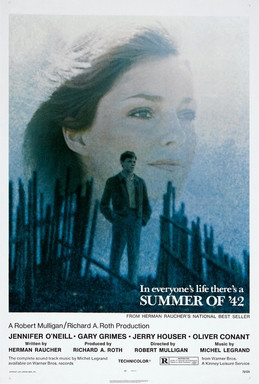
Back to School Part II #4: Summer of ’42 (dir by Robert Mulligan)


Summer_of_'42_POSTER

Originally, I was going to finish up the first day of my back to school reviews by talking about A Clockwork Orange.  I figured that, since the second film I reviewed was Andy Warhol’s Vinyl, it would just make sense that the fourth film would A Clockwork Orange.

But, I don’t know.  As I sat down and started to work on my fourth review, I realized that I’m not quite ready to write about A Clockwork Orange.  Instead, I’d rather hold off on that until tomorrow.  So, instead, I’m going to talk about Summer of ’42, another coming-of-age film that came out the same year.

That’s right — A Clockwork Orange and Summer of ’42 both came out in 1971 but — in content and sensibility — they might as well exist in different universes.  In fact, the only thing that they have in common is that they both tend to show up on TCM fairly frequently and that they’ve both influenced countless other films.

Speaking of TCM, that’s where I first saw Summer of ’42.  I have to admit that I’m writing this review from memory and that may not be the best way to review a film.  I saw Summer of ’42 about four months ago and, at the time, I thought it was a well-done but predictable little movie.  I even took notes for a future review but I didn’t get around to writing that review because … well, at the time, it just seemed like there wasn’t a lot to say about it.  Summer of ’42 is a sweet film but almost everything about it is right on the surface.  What you see is what you get.  I’m not surprised to discover that it was the 6th highest grossing film of 1971.  In a year that saw not only A Clockwork Orange but The Last Picture Show, The French Connection, Brother John, Billy Jack, Carnal Knowledge, Dirty Harry, Harold and Maude, Let’s Scare Jessica To Death, Klute, Straw Dogs, Pretty Maids All In A Row, and The Zodiac Killer, audiences were probably relieved to see a film that was neither violent, morally ambiguous, nor apocalyptic.

Instead, Summer of ’42 is a coming-of-age story that was specifically crafted to appeal to a world-weary audience’s nostalgia for the simple and carefree days of World War II.  This is one of those films where an older narrator continually reassures us that we’re seeing the most defining moment of his youth and all of the pretty images are in soft focus.  Hermie (Gary Grimes), Oscy (Jerry Houser), and Benjie (Oliver Conant) are three fifteen year-olds, all of whom are spending their summer on Nantucket Island.  Benjie is obsessed with sex but he’s nerdy.  Oscy is obsessed with sex but he’s a jerk.  Hermie is obsessed with sex but he’s the narrator so we already know that he’s too sensitive to lose his virginity to any girl his own age.

Luckily, there’s a woman in her 20s who is living in a nearby beach house.  Dorothy (Jennifer O’Neill) is beautiful but she’s married.  However, her husband’s a soldier and it is 1942 so, pretty soon, he’s out of the picture.  Hermie develops a mad crush on her and then, luckily for him, her husband dies and she spends a night teaching him the ways of love.  The next morning, she vanishes but leaves Hermie a note, telling him that she will never forget him and that it’s up to him to decide what their night together meant.

(Hermie never gets around to telling us what their night together meant so I guess it’s up to us to decide.  Personally, I just hope Hermie was careful who he told because, nowadays, a 23 year-old can get in a lot of legal trouble if she’s caught having sex with a 15 year-old.  Maybe things were different in 1942…)

As I said before, my initial response was that Summer of ’42 was sweet but predictable.  And that’s the way I still feel about it.  It was well-acted, well-filmed, and Jennifer O’Neill was amazingly beautiful but there was still something about Summer of ’42 that kind of bothered me.  We never really got to know who Dorothy was.  Her entire character was defined by her one night with Hermie.  Yes, I do understand that was kind of the point because the story was being told exclusively from Hermie’s point of view.  But it still bothered me.  Beyond being beautiful, tragic, and ultimately available, who was Dorothy?

But really, it wasn’t just something about the Summer of ’42 that was bothering me.  Instead, it was something about the coming-of-age genre in general.  I have lost track of how many nostalgic films and TV shows that I have seen that feature a narrator talking about the summer that he “became a man.”  It’s amazing how many awkward teenage boys apparently lost their virginity to a beautiful older woman who promptly vanished afterwards.  If, as has been recently suggested, I spent next summer in a rented beach house, am I going to be obligated to be the first lover of every 15 year-old, aspiring writer who happens to come wandering down the beach?  That could be time consuming, depending on how popular the beach is.

I guess what I’m saying is that perhaps somebody needs to remake Summer of ’42 and tell it from Dorothy’s point of view.

Just a thought.


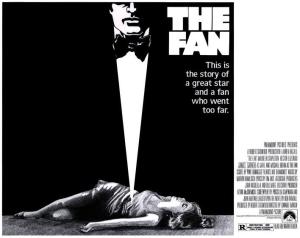
What Lisa Watched Last Night: The Fan (dir. by Edward Bianchi)


Last night, I watched the 1981 slasher-musical hybrid, The Fan.

Why Was I Watching it?

I had read about The Fan on a few slasher-related film sites and, despite the fact that the reviews were always universally negative, the former aspiring prima ballerina was intrigued by the idea of a slasher movie where the mayhem was occasionally put on hold for a dance number.  When I saw it listed as being on AMC last night, I set the DVR to record it.  Later, around 4 in the morning, I was battling insomnia and I didn’t really feel like watching infomercials or hurricane coverage.  So, I watched The Fan.

What Was It About?

Lauren Bacall is Sally Ross, an aging actress who smokes and smokes and smokes.  A very young and handsome Michael Biehn is Douglas, The Fan.  He’s obsessed with Sally and writes her hundreds of adoring letters.  “Believe me, I have the equipment to make you very, very happy,” the 20ish Douglas tells the 60ish Sally.  Sally’s secretary (Maureen Stapleton) writes back to Douglas and tells him that it’s illegal to “send pornography through the mail.”  Douglas responds by doing the whole slashing-up-the-world-with-a-straight-razor thing.  Meanwhile, Sally is in rehearsals for her Broadway musical debut and wow, it’s the worst musical since Nine.  Will Douglas be stopped?  Will Sally getting a standing ovation?  And how many cigarettes will be left by the end of the movie?

What Worked?

Michael Biehn is actually fairly good as the killer and the opening credits — where the musical score is nicely integrated with the sound of Biehn typing and reading his obsessive prose — are nicely done.  And technically, the film looks good.  The cinematography is credited to someone named Dick Bush and that’s all I’ll say about that.

But, let’s be honest, I wasn’t watching this film for quality.  I was watching for the Broadway dance sequences.  Films are always at their campiest when they try to portray a “Broadway” hit and that’s especially true if the film was made in 1981 (like this one).  And, on this, The Fan did not disappoint.  Seriously, the “show-within-the-show” here appears to be one of the greatest debacles in the history of imaginary Broadway.  Lauren Bacall rasps out her songs while chain-smoking while the chorus line spins across the stage in a blur of sequins and glitter.  On top of that, the show is named Never Say Never which has to be one of the most boring titles ever, as far as imaginary Broadway is concerned.  Yet, when it’s all over, the audience gives Never Say Never a standing ovation.  It’s a hit!  There’s no accounting for taste as far as fake Broadway is concerned.

Here’s a show-stopper from Never Say Never, starring Sally Ross:

Plus, about 40 minutes into the film, Bacall and Stapleton have themselves a good, old-fashioned bitch-off which just has to be seen.  There’s nothing like watching two divas compete to see who can devour the most scenery.

What Does Not Work:

Well, to be honest, the entire film doesn’t work.  The pacing is terrible, the scenes with Biehn kills his victims somehow manage to be both bloodless and overly sadistic at the same time, and Bacall seems to be not only ticked off at having to appear in the film but angry with you for watching it as well.  Add to that, there’s a bizarre homophobic subtext to this film that, while typical of a film released in the 80s, still seems odd for a movie that’s so obsessed with Broadway show tunes.

“OMG! JUST LIKE ME!” Moments:

I related to the dancers who show up on-screen whenever Sally is in rehearsals for her show.  Being trapped on the chorus line of a terrible show?  Been there, done that.  It’s actually a lot of fun because you’re freed from having to worry about how terrible the show is.  Instead of rehearsals being a death march, they’re an exuberant, doom-themed Mardi Gras.

Lessons Learned:

Don’t allow anyone else to answer your fan mail.