I love the Kingsman series. It looks like we have a third installment to the series, with a prequel showcasing the origins of the secret agent organization. Ralph Fiennes, Tom Hollander, Aaron Taylor-Johnson (who also worked with director Matthew Vaughn in Kick-Ass), Gemma Arterton, Daniel Bruhl, Djimon Hounsou, Charles Dance, Matthew Goode, and Stanley Tucci are all on board.
The 2014 film, The Imitation Game, takes place in three very different time periods.
The majority of the film takes place during World War II. While the Germans are ruthlessly rolling across and conquering huge swaths of Europe, the British are desperately trying to, at the very least, slow them down. A key to that is decrypting the secret codes that the German forces use to communicate with each other. Since the Germans change the code every day, the British not only have to break the code but also predict what the next day’s code will be.
Working out of a 19th century mansion called Bletchley Park, a small group of mathematicians, chess players, and spies work to design a machine that will be able to decode the German messages. Heading up this group is a man named Alan Turing (Benedict Cumberbatch). Alan is a remote and, at times, rather abrasive figure, a man who appears to be more comfortable dealing with equations than with other human beings. The people working under him occasionally chafe at Alan’s lack of social skills. Commander Denniston (Charles Dance) suspects that Alan’s a Russian spy and would just as soon close down the entire operation. At first, the only person who seems to have any faith in Alan’s abilities appears to be Winston Churchill himself.
It’s only when Joan Clarke (Kiera Knightley) joins Alan’s team that they start to make progress. Joan brings Alan out of his shell and teaches him how to deal with other human beings. When Joan’s parents object to her being away from home, Alan even offers to marry her. Of course, Alan also explains that it would just be a marriage of convenience, one that will last until they get Christopher up and working.
Christopher is the name that Alan has given to his encryption machine. Why Christopher? Throughout the film, we get flashbacks to Alan’s time in boarding school and his close friendship to another student, a boy named Christopher.
And finally, serving as a framing device to both the World War II intrigue and Alan’s relationship with Christopher, is a scene that’s set in 1951. Alan’s home has been broken into and, as the police investigate the matter, they come to realize that Alan is hiding something about both his past and his present. Their initial assumption is that Alan must be a communist spy. The truth, however, is that Alan is gay. And, in 1951 Britain, that is a criminal offense….
The Imitation Game is based on a true story. During World War II, Alan Turing actually was a codebreaker and he did play a pivotal role in creating the machine that broke the German code. After World War II, Turing was arrested and charged with “gross indecency.” Given a choice between imprisonment or probation and chemical castration. Turing selected the latter and committed suicide in 1954. Alan Turing’s work as a cryptographer is estimated to have saved 14 million lives during World War II but he died a lonely and obscure figure, a victim of legally sanctioned prejudice.
Admittedly, The Imitation Game does take some liberties with history. For one thing, most of the people who worked with Turing described him as being eccentric but not anti-social. Though the film pretty much portrays the decoding machine as solely being Turing’s creation, it was actually a group effort. Perhaps the biggest liberty that the film takes is that the machine was never called Christopher. Instead, it was called Victory.
That said, The Imitation Game is still a strong and effective film. Anchored by a brilliant lead performance from Benedict Cumberbatch, The Imitation Game is a film that manages to be both inspiring and infuriating at the same time. It’s impossible not to get caught up in the team’s joy as they realize that they actually can beat the Germans at their own encryption game and, after spending 90 minutes listening to everyone doubt Alan’s abilities, you’re more than ready to see him and his unorthodox methods vindicated. And yet, because of the film’s framing device, you already know that Alan is not going to get the credit that he deserves for his hard work. Instead, he’s going to be destroyed by the laws of the very country that he worked so hard to save. Success and tragedy walk hand-in-hand throughout The Imitation Game and the end result is a very powerful and very sad movie.
I have to admit that it was a bit jarring when the opening credits appeared onscreen and the first words that I read were “The Weinstein Company Presents.” It’s only been a year and a half since Harvey Weinstein was finally exposed and forced out of power but it’s still easy to forget just how much the Wienstein Company used to dominate every Oscar season. In many ways, with its historical setting and its cast of up-and-coming Brits, The Imitation Game feels like a typical Weinstein Company Oscar contender. In this case, The Imitation Game was nominated for a total of 8 Oscars, including Best Actor for Benedict Cumberbatch, Best Supporting Actress for Keira Knightley, Best Director for Morten Tyldum, Best Adapted Screenplay for Graham Moore, and Best Picture. In the end, only Moore won his category. In a decision that continues to confound me, the Academy named Birdman the best film of the year.
Earlier today, after deciding to take a break from watching the Lifetime films that have been steadily accumulating on my DVR, I went down to the Alamo Drafthouse with my BFF Evelyn and we watched the new World War II romantic adventure film, Allied.
Now, you should understand that I’m an Alamo Victory member and one of the benefits of my membership is that I get a free movie for my birthday! (My birthday was on November 9th. The offer’s good for up to a month after the big day. Pretty nice, no?) I have to admit that there’s a reason why I wanted to see Allied for free. I knew that, since this big movie with big stars and a big director was being released at the start of Oscar season, I would have to see it eventually. Add to that, Allied is current somewhat infamous for being the movie that contributed to the divorce of Brad Pitt and Angelina Jolie. Apparently, Brad had an affair with Marion Cotillard while making this movie. I knew I had to see Allied but I didn’t want to pay for it because, quite frankly, I wasn’t expecting it to be very good.
I mean, the trailer looked awful! The trailer was a collection of war film clichés and, as happy as I was to see Brad without that raggedyass beard that he tends to have whenever he’s trying to be a serious actor, it was still hard to ignore that he essentially looked like a wax figure. Then you had Marion Cotillard, looking as if she’d rather be playing Lady MacBeth. Judging from the trailer, Allied just didn’t look very good.
Having now seen Allied, I can say that the trailer does the film a great disservice. Not only is Allied far more entertaining than the trailer suggests but the trailer also gives away the film’s big twist! Seriously, this twist occurs about 75 minutes into a 120 minute film and, if it was sprung on you without warning, it would totally blow you away. It would leave you reeling and reconsidering everything that you had previously seen. But since the twist is highlighted in the trailer, you instead spend the first half of the movie impatiently waiting for it.
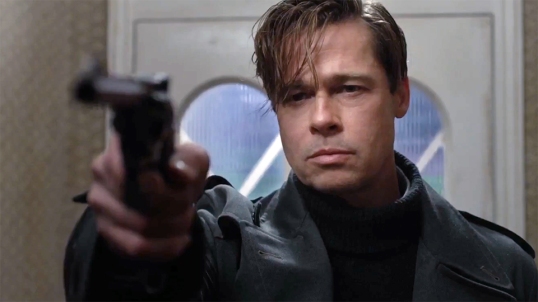
You probably already know the twist. But I’m still not going to reveal it because maybe there’s one or two of you out there who have managed to avoid the trailer. Instead, I’ll tell you that Allied is a World War II romance. It opens in Casablanca, with Canadian secret agent Max Batan (Brad Pitt) working with Marianne Beausojour (Marion Cotillard). Marianne is a legendary member of the French Resistance. It doesn’t take long for Max and Marianne to fall in love and soon, they’re having sex in the middle of the desert, making love in a car while a sandstorm rages all around them. Max eventually marries Marianne and they have a daughter. But around them, the war continues and both of them find themselves struggling to determine who they can and cannot trust.
As directed by Robert Zemeckis, Allied is a big movie, one that is frequently entertaining and yet occasionally and frustratingly uneven. Allied feels like its less about recreating history and more about paying homage to the World War II and espionage films that Zemeckis watched when he was growing up. It’s a technical marvel, featuring not only sandstorm sex but crashing airplanes and a painstaking recreation of Europe in the 1940s. The film is full of seemingly random details, many of which don’t add much to the narrative but they do contribute to Allied‘s oddly dreamlike feel. This is the type of film where espionage is discreetly discussed at a party while Gershwin plays on the soundtrack and British airmen casually snort cocaine in the background. When Marianne gives birth to Anna, she does it outside while bombs explode around her. When the baby is finally delivered, a group of nurses applaud. It’s all wonderfully over the top but, occasionally, the narrative lags. Zemeckis sometimes seems to be torn as to whether or not he’s paying homage to or deconstructing the genre. As a result, some scenes work better than others. (There’s a lengthy sequence involving a note containing false information. It’s obvious that Zemeckis is trying to pay homage to Hitchcock’s Notorious but he never quite manages to pull it off.)
Despite what I previously assumed as a result of seeing the trailer, both Brad Pitt and Marion Cotillard are well-cast. Cotillard is one of the few actresses who feels at home in a throwback film like this one and she does a good job keeping the audience guessing. (Of course, if we accept that Allied is essentially Zemeckis’s cinematic dream of World War II, Cotillard serves to remind us of Inception and its multiple layers of dream logic.) Brad Pitt, meanwhile, should consider playing more roles without his beard. After watching Daniel Craig sulk through four James Bond films, it’s nice to be reminded that, occasionally, an actor can actually have fun while playing a secret agent.
Allied is uneven but entertaining. Don’t let the trailer fool you.


 Through the Shattered Lens