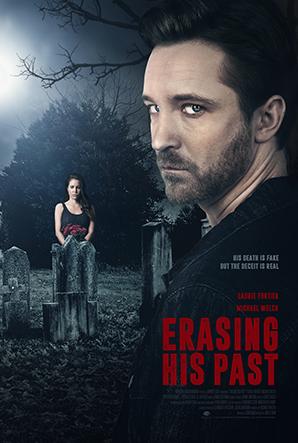
What Lisa Watched Last Night #202: Erasing His Dark Past (dir by Jared Cohn)


Last night, I turned over to the Lifetime Movie Channel and I watched Erasing His Dark Past.
Why Was I Watching It?

So, October isn’t even over yet and Lifetime has already decided that they’re going to start with the Christmas movies!  That’s right — the next two months are just going to be Christmas cheer on my favorite channel!  And listen, I love Christmas.  You know that about me.  I love any holiday that involves me getting presents!  But seriously, it’s too soon for the Christmas movies!

So, instead of watching a Christmas movie last night, I switched over the Lifetime Movie Network and I got caught up with Erasing His Dark Past.

(Don’t worry, everyone!  The holiday spirit will possess me soon and I’ll happily be watching every Christmas movie on Lifetime!)

What Was It About?

David (Michael Welch) has a dark past and he needs to erase it!  What better way to do that than to disappear after a plane crash?

Everyone thinks that David is dead but his wife, Karen (Lauren Fortier), has her doubts.  Those doubts turn out to be justified when she discovers that David had all sorts of weird financial stuff going on.  By vanishing (or dying or whatever he did), he’s basically left Karen broke and in a lot of trouble.  Was David just bad with money or was it all a part of his criminal scheme?

And could it be that David may have had a ….. second family!?

What Worked?

Micheal Welch did a good job as David, I thought.  He came across as being sinister enough to fake his own death and charismatic enough to pull it off.

Fans of the classic film To Kill A Mockingbird will want to keep an eye out for Scout herself, Mary Badham, playing a sympathetic bank employee.

What Did Not Work?

There have been several Lifetime films about husbands faking their own death and running off to their second family.  In fact, it’s become a bit of cliche that you should never trust a husband in a Lifetime film.  Unfortunately, as a result, there was really no shock in discovering that David wasn’t actually dead.  We knew it was going to happen as soon as he first appeared.  To a certain extent, their predictability is one of the things that make Lifetime films enjoyable but still, it was a little bit to easy to see the direction in which Erasing His Dark Past was heading.

“Oh my God!  Just like me!” Moments

This was one of those rare films where there really weren’t any “Oh my God!  Just like me!” moments.  I’ve never been married so I’ve never had to deal with a husband faking his own death and running off with all of my money.  I guess I should consider myself lucky in that regard.

Lessons Learned

If there’s no body, there’s no proof.

Shattered Politics #19: To Kill A Mockingbird (dir by Robert Mulligan)


To_Kill_a_Mockingbird_poster

So, I guess I should explain why I’m including the classic 1962 film (and best picture nominee), To Kill A Mockingbird, in this series of reviews of films about politicians.  After all, while To Kill A Mockingbird dealt with the issue of racism in Alabama in a surprisingly honest manner, it doesn’t feature any elected officials.  Nobody shows up playing Gov. Benjamin J. Miller or President Franklin Roosevelt.  Instead, this film is about a wise lawyer named Atticus (Gregory Peck), an innocent man named Tom (Brock Peters), a girl named Scout (Mary Badham) and her older brother Jem (Philip Alford), and a mysterious recluse named Boo (Robert Duvall).

However, if you’ve read Harper Lee’s wonderful novel, then you know that Atticus is not just the smartest man in Maycomb, Alabama.  He’s also a member of the Alabama state legislature and his political career is a fairly important subplot in the book, with him occasionally having to leave home so he can go down to Montgomery and help to write the budget.  (Incidentally, Harper Lee’s father actually was a member of the Alabama House of Representatives.)

In the film, no mention of Atticus being a member of the state legislature is made but I still choose to believe that he was.  Because, as played by Gregory Peck, Atticus Finch is exactly the type of man who you would want to think of as serving in government.  He’s wise, compassionate, and firm.  For much of To Kill A Mockingbird, he is literally the only sane adult in Maycomb.  He’s the only attorney willing to defend Tom Robinson when Tom is accused of raping a white girl.  When a mob shows up to lynch Tom, Atticus is the only adult willing to stand up to them.  (Fortunately, Jem also runs up and shames the mob by reminding them that she goes to school with their children.)  And, in court, it is Atticus who proves that Tom is innocent.

When Tom is still convicted, what makes it all the more devastating is that wise and compassionate Atticus doesn’t seem to be surprised as all.  If even Atticus feels that there is no hope for a black man to get a fair trial from an all-white jury, the film seems to be saying, then there truly is no hope.

Of course, the film is not just about Atticus.  It’s about Scout and Jem and their friend Dill (John Megna) and how the three of them grow up and learn the truth about their world.  Watching them from behind the closed doors of his house is the mysterious and reclusive Boo Radley.  When Boo shows up towards the end of the film, I always find tears in my mismatched eyes.  Boo is played, in his film debut, by Robert Duvall.  Duvall doesn’t say a word but he still makes an incredible impression as the shy and withdrawn Boo.

So, I may be cheating a lot by including To Kill A Mockingbird in this series of reviews.  Oh well.  Who am I to turn down a chance to rewatch it?  To Kill A Mockingbird is just a great film.