Welcome to Late Night Retro Television Reviews, a feature where we review some of our favorite and least favorite shows of the past! On Fridays, I will be reviewing Friday the 13th: The Series, a show which ran in syndication from 1987 to 1990. The entire series can be found on YouTube!

This week, people are dying and somehow television is to blame.
Episode 3.18 “Spirit of Television”
(Dir by Jorge Montesi, originally aired on April 30, 1990)
Ilsa (Marj Dusay) claims to be a medium. She uses a television set to summon the spirits of the dead for her rich clients and then, later on, the spirits kill her customers and Ilsa, who has a degenerative disease, gets another ten days added to her life. If she doesn’t continually kill, her skin starts to look like rubber and her fingernails fall off. Agck!
This was largely a Jack episode. Jack is the one who, with his years of experience as a magician, assumes that Ilsa is a fake. He’s also the one who recruits an old friend named Robert Jandini (Paul Bettis) to go undercover and check Ilsa out. And when Robert is inevitably killed as a result, Jack is the one who has to live with the guilt. One thing that I’ve always appreciated about Friday the 13th is that it doesn’t shy away from showing what a lifetime of battling the supernatural would do to someone’s psyche. At the end of this episode, Jack is about as depressed as I’ve ever seen him. The great Chris Wiggins was always Friday the 13th’s not-so secret weapon and he gives another stand-out performance here.
In fact, this episode is so focused on Jack, Jandini, and Ilsa that Micki and Johnny largely feel like bystanders. There’s nothing wrong with that, to be honest. Micki and Johnny just don’t have the same sort of enjoyable chemistry that Micki and Ryan had. Still, watching Johnny in the background, it’s hard not to consider that the third season’s writers never really figured out who the character was meant to be or what they really wanted to do with him. I have sympathy for Steve Monarque because he doesn’t come across as being a bad actor. Instead, he comes across as being an actor who was saddled with an extremely inconsistent character.
As for this episode, it was nice to finally get an episode that was just about a cursed antique and that didn’t feel the need to try to reinvent the show’s format. That said, the television seems likes a really bulky object to curse. How did Ilsa even figure the curse out? What if the television had been purchased by someone who wasn’t terminally ill? Can Ilsa watch regular programming on the television or is it always a portal to Hell? These questions go unanswered.
Still, it’s an atmospheric episode and Chris Wiggins gives a strong performance. For a season 3 episode, this wasn’t bad. It’s also the the third-to-late episode of Friday the 13th. Only two more left to go.
I’m going to miss this show.
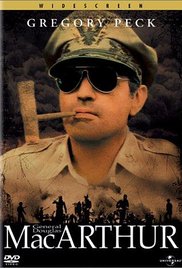 The year is 1962 and Douglas MacArthur (Gregory Peck), the legendary general, visits West Point for one last time. While he meets the graduates and gives his final speech, flashbacks show highlights from MacArthur’s long military career. He leaves and then returns to Philippines. He accepts the Japanese surrender and then helps Japan rebuild and recover from the devastation of the war. He half-heartedly pursues the Presidency and, during the Korean War, gets fired by Harry Truman (Ed Flanders).
 Through the Shattered Lens