Film Review: Groundhog Day (dir by Harold Ramis)


Happy Groundhog Day!  For the record, Punxsutawney Phil saw his shadow today so get ready for six more weeks of winter!

Oh, how I love Groundhog Day.  I really do.  It’s perhaps the silliest holiday that we have in America and I absolutely adore the whole thing.  I love the fact that people get dressed up for it.  I love that there are people who plan their entire weekend around seeing what the groundhog predicts.  I love that we all know there’s no way a groundhog can reasonably predict the weather but, for one day, we pretend like it can.  And while Groundhog Day itself had its beginning in Germany, the holiday really has become pure Americana.  It’s such an innocent holiday, or at least it is now that Bill de Blasio is no longer in a position to kill the magic groundhog.

(Boo de Blasio!  Boo!)

Of course, no Groundhog Day is complete without watching the 1993 comedy of the same name.  The film has become such a major part of American culture that even people who haven’t watched it know what it’s about.  (It’s a bit like It’s A Wonderful Life in that way.)  Bill Murray plays Phil Connors, a cynical weatherman who is sent to cover Groundhog Day in Punxsutawney and finds himself reliving the same day over and over again.  Every morning, it’s once again February 2nd.  Sonny and Cher’s I Got You Babe plays on the radio.  Phil is approached by Ned Ryerson (Stephen Tobolowsky), an annoying former classmate turned insurance salesman.  Phil steps in the same puddle.  He finds himself covering the same story and, again and again, he’s stranded by the same blizzard.  At first, Phil is angry.  Even multiple suicides can’t stop the cycle.  Kidnapping the groundhog can’t stop the cycle.  Then, he decides to take advantage of living the same day over and over again.  He gets to know the people in the town and realizes that they’re not so bad.  He saves the mayor (Brian Doyle-Murray) from choking at dinner but, in the film’s most poignant moment, realizes that an old homeless man is going to die regardless of how many times he tries to save him.  Phil learns how to learn the piano.  He learns how to speak French.  And, most importantly, he falls in love with Rita (Andie MacDowell).  Of course, when he tells Rita this, she assumes he’s just trying to take advantage of her.  Rita says that they barely know each other but what she doesn’t realize is that Phil has been spending day-after-day with her.

As you might have guessed I relate to Rita.  She loves the silliness of the holiday and so do I.  I also relate to Nancy Taylor (Marita Geraghty), just because of her determination to enjoy the day no matter what.  That said, this is totally Bill Murray’s film and this is one of his best performances, one in which he expertly mixes his trademark comedy with some very poignant drama.  One thing I like about this film is that Phil becomes a better man as a result of living the same day over and over again but it doesn’t totally change his personality.  At the end, he’s still the same sarcastic smartass that he was at the start of the film but he’s no longer a cynic.  He’s learned how to appreciate other people.  He’s fallen in love.  Much like George Bailey, he’s become the richest man in town.  This is a rare film where the main character is as interesting after he’s reformed as before.

It always breaks my heart a little to read that Bill Murray and director Harold Ramis had a difficult time working together while making this film.  It’s truly a perfect film and that’s due to both Murray’s performance and Ramis’s heartfelt direction.  I’m also glad that Ramis and Murray made up before Ramis passed away.  Life’s too short and sadly, unlike in the movies, we don’t always get a chance to go back and correct the past.

Groundhog Day is a holiday classic and may it continue to be watched for decades to come.
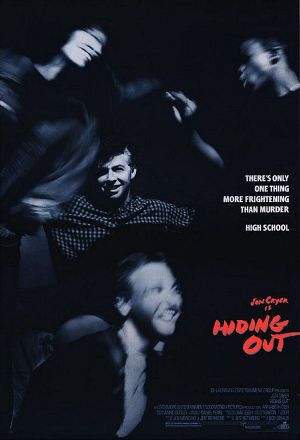
A Movie A Day #342: Hiding Out (1987, directed by Bob Giraldi)


Andrew Morenski (Jon Cryer) is a stockbroker in the 1980s.  What could be better than handling large amount of money during the decade of excess, right?  The only problem is that Andrew and two of his colleagues have gotten involved with Mafia.  And now, the Mafia wants them all dead.  On the run from both the FBI and the Mob, Andrew tries to change his appearance.  He shaves off his beard.  He gives himself a bad dye job.  No sooner has Andrew traded clothes with a homeless person than he is mistaken for a high school student.

What better place could there be for Andrew to hide than a high school?  Despite being 29 years old, Andrew fits right in and soon becomes one of the most popular students at the school.  Andrew not only gets a girlfriend (Annabeth Gish) but he is even nominated to run for student body president.  As Andrew discovers, the mob may be ruthless but they’re nothing compared to the student council.

Hiding Out may begin like a violent action thriller but it quickly reveals itself to be yet another John Hughes-influenced high school movie.  Andrew starts out as a sleazy stockbroker but, by the end of the movie, he has transformed himself into Ferris Bueller.  After spending his teenage years as a self-described “short, horny, hopeless dork,” Andrew is finally getting his chance to be cool.  (“Well, I’m not short,” Andrew says.)  The best scenes are the ones where Andrew occasionally forgets that he’s just supposed to be an apathetic teenager, like when he gets into a fierce argument with his history teacher over whether Richard Nixon should have been forced out of office or when he meets his girlfriend’s father and ends up giving him stock advice.  There’s no denying that the plot is frequently dumb and features some massive plot holes but, largely due to Jon Cryer’s likable and energetic performance, Hiding Out is also a breezy and enjoyable movie.

Cleaning Out The DVR #29: Broadcast News (dir by James L. Brooks)


(For those following at home, Lisa is attempting to clean out her DVR by watching and reviewing 38 films by the end of this Friday.  Will she make it?  Keep following the site to find out!)

220px-Broadcast_News

I’ll give you three chances to guess what the 1987 film Broadcast News is about.

Broadcast News takes place at the Washington bureau of a major network news operation.  (You can tell this film was made in the 80s in that nobody’s working for a blog and there’s no mention of Fox, MSNBC, or CNN.)  This is where a group of hard-working men and women do their best to make the national news anchor, Bill Rorish, look good.

Bill Rorish is played by Jack Nicholson and, even though he only has about five minutes of screen time (out of a 133 minute movie), he pretty much dominates the entire film.  Some of that is because he’s Jack Nicholson and he kicks ass.  All Jack has to do to dominate a scene is show up and arch an eyebrow.  But, beyond that, everyone in the movie is obsessed with impressing Bill Rorish.  Whenever a reporter and his producer get a story on the air, they obsessively watch to see if Bill smiles afterward.  Bill Rorish is the God they all hope to please and the film (as well as Nicholson’s performance) suggests that he barely even knows that they’re alive.  It’s telling that the only time Bill shows up in person (as opposed to appearing on a TV screen), it’s because a huge number of people at the Washington bureau are being laid off.

When Bill says that it’s a shame that budget cuts are leading to so many good newspeople being laid off, someone suggests that maybe Bill could help by taking a cut in his million-dollar salary.  Needless to say, Bill Rorish is not amused.

Broadcast News centers on three of the characters who work at the Washington Bureau.  First off, there’s Jane Craig (Holly Hunter), a producer.  Jane is a true believer in the mission and the importance of journalism.  Her ethics and her belief in what constitutes proper journalism are everything to her and, at times, she can get more than a little self-righteous about it.  (If Broadcast News were made today, Jane would spend the entire movie whining about how new media is destroying the country.)  At the same time, Jane is completely neurotic, a self-described “basket case” who, at one point, ends up sobbing in a hotel room as she prepares to go to sleep by herself.

Jane’s best friend is Aaron Altman (Albert Brooks), a reporter who wants to someday be an anchor.  Aaron is smart and funny (and he better be, seeing as how he’s being played by Albert Brooks) but he’s not telegenic and he’s almost as neurotic as Jane.  Like Jane, Aaron is all about journalistic ethics but there’s a defensiveness to Aaron.  Whenever Aaron complains about vapid news anchors, it’s obvious that he’s more jealous than outraged.

And then there’s Tom Grunick (William Hurt), who represents everything that Jane and Aaron claim to be against.  He’s handsome, he’s smooth, he’s charismatic, and he’s definitely not an intellectual.  He knows little about the specifics of current events.  However, he has great instincts.  He knows how to sell a story and he knows how to present himself on camera.  He’s also a surprisingly nice and sincere guy, which makes it all the more difficult for Aaron to justify his belief that “Tom is the devil.”

From the minute that Tom arrives at the Washington bureau, there’s a strong attraction between Tom and Jane.  (Jane even sends another reporter to Alaska after she finds out that Tom slept with her.)  Tom wants to be a better reporter.  Jane wants to be happy but fears compromising her ethics.  And Aaron … well, Aaron wants Jane.

Not surprisingly, considering that the film was made 29 years ago, there were some parts of Broadcast News that felt extremely dated.  A scene where Aaron complains about a story that Tom did on date rape feels especially uncomfortable when viewed today and both Jane and Aaron occasionally came across as being a bit too self-righteous.  In today’s media world, Tom’s sins really didn’t seem like that big of a deal.

But, for the most part, I enjoyed Broadcast News.  It was an intelligent film, one the featured people having actual conversations about actual ideas and, listening to them, I realized how rare, in both movies and real life, that actually is.  It’s a witty film, full of good performances.  While I hope I never become as self-righteous as Jane, I could still relate to her in her more neurotic moments.  And who wouldn’t want a best friend like Aaron?

And, for that matter, who wouldn’t want a lover like Tom?

(That’s something I never expected to write about a character played by William Hurt.)

And, of course, there’s this scene.  Poor Aaron!

Broadcast News was nominated for best picture of 1987.  However, it lost to The Last Emperor.

http://www.youtube.com/watch?v=BPjx2pI–2U