International Horror Film Review: Requiem For A Vampire (dir by Jean Rollin)


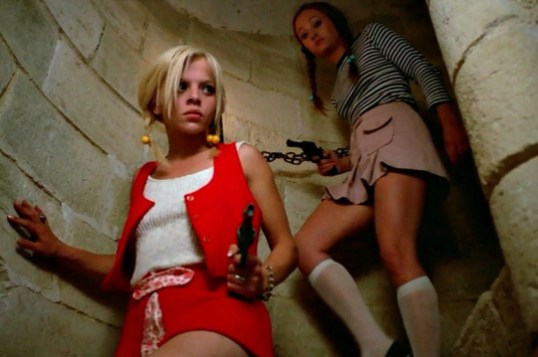
1971’s Requiem for A Vampire opens with a car chase.

In one car, there’s a male driver and then there’s Michelle (Mirelle Dargent) and her girlfriend Marie (Marie-Pierre Castel).  Who is pursing them?  Who is shooting at them?  Why are both of the girls wearing clown makeup?  These are all good questions and they’re never clearly answered in the film.  We shouldn’t be surprised about that, however.  This is a Jean Rollin film, which means that the imagery is far more important than the storyline.  In the end, the girls are wearing clown makeup because Rollin often worked clown imagery into his films.  And they’re fleeing together because Rollin’s films often celebrated female friendship.  As for why they’re being chased, if you listen carefully, you’ll hear some mention of a murder but it’s never made clear who was murdered or why or even by whom.  It’s not important.  This is a Jean Rollin film.  You either get it or you don’t.

After the car crashes, the girls wash off their clown makeup, change clothes, and set the car on fire.  They also set the driver on fire.  They claim that the driver was killed in the car accident but the actor playing the driver visibly twitches while they pour the gasoline on him.  Was that simply a mistake on the actor’s part or did Michelle and Marie essentially burn a man alive?  Does it really matter?  Michelle and Marie survived, that’s what’s important.

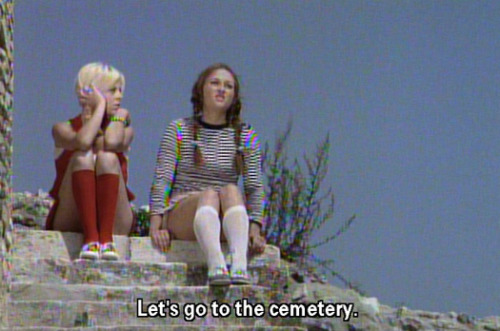
Marie and Michelle walk through the French countryside, stealing food and avoiding detection.  As always, Rollin’s camera loves the the beauty of the countryside.  They explore the forest.  They go down to the cemetery.  Michelle nearly gets buried alive.  It’s a dangerous world out there.

Eventually, they stumble across a gothic castle and, as you might guess from the title and the fact that this is a Jean Rollin film, the castle is full of perverse vampires who take Marie and Michelle prisoner. It’s here that film reaches a level of peak Rollin as we’re confronted with scenes of dungeons, dark hallways, and vampires transforming into bats while (literally) going down on their victims.  The castle is ruled over by a vampire woman who plays an organ and a male vampire who wants to use Marie and Michelle to continue his bloodline, specifically because neither has ever been with a man.  Michelle is totally happy with the idea of living forever but Marie is a bit less enthused and starts looking around for a random male.

What’s interesting is that, for a vampire film, the vampires themselves are largely red herrings.  For that matter, so is the car chase and the cemetery and almost everything else that Michelle and Marie have to deal with over the course of the film.  Instead, the film is really about their relationship and whether or not it will survive all of the challenges that it faces.  Marie and Michelle may both have differing views on whether or not to become a vampire but what’s the most important is that nothing be allowed to come between the bond that they share.  This was a theme to which Rollin would often return.  Dargent and Castel are both perfectly cast as Marie and Michelle, who reminded me of myself and my BFF.  If I ever get into a car chase while wearing clown makeup, I would definitely want my best friend at my side.  She makes stuff like that fun.

Especially during the film’s early scenes.  Requiem for a Vampire plays out almost like a silent film.  The dialogue is kept to a minimum and the emphasis is put on the imagery with Rollin emphasizing the beauty of the countryside and the stately menace of the imposing castle.  The film is a visual poem, a celebration of friendship, and one of Rollin’s best.
International Horror Film: The Shiver of the Vampires (dir by Jean Rollin)


This is the one with the vampire in the clock.

Now, admittedly, a female vampire emerging from a grandfather clock is an image to which filmmaker Jean Rollin would frequently return.  It was one of his most iconic images and, in many ways, a perfect visual for his uniquely dream-like aesthetic.  Seeing as how Rollin’s films always seemed to be, at least somewhat, concerned with how the past bleeds over into the present, it only makes sense that every grandfather clock — that ultimate symbol of the past — would have a vampire lurking somewhere within it.

As far as I know, though, 1971’s The Shiver of the Vampires was the first time that Rollin ever featured a vampire emerging from a clock.  Rollin often cited The Shiver of the Vampires are being one of his personal favorites from his filmography so it makes sense that he would continually return to that film’s best-known moment.

Though I prefer later films like Living Dead Girl, Two Orphan Vampires, and Night of the Hunted, The Shiver of the Vampires is definitely one of Rollin’s best films.  It’s certainly the first of his films in which Rollin feels like a truly mature filmmaker.  This was his third film and, like both Le Viol du Vampire and The Nude Vampire, it plays out like a cinematic dream.  At the same time, it’s more coherent than either of those earlier films, without the occasional moments of pretension that sometimes threatened to make those two films feel like elaborate student exercises.

The Shiver of the Vampires takes place in all of the usual Rollin locations.  There’s an isolated castle and decrepit castle, a symbol of the past which still features very modern graffiti on some of the walls.  There’s the chapel, which seems to be specifically designed to accommodate human sacrifice.  And, of course, there’s the beach.  As with so many Rollin films, all paths lead to the beach, a location that Rollin presents as being both comforting and menacing.

The Shiver of the Vampires tells the story of a honeymooning newlywed couple, Isle (Sandra Julien) and Antoine (Jean-Marie Durand).  Isle is looking forward to visiting her two cousins at their castle but, upon arriving, Isle and Antoine discover that the castle is now the home to two young women and that Isle’s cousins died just the day before.  Upset at both the news and a strange meeting with another woman named Isabelle (Nicole Nancel), Isle decides to spend the night sleeping alone.  However, while Isle is getting ready for bed, Isolde (played by the singularly-named Dominique) emerges from the grandfather clock.

Isolde is the vampire who not only killed the cousin but who, along with her two servants, has taken over the castle.  While Isolde leads Isle to the cemetery, Antoine wanders around the castle and just happens to run into the two dead cousins…

At its heart, The Shiver of the Vampires is an old Universal haunted castle movie with a bit more nudity and the sexuality move to the forefront as opposed to just being subtext.  It’s a horror film with plenty of blood and one rather nasty death via piercing by pointed nipple covers.  At the same time, it’s also a rather sentimental film.  Ultimately, Isle is vulnerable not because she has any secret desire to be a vampire but instead because her cousins, regardless of what they’ve become, are the only family that she has left.  Married or not, Antoine is just an interloper.

As with all of Rollin’s films, The Shiver of the Vampires plays out at its own dream-like pace, with the camera loving examining every inch of the old castle.  On the one hand, the film may be a dream of dark and disturbing things but, at the same time, it’s also a sad-eyed look at family and the impossibility of escaping the past.

And, of course, you’ll never forget that grandfather clock.