There are many reasons why Jason Newsted is one of the greatest bassists of all time. Beyond his talent, there’s his honesty. Newsted is someone who is going to shoot straight, no matter what the question may be. For instance, in 2002, Newsted was asked if, as a heavy metal fan, he would have bought Metallica’s 1997 album, Reload.
Newsted, who had left Metallica the previous year, replied, “Not if I heard ‘The Memory Remains‘ first.”
TheMemoryRemains might not be Metallica’s song. Newsted was definitely right about that. But it does have a memorable video, one that shows that, once the band broke their previous “no videos” stance, they quickly figured out how to use the format to their advantage.
This video was shot at the Van Nuys Airport and it had a budget of $400,000. The room that they are performing in was actually a constructed box. The room moved while the band remained stationary on a platform, which created the impression of the band playing while on a giant swing. Marianne Faithfull adds her vocals as well.
Co-written with Keith Richards and Mick Jagger, Sister Morphine was originally recorded by Faithfull in 1969 but her recording was initially banned in the United Kingdom due to the song’s drug-related content. The Rolling Stones would go on to release a version of the song in 1971 and Faithfull would record and release the song a second time in 1979.
Here I lie in my hospital bed Tell me, Sister Morphine When are you coming around again? Oh I don’t think I can wait that long Oh you see that my pain is so strong
All the other patients say They’ve never seen a man with such pain Tell me, Sister Morphine When are you coming round again? Oh I don’t think I can wait that long Oh you see that I’m not that strong
The scream of the ambulance Is sounding in my ear So tell me, Sister Morphine How long have I been lying here? What am I doing in this place? Why does the doctor have no face? Oh I can’t crawl across the floor Can’t you see, Sister Morphine? Just tryin’ to score
Well the actions go to show Things are not what they seem Please, Sister Morphine Turn my nightmare into dream Oh can’t you see that I’m fading fast? And this shot will be the last
Please, cousin Cocaine Lay your cool hands on my head Hey, Sister Morphine You better make up the black bed ‘Cause you know and I know That you want me, I’ll be dead You sit around and watch The clean white sheets stained red
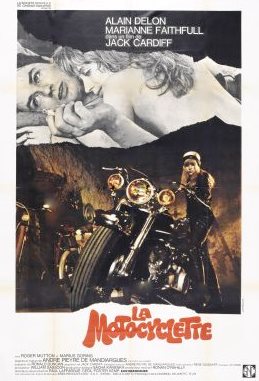
Who would have guessed that a film from 1968, starring Marianne Faithfull and Alain Delon, would be a little bit pretentious? I’m as shocked, as anyone.
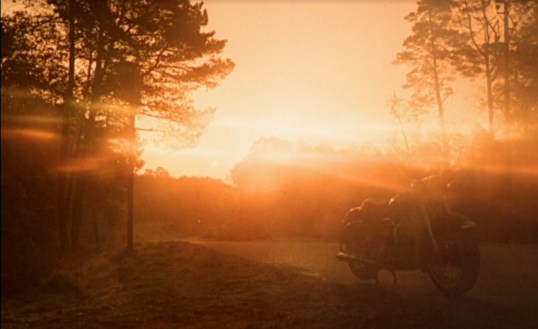
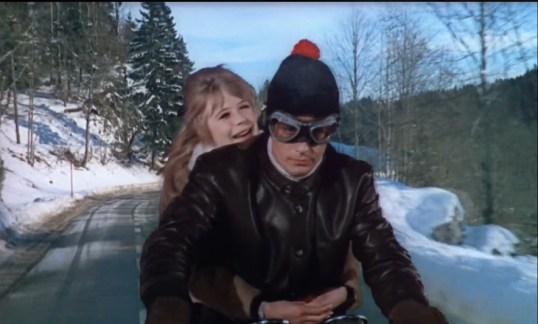
The Girl On A Motorcycle is Rebecca (Marianne Faithfull), the wife of Raymond (Roger Mutton). One day, Rebecca wakes up, puts on a black leather jumpsuit, and gets on her motorcycle. Abandoning her husband and her home, she rides through France and eventually reaches Germany. Along the way, she thinks about how the motorcycle represents freedom and how no one is truly free unless they’re doing what they want to do. We hear her inner monologue and it’s hard not to notice that, for someone riding a motorcycle across two countries, she often doesn’t seem to be paying that much attention to the road. Rebecca has more important things to think about, like free love and Vietnam. She watches as a transport of soldiers drive past her and she silently tells them not to look at her. She drives through a city and starts to laugh while shouting “Bastard!” at the top of her lungs. Pedestrians, all of whom are unhappy and middle-aged, stare at her in shock.
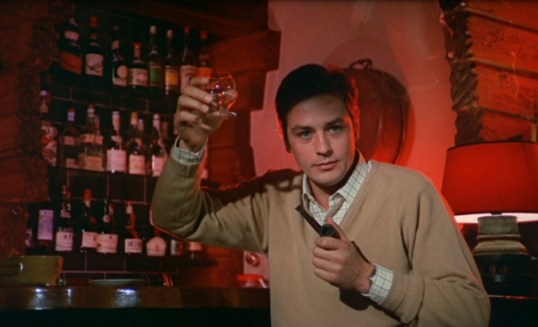
Along the way, Rebecca thinks about her life. She’s married to Roger, who is a mild-mannered teacher who is so ridiculed by his students that even the local gas station attendant mentions how little respect anyone has for him. However, Rebecca is haunted by memories of Daniel (Alain Delon), who is very, very French.
How French? This French.
Rebecca first met Daniel while working in her father’s bookstore and they had a passionate affair, despite the fact that Rebecca was already engaged to boring old Raymond. Daniel even taught her how to ride a motorcycle. When Rebecca got married, Daniel sent her the motorcycle that she is now riding as a wedding gift. Rebecca is racing through Germany to be reunited Daniel, though it’s never quite clear if she’s truly leaving her husband or if she just wants to have a quick tryst before returning home. Will Rebecca make it or will the unpredictable whims of fate intervene?
The Girl on a Motorcycle was directed by Jack Cardiff, a veteran cinematographer who first found acclaim working with directors like Michael Powell, Alfred Hitchcock, and John Huston. Not surprisingly, the film is full of striking shots. Unfortunately, Cardiff was 54 when he directed The Girl On A Motorcycle and he had been involved in the film industry since he was a child. Watching the film, one gets the feeling that Cardiff was trying a bit too had to appeal to a young counterculture audience that he didn’t really have much of a natural affinity for. As such, Cardiff drags out every psychedelic trick in the book. Do you want excessive use of the zoom lens, ludicrously skewed camera angles, pointlessly surreal flashbacks, portentous narration, extreme close-ups, retina-burning solarization effects, and an ending that feels like it was stolen from Godard? The Girl On A Motorcycle has all of them! For every impressive shot of Rebecca riding on her motorcycle, there are several more shots that feel as if they were filmed in migrainevision.
There’s also quite a few shots that make remarkably poor use of rear projection.
The Girl On A Motorcycle is definitely a film of its time. To give credit where credit is due, Alain Delon is handsome and charismatic as the enigmatic Daniel. The viewer gets the feeling that Rebecca is probably idealizing him and assuming that he has more depth than he actually does but it’s still easy to understand why she would not be able to resist the temptation. Marianne Faithfull seems a bit lost as Rebecca. She smiles a lot and she laughs a lot but her inner monologue is flatly delivered and, as a result, the character comes across as being vapid. The ideal Rebecca probably would have been a young Helen Mirren.
As it is, The Girl On A Motorcycle is a time capsule of the 60s aesthetic (albeit an aesthetic translated through the lens of a director who seems to be trying too hard to remain relevant). Due to a few flashes of nudity and some sex scenes that are so psychedelic that they’re nearly impossible to watch, Girl On A Motorcycle was the first film to be slapped with an X rating in the United States. It seems rather tame today.
(Lisa recently discovered that she only has about 8 hours of space left on her DVR! It turns out that she’s been recording movies from July and she just hasn’t gotten around to watching and reviewing them yet. So, once again, Lisa is cleaning out her DVR! She is going to try to watch and review 52 movies by the end of Tuesday, December 6th! Will she make it? Keep checking the site to find out!)
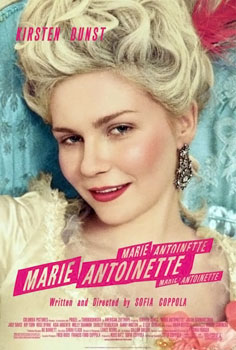
On November 12th, I recorded 2016’s Marie Antoinette off of Starz.
Before I review Marie Antoinette, I think it’s important that you know that I am an unapologetic Sofia Coppola fan. I love every film that she’s made and I look forward to her upcoming remake of The Beguiled. At the same time, I can also understand why some people feel differently. Sofia Coppola’s films are not for everyone. For one thing, almost all of her films deal with rich people. The existential angst of the wealthy and/or famous is not a topic that’s going to fascinate everyone. When you watch a Sofia Coppola film, you never forget that you’re watching a film that’s been directed by someone who largely grew up in the spotlight and who knows what it’s like to have money. An ennui born out of having everything and yet still feeling empty permeates almost every scene that Sofia Coppola has ever directed. (If you have to ask what ennui is, you’ve never experienced it.) Many viewers look at Sofia Coppola’s filmography and they ask themselves, “Why should we care about all these materialistic people?”
However, while Sofia Coppola may not know what’s it’s like to be poor (or even middle class for that matter), she does understand what it’s like to feel lonely. Her filmography could just as easily be called “the cinema of isolation.” It doesn’t matter how much money you may have or how famous you may or may not be, loneliness is a universal condition. A typical Sofia Coppola protagonist is someone who has everything and yet still cannot connect with the rest of the world. More often that not, they turn to excessive consumption in order to fill the void in their life. To me, the ultimate Sofia Coppola image is not, regardless of how much I may love them, Bill Murray and Scarlett Johansson in Lost in Translation. Instead, it’s Stephen Dorff (playing a far less likable version of Bill Murray’s Translation character) standing alone in the desert at the end of Somewhere.
Marie Antoinette, which was Sofia’s follow-up to Lost in Translation, is technically a historical biopic, though it makes little effort to be historical or accurately biographical. Kirsten Dunst plays Marie Antoinette, the final queen of France before the French Revolution. It was Marie Antoinette was accused of dismissing starving French peasants by announcing, “Let them eat cake!” (For the record, it’s probable that Marie Antoinette never said that. It’s certainly never heard in Coppola’s film.)
Marie Antoinette opens with the title character arriving in France at the age of 14. She’s an Austrian princess who has been sent to marry the future king of France, Louis XVI (Jason Schwartzman). From the minute we meet her, Marie Antoinette is portrayed as being a pawn. Her mother arranges the marriage as a way to seal an alliance with France. The king of France (played by Rip Torn) expects Marie Antoinette to get produce an heir to the throne as quickly as possible. Meanwhile, her new husband is an infantile and immature fool who doesn’t even know how to make love. Marie Antoinette finds herself isolated in a strange country, expected to be all things to all people.
And so, Marie Antoinette does what I always do whenever I’m feeling unsure of myself. She hangs out with her girlfriends. She throws expensive parties. She gambles. She flirts. She shops. She has fun, regardless of whether it’s considered to be proper royal behavior or not. Occasionally, she is warned that she is losing popularity with the French people but she’s not concerned. Why should she be? She doesn’t know anything about the French people. All she knows about is the life that she was born into. She didn’t choose to be born in to wealth and power but, since she was, why shouldn’t she have a good time?
The French Revolution doesn’t occur until near the end of Marie Antoinette and when it does happen, it happens quickly. And yet, the shadow of the revolution hangs over the entire film. We watch the knowledge that neither Marie Antoinette nor her husband possess: eventually, they are both going to be executed. And knowing that, it’s hard not to cheer Marie Antionette on. She may be destined for a tragic end but at least she’s having a little fun before destiny catches up with her.
Kirsten Dunst makes no attempt to come across as being French or Austrian but then again, neither does anyone else in the film. After all, this is a movie where Rip Torn plays the King of France without once trying to disguise his famous Texas accent. Coppola isn’t necessarily going for historical accuracy. Instead, in this film, Marie Antoinette serves as a stand-in for countless modern celebrities. In the end, Marie Antoinette is portrayed as not being much different from Paris Hilton or Kardashian. Meanwhile, the people who eventually show up outside the palace, carrying torches and shouting threats, are the same as the viewers who loudly condemn reality television while obsessively watching every episode of it.
Coppola’s stylized direction results in a film that is both thought-provoking and gorgeous to look at and which is also features several deliberate anachronisms. (In many ways, Marie Antoinette blatantly ridicules the very idea that history can be accurately recreated.) Perhaps because it was following up the beloved Lost In Translation, Marie Antoinette has never got as much praise as it deserves but I think it’s a film that is totally deserving of a reevaluation.
(Sidenote: Fans of Italian horror should keep an eye out for Asia Argento, who has a small but very important supporting role.)
 Through the Shattered Lens