For today’s scene that I love, here is the Mardi Gras sequence from 1969’s Easy Rider. Featuring Peter Fonda, Dennis Hopper, Karen Black, and Toni Basil walking through the streets of New Orleans, this scene was actually filmed during Mardi Gras. Those are real Mardi Gras floats and real Mardi Gras participants staring at the camera. That’s an actual citizen of New Orleans with whom Dennis Hopper appears to have nearly gotten into a fight. Personally, I relate to Toni Basil in this scene. She is having a good time no matter what!
I just love how Toni Basil can’t help but dance, no matter what.
If you can’t get down to New Orleans today (because maybe you have a sprained ankle like me), fear not! Mardi Gras has been immortalized in a number of films. In fact, some have theorized that the whole reason 1969’s Easy Rider was filmed was because Dennis Hopper wanted to go to New Orleans.
The Mardi Gras sequence occurs towards the end of Easy Rider. After a long and eventful journey, Wyatt (Peter Fonda) and Billy (Dennis Hopper) reach New Orleans and experience Mardi Gras with two women that they met at a brothel (Karen Black and Toni Basil). However, the Mardi Gras scenes were actually amongst the first to be shot and Hopper actually filmed several hours of documentary footage of New Orleans’s most famous party. If you watch the footage, you can see bystanders looking directly at the camera. They were not extras hired for the film. They were people on the street who became a part of one of the most important indie films in the history of American cinema. These scenes were shot guerilla style, without permits or, by most reports, any advanced planning.
Hopper also filmed Fonda having an actual bad acid trip. For obvious reasons, Fonda was not happy about being filmed in that condition but he did say, in later interviews, that Hopper made the right decision to include the footage in the film.
For the record, I relate to Toni Basil in this film. She’s having fun and dancing no matter what.
Today is not only the 1st of March. It’s not only Texas Independence Day. It’s not only Zack Snyder’s birthday. It’s not only the day of Texas primaries. It’s not only the day when the State of the Union address is scheduled to be given (yawn!). It’s also Mardi Gras!
What a busy day!
For today’s scene that I love, here is the Mardi Gras/Cemetery sequence from 1969’s Easy Rider. Featuring Peter Fonda, Dennis Hopper, Karen Black, and Toni Basil walking through the streets of New Orleans, this scene was actually filmed during Mardi Gras. Those are real Mardi Gras floats and real Mardi Gras participants staring at the camera. That’s an actual citizen of New Orleans with whom Dennis Hopper appears to have nearly gotten into a fight. And, in the cemetery scene, that was real acid that Peter Fonda took.
Here is today’s scene. The scene is age-restricted so you’ll actually have to click on “watch on YouTube” to see it.
If you don’t want to click on “watch on YouTube,” here is a shorter version that just features the parade without the admittedly disturbing cemetery stuff.
I like how Toni Basil can’t help but dance, no matter what.
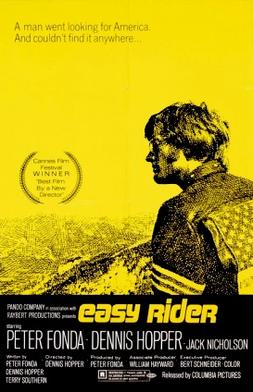
If you are among those who wanted to celebrate Mardi Gras today but couldn’t make it down to New Orleans, fear not! There is a solution to your problem. You can always just watch 1969 counterculture classic, Easy Rider.
Easy Rider features one of the most famous Mardi Gras scenes of all time and adding to the scene’s authenticity is the fact that it was actually shot in New Orleans during the celebration. If you watch the Mardi Gras sequence carefully, you’ll notice that several people on the streets of the French Quarter actually stop and stare directly at the camera. It reminds you that you’re watching a movie but, at the same time, it also reminds you that you’re seeing something authentic. Those weren’t just professional extras pretending to get drunk and glaring at Dennis Hopper and Peter Fonda. Those were people who were actually in the French Quarter for Mardi Gras and who just happened to end up getting included in one of the biggest cult films of all time. If you want to know what Mardi Gras was like in the late 60s, this is the film to watch.
At the same time, after watching Easy Rider, you may be find yourself happy to not be in New Orleans today. As with almost everything else in Easy Rider, Mardi Gras starts out as something exciting and full of promise but it ends as something dark and full of death. One minute, Peter Fonda, Dennis Hopper, Karen Black, and Toni Basil are walking down the streets of New Orleans and having what appears to be a good time. The next thing you know, they’re in a cemetery and Peter Fonda’s sobbing and talking about his mother’s suicide while Toni Basil and Karen Black are freaking out. Of the four of them, only Dennis Hopper appears to not be having a bad trip but then again, Hopper is so naturally spacey in Easy Rider that it’s kind of hard to tell.
The next morning, Fonda and Hopper leave New Orleans on their motorcycles and promptly get blown away by two shotgun-toting rednecks in a pickup truck. It seems a fitting conclusion to a film that celebrates the beauty of the American landscape while, at the same time, suggesting that almost everyone who lives there is a complete and total prick.
Of course, the whole Mardi Gras sequence doesn’t occur until the very end of the film. The majority of the film deals with the journey to New Orleans. Billy (Dennis Hopper) and Wyatt (Peter Fonda) are two motorcycle-riding drug dealers who have just made a small fortune off of selling cocaine to Phil Spector. Billy and Wyatt are heading to New Orleans to celebrate and visit a famous brothel. Wyatt is cool and stoic and always seems to be thinking about something. Billy is Dennis Hopper. Easy Rider is often referred to as being a hippie film but neither Billy nor Wyatt is really a hippie. They’re outsiders and they like to smoke weed but they’re also largely apolitical. They just want to enjoy the open road. If anything, they’re beatniks who were born a year or two too late.
As they ride from California to New Mexico, Billy and Wyatt meet plenty of people along the way. They stop off at a hippie commune and then later, they get harassed by a bunch of rednecks in a diner. The rednecks are menacing while the hippies are annoying. The rednecks throw Wyatt and Billy in jail for “parading without a permit.” The hippies have a mime troupe. The rednecks drive around with shotguns. The hippies try to grow crops in the desert. (I’m enough of a country girl to know that Billy’s right when he scornfully says that nothing that they’re planting is going to actually grow.) The rednecks are ignorant. The hippies are smug. None of them really seem like people that you would want to spend too much time around.
Along the way, Wyatt and Billy temporarily travel with two others. The hitchhiker is played by Luke Askew. We never learn his name but he does play a key role in the film when he gives Wyatt the tab of acid that will eventually ruin Mardi Gras. Meanwhile, George Hanson is an alcoholic lawyer and he’s played by Jack Nicholson. At the time that the film was shot, Nicholson was on the verge of retiring from acting so he could concentrate on directing and writing. He took the role and expected, as almost everyone did, that Easy Rider would just be another biker film. Instead, Easy Rider became a hit and a cultural milestone that not only won Nicholson his first Academy Award nomination but also made him a star.
Interestingly enough, Jack Nicholson is not really that good in Easy Rider. His attempt at a Texas accent is terrible and you never believe him as someone who has never smoked weed before. If anything, Luke Askew gives a far better performance than Nicholson and he actually has more screen time as well. However, I think Nicholson benefited from the fact that George is probably the most likable character in the film. (Depending on how you feel about Billy and Wyatt, you could argue that he’s the only likable character in the film.) He’s not a smug hippie nor is he a murderous redneck. Unlike Wyatt and Billy, he has a job that doesn’t involve selling cocaine to Phil Spector. Whereas Luke Askew’s Hitchhiker seems like the type of guy who would just love to lecture you about why Vietnam is all your fault, George comes across as being a gentle soul. George is a character that viewers can feel safe identifying with, even if Nicholson is never quite convincing as someone so naive that he fears he’ll freak out after taking one hit off of a joint.
Easy Rider‘s critical reputation tends to go up and down, depending on who you’re reading or talking to. There’s a tendency, among many critics, to complain that Fonda acted too little while Hopper acted too much. Personally, I think there’s a lot of hidden wit to be found in Hopper’s performance and I love how annoyed he gets when they’re at the hippie compound. As for Peter Fonda, he may not have been the most expressive actor but he did capture a certain feeling of ennui. For most of the film, it’s hard to tell whether there’s anything actually going on in Wyatt’s head. Then, we follow Wyatt and Billy to that cemetery in New Orleans and we discover that there’s actually quite a bit going on behind Wyatt’s wall of stoicism. After watching Wyatt curse at a statue while sobbing, we understand why he keeps so much hidden.
When it was released in 1969, Easy Rider was a huge box office success and it inspired every major studio to try to duplicate it’s success with a counter culture film of its own. (Hopper was given several million dollars and sent down to Peru to make a follow-up to Easy Rider. The result was The Last Movie, a legendary disaster that temporarily ended Hopper’s career as a director.) Seen today, Easy Rider is undeniably pretentious but always watchable. The scenery is beautiful and the Mardi Gras sequence sets the standard by which all other bad trips should be judged. Most importantly, the film works as a historical document. Everything about it — from the music to the cultural attitudes to even Hopper’s attempts to imitate Jean-Luc Godard in his direction — makes this film into a time capsule. Until they invent a time machine that works, Easy Rider is as close as some of us will ever get to experiencing the end of the 60s.
And finally, it’s the ultimate Mardi Gras film, even if it’s main message seems to be that everyone needs to stay the Hell away from Mardi Gras. Or, at the very least, don’t accept LSD from a scruffy hitchhiker before rolling into New Orleans. Seriously, the more you know….
One of the more surprising things about the 1987 film, The Big Easy, is that there aren’t any big Mardi Gras scenes.
Don’t get me wrong. Several characters in the film mention Mardi Gras, usually in a semi-mocking way. And there is a scene in a warehouse where Ellen Barkin and Ned Beatty walk past some fearsome looking floats which Beatty says are being stored there until Mardi Gras. But that’s pretty much it.
Despite not having any huge Mardi Gras scenes, The Big Easy is essentially a cinematic love letter to New Orleans. (In fact, one could probably argue that the film is so in love with New Orleans that, by not including any big Mardi Gras scenes, the film is saying, “There’s more to this wonderful city than just beads, boobs, and people throwing up i the streets!”) While the film does have a plot — technically, it’s both a romantic comedy and a crime drama — the plot is ultimately less important than the city where it takes place. The Big Easy was shot on location in New Orleans and the camera loves every single street, building, and bridge to be found in the Crescent City. The Big Easy loves the distinctive music and dialect of New Orleans. Even more importantly, The Big Easy loves the attitude of New Orleans. This is perhaps one of the most laid back and nonjudgmental crime films to have ever been made.
Dennis Quaid plays Remy McSwain, a Cajun police detective with a nonstop grin and a cheerfully corrupt nature. Today, we tend to associate Dennis Quaid with playing grim-faced authority figures and serving as the commercial spokesman for Esurance so it’s interesting to see him here, playing a lovable, charismatic, and undeniably sexy rogue. Remy may be corrupt but he doesn’t mean any harm. For the most part, he just takes the occasional bribe and sometimes looks the other way when it comes to certain crimes. He used at least some of the money to put his younger brother through college so really, how can you hold his lack of ethics against him?
Ellen Barkin plays Anne Osborne, a state district attorney who has been sent to New Orleans to investigate allegations of police corruption. Anne is serious about doing her job and exposing corruption. At the same time, she also finds herself falling for Remy, even when she has to prosecute him on charges of taking bribes. It doesn’t take them long to become lovers.
Together, they have great sex and solve crimes!
Actually, in this case, they really do. The film opens with the murder of a local mafia boss. (“We call them wise guys,” Remy says, at one point.) When more drug dealers start to turn up dead, Remy’s boss, Captain Kellom (Ned Beatty), suspects that a gang war has broken out. (Two of the drug dealers are found with their hearts missing from their bodies, which leads to a lot of talk about how one of the city’s biggest drug kingpins is into voodoo. It’s not a New Orleans films without a little voodoo.) Remy, however, has reason to believe that the murderers could be cops!
As I said before, the film’s plot is less important than the city where it takes place and the people who live in that city. Director Jim McBride and screenwriter Daniel Petrie, Jr. do a good enough job with the crime plot but it’s obvious that they’re most interested in taking Remy and Anne and surrounding them with a host of eccentric, identifiable New Orleans characters. As a result, the film is full of memorable performances from character performers like Ned Beatty, John Goodman, Lisa Jane Persky, and Grace Zabriskie. Even Jim Garrison, the former New Orleans district attorney whose attempt to frame an innocent man for the murder of John F. Kennedy inspired Oliver Stone’s JFK, makes an appearance as himself.
Even without any big Mardi Gras scenes, The Big Easy is an entertainingly laid back tribute to New Orleans.
Are you currently heading to New Orleans for Mardi Gras? Or are you already in New Orleans, getting drunk and dreaming about how many beads you’ll end up with by the end of Tuesday night? If that’s the case, have fun but be careful. New Orleans is a town that’s full of ghosts and voodoo.
At least, that’s what the movies would have you believe. Whenever you see a horror film that’s set in New Orleans, you know that voodoo is going to somehow play into it. The other thing that you can usually count on is that there will be at least one scene set during Mardi Gras. Really, that’s not surprising. Mardi Gras in New Orleans is not only a great party but it’s also uniquely cinematic in a way that Mardi Gras in Dallas never is.
(Yes, we celebrate Mardi Gras in Dallas. It’s nothing to get too excited about.)
The 2018 film, Gothic Harvest, is all about Mardi Gras and voodoo. When four college students head down to New Orleans for the party of the year, they have no idea that they’re about to get sucked into a centuries old curse. When Hope (Abbie Gayle) meets the handsome and enigmatic Gar (Ashley Hamilton, who also directed the film), she goes off with him without bothering to tell her friends where she’s going. That turns out to be a mistake because it turns out that Gar is a member of a cursed family. The family is immortal but that immortality comes with a price. Every year, they have to find and sacrifice a young woman in order to stay alive. It’s all because the family, centuries ago, ran afoul the queen of New Orleans voodoo, Marie Laveau (Janee Michelle).
Hope’s friends are concerned about her disappearance but they can’t get anyone to help them out. After all, it’s Mardi Gras and the entire city is full of people who are probably going to wake up in a strange bed with a hangover on Wednesday morning. However, Hope’s friends do eventually run into an undercover cop named Detective Hollis (Bill Moseley). Hollis has an impressive beard and brags about how his favorite band is Pantera. He seems to be a bit strange but he agrees to help the girls look for Hope.
Hope, meanwhile, has now met the cursed and immortal Boudine family and, not surprisingly, they’re an interesting group of characters. What distinguished them from other cursed immortals is that they all seem to be hate being stuck with each other but they hate the idea of dying even more. So, they keep doing what they have to do even though it makes them all miserable. The family matriarch is Griselda (Lin Shayne) while her daughter, Amelia (Sofia Mattson), is a self-styled dominatrix. And then there’s Dolly (Ciara Rizzo), who is obsessed with dolls.
Gothic Harvest is a bit of a strange viewing experience. This was Ashley Hamilton’s directorial debut and the film itself can be confusing upon first viewing. The timeline jumps back and forth, from the past to the present, and it can often be hard to keep track of just who is doing what or why. It’s hard not to feel that the film might have worked better if it had dropped the modern storyline and instead just concentrated on telling the story of how the family came to be cursed. That said, Gothic Harvest does occasionally achieve a dream-like intensity and Hamilton makes good use of New Orleans’s spooky atmosphere. This is a flawed film that doesn’t really work but I would still be interested in seeing what Hamilton directs next.
The cast is a bit of a mixed bag. Hope and her friends are not particularly memorable but Bill Moseley and Lin Shaye are both ideally cast. Moseley, in particular, appears to be having fun and there’s a great scene where he sits in a truck and recites some of the worst pick-up lines ever. Finally, Janee Michelle goes totally over the top as Marie Laveau but that’s exactly the right approach to take to the character. The Queen of New Orleans Voodoo isn’t going to be a quiet or a reserved character.
For those of you celebrating, have fun but use your common sense. If someone says that he needs to sacrifice you so that his family can continue to live forever, don’t go off with him regardless of how many beads he offers.
The 1938 film, Lady Behave!, begins with a woman named Clarice (Patricia Farr) getting ready to go out and celebrate Mardi Gras. Even though Clarice invites her older sister, Paula (Sally Eilers), to come with her, Paula refuses. Paula has work to do at home. It’s pretty obvious that this is the way that it’s always been between the two sisters. Clarice has fun while Paula stays home and waits for her to return.
Fortunately, Clarice does return in the morning. As she tells Paula, she had a great time during Mardi Gras. In fact, she had such a great time that she ended up getting married! She married a wealthy northerner named Stephen Cormack (Neil Hamilton). The only problem is that Clarice is already married! She’s totally forgotten that she only recently became the wife of a dissolute playboy named Michael Andrews (Joseph Schildkraut). By getting married a second time, Clarice has committed bigamy! She could go to prison for 10 years!
Whatever is Paula to do?
Well, what if she arranges for Clarice to leave the country?
What if she tries to bribe Michael into accepting an annulment?
What if Paula goes up to New York and pretends to be Clarice (because, after all, Stephen was pretty drunk when he married her)?
What is she does all three!?
Of course, when Paula goes up to New York, she discovers that Stephen is out of the country. She moves into his mansion, where she discovers that his two children — Patricia (Marcia Mae Jones) and Hank (George Ernest) — are convinced that she’s just a gold digger who only wants to steal their father’s money (and, it should be noted, also their inheritance). When Michael shows up at Stephen’s mansion, he explains to Paula that he needs $10,000 for a horse and he’ll only agree to an annulment if he gets the money. However, when he meets Patricia and Hank, he tells them that if they pay him $30,000, he’ll help to break up the marriage between Stephen and Paula (who, of course, everyone but Michael thinks is actually Clarice).
Eventually, Stephen shows up and he assumes that Paula actually is Clarice. Paula and Stephen quickly fall in love and it turns out that Stephen is very serious about his new marriage. He even wants to take Paula on a honeymoon. Of course, he thinks Paula is Clarice and Paula is freaking out because they’re not actually married but she wishes that they were. But, if they did actually get married, Stephen would be guilty of bigamy and then he’d have to leave the country like Clarice and….
Yes, this is one of those somewhat busy screwball comedies where almost every action is motivated by a misunderstanding and where all of the dialogue is extremely snappy. To be honest, it’s all a bit too hyper. Though the film originally had a running time of 70 minutes, most of the existing prints are only 57 minutes long. This film has a lot of plot for only 57 minutes and it’s often difficult to keep track of what’s happening from one scene to the next. That wouldn’t be a problem if this film starred someone like William Powell and Carole Lombard (or, for that matter, Cary Grant and Myrna Loy) but instead, this film features Sally Eilers and Neil Hamilton, who are likable performers but not quite likable enough to carry the film over it’s rough edges.
On the plus side, Joseph Schildkraut has some very funny scenes as the flamboyant Michael. And Marcia Mae Jones and George Ernest both do a great work as Stephen’s paranoid children. They consistently made me laugh. Otherwise, Lady Behave! is a bit too frantic for its own good.