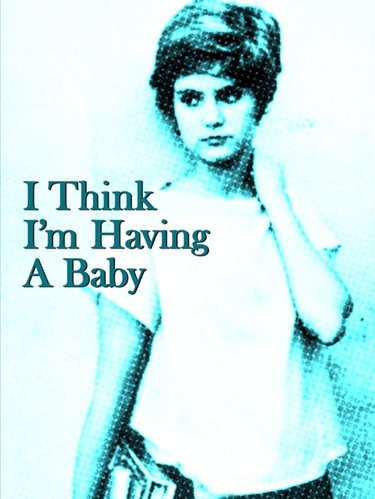
Poor Jennifer Jason Leigh!
Seriously, whenever you watch any of the movies that Leigh made early in her career, your heart just goes out for. She was always either getting stalked or getting abused or getting lost or struggling through a pregnancy scare. In Fast Times At Ridgemont High, she actually did get pregnant and had to go to the abortion clinic on her own after Mike Damone failed to keep his promise to be there for her. It doesn’t get quite as bad as that for her in 1981’s I Think I’m Having A Baby but she still has to put up with a lot.
In I Think I’m Having A Baby, Jennifer Jason Leigh plays 15 year-old Laurie, who is not only socially awkward but also has the worst haircut that has even been inflected on an otherwise attractive person. Laurie idolizes her older cousin, Phoebe (Helen Hunt). Phoebe is dating a lunkhead jock named Peter (Shawn Stevens). Phoebe does Peter’s homework for him and Peter complains that Phoebe won’t go beyond some mild making out in his car. That’s the kind of relationship that they have. On the night of his birthday, Peter and Phoebe have an argument at the outdoor party that Phoebe went out of her way to set up. Peter drives off in his car, little realizing that the shy Laurie is hiding in the backseat. When Peter notices Laurie there, he pulls over and starts talking about how difficult (cue a massive eye roll from me) his life is. By the end of the night, Peter has revealed himself to be a whiny jerk and Laurie is no longer a virgin.
Soon afterwards, Laurie starts to feel ill. Her nerdy best friend, Marsha (Samantha Paris), thinks that Laurie might have the flu. Laurie, however, fears that it’s definitely not the flu. When Laurie tells Peter that she thinks she might be pregnant, Peter freaks out. He tells her to take care of it and makes it clear that he has no interest in being a father. Marsha says that she can’t understand why anyone would want to have a baby. She announces that she’s never going to have one. Instead, she’ll just adopt a dog. That really doesn’t help out Laurie, though. Eventually, Marsha and Laurie head to the clinic to discover whether or not Laurie is actually pregnant.
Meanwhile, Laurie’s little sister, Carrie (Tracey Gold), makes the mistake of letting her pet rabbits all socialize with each other. Carrie learns a lesson about the importance of keeping a safety barrier between male and female rabbits. At school, the students smirk as Mr. Fenning (David Birney) ties to teach a sexual education class. One of the students is played by future Breakfast Club member Ally Sheedy, making her television acting debut by uttering a handful of lines. The ultimate message is that no one knows anything and all of the education that they’ve gotten so far has been inadequate.
It’s pretty heavy-handed and some of the acting is a bit less than award-worthy. (Samantha Paris shouts nearly every line that she has.) But Jennifer Jason Leigh gives a good performance as Laurie, perfectly capturing not only Laurie’s fear of being pregnant but also the sadness that comes from being painfully shy. Your heart breaks for her when you watch this film. If nothing else, hopefully Laurie realizes, by the time the end credits roll, that she can do far better than Peter. For that matter, so can Phoebe. While everyone has a bright future ahead of them, Peter is destined to spend the rest of his life wondering why he peaked at 17.
And that’s the way it should be.
 Through the Shattered Lens