As some of our regular readers undoubtedly know, I am involved in a few weekly live tweets on twitter. I host #FridayNightFlix every Friday, I co-host #ScarySocial on Saturday, and I am one of the five hosts of #MondayActionMovie! Every week, we get together. We watch a movie. We tweet our way through it.
Tonight, for #ScarySocial, I will be hosting Lucio Fulci’s Manhattan Baby!
If you want to join us on Saturday night, just hop onto twitter, start the film at 9 pm et, and use the #ScarySocial hashtag! The film is available on Prime and Tubi! I’ll be there co-hosting and I imagine some other members of the TSL Crew will be there as well. It’s a friendly group and welcoming of newcomers so don’t be shy!
Manhattan Baby (1982, dir by Lucio Fulci, DP: Guglielmo Mancori)
6 Shots From 6 Films is just what it says it is, 6 shots from 6 of our favorite films. As opposed to the reviews and recaps that we usually post, 6 Shots From 6 Films is all about letting the visuals do the talking.
This October, I am going to be using our 6 Shots From 6 Films feature to pay tribute to some of my favorite horror directors, in alphabetical order! That’s right, we’re going from Argento to Zombie in one month!
Today’s director? The master of Italian horror himself, Lucio Fulci!
6 Shots From 6 Lucio Fulci Films
Zombi 2 (1979, dir by Lucio Fulci, DP: Sergio Salvati)
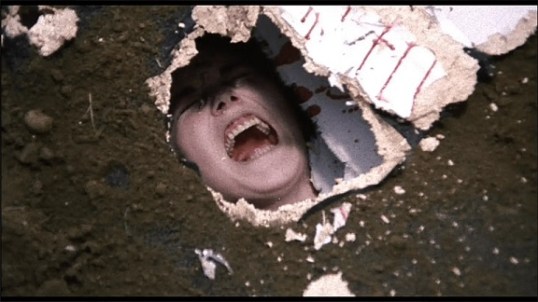
City of the Living Dead (1980, dir by Lucio Fulci, DP: Sergio Salvati)
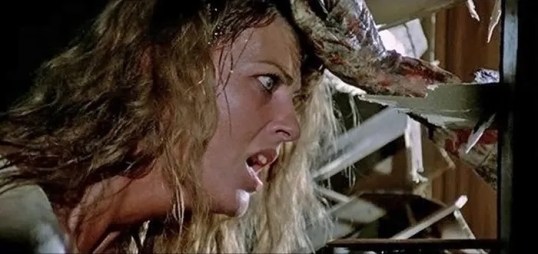
The Beyond (1981, dir by Lucio Fulci, DP: Sergio Salvati)
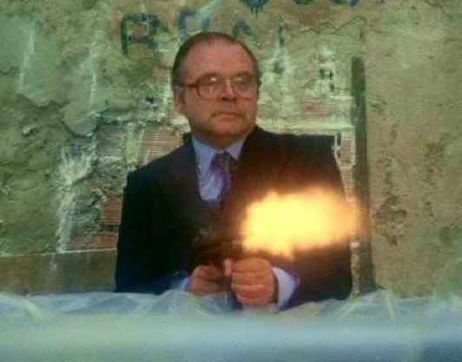
The House By The Cemetery (1981, dir by Lucio Fulci, DP: Sergio Salvati)
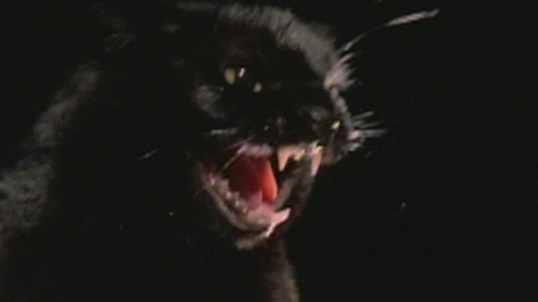
The Black Cat (1981, dir by Lucio Fulci, DP: Sergio Salvati)
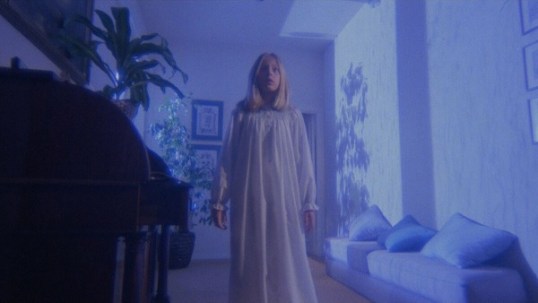
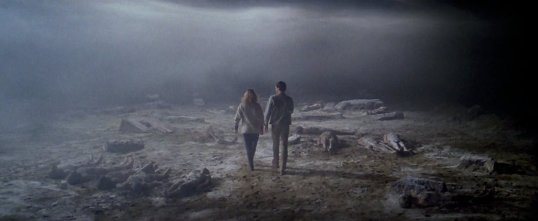
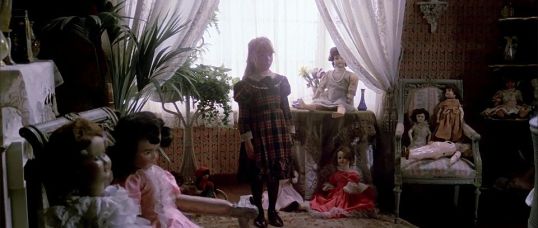
Manhattan Baby (1982, dir by Lucio Fulci, DP: Guglielmo Mancori)
That’s what a friend of mine yelled a few years ago. Jack was a choreographer who had just received a call from someone in New York City, offering him the chance to come work on an off-Broadway show. He accepted, of course and then he hugged everyone who had been standing nearby, listening to the call.
“Manhattan, baby!” he shouted.
Now, the show itself didn’t really work out but Jack did get a trip to Manhattan out of it and really, I think that’s what everyone was excited about. No matter how many bad things you may hear about New York City, it’s hard not to get excited when you hear the word Manhattan. For many, Manhattan represents culture, sophistication, and wealth. For others, Manhattan represents crime, inequity, and alienation. Across the world, Manhattan stands for everything that is both good and bad about America. Just the word Manhattan carries a power to it. You would never get excited if someone announced that they had gotten a job in Minnesota, for instance. If Jack had shouted, “Minnesota, baby!,” we all would have been concerned about him. Minnesota? Who gives a fuck? But Manhattan …. Manhattan has power, baby!
Manhattan also lent its name to one of Lucio Fulci’s post-Zombi films and the title just happened to duplicate Jack’s proclomation, Manhattan Baby. Released in 1982, Manhattan Baby is often cited as being the last of Fulci’s “major” productions. While his career was reinvigorated by the success of the films he made with producer Fabrizio De Angelis (including Zombi 2 and the Beyond trilogy), Fulci and De Angelis had a falling out over Manhattan Baby. Fulci claimed that De Angelis essentially forced him to make the movie, despite the fact that Fulci himself did not have much interest in the script. Initially, the film was to be a special effects spectacluar with a large budget but, after the controversy surrounding Fulci’s The New York Ripper, the budget was drastically scaled back and the special effects were done on the cheap. Fulci later said that he felt the movie was terrible and that it set back his career.
As for what the film is actually about, Manhattan Baby deals with …. well, the plot is not easy to describe. Fulci’s films were always better known for their surreal imagery than their tight plots and, even by his standards, Manhattan Baby is all over the place. The film opens in Egypt, where archeologist George Hacker (Christopher Connelly) is struck blind when he enters a previously unexplored tomb. Meanwhile, his daughter, Susie (Brigitta Boccoli), is given an amulet by another blind woman.
Back in Manhattan, George waits for his sight to return and Susie and her little brother, Tommy (Giovanni Frezza, who played Bob In The House By The Cemetery) start to act weird. It turns out that their bedroom is now some sort of demensional gateway, from which snakes sometimes emerge. At the same time, the gateway occasionally sucks people through and they end up stranded in the Egyptian desert. Why? Who knows? Is Susie possessed or does the gateway operate independently from her? Why does she occasionally glow a weird blue color? Why do she and her brother suddenly seem to hate their nannny (played by Cinzia De Ponti, who was also in The New York Ripper)? It all has something to do with the amulet but the exact details of how it all works seems to change from scene-to-scene. Eventually, it turns out that the owner of the local antique shop knows about the amulet and its evil designs. Unfortunately, all of his stuffed birds come to life and peck his eyes out. Meanwhile, Susie’s parents and her doctors wonder why her latest x-ray seems to indicate that Susie has a cobra living inside of her and….
Like I said, it doesn’t really make any sense and, despite the power of the name, the meaning behind Manhattan Baby as a title is never really explained. In fact, more time is probably spent in Egypt than in Manhattan. It’s easy to assume that the film was called Manhattan Baby because it was felt that the title would appeal to American audiences but, when then the film was released in the U.S., it was actually retitled Eye of the Evil Dead in an attempt to disguise it as being a sequel to Sam Raimi’s classic shocker. (This was actually a common practice as far as the Italian film industry was concerned. Many films were retitled to disguise them as being a sequel. Fulci’s Zombi 2, for instance, recieved that title because, in Europe, Dawn of the Dead was released under the title Zombi.)
One can understand Fulci’s frustration with Manhattan Baby but, at the same time, is it really as bad as he often said it was? Yes, the plot is incoherent but that’s to be expected with a Fulci film. Yes, the special effects are cheap but again, that’s kind of part of the charm when it comes to Italian exploitation films. While Manhattan Baby never duplicates the ominous atmosphere of Zombi 2 or achieves the same sort of surreal grandeur as The Byond trilgoy, there are still enough memorable, if confusing, moments to make it watchable. The sequece where a shot of a man standing in a doorway cuts to a shot of him lying dead in the desert works surprisingly well. The scene where the shop owner is attacked by reanimated birds is both ludiscrous and scary, in the grand Fulci tradition. With their emphasis on foolhardy explorers ignoring curses, the Egyptian scenes feel almost as if they could have been lifted from one of the Hammer mummy films. Manhattan Baby may not be Fulci’s best but it’s hardly his worst.
In fact, with its obsession with blindness, Manhttan Baby is actually one of Fulci’s more personal films. Fulci was diabetic and reportedly lived in fear that he would someday lose his eyesight. Many critics, including me, have suggested that he dealt with this fear by having people lose their eyesight in his movies, often in the most violent ways possible. Manhattan Baby is full of people losing the ability to see. George Hacker is rendered blind in Egypt. The mysterious Egyptain woman hands out amulets to people who she cannot see. The store owner loses his eyes. One of George’s colleagues falls on a bed of spikers and, of course, one spike goes straight through an eye. Manhattan Baby is all about blindness and only be getting rid of the amulet can George hope to once again truly see the world and the people that he loves. If only illness could be tossed away as easily as an amulet.
Despite Fulci’s disdain for the final result, Manhattan Baby is hardly the disaster that it’s often made out to be. Those who aren’t familiar with Fulci’s unique aesthetic will undoubtedly confused by the film but, for those of us who know the man’s work, Manhattan Baby may be a minor Fulci film but it’s still an occasionally intriguing one.
So, in honor of Val’s commitment to her craft, I decided that today’s six trailers would be for six movies that Val either watched or mentioned in her review of The Evil Eye! Unfortunately, it turns out that not all of those movies have trailers on YouTube. And I already shared the trailer for Mario Bava’s The Girl Who Knew Too Much (a.k.a. Evil Eye) last week.
Let’s see what I did find!
Bruka, Queen of Evil (1973)
I could not find a trailer for Queen of Evil. However, when I did a search for “Queen of Evil Trailer,” one of the trailers that came up was for Bruka, Queen of Evil. I’ve never heard of this film before but it looks like something some of our readers would like.
2. Manhattan Baby (1982)
However, YouTube did have a trailer for Lucio Fulci’s Manhattan Baby, which was also known as Evil Eye. Actually, Evil Eye was probably a better title for it. I’m one of the few people willing to defend this film and even I’m unsure just what exactly Manhattan Baby is supposed to mean.
3. The Green Inferno (1988)
Val’s search for information about The Evil Eye led her to Bloody-Disgusting.com, which featured an infamous review of The Green Inferno. Here’s the trailer for 1988’s Green Inferno, which should not be mistaken for Eli Roth’s Green Inferno.
4 Shots From 4 Films is just what it says it is, 4 shots from 4 of our favorite films. As opposed to the reviews and recaps that we usually post, 4 Shots From 4 Films is all about letting the visuals do the talking.
4 Shots From 4 Films
The City of The Living Dead (1980, directed by Lucio Fulci)
The Beyond (1981, dir by Lucio Fulci)
The House By The Cemetery (1981, directed by Lucio Fulci)
Hi. Good morning. I’m sitting here in my beloved Pirates shirt with my hair a big mess and an aggressive kitty trying to dig his claws into my thigh as a sign of affection as I try to complete this thing known as “waking up” but I’m still a happy girl and I’ll tell you why.
First off, we’re only six posts away from hitting that magical 1,000th post. And, once we hit a thousand, Arleigh is going to give us all a 50% raise on our current Shattered Lens salary. Yay! I know I can really use the money as I’m getting ready to go back to school and get my master’s.
This trailer is for the Italian satire/sci-fi film The 10th Victim. As this trailer makes clear, the film’s American distributor wasn’t quite sure how to sell this particular film.
By contrast, the distributors of Chained Heat appear to have known exactly who would be sitting in their audience. Chained Heat has a reputation for being one of the sleaziest of the Women in Prison films and that’s saying something. I actually saw this playing on cable once though I was kinda *ahem* tied up at the time and as such, didn’t pay too much attention to it.
Yeah, I haven’t actually seen this film but I’m going to guess that the trailer is probably more exploitive than the actual film. This is a classic example of the exploitation tease. Also, this is yet another example of a ’70s trailer that makes me go, “Ewwwwww!” at the sight of a dumpy man running around in his man panties. I mean, seriously — ewwwww, 1970s, ewwww!
The title makes it sound like a second-rate Broadway musical but actually, Manhattan Baby was (along with the far better remember New York Ripper) Lucio Fulci’s follow-up to the brilliant Beyond trilogy. I’ve sat through this film a few times and I’m still not sure why it’s called Manhattan Baby. Maybe Fulci was trying to start a trilogy of New York-themed horror films. Maybe The House By The Bronx was meant to be next…
I love movies and I love books so I guess it would stand to reason that I love books about movies the most of all. (I also love movies about books but there are far fewer of those, unfortunately.) Below are my personal favorites. I’m not necessarily saying that these are the ten greatest film books ever written. I’m just saying that they’re the ones that I’m always happy to know are waiting for me at home.
10) Soon To Be A Major Motion Pictureby Theodore Gershuny — This is one of the great finds of mine my life. I found this in a used bookstore and I bought it mostly because it only cost a dollar. Only later did I discover that I had found one of the greatest nonfiction books about the shooting of a movie ever written! Gershuny was present during the filming of a movie called Rosebud in the early 70s. I’ve never seen Rosebud but, as Gershuny admits, it was a critical disaster that managed to lose a ton of money. The book provides a fascinating wealth of backstage gossip as well as memorable portraits of director Otto Preminger and actors Robert Mitchum (who was originally cast in the lead role), Peter O’Toole (who took over after Mitchum walked off the set), and Isabelle Huppert. If nothing else, this book should be read for the scene where O’Toole beats up critic Kenneth Tynan.
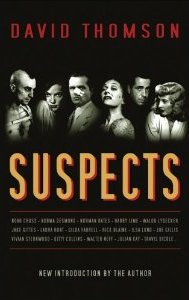
9) Suspectsby David Thomson — A study of American cinema noir disguised as a novel, Suspects imagines what would happen if George Bailey from It’s a Wonderful Life fell in love with Laura from the movie of the same name. Well, apparently it would lead to Sunset Boulevard’s Norma Desmond having an affair with Chinatown’s Noah Cross and to one of George’s sons, sensitive little Travis, getting a job in New York City as a Taxi Driver. And that’s just a small sampling of what happens in this glorious mindfuck of a novel.
8 ) Profondo Argentoby Alan Jones — Long-time fan Alan Jones examines each of Dario Argento’s films (even Argento’s obscure historical comedy The Five Days of Milan) and proceeds to celebrate and (in many cases) defend Argento’s career. Jones also interviews and profiles several of Argento’s most frequent collaborators — Daria Nicolodi, Asia and Fiore Argento, Simon Boswell, Claudio Simonetti, Keith Emerson, George Romero, Lamberto Bava, Michele Soavi, and many others. Jones’ sympathetic yet humorous profile of Luigi Cozzi is priceless.
7) Spaghetti Nightmaresby Luca Palmerini — Spaghetti Nightmares is a collection of interviews conducted with such Italian filmmakers as Dario Argento, Ruggero Deodato, Umberto Lenzi, Lucio Fulci, and others. Among the non-Italians interviewed are Tom Savini (who, as always, comes across as appealingly unhinged) and David Warbeck. (Sadly, both Warbeck and Fulci would die shortly after being interviewed.) What makes this interesting is that, for once, Argento, Fulci, et al. are actually being interviewed by a fellow countryman as opposed to an American accompanied by a translator. As such, the subsequent interviews turn out to be some of the most revealing on record.
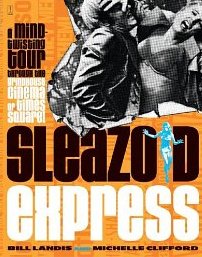
6) Sleazoid Expressby Bill Landis and Michelle Clifford — Landis and Clifford’s book is both a history and a defense of the old grindhouse theaters of New York City. Along with describing, in loving and memorable detail, some of New York’s most infamous grindhouses, they also write about some of the more popular movies to play at each theater. Along the way, they also offer up revealing profiles of such legendary figures as David Hess and Mike and Roberta Findley. Reading this book truly made me mourn the fact that if I ever did find myself in New York City, I won’t be able to hit the old grindhouse circuit.
5) Beyond Terror: The Films of Lucio Fulciby Stephen Thrower — Fulci has always been a terribly underrated director and, indeed, it’s easy to understand because, in many ways, he made movies with the specific aim of alienating and outraging his audience. It requires a brave soul to take Fulci on his own terms and fortunately, Stephen Thrower appears to be one. Along with the expected chapters on Fulci’s Beyond Trilogy and on Zombi 2, Thrower also devotes a lot of space to Fulci’s lesser known works. Did you know, for instance, that before he became the godfather of gore, Fulci specialized in making comedies? Or that he also directed two very popular adaptations of White Fang? Thrower also examines Fulci’s often forgotten westerns as well as his postapocalyptic sci-fi films. And, best of all, Thrower offers up a defense of the infamous New York Ripper that, when I read it, actually forced me to consider that oft-maligned film in a new light. That said, Thrower does admit to being as confused by Manhattan Baby as everyone else.
4) Immoral Talesby Cathal Tohill and Pete Toombs — Tohill and Toombs offer an overview of European “shock” cinema and some of the genre’s better known masters. The book contains perhaps the best critical examination of the work of Jean Rollin ever written. The authors also examine the work of Jesus Franco and several others. This is a great book that reminds us that the Italians aren’t the only ones who can make a great exploitation film.
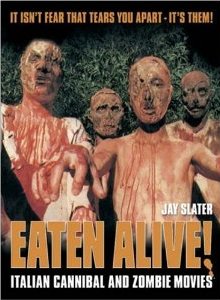
3) Eaten Aliveby Jay Slater — This book offers an overview of the Italian film industry’s legendary cannibal and zombie boom. Along with reviewing every Italian movie to feature even the slightest hint of cannibalism or the living dead (this is one of the few books on Italian cinema that discusses both Pasolini and Lucio Fulci as equals), Eaten Alive also features some very revealing interviews with such iconic figures as Catriona MacColl, Ian McCullough, and especially Giovanni Lombardo Radice. Radice, in fact, also contributes a memorable “guest” review of one of the movies featured in the book. (“What a piece of shit!” the review begins.) Memorable reviews are also contributed by Troma film founder Lloyd Kaufman who brilliantly (and correctly) argues that Cannibal Holocaust is one of the greatest films ever made and Ramsey Campbell who hilariously destroys Umberto Lenzi’s infamous Nightmare City.
2) The Book of the Deadby Jamie Russell — If, like all good people, you love zombies then you simply must do whatever it takes to own a copy of this book. Starting with such early masterpieces as White Zombie and I Walked With A Zombie, Russell proceeds to cover every subsequent zombie film up through George Romero’s Land of the Dead. Russell offers up some of the best commentaries ever written on Romero’s Dead films, Fuci’s Beyond Trilogy, Rollin’s Living Dead Girl, and Spain’s Blind Dead films. The pièce de résistance, however, is an appendix where Russell describes and reviews literally ever zombie film ever made.
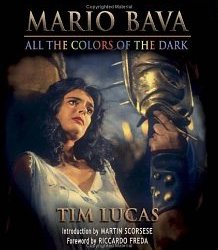
1) All The Colors Of the Darkby Tim Lucas — This is it. This is the Holy Grail of All Film Books. If you’ve ever asked yourself if any book is worth paying close to 300 dollars, now you have your answer. This one is. Tim Lucas offers up the most complete biography of director Mario Bava ever written. In fact, this may be the most complete biography of any director ever written! Lucas examines not only Bava’s life but also every single movie that Bava was ever in any way connected to, whether as a director or as a cameraman or as the guy in charge of the special effects. This is 1,128 pages all devoted to nothing but the movies. This is the type of book that makes me thankful to be alive and I owe a huge debt of gratitude to Tim Lucas for writing it.



 Through the Shattered Lens