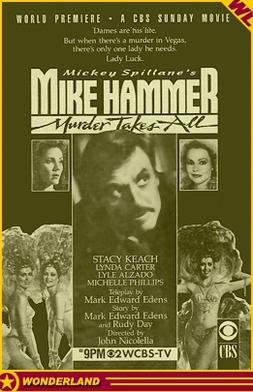
Mike Hammer: Murder Takes All (1989, directed by John Nicollela)


Entertainer Johnny Roman (Ed Winter, best-known as the crazed Colonel Flagg on M*A*S*H) sends an invitation to New York P.I. Mike Hammer (Stacy Keach), asking him to come to Vegas for a job.  Hammer refuses.  Vegas is not for him.  He’s pure New York.  So, someone has Hammer abducted and thrown out of an airplane over Vegas.  Luckily, they gave Hammer a parachute.  Unluckily, for them, Hammer is now in Las Vegas and he’s pissed off.

Johnny, who says he had nothing to do with the kidnapping and just wants Hammer to help him deal with a singer who has been stealing from him, is killed by an explosive device while hosting a telethon.  Everyone suspects Hammer.  When the singer that Hammer was supposed to investigate also turns up dead, Hammer is again suspected.  Hammer has to clear his name while dealing with guest stars ranging from Lynda Carter to Michelle Phillips to Jim Carrey.

Stacy Keach was Mike Hammer for most of the 80s, playing Mickey Spillane’s notorious detective in a television series and in several made-for-TV movies, like this one.  Television was an awkward fit for Mike Hammer, or at least Hammer the way he was imagined in the books.  Mike Hammer was written to be a killer with his own brand of justice.  He was not written to be a nice person.  Instead, he was the brutal but intelligent warrior that you hoped would be on your side.  The television version of Mike Hammer was considered to be violent for the era but the show still toned down Hammer’s signature brutality.  Keach’s Hammer still killed people but he no longer gloated about it.  Stacy Keach, with his trademark intensity, was a good pick for Mike Hammer, even if the show’s scripts often let him down.

This movie is hamstrung by the fact that it was made-for-TV.  Hammer is not happy about being in Las Vegas but he can’t go off on the city in the same way that he would have in one of Mickey Spillane’s novels.  Keach still gives a good and tough performance as Hammer, getting as close to the character as anyone could under the restrictions of 80s network television.  The mystery is interesting, though Hammer doesn’t really solve it as much as he just waits until all the other suspects have been killed.  The main attraction of this one is the amount of guest stars who show up.  Lynda Carter is a great femme fatale and it’s always good to see Michelle Phillips, even in a small role.  Jim Carrey, in his pre-In Living Color days, plays an accountant and does okay with a serious role.

Who could play Mike Hammer today?  It’s hard to say.  There aren’t many believably tough actors around anymore and even those who do seem like they could hold their own in a fight don’t have the gritty world-weariness that the character requires.  (Just try to imagine Dwayne Johnson reenacting the end of I, the Jury.)  A few years ago, I would have said Frank Grillo.  In the 90s, Bruce Willis would have been the perfect Hammer.  Today, though, Mike Hammer’s time may finally have passed.

Retro Television Reviews: When Friendship Kills (dir by James A. Conter)


Welcome to Retro Television Reviews, a feature where we review some of our favorite and least favorite shows of the past!  On Sundays, I will be reviewing the made-for-television movies that used to be a primetime mainstay.  Today’s film is 1996’s When Friendship Kills!  It  can be viewed on YouTube!

After the divorce of her parents, Lexi Archer (Katie Wright) moves to Seattle with her mother (Lynda Carter).  Lexi is having a tough time adjusting to the divorce, especially since her father (Josh Taylor) is convinced that he’s a better parent than Lexi’s mother has ever been.  Still, Lexi is hoping to make a good impression at her new high school and she gets off to an effective start by not only winning a spot on the school’s volleyball team but by also becoming friends with the most popular girl in school, Jen Harnsberger (Marley Shelton).

The wealthy Jen is a straight-A student and a star volleyball player and she appears to have a very bright future ahead of her.  Jen not only shows Lexi around the high school but she also shows Jen that one way to eat without gaining weight is to throw up after every meal.  Jen is bulimic and soon, Lexi is anorexic.  Eventually, Lexi is collapsing on the volleyball court and Jen is angrily denying that she has a problem and the whole things leads to tragedy.

Obviously, eating disorders are a serious issue and When Friendship Kills is honest about not only the pressures that lead to so many girls and women developing body image issues but it also deals with the danger of having a relapse.  Growing up attending dance classes, I met and hung out with a lot of girls who had “tricks” for keeping their weight down and I recognized all of them in the characters of Jen and Lexi.  This film hits all of the usual plot points that we’ve come to expect from 90s films about eating disorders, from the volleyball coach saying that the already thin Lexi needs to lose weight to the scenes of Lexi staring in the mirror and seeing a distorted version of herself to Lexi’s father demanding that a feeding tube be used on his daughter, regardless of what Lexi’s mother might think.

That said, many viewers will find the most interesting thing about this movie to be that it features an early performance from Ryan Reynolds.  Reynolds plays the role of Ben, a friendly jock who asks Lexi out on a date.  Reynolds doesn’t do much in the film but he does show some hints of the amiable goofiness that would later become his trademark.  If one wanted to view this film as being a part of a Deadpool origin story, they certainly could.

As well, Lochlyn Munro also appears in the film!  It’s not really a melodramatic made-for-television movie unless Lochlyn Munro has a role.  In this particular film, Munro played a sleazy photographer who approached Jen and told her that she had the perfect look to be a model and invited her back to his studio.  Of course, when Jen brought Lexi to the studio with her, the photographer rather rudely announced that Lexi didn’t have the right look to be a model.  This led to Lexi refusing to eat and becoming hollow-eyed and skeletal and Katie Wright, it must be said, did a wonderful job portraying Lexi’s transformation from being hopeful to being haunted by her own self-image.  Marley Shelton did an equally good job of portraying Jen’s more cheerful style of self-destruction.

When Friendship Kills is an effective if predictable eating disorder film.  The film originally aired under the title A Secret Between Friends, which is a far more honest title than the over-the-top When Friendship Kills.  Friendship does not kill in this movie but self-starvation does.

Horror on the Lens: Hotline (dir by Jerry Jameson)


Yay!  Brianne O’Neill (Lynda Carter) has a got a new job, working at a crisis hotline!

Boooo!  The serial called known as the Barber is now obsessed with calling her!

The Barber is known as the Barber because he cuts his victims’s hair before killing them, which as far as I’m concerned, make him even worse than a normal serial killer.  You have to wonder if he resents being known as the Barber as opposed to The Stylist.

Anyway, it’s up to Brianne to figure out why The Barber keeps calling her and to hopefully discover his identity.  For whatever reason, no one else seems to be that concerned about it.

That’s the plot of Hotline, a 1982 made-for-TV movie that is today’s horror on the lens.  It’s not a bad film, though it does inspire a certain amount of snarkiness while you’re watching it.  For the most part, though, it’s well-acted and effectively directed.  If you’ve got 95 minutes to kill, why not kill them with Lynda Carter, The Barber, and Frank Stallone?

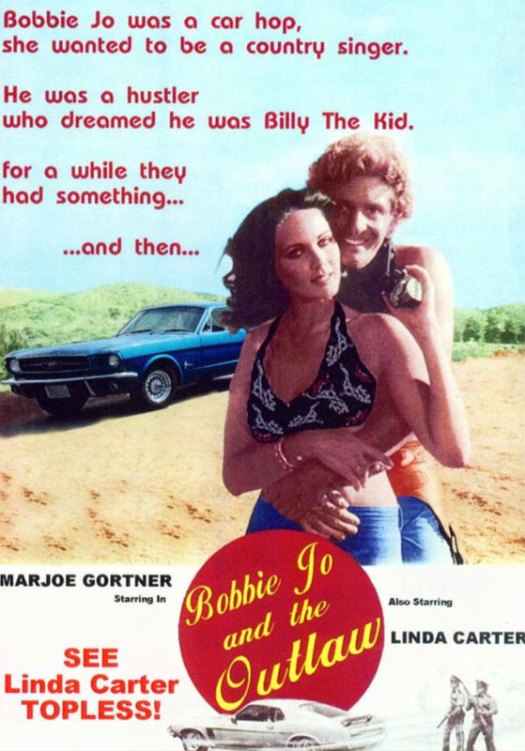
Existential Exploitation: BOBBIE JO & THE OUTLAW (AIP 1976)


gary loggins's avatarcracked rear viewer

I discussed filmmaker Vernon Zimmerman in a post on his UNHOLY ROLLERS back in January. Zimmerman wrote the script (but did not direct) for 1976’s BOBBIE JO & THE OUTLAW, which on the surface is just another sex’n’violence laden redneck exploitation film. Yet after a recent viewing, it seemed to me Zimmerman was not just delving into exploitation, but exploring something more: disaffected youth, gun culture, the cult of personality, and violence in America, themes that still resonate today.

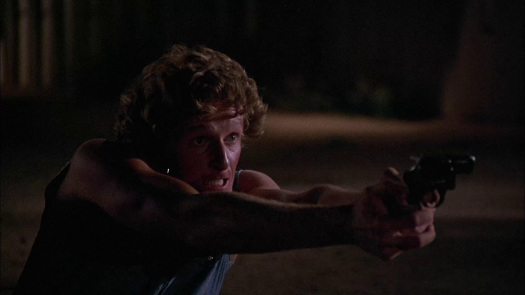
Former child evangelist turned rock star turned actor Marjoe Gortner is Lyle Wheeler, a drifter who enters quick draw contests and idolizes Billy the Kid. Lyle’s a hustler, as we find out as he pulls into a gas station and steals a Mustang from a travelling salesman. Lyle outruns a police car hot on his tail, causing the cop to go off the road, and revs into the next town, where…

View original post 458 more words