Welcome to Retro Television Reviews, a feature where we review some of our favorite and least favorite shows of the past! On Thursdays, I will be reviewing Jennifer Slept Here, which aired on NBC in 1983 and 1984. The entire show is currently streaming on YouTube!

This week, the afterlife of film star Jennifer Farrell continues as a Hollywood production company comes to the house to shoot a scene for their Jennifer biopic!
Episode 1.2 “Jennifer: The Movie”
(Dir by John Bowab, originally aired on October 28th, 1983)
The second episode of Jennifer Slept Here opens with ghostly Jennifer in a good mood. A movie is being made about her life and Joey has somehow gotten a hold of the script. Jennifer reads the script and announces that the movie is going to be the “great biopic since Gandhi! And I look a lot better under a sheet!”
(The audience loves that line.)
Jennifer’s main concern is who is going to be play her in the movie and, at her insistence, Joey asks his parents. Since his parents are wacky sitcom parents, it takes them forever to finally reveal that not only is Jennifer going to be played by Sheila Drake (Lynnda Ferguson) but that a scene from the movie is going to be filmed at the house. Jennifer is not a fan of Sheila Drake’s and she takes out her annoyance by playing the piano. When his mother comes in the room to see who is so beautifully playing the piano, Joey is forced to pretend to be a talented musical prodigy.
Later, Jennifer is super-excited when the film crew shows up at the house to shoot a scene in which she talks to a producer. This actually leads to a rather poignant moment in which Jennifer tries to talk to a few familiar members of the crew, just to be reminded that she’s dead and they can no longer hear her. (When I say that the scene is poignant, it’s almost all totally due to the performance of Ann Jillian.)
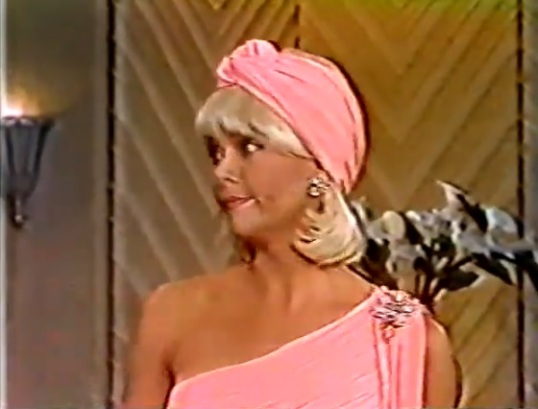
However, Jennifer is not amused when she discovers that Sheila is planning on playing her as a “cheap tramp” who slept her way to the top. Jennifer goes out of her way to disrupt filming, first by unplugging a power chord and then, after Sheila has gone up to Joey’s room to wait while the next scene is set up, spraying Sheila with water and then ripping off Sheila’s skirt. Because Joey is in the room at the time, he gets blamed for both of these incidents. So, I guess Joey’s going to jail and get booked on assault charges now, right? Nope. Instead, Sheila just walks off the picture.
The director (Luis Avalos) is freaking out because he’s got “a six million dollar picture” and no star when suddenly, Joey’s mom announces that there’s someone that the director should see. The director says he doesn’t want to see anyone but then, Jennifer comes walking down the stairs. AND EVERYONE CAN SEE HER!
It turns out that Jennifer has the ability to be seen when she wants to be seen. She convinces the crew that she’s Sheila’s stand-in and then she shoots the scene the way that it really happened, revealing that she was a hard-worker who earned her roles with her talent. Unfortunately, when the scene is later watched by the family, it turns out that the stand-in does not appear on camera. (Instead, just as in The Invisible Man, the camera just picks up Jennifer’s dress moving around on its own.) The family assumes that it was a problem with the camera while only Joey knows that it’s because Jennifer’s a ghost.
Accompanied by Jennifer (who is once again invisible to everyone but him), Joey heads down to a snooty restaurant where he confronts Sheila and, with Jennifer’s help, blackmails her to return to the film. Joey threatens to reveal that Sheila steals her wardrobe from her movies and that she once spent a night in Madrid with a soccer team. If I was Sheila, I would reply by calling the police and telling them that Joey was in the room when I was sprayed with water and had my skirt ripped off. But apparently, everyone’s moved on from that.
Sheila returns to the film and shoots the scene, this time the way that it actually happened. Jennifer wipes away a tear. Awwwww!
Hey, this isn’t actually was not a bad episode. It was certainly an improvement over the pilot and Ann Jillian did a great job playing up both Jennifer’s pride in her career and her anger that her accomplishments were being denigrated by a lesser actress. The supporting characters continue to be the show’s biggest weakness but this episode largely worked, even if it never really made sense for the director to be okay with the family hanging out at the house while they were shooting the film.
Next week: Joey and his loser friend Marc both want to date the same girl!

 Through the Shattered Lens