Film Review: Lucy and Desi (dir by Amy Poehler)


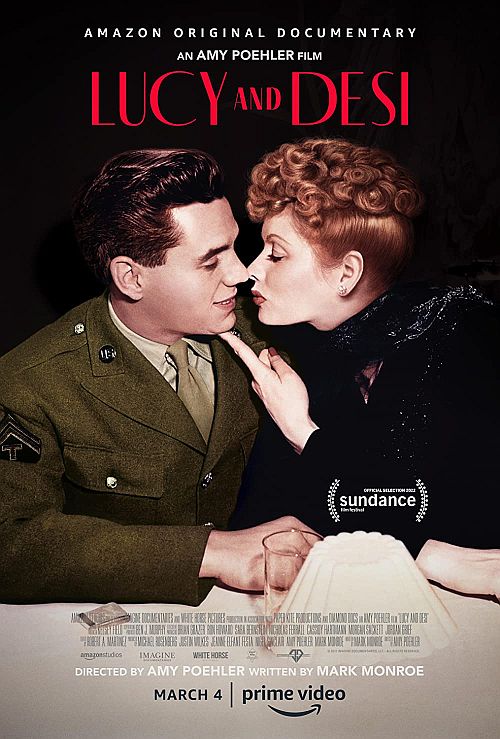
If you were as disappointed with Being the Ricardos as I was but you still want to learn something about the lives and the marriage of Lucille Ball and Desi Arnaz, might I suggest checking out Lucy and Desi?

Directed by Amy Poehler, Lucy and Desi covers much of the same material as Being the Ricardos but it does so in a far more authentic way.  This is because Lucy and Desi is a documentary, one featuring actual interviews and recordings from Lucy, Desi, and the people who worked with them through the years.  As a result, we get to hear the story in their own words as opposed to Aaron Sorkin’s words.  I’m hardly the first person to point out that Aaron Sorkin is incapable of writing dialogue that doesn’t sound like something that Aaron Sorkin himself would say.  In Being the Ricardos, Lucy and her writers all spoke in Sorkinese and it all felt rather false.  Watching Lucy and Desi, you quickly realize that both Lucy and Desi were intelligent and articulate people.  Their own words are strong enough, without needing a polish from a screenwriter who, by his own admission, never found I Love Lucy to be all that funny.

Lucy and Desi covers the early lives of both Lucy and Desi as well as detailing how they first met, how they married, and how they went on to revolutionize television with I Love Lucy.  More than just being portrayed as being a talented but somewhat volatile couple, both Lucy and Desi emerges as fascinating individuals in their own right.  Both of them survived childhood difficulties, both of them remade themselves in Hollywood, and, most importantly, both of them had an instinctive understanding of what audiences wanted to see.

They were also very much in love, even after their divorce.  That love was missing from Being the Ricardos but it’s very much present in Lucy and Desi.  It was that love that led to the marriage that led to the partnership that made them a success but it was that same success that eventually led to the end of their marriage.  And yet, even after divorcing, Lucy and Desi remained close.  Their daughter, Lucie Arnaz, talks about the last few times that Lucy saw Desi before Desi’s succumbed to lung cancer.  They watched old episodes of I Love Lucy and they laughed together.  It’s an incredibly touching moment.

And if sentimentality isn’t your thing, Lucy and Desi also explores just how important their partnership was to the development of modern television.  I Love Lucy was the first “modern” sitcom but their company, Desilu Productions, had a hand in producing several other classic shows as well.  Star Trek was a Desilu production.  So were Mission Impossible and The Untouchables.  So much of what we take for granted about pop culture started with Lucy and Desi.

Perhaps the most shocking revelation in the Lucy and Desi documentary is that the J. Edgar Hoover story was true!  You may remember that, when I reviewed Being the Ricardos, I scoffed at the scene where Hoover called the studio and personally cleared Lucy of being a communist.  But apparently, this actually did happen!  I’m as stunned as anyone.

Lucy and Desi is a good and heartfelt tribute to Lucy and Desi, their talent and their love and their lasting influence.  It can be viewed on Prime.
Structural Failure: THE BIG STREET (RKO 1942)


gary loggins's avatarcracked rear viewer

When I hear the word “Runyonesque”, I think about racetrack touts, colorful Broadway denizens, dames with hearts of gold, and the like. If you want to make a Runyonesque movie, what better way than to have author Damon Runyon himself produce it, as RKO did for 1942’s THE BIG STREET. All the elements are there, the jargon, the characters, but the film suffers from abrupt shifts in tone from comedy to drama, and a totally unpleasant role for Lucille Ball . The result is an uneven movie with a real downer of an ending.

Based on Runyon’s short story “Little Pinks”, it follows the unrequited love of bus boy Augustus “Little Pinks” Pinkerton for torch singing gold digger Gloria Lyons, dubbed “Her Highness” by Pinks. Henry Fonda plays Pinks as  lovestruck, spineless sad sack, dubbing Lucy Her Highness, even though she’s thoroughly rotten to him. When she’s smacked by her gangster boyfriend Case Ables ( Barton MacLane )…

View original post 380 more words

Happy Birthday Lucille Ball: THE DARK CORNER (20th Century Fox 1946)


gary loggins's avatarcracked rear viewer

corner1

Having grown up on endless reruns of I LOVE LUCY (and her subsequent variations on the Lucy Ricardo character), I’m not used to watching Lucille Ball in a dramatic role. In fact, I think the 1985 TV movie STONE PILLOW is the only time I’ve seen her play it straight until I recently watched THE DARK CORNER on TCM, a minor but enjoyable noir with Lucy headlining a good cast in a story about a private eye framed for murder. And since today marks the 105th anniversary of the redhead’s birth, now’s as good a time as any to look back on this unheralded hardboiled tale.

corner2

Lucy, looking mighty sexy at age 35, plays Kathleen Stewart, secretary to PI Bradford Galt, recently relocated to The Big Apple. He’s got a secret past that’s dogging him, and a shady man in a white suit following him. Galt confronts the tail, who claims to be…

View original post 588 more words

Cleaning Out The DVR #35: Stage Door (dir by Gregory La Cava)


(For those following at home, Lisa is attempting to clean out her DVR by watching and reviewing 38 films by the end of today!!!!!  Will she make it?  Keep following the site to find out!)

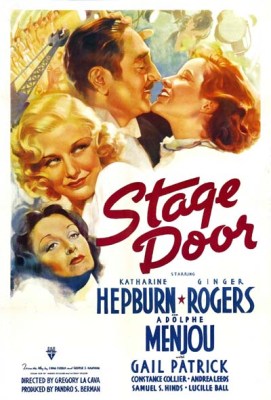
Stage_Door_(1937)

The 1937 film Stage Door is a great example of a unique genre of American film, the Katharine Hepburn Gets Humbled genre.

In the 1930s, Katharine Hepburn went through a period of time where she was considered to be “box office poison.”  She was undeniably talented but it was obvious that the studios weren’t sure how to showcase that talent.  They put her in high-brow films that often did not have much appeal to audiences.  As well, the press hated her.  Katharine Hepburn was outspoken, she was confident, she was a nonconformist, and, too many, her refusal to do interviews and sign autographs marked her as a snob.  Very few people wanted to see a movie starring Katharine Hepburn and therefore, very few people were willing to make a movie starring Katharine Hepburn.

(Interestingly enough, as I sit here typing this, another KH — Katharine Heigl — is pretty much in the exact same situation, with the main difference being that Hepburn was a far more interesting actress.)

Fortunately, Katharine Hepburn was smart enough to recognize the problem and she started to appear in films like Stage Door.  In Stage Door, she essentially played a character who mirrored the public’s perception of her.  Terry Randall is a snobbish and pretentious aspiring actress who comes to New York to pursue her career and moves into a theatrical rooming house.  At first, her attitude makes her unpopular with the other actresses living in the house.  But, as the film progresses, Terry slowly starts to let down her defenses and reveals that she’s just as insecure, neurotic, and vulnerable as everyone else.  She also proves herself to be willing to stand up to manipulative producers and condescending directors.  When she’s cast in her first Broadway show, it turns out that the show is being financed by her father and his hope is that she’ll do such a bad job and be so humiliated that she’ll give up acting.  And, at first, it appears that Terry will be terrible.  During rehearsals, she is stiff and mannered.  (Hepburn was actually quite brave to portray Terry as being such a believably bad actress.)

Of course, Terry isn’t the only actress at the rooming house who has issues to deal with.  For instance, Judy Canfield (Lucille Ball) has to choose between pursuing her career or getting married and starting a family.  Kay (Andrea Leeds) is a once successful actress who is now struggling to find roles, can’t pay her bills, and has become suicidal as a result.  And then there’s Jean (Ginger Rogers), Terry’s cynical roommate and frequent enemy and occasional friend.  Jean is falling in love with Anthony Powell (Adolphe Menjou), the lecherous producer of Terry’s play.

Stage Door is a wonderfully entertaining mix of melodrama and comedy.  You’ll laugh, you’ll cry, and you’ll really find yourself hoping that all of the actresses at the rooming house will have their dreams come true.  While the film is dominated by Hepburn and Rogers, it truly is an ensemble piece.  Not only does the cast include Eve Arden, Lucille Ball and Andrea Leeds (giving the film’s best and most poignant performance) but the great dancer Ann Miller appears as Jean’s equally cynical best friend.  Stage Door may be 79 years old but it’s aged wonderfully.

At the box office, Stage Door was a modest success and it directly led to Hepburn being cast in the classic screwball comedy, Bringing Up Baby.  Stage Door was nominated for best picture but it lost to The Life of Emile Zola.

Cleaning Out The DVR #28: Top Hat (dir by Mark Sandrich)


(For those following at home, Lisa is attempting to clean out her DVR by watching and reviewing 38 films by the end of this Friday.  Will she make it?  Keep following the site to find out!)

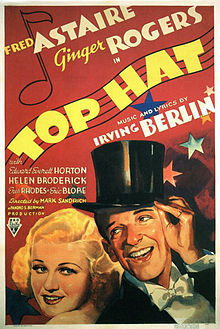
220px-TopHatORGI

The 1935 film Top Hat is a film that, much like An American In Paris, is pure joy.

Top Hat features Fred Astaire as Jerry Travers, a famous dancer who has come to London to star in a show that’s being produced by his friend, Horace Harwick (Edward Everett Horton).  (Oddly enough, Gene Kelly also played a character named Jerry in An American In Paris.)  Jerry may be sophisticated and refined but he’s still enough of an American that, upon leaving a snooty British club that insists on total silence, he still breaks up the tedium with some impromptu tap moves.

Back at his hotel, Jerry is practicing a tap routine and makes such a racket that he ends up waking up the guest staying in the room below him, Dale Tremont (Ginger Rogers).  When Dale goes upstairs to complain, Jerry immediately falls in love with her.  Soon, he is pursuing her all over London, trying to win her heart.  Eventually, he even follows her to Venice.

And Dale is definitely attracted to Jerry.  Whenever they get near each other, they start dancing.  (Needless to say, whether they’re dancing or talking or merely looking at each other from across the room, Astaire and Rogers have wonderful chemistry.)  However, Dale thinks that Jerry is actually Horace.  And Horace happens to be married to her friend, Madge (Helen Broderick.)  Convinced that Jerry is pursuing an adulterous affair with her, the indignant Dale makes plans to marry the Italian fashion designer, Alberto Beddini (Erik Rhodes).

The plot is typical screwball comedy stuff and the fact that you don’t even end up getting annoyed with all the misunderstandings is a testament to the abilities of Astaire, Rogers, and their wonderful supporting cast.  Even if not for the dancing, Top Hat would be a success because of the chemistry between the actors and film’s mix of sophistication with just pure silly fun.  I imagine that for audiences dealing with the daily realities of the Great Depression, Top Hat offered a wonderful escape.  And you know what?  It still provides a wonderful escape for today, as well.

(Wouldn’t it be nice if we could just dance this presidential election away?)

And then, of course, there’s the dancing.  That really is the main reason that we’re here, right?  Check out a few scenes.  They’ll make you happy.

(Incidentally, I’m a bit disappointed that YouTube does not feature more from Top Hat.)

Top Hat was nominated for best picture, though the award itself went to Mutiny On The Bounty, a film that did not feature quite as much dancing.