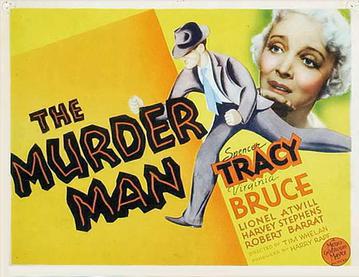
Film Review: The Murder Man (dir by Tim Whelan)


Seven minutes into the 1935 film, The Murder Man, 27 year-old James Stewart makes his film debut.

He’s playing a reporter named Shorty and, since this is a 30s newspaper film, he’s first seen sitting at a table with a bunch of other cynical reporters, the majority of whom seem to be alcoholics and gambling addicts.  Suddenly, words comes down that a corrupt businessman named Halford has been assassinated, shot by an apparent sniper.  (It is theorized that he was shot from one of those carnival shooting gallery games, which was somewhat oddly set up on a street corner.  Maybe there was shooting galleries all over place in 1935.  I supposed people had to do something to keep their spirits up during the Depression.)  While the other reporters run to the scene of the crime, Shorty is on the phone and calling his editors to let them know that a huge story is about to break.

Steve Grey (Spencer Tracy) is the reporter assigned to the story.  Crime is his beat and everyone agrees that no one’s better at covering criminals and understanding what makes them tick.  Unfortunately, it’s not always easy to track Steve down.  He’s a hard drinking reporter and lately, he’s been concerned about the collapse of his father’s business.  Still, when Steve is finally tracked down, he throws himself into covering the story and speculating, in print, about who could have killed Halford.  In fact, his girlfriend (Virginia Bruce) worries that Steve is working too hard and that he’s developing a drinking problem.  She suggests that Steve needs to take some time off but Steve is driven to keep working.

It’s largely as a result of Steve’s actions that a man named Henry Mander (Harvey Stephens) is arrested and convicted of Halford’s murder.  Steve should be happy but instead, he seems disturbed by the fact that he is responsible for Mander going to jail.  When his editor requests that Steve go to Sing Sing to interview Mander, a shocking truth is revealed.

Admittedly, the main reason that I watched The Murder Man was because it was the feature film debut of James Stewart.  (Stewart previously appeared in a comedy short that starred Shemp Howard.)  Stewart is only in a handful of scenes and he really doesn’t have much to do with the main plot.  To be honest, Shorty’s lines could have been given to anyone.  That said, Stewart still comes across as being a natural on camera.  As soon as you hear that familiar voice, you can’t help but smile.

Even if Stewart hadn’t been in the film, I would have enjoyed The Murder Man.  It’s fast-paced mystery and it has a decent (if not totally unexpected) twist ending.  It’s one of those films from the 30s where everyone speaks quickly and in clipped tones.  Casual cynicism is the theme for the day.  Spencer Tracy gives a wonderful performance as the hard-drinking and troubled Steve Grey and the scene where he meets Mander in prison is surprisingly moving.  Clocking in at only 68 minutes, The Murder Man is a good example of 30s Hollywood.
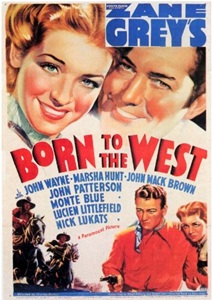
Born To The West (1937, directed by Charles Barton)


John Wayne plays Dare Rudd, a friendly rogue who aspires to be the best poker player west of the Mississippi.  When he and his sidekick, Dinkey Hooley (Syd Saylor), ride into Montana, they meet up with Dare’s cousin, Tom Filmore (Johnny Mack Brown, billed as John here).  Filmore needs some help on his cattle drive and Dare sure does like Tom’s girl, Judy (Marsha Hunt).  Dare replaces Lynn Hardy (John Patterson) as head of the cattle drive and Lynn teams up with rustler Bart Hammond (Monte Blue) to try to get revenge.  While Dinkey tries to sell lightning rods, Dare moves the herd and even finds time to play poker with notorious gambler Buck Brady (James Craig).

This is another one of the B-westerns that John Wayne made before John Ford made him a stars by casting him in Stagecoach.  This one is interesting because Wayne is not playing his usual stolid do-gooder or even an expert marksman.  Instead, Dare is impulsive and reckless and he’s ultimately not as smart a card player as he thinks he is.  It’s rare to see John Wayne need help from anyone but that’s what he gets from Johnny Mack Brown, who shows up in time to reveal that Dare is getting cheated in his poker game.  For fans of the genre, this short oater is worth watching for the chance to see two western icons acting opposite each other.  Johnny Mack Brown and John Wayne would both go on to appear in a countless number of westerns.  Wayne became a superstar, appearing in big budget studio films.  Brown remained a mainstay on the B-circuit.  They’re amusing to watch in this film as they bounce dialogue off of each other and continually try to steal scenes from one another.  Brown is playing the type of no-nonsense, hard-working westerner who would later become John Wayne’s trademark character.

Based on a novel by Zane Grey, Born to the West is a fast-paced western featuring two of the best to ever ride a horse.

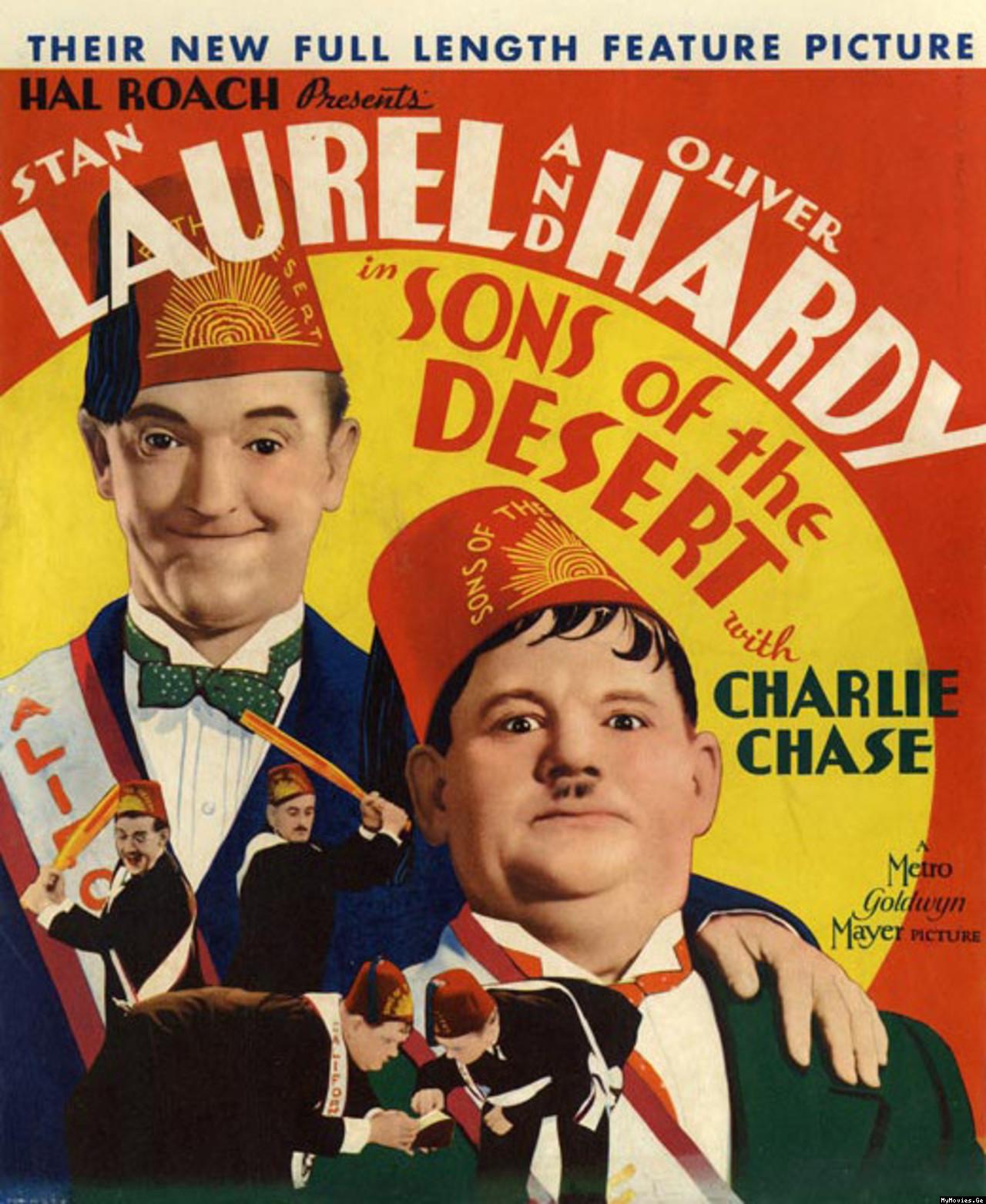
A Pair of Aces: Laurel & Hardy in SONS OF THE DESERT (MGM 1933)


gary loggins's avatarcracked rear viewer

sonsof1

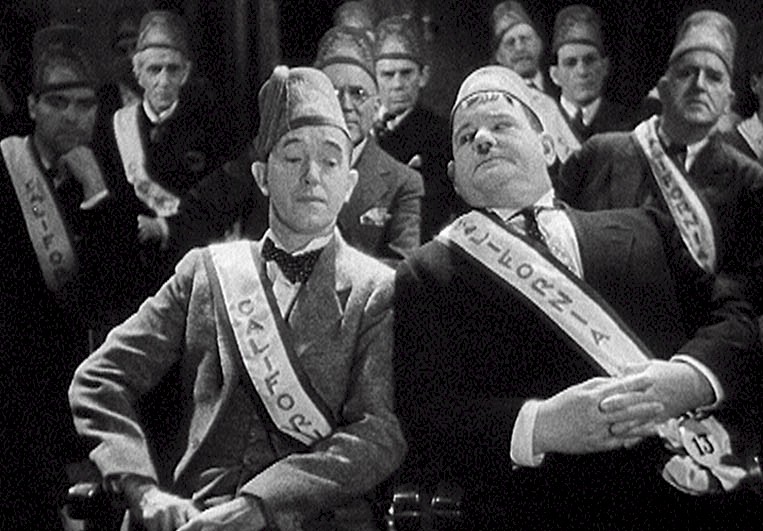
Laurel and Hardy are still beloved by film fans today for their marvelous contributions to movie comedy. Rooted firmly in the knockabout visual style of the silent screen, the team adapted to talking pictures with ease, and won the Best Short Subject Oscar for 1932’s THE MUSIC BOX. The next year the duo made what’s undoubtably their best feature film SONS OF THE DESERT, a perfect blend of slapstick, verbal humor, and situation comedy benefitting from a fine supporting cast and the undeniable chemistry between Stan and Ollie .

sonsof2

The boys are at a meeting of their lodge The Sons of the Desert when it’s announced all members must swear a sacred oath to attend the annual convention in Chicago. Timid Stanley is afraid his wife won’t let him go, but blustery Ollie insists, boasting about who wears the pants in his family. Of course, Ollie’s just as henpecked as Stan, and his…

View original post 704 more words

The Fabulous Forties #13: Scared Stiff (dir by Frank McDonald)


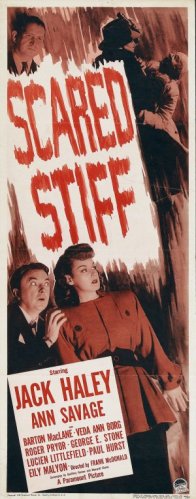
Poster_of_the_movie_Scared_Stiff

Last night, as a gentle rain fell outside, I watched the 13th film in Mill Creek’s Fabulous Forties box set, 1945’s Scared Stiff.  (The version in the box set appeared under the title Treasure of Fear, which was what the title was changed to when the film was later re-released.  However, the film was originally entitled Scared Stiff and that’s the title that I’m going to use.  Scared Stiff is just a better title and I happen to like the Scared Stiff film poster, featured above.  So, just remember that if you ever find yourself watching an old movie called Treasure of Fear, you’re actually watching Scared Stiff.)

As I attempted to watch Scared Stiff, I was reminded of some of the problems that occasionally come with watching a film that has slipped into the public domain.

On the one hand, the public domain is great because it makes it a lot easier to watch old movies.  And while it’s true that many public domain films aren’t exactly classics, there are a few gems to be found.  For instance, since I started watching the movies in the Fabulous Forties box set, I’ve discovered The Black Book, Trapped, and Jungle Book.

On the other hand, being in the public domain means that virtually anyone can duplicate and sell a copy of the film.  As a result, many of these films are available (and frequently viewed) in versions that are of an extremely poor quality and which have often been haphazardly edited.

That’s one reason why it’s going to be difficult for me to review Scared Stiff.  The version that I saw was, even for a public domain B-movie, rough.  The picture was slightly fuzzy and the sound quality was not the greatest.  I don’t think you can ever truly understand that importance of a clean soundtrack until you listen to a scratchy one.

As for Scared Stiff itself, it’s a comedic murder mystery and thankfully, it’s only 65 minutes long.  Jack Haley plays a reporter who covers chess tournaments for his uncle’s newspaper.  Unfortunately, Haley’s not a very good reporter so his frustrated uncle orders him to go to Grape City so that he can cover a beauty contest, apparently believing that there’s no way that Haley could possibly screw that up.

However, Haley manages to do just that.  He gets off the bus at Grape Center, instead of Grape City.  He finds himself stranded at an inn that’s run by two twins (both played by Lucien Littlefield).  The twins hate each other for reasons that aren’t clear.  However, they do possess a chess set that was once owned by Marco Polo!  One twin owns the white pieces while the other owns the black pieces!  Haley wants to buy all the pieces but things get complicated when it turns out that a gang of thieves are also in town and they want to steal the set for themselves.

But that’s not at all!  One of the passengers on the bus is found murdered and he has a chess piece in his hand.  Of course, everyone suspects Haley.  So, Haley has to get the chess pieces, clear his name, and hopefully get to Grape City before his uncle fires him.

Scared Stiff is way too frantic for its own good and I have a feeling that I would feel the same even if I had seen a version that didn’t sound scratchy or often look fuzzy.  That said, it is interesting to see Jack Haley, who is best known for being The Tin Man in The Wizard of Oz, play a human being.  Also of interest, to film noir fans, was that Haley’s girlfriend was played by Detour‘s Ann Savage.  Both Haley and Savage gave good performances but it was not enough to save this misbegotten little film.

Lisa Watches An Oscar Nominee: The Little Foxes (dir by William Wyler)


Little_foxesThat Bette Davis was an amazingly talented actress is something that we all already know.

However, she has become such an iconic figure that I think that it’s easy to forget just how versatile she could be.  She was ferocious in Of Human Bondage.  She was poignant in Dark Victory.  She was majestic in All About Eve.  Even when she eventually ended up appearing in stuff like Burnt Offerings, she still managed to command the screen.  Of course, nobody played evil with quite the style and power as Bette Davis at her prime.  And if you ever have any doubt about that fact, I would suggest watching the 1941 Best Picture nominee, The Little Foxes.

Based on a play by Lillian Hellman, The Little Foxes is a dark Southern melodrama that takes place in 1900.  The once mighty Hubbard Family has fallen on hard times.  Brothers Benjamin (Charles Dingle) and Oscar (Carl Benton Reid) have inherited their father’s money and Oscar has made himself even more wealthy by marrying the poignant alcoholic Birdie (Patricia Collinge).  However, when Oscar and Benjamin decide that they want to build a cotton mill, they discover that, even with their own fortunes, they are still $75,000 short.

They turn to their sister, Regina (Bette Davis).  As quickly becomes obvious, Regina is a hundred times more intelligent and clever than either one of her brothers.  However, because she’s a woman, Regina was not considered to be a legal heir to their father’s fortune.  As a result, after his death, she was left penniless.  In order to survive, Regina had to marry the wealthy but sickly Horace (Herbert Marshall).  When Regina asks Horace for the $75,000, Horace refuses.  He wants nothing to do with either one of her brothers.

With the reluctant help of Oscar’s son, Leo (Dan Duryea), the brothers steal the money straight from Horace’s bank account.  Regina, however, finds out about the theft and schemes to blackmail her two brothers….

For the majority of the film, you are totally on Regina’s side.  Despite the fact that Regina is ruthless and obviously taking advantage of Horace’s weakened state, you find yourself making excuses for her.  Her brothers are both so sleazy and greedy and Regina is so much smarter than her idiotic siblings that the film occasionally feels like a dark comedy.  It’s fun watching her get the better of them and you find yourself assuming (and hoping) that Regina will somehow be redeemed by the end of the movie.

And then it happens.

Aware of both Regina’s scheme and the fact that she never loved him, Horace announces that he’s going to change his will and he’s going to leave his entire fortune to their daughter, Alexandra (Teresa Wright, in her Oscar-nominated film debut).  He also tells Reginia that he’s going to say that he lent Leo the money, which would make it impossible for her blackmail scheme to work.

It’s while they’re arguing that Horace suddenly suffers a heart attack.  And as Horace struggles to climb up a staircase so that he can get his medicine, Regina calmly sits in a chair and shows not a hint of emotion as he dies.  It’s such an unexpected and effective moment, largely because Bette Davis’s performance was so good that it kept both the viewer and Horace from realizing just how monstrous Regina truly was.

It’s hard to think of any contemporary actress who could so totally and believably embody a character of Regina Gibbons.  It takes courage to commit so fully to playing such an evil and hateful character.  Bette Davis had that courage and her performance alone makes The Little Foxes worth watching.

Lisa Watches An Oscar Nominee: Ruggles of Red Gap (dir by Leo McCarey)


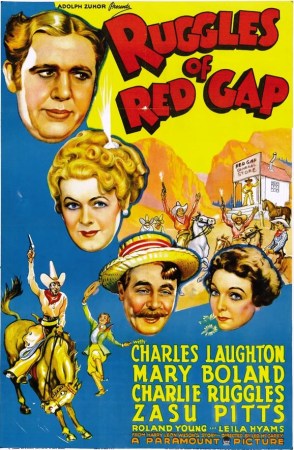
Ruggles_of_red_gap

After watching Barry Lyndon, I decided to continue to explore my DVR by watching another film that was shown as a part of TCM’s 31 Days of Oscar.

First released way back in 1935, Ruggles of Red Gap was nominated for best picture but it lost to Mutiny of the Bounty.  Interestingly enough, both Ruggles and Bounty featured the great Charles Laughton.  In Bounty, Laughton played a tyrannical villain, Capt. Bligh.  In Ruggles, however, Laughton is the film’s hero, a gentle and comedic butler named Marmaduke Ruggles who, after having his contract gambled away in a poker game, finds himself living in the frontier town of Red Gap, Washington.

It’s also interesting to note that Ruggles of Red Gap is one of the few best picture nominees to receive absolutely no other nominations.  To a certain extent, it’s understandable.  Ruggles of Red Gap was made at a time when the Academy had less categories but still nominated ten films for best picture.  As a film, Ruggles mostly serves as a showcase for Charles Laughton but, that year, he received his best actor nomination for his work in Mutiny.  (At that time, there were no supporting categories.  Had there been, it’s likely that Laughton could have received a lead actor nomination for Ruggles and a supporting nomination for Bounty.)  The next time that someone complains that Selma only received two nominations, you remind them that’s one more than Ruggles of Red Gap received.

As for the film itself … well, for a modern audience, the film’s deliberate pace takes some getting used to.  The film’s best moments occur at the start.  Ruggles wakes up one morning to discover that his boss (Roland Young) lost him in a poker game.  Ruggles spends the day meeting and attempting to get used to his new employer, a nouveau riche cowboy named Egbert Floud (Charlie Ruggles).  The joke here, of course, is that Ruggles is stereotypically reserved and British while Egbert is loud, brash, and American.  Ruggles lives his life by the rules of the class system.  Egbert comes from a world where there is no class and everyone is equal.  Ruggles refuses to call Egbert by his first name.  Egbert gets Ruggles drunk.  The scenes of Egbert and Ruggles in Europe are a lot of fun, largely because the two actors were obviously having a lot of fun playing off each other and Laughton clearly relished getting to play comedy as opposed to villainy.

The second half of the film features Ruggles settling into life in Red Gap, Washington.  The citizens of Red Gap are, of course, all honest and hard-working folks who don’t have the slightest hint of pretension.  (Red Gap may have been in Washington but it was obviously nowhere close to Seattle.)  They welcome Ruggles into the community but they also mistake him for being a colonel and soon, everyone is under the impression that Ruggles himself is a war hero.  It’s an odd subplot, one that doesn’t seem to really be necessary to make the film’s point.

And that point, by the way, is that America is a land where everyone is equal and where butlers have the same rights as their employers.  Ruggles goes from being somewhat horrified by his new surrounding to being a proud American, an entrepreneur who is now capable of being his own man.  And it may sound corny and I’m sure all of my cynical friends are rolling their eyes but you know what?  Charles Laughton pulled it off.  As uneven as the film may sometimes be, Laughton’s sincere performance holds it all together.  He’s the main reason to watch Ruggles of Red Gap.

How proud of an American does Ruggles become?  He’s enough of an American that he can even recite the Gettysburg address!  Watch below!