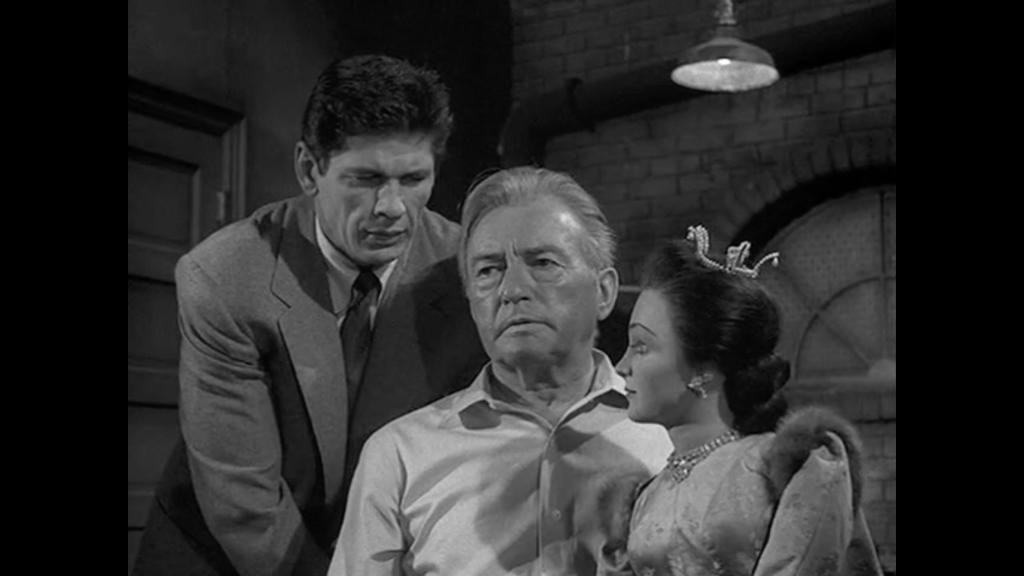
ALFRED HITCHCOCK PRESENTS (TV Series) – S1, E20: “And So Died Riabouchinska,” starring Claude Rains and Charles Bronson!


I’ve never been a rabid consumer of horror films, but I do love Alfred Hitchcock. And when you consider that Charles Bronson was featured three times in his TV series, ALFRED HITCHCOCK PRESENTS, you know I’m all in. Bronson first appeared in the season 1 episode, “And So Died Riabouchinska” which starred the Invisible Man himself, Claude Rains! I thought it would be fun to revisit this early episode from the classic TV series. 

When a juggler named Ockman is found dead in the basement of a vaudeville theater, Detective Krovitch (Charles Bronson), a no-nonsense police investigator, is on the case. The prime suspect quickly emerges to be John Fabian (Claude Rains), a ventriloquist whose act revolves around his beautiful female dummy, Riabouchinska, who we find out is modeled after a long, lost love. As Krovitch interrogates Fabian and all of those around him, including his embittered wife Alyce (Wynne Miller), and her lover, the shady manager Douglas, it becomes clear that the ventriloquist has a dark and dangerous past. We discover a Fabian who is lost in a world of obsession, self delusion and even perversion, a world that the now deceased Ockman was threatening to expose.  Without giving too much away, this episode blends psychological horror with police procedural and spits out an episode that still resonates loudly on the freaky-meter!

Adapted by Mel Dinelli from Ray Bradbury’s short story, “And So Died Riabouchinska” is an exceptional entry in Season 1 of the ALFRED HITCHCOCK PRESENTS TV series. Claude Rains is incredible as Fabian. It’s a thespian tour-de-force, with Rains creating a role that’s creepy, pathetic, and oddly relatable all at the same time. I haven’t seen many of Rains’ most notable works, but based on his performance here, I do know that he’s amazing. Charles Bronson, whose strong screen presence was as obvious as the nose on his face, even this early in his career, goes toe to toe with Rains (and Riabouchinska) and helps ground the episode in something resembling the real world. It’s not a showy role for the legendary tough guy, but he conveys the toughness and authority that would go on to define his career. Performances aside, the episode is truly set apart with an emotional storyline that plumbs the depths of the human psyche in a way that seems daring for 1956 television. There are parts of this episode that will definitely make you squirm in your seat! 

Overall, in my opinion, “And So Died Riabouchinska” is an essential episode of the ALFRED HITCHCOCK PRESENTS series. It’s a lot of fun seeing Hitchcock introduce the show at the beginning and wrap it up at the end, but the best part is the fact that the story that takes place in-between is creepy, clever, and compulsively re-watchable.
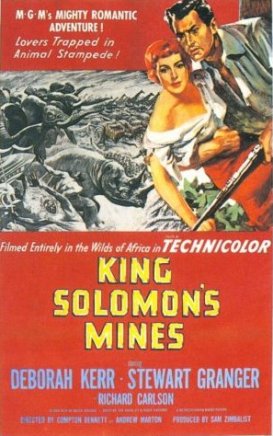
Lisa Reviews An Oscar Nominee: King Solomon’s Mines (dir by Compton Bennett and Andrew Marton)


Kingsolomonsmines1950

So, this is a weird one.

As we all know, today is Oscar Sunday!  As I wait for the big show to begin, I’ve been watching some of the Oscar-nominated films that I have collected on the DVR over the past month.  For instance, this morning, I watched 1950’s King Solomon’s Mines.

King Solomon’s Mines was nominated for best picture of the year and watching it … well, you really have to wonder why.  It’s an adventure film, one that was shot on location in Africa and it features a lot of footage of wild animals.  It also features several scenes that were shot in actual African villages and a good deal of time is devoted to documenting tribal rituals.  It’s true that the film has a plot but, for the most part, it’s a travelogue.  One gets the feeling that it was mostly sold as a chance for American and European audiences to see a part of the world that, up until that point, they had only read about.  Not only would they get to experience Africa from the safety of the neighborhood movie theater but they’d get to see it in a color as well!

(Seriously, it’s difficult to watch the nature footage in King Solomon’s Mines without imagining a serious voiced narrator saying, “However, one gazelle has strayed too far from its mother.  The lion cubs will eat tonight…”)

As for the plot, King Solomon’s Mines is based on a novel by British adventure enthusiast H. Rider Haggard.  Allan Quartermain (Stewart Granger) is an experienced guide and hunter.  When we first meet him, he’s helping two rich Englishmen hunt an elephant.  It’s a disturbing scene, largely because it’s obvious the footage of the elephant dying is real.  Allan prevents his clients from killing more than one elephant and later talks about how much he hates his job but still, it’s pretty much to impossible to really like him after watching that elephant die.

Anyway, Allan gets hired by Elizabeth Curtis (Deborah Kerr) and her brother John (Richard Carlson).  It seems that Elizabeth’s husband disappeared in Africa while searching for a legendary treasure.  Allan tells Elizabeth that her husband is probably dead.  Elizabeth still insists on searching for him…

…and, from that point on, you can pretty much predict everything that is going to happen.  Though the footage of Africa looks great, it’s just not a very interesting film.  Playing the type of role that would probably be played by Gerard Butler if the movie was made today, Stewart Granger comes across as being bored with it all.  For that matter, even the great Deborah Kerr seems as if she’d rather be hanging out with Robert Mitchum.

Still, it is interesting to note that Hugo Haas shows up as a villain.  Who is Hugo Haas?  He was a Hungarian actor who, after playing a bad guy here, went on to direct several idiosyncratic B-movies, like Hold Back Tomorrow, The Girl On The Bridge, Bait, and One Girl’s Confession.  If nothing else, watching King Solomon’s Mines has inspired me to, someday, do a little Hugo Haas film festival here on the Lens.

King Solomon’s Mines seems like an odd best picture nominee.  Its triumphs are largely technical and even those successes no longer seem that special.  It was, however, a big hit at the box office and I imagine that probably has something to do with its nomination.  However, when the Oscars were awarded, best picture went to All About Eve.

Stewart Granger was no match for Bette Davis.