Late Night Retro Television Review: Friday the 13th: The Series 2.2 “The Voodoo Mambo”


Welcome to Late Night Retro Television Reviews, a new feature where we review some of our favorite and least favorite shows of the past! On Fridays, I will be reviewing Friday the 13th: The Series, a show which ran in syndication from 1987 to 1990. The show can be found on YouTube!

This week, Micki, Ryan, and Jack get involved in voodoo!

Episode 2.2 “The Voodoo Mambo”

(Dir by Timothy Bond, originally aired on October 7th, 1988)

This episode opens with Micki and Ryan watching a street party that just happens to be taking place in front of Curious Goods.  It’s a Haitian voodoo party and, judging from Micki and Ryan’s comments, it is apparently some sort of annual event that takes place wherever this show is supposed to be set.

(If Curious Goods was set in New Orleans, I could maybe buy this without giving it too much thought.  But the show is filmed in Canada and, judging from the states that were specifically mentioned over the course of the first few episode, it appears that Curious Goods is meant to be located in the Northeast.  How many voodoo street parties do you see in New Jersey?)

Micki and Ryan want to join the party but Jack insists that they first meet his old friend, Hedley (Joe Seneca).  Hedely is a powerful voodoo priest and he has traveled to the city so that his daughter, Stacy (Rachael Crawford, who was on the first season of T & T until her character vanished), can become a priestess.  Ryan is obviously attracted to Stacy but the attraction goes nowhere, which I guess is good considering that every woman who likes Ryan ends up dying in some terrible way.

Meanwhile, good-for-nothing Carl Walters (David Matheson) is in danger of losing the mansion that has been in his family’s possession ever since their days as plantation overlords.  Carl finds a voodoo mask in the basement.  Whenever he puts the mask on, the spirit of a voodoo priestess named Laotia (Suzanna Coy) rips out someone’s throat.  Laotia wants to rip out the throats of the city’s top voodoo priests so that she can gain their powers.  Carl agrees to help because part of the deal is that Carl will get what he wants as well.  I’m not sure what Carl wants, though.  Money, I guess.  But it doesn’t matter because, of course, Laotia is really only concerned with what she wants.

This episode had some atmospheric moments, especially in the scenes featuring the big party outside of Curious Goods.  There’s also some black-and-white footage of actual voodoo ceremonies that is randomly inserted throughout the episode.  I assume that black-and-white footage is meant to be a flashback or something like that, though the show never really makes it all that clear.  That said, this episode was a bit on the dull side.  Carl and Laotia were not particularly interesting and this is the second episode this season to feature an old friend of Jack’s.  (That wouldn’t be a problem, except for the fact that we’re only two episodes in.)  This episode felt a bit tired, as if someone entered the production office and shouted, “I need an episode about Voodoo!  You’ve got 48 hours!”

Next week, hopefully, thing will be a bit more interesting.
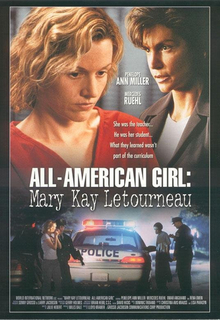
Retro Television Review: All-American Girl: The Mary Kay Letourneau Story (dir by Lloyd Kramer)


Welcome to Retro Television Reviews, a feature where we review some of our favorite and least favorite shows of the past!  On Sundays, I will be reviewing the made-for-television movies that used to be a primetime mainstay.  Today’s film is 2000’s All-American Girl: The Mary Kay Letourneau Story!  It  can be viewed on YouTube.

In 1996, a 34 year-old teacher named Mary Kay Letourneau decided that she had fallen in love with someone who was not her husband.

A 34 year-old deciding that they are no longer happy in their marriage and subsequently deciding that that they’ve found love with someone else is hardly an unusual or even surprising occurrence.  What made Mary Kay Letourneau’s case a national scandal was that the person that she decided that she was in love with was a 12 year-old student named Vili Fualaau.  Mary Kay started her affair with Vili when she was his sixth grade teacher.  When she was arrested and charged with two counts of second-degree rape of a child, Letourneau was pregnant with Vili’s child.  Even after being arrested, Letourneau insisted that she and Vili were soulmates.  After giving birth to Vili’s child, Letourneau was sentenced to six months of prison and somehow managed to avoid having to register as a sex offender.  After serving her sentence, Letourneau was promptly arrested again with Vili and was sent back to jail, where she gave birth to Vili’s second child.

All-American Girl opens with Mary Kay Letourneau (Penelope Ann Miller) in jail, insisting that everything that happened between her and Vili was consensual and that their love is real.  The majority of the film is shown in flashbacks.  Some of those flashbacks deal with Mary Kay, her husband (Greg Spottiswood), and Vili (Omar Anguiano).  Watching the flashbacks, I couldn’t help but notice that the film really did seem to be on Mary Kay’s side, to an almost ludicrous extent.  Her husband is portrayed as being a soulless sociopath, even before Mary Kay starts sneaking around with Vili.  As for Vili, he is presented as being the one who initiated his relationship with Mary Kay, flirting with her in class and comforting her when she starts crying in a school hallway.  The actor playing Vili looked, acted, and sounded considerably older than just 12 years old.  At times, he appeared to be nearly as old as Penelope Ann Miller.  And I’ll admit that it’s totally possible that Vili could have looked older than his age and maybe he did have a surprisingly mature vocabulary.  But still …. he was 12 years old!  Apparently, Letourneau cooperated with the film’s producers and that’s pretty obvious from the first minute we see Vili giving Letourneau a wolfish smile in the 6th grade.

The flashbacks dealing with Letourneau’s childhood are a bit more interesting, if just because Letourneau was the daughter of a congressman who ran for president in 1972.  (One of her brothers served in the first Bush White House.  Another served as an advisor to the 2016 Trump campaign.)  At one point, she taunts a group of protestors that have gathered outside of her family’s home and her father praises her courage.  The film hints that it was the twin traumas of her brother’s death and the discovery that her beloved father had fathered two children with a mistress that led to Letourneau’s subsequent instability.  Perhaps that’s true, though I think the film is a bit too eager to accept that as an all-purpose explanation.

You may have guessed that I had mixed feelings about this film.  Penelope Ann Miller gave an excellent performance as Mary Kay but the film’s attempts to portray May Kay as being even more of a victim that Vili were undeniably icky.  

As for the real Mary Kay, she married Vili four years after being released from prison.  They separated a year before Mary Kay died in 2020.  Their relationship inspired several films, most recently May/December.