The Unnominated #16: The Mortal Storm (dir by Frank Borzage)


Though the Academy of Motion Picture Arts and Sciences claim that the Oscars honor the best of the year, we all know that there are always worthy films and performances that end up getting overlooked.  Sometimes, it’s because the competition too fierce.  Sometimes, it’s because the film itself was too controversial.  Often, it’s just a case of a film’s quality not being fully recognized until years after its initial released.  This series of reviews takes a look at the films and performances that should have been nominated but were, for whatever reason, overlooked.  These are the Unnominated.

Oh, how this movie made me cry!

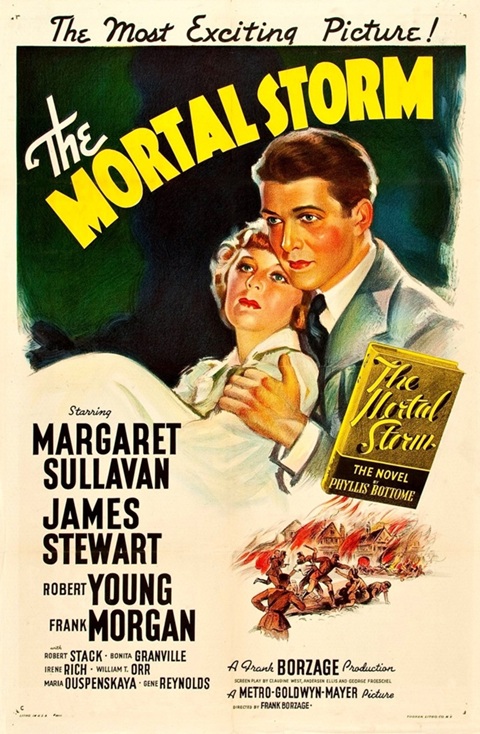
Released in 1940, at a time when war was spreading across Europe, Asia, and Africa but the United States was still officially neutral, The Mortal Storm opens on January 30th, 1933.  In the mountains of Germany, near the Austrian border, Professor Viktor Roth (Frank Morgan) is celebrating his 60th birthday.  He starts the day being applauded by his students at the local college.  In the evening, he returns home for a celebration with his family, including wife (Irene Rich), his daughter Freya (Margaret Sullivan), his son Rudi (Gene Reynolds), and his two stepsons, Otto (Robert Stack) and Erich von Rohn (William T. Orr).  Also present are Freya’s fiancé, Fritz (Robert Young) and one of Roth’s students, a pacifist named Martin Breitner (James Stewart).  It’s a joyous occasion and the film takes its time introducing us to Prof. Roth and his extended family.  At first, everyone seems very kind.  They seem like people who most viewers would want to spend time with or live next to….

But then, the family’s maid excitedly enters the room and announces that it’s just been announced that Adolf Hitler is the new chancellor of Germany.  Otto and Erich are overjoyed and head out to celebrate with the other members of the Nazi Youth Leage.  Martin is less happy and excuses himself to return home.  Roth and his wife worry about what this means for people who do not agree with Hitler’s beliefs.  Freya says that they shouldn’t talk politics.  It is jokingly mentioned that Hitler has taken away Roth’s special day but Roth’s young son Rudi says that he’s learned in school that the needs of the individual will never be more important than the needs of the state.  If Hitler wants to take away your day, it’s your duty to give it up or face the consequences.

Based on a 1937 novel, The Mortal Storm was not the first Hollywood production to take a stand against Hitler and the Nazis but it was one of the best.  I say this despite the fact that the film only hints at the fact that Prof. Roth is Jewish, something that was made very clear in the book.  (In the movie, Roth and his wife worry what will happen to “Non-Aryans” and “freethinkers.”)  That said, the film perfectly captures how quickly and insidiously the authoritarian impulse can spread.  The town, which once seemed so friendly, becomes a very dark place as the students at the university put on their swastika armbands and start to hunt down anyone who dissents from the party line.  When Roth says that, as a scientist, he does not believe one race can be genetically superior to another, his students walk out on him.  A local teacher is beaten when he fails to return to the Nazi salute.  When Martin refuses to join the Party, Otto and Erich turn against him despite being lifelong friends.  When Martina and Freya flee for the border, Fritz pursues them.  And even after Prof. Roth is sent to a concentration camp, Otto and Erich continue to follow the orders of Hull (Dan Dailey), the sinister Youth Party Leader.

It’s a powerful film, one that remains just as relevant today as it was when it was first released.  Hull and Erich’s fanaticism would, today, find a welcome home on social media.  The scenes in which the townspeople eagerly threaten to report their former friends and neighbors for failing to salute or show proper enthusiasm for the government have far too many modern day equivalents for me to even begin to list them all.  This film was also the last the James Stewart made with frequent co-star Margaret Sullivan and they both give great performances.  (All-American Jimmy Stewart might seem a strange choice to play a German farmer but he is never less that convincing as Martin, one of the few people in the town not to surrender his principles and beliefs to the crowd.)  The film’s final moments, with the camera panning around the empty Roth home, brought very real tears to my eyes.

Despite being a powerful film, The Mortal Storm was not nominated for a single Oscar.  (Jimmy Stewart did win his only Oscar that year but it was for The Philadelphia Story.)  It’s temping to assume that, at a time when America was still divided about how to react to the war in Europe and when many Americans still remembered the trauma of the first World War, The Mortal Storm was too explicitly political and anti-Nazi to get a nomination but, the same year, The Great Dictator was nominated for Best Picture.  It seems more likely that, in those days when the studios ruled supreme, MGM decided to puts it weight behind The Philadelphia Story rather than The Mortal Storm.

That said, The Mortal Storm was definitely worthy of being nominated, for Picture, Director, Screenplay, Actress (Margaret Sullivan), Actor (Stewart), Supporting Actor (Frank Morgan and Robert Stack), and Supporting Actress (Irene Rich and, in the role of Stewart’s mother, Maria Ouspenskaya).  The film may not have been nominated but it remains a powerful and important work of art.
Previous entries in The Unnominated:
  1. Auto Focus 
  2. Star 80
  3. Monty Python and The Holy Grail
  4. Johnny Got His Gun
  5. Saint Jack
  6. Office Space
  7. Play Misty For Me
  8. The Long Riders
  9. Mean Streets
  10. The Long Goodbye
  11. The General
  12. Tombstone
  13. Heat
  14. Kansas City Bomber
  15. Touch of Evil

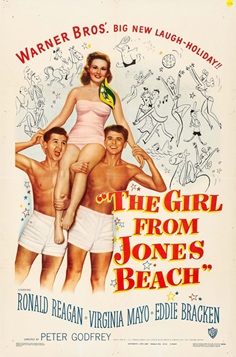
The Girl From Jones Beach (1949, directed by Peter Godfrey)


Painter Bob Randolph is famous for painting a beautiful woman who is known as “the Randolph Girl.”  Everyone wants to meet the model but they can’t because there is no one model.  Instead, there are a dozen models, each with a perfect feature that Bob uses in his paintings.  In need of money, Bob and his business partner, Chuck Donavon (Eddie Bracken) search for a woman who can be the real-life Randolph Girl.  Chuck thinks that he’s found her when he spots school teacher Ruth Wilson (Virginia Mayo) but Ruth has no interest in being a model.  She wants to be known for how she thinks and not how she looks.  Hoping to change her mind, Randolph pretends to be Czech immigrant and enrolls in Ruth’s citizenship class.

When a photograph of Ruth in a swimsuit is published without her prior knowledge, the school board decides that Ruth is not a good role model and they fire her.  With the support of Bob and Chuck, Ruth sues for reinstatement.  Bob ends up posing in the courtroom in his own swimsuit, the better to prove that there’s nothing wrong with  appearing in public in a swimsuit.

The role of Ruth was originally offered to Lauren Bacall, who turned it down because she didn’t think she could play a pin-up.  Not to knock Bacall but Virginia Mayo does seem like a better choice for the role of Ruth and she does a good job of bringing the role to life.  She proves to be a good match for Ronald Reagan, whose amiable nature allows him to get away with taking her class under a false pretext and speaking in a mangled approximation of a foreign accent.  The comedy is light and it fits well with Reagan’s affable screen presence.  The film is pleasant but ultimately lightweight and forgettable.  I can understand why, by this point in his career, Reagan was getting frustrated with the quality of scripts he was being sent.  The Girl From Jones Beach would be forgotten today if it didn’t star the future president of the United States.

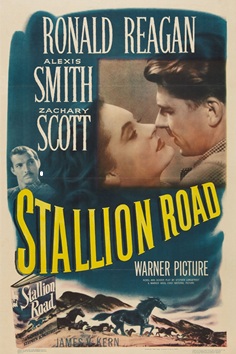
Stallion Road (1947, directed by James V. Kern)


Writer Stephen Purcell comes out to the country to visit an old school friend, veterinarian Larry Hanrahan (Ronald Reagan).  Larry is great at taking care of horses but a little clueless when it comes to women.  Both rancher Rory Teller (Alexis Smith) and Rory’s neighbor, Daisy Otis (Peggy Knudsen), have a thing for Larry but Larry is kept pretty busy taking care of all the horses in the community.  Stephen decides that he likes Rory but, deep down, he knows there’s no way he can compete with Larry.  When Larry gets busy tending to an anthrax outbreak, Rory finds herself tempted to give Stephen a shot.

When Stallion Road originally went into production, Humphrey Bogart was cast as Stephen and Lauren Bacall was cast as Rory.  Both of the stars refused to do the movie, feeling it was too lightweight.  Audiences were cheated out of a chance to see Reagan and Bogart, who were friends despite their differing styles of acting, co-starring opposite each other.  (They were both in Dark Victory but they didn’t share any scenes.)  Speaking of Bogart and Reagan, it’s a Hollywood legend that Reagan was originally offered the role of Rick in Casablanca though I’ve also read that Reagan was actually offered the role of Victor Laszlo.

Bogart and Bacall were right.  Stallion Road is the epitome of lightweight entertainment, with Reagan giving a pleasant but bland performance as Larry and the film never really allowing any doubt as to who Rory belongs with.  It’s the type of movie that would be a Hallmark film today so if you’re actually looking for a realistic drama about ranching and taking care of horses, it’s best to look elsewhere.  This film does show why Reagan was such a successful politician.  Even though his character isn’t exactly exciting, he’s innately likable and, from the minute he first appears, he’s dependable.  He’s someone who any rancher would trust to take care of their horses.


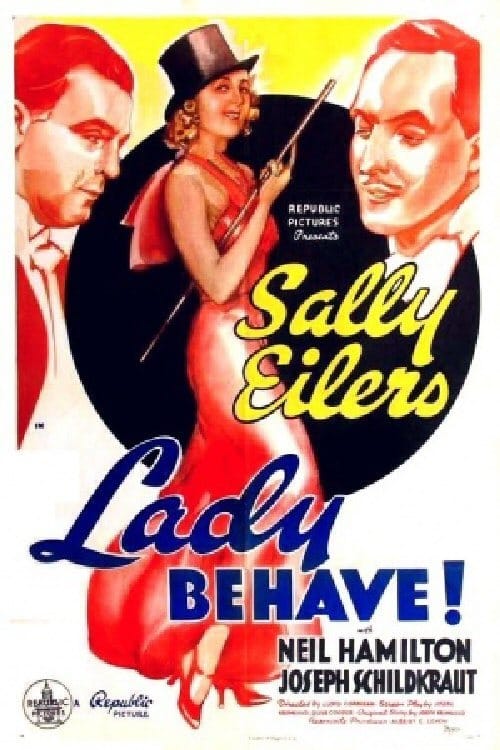
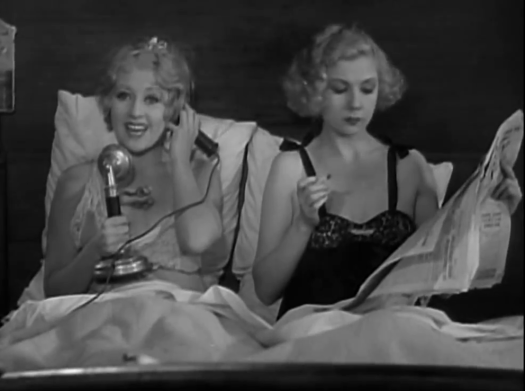
Mardi Gras Film Review: Lady Behave! (dir by Lloyd Corrigan)


The 1938 film, Lady Behave!, begins with a woman named Clarice (Patricia Farr) getting ready to go out and celebrate Mardi Gras.  Even though Clarice invites her older sister, Paula (Sally Eilers), to come with her, Paula refuses.  Paula has work to do at home.  It’s pretty obvious that this is the way that it’s always been between the two sisters.  Clarice has fun while Paula stays home and waits for her to return.

Fortunately, Clarice does return in the morning.  As she tells Paula, she had a great time during Mardi Gras.  In fact, she had such a great time that she ended up getting married!  She married a wealthy northerner named Stephen Cormack (Neil Hamilton).  The only problem is that Clarice is already married!  She’s totally forgotten that she only recently became the wife of a dissolute playboy named Michael Andrews (Joseph Schildkraut).  By getting married a second time, Clarice has committed bigamy!  She could go to prison for 10 years!

Whatever is Paula to do?

Well, what if she arranges for Clarice to leave the country?

What if she tries to bribe Michael into accepting an annulment?

What if Paula goes up to New York and pretends to be Clarice (because, after all, Stephen was pretty drunk when he married her)?

What is she does all three!?

Of course, when Paula goes up to New York, she discovers that Stephen is out of the country.  She moves into his mansion, where she discovers that his two children — Patricia (Marcia Mae Jones) and Hank (George Ernest) — are convinced that she’s just a gold digger who only wants to steal their father’s money (and, it should be noted, also their inheritance).  When Michael shows up at Stephen’s mansion, he explains to Paula that he needs $10,000 for a horse and he’ll only agree to an annulment if he gets the money.  However, when he meets Patricia and Hank, he tells them that if they pay him $30,000, he’ll help to break up the marriage between Stephen and Paula (who, of course, everyone but Michael thinks is actually Clarice).

Eventually, Stephen shows up and he assumes that Paula actually is Clarice.  Paula and Stephen quickly fall in love and it turns out that Stephen is very serious about his new marriage.  He even wants to take Paula on a honeymoon.  Of course, he thinks Paula is Clarice and Paula is freaking out because they’re not actually married but she wishes that they were.  But, if they did actually get married, Stephen would be guilty of bigamy and then he’d have to leave the country like Clarice and….

Yes, this is one of those somewhat busy screwball comedies where almost every action is motivated by a misunderstanding and where all of the dialogue is extremely snappy.  To be honest, it’s all a bit too hyper.  Though the film originally had a running time of 70 minutes, most of the existing prints are only 57 minutes long.  This film has a lot of plot for only 57 minutes and it’s often difficult to keep track of what’s happening from one scene to the next.  That wouldn’t be a problem if this film starred someone like William Powell and Carole Lombard (or, for that matter, Cary Grant and Myrna Loy) but instead, this film features Sally Eilers and Neil Hamilton, who are likable performers but not quite likable enough to carry the film over it’s rough edges.

On the plus side, Joseph Schildkraut has some very funny scenes as the flamboyant Michael.  And Marcia Mae Jones and George Ernest both do a great work as Stephen’s paranoid children.  They consistently made me laugh.  Otherwise, Lady Behave! is a bit too frantic for its own good.

Halloween Havoc!: CAPTIVE WILD WOMAN (Universal 1943)


gary loggins's avatarcracked rear viewer

Universal decided the time was ripe for a new monster, and 1943’s CAPTIVE WILD WOMAN introduced the world to Paula Dupree, aka The Ape Woman! What’s that you say? You’ve never HEARD of her? Don’t worry, you’re not alone – The Ape Woman is the most obscure of the Universal Monsters despite the fact she was featured in three films, with various degrees of quality. The first is the best of the bunch, a fun little ‘B’ lifted by the presence of John Carradine in the first of his patented mad scientist roles.

Animal trainer Fred Mason returns from Africa with a shipload of lions, tigers, and a powerful female gorilla named Cheela. He’s greeted at the docks by his sweetie Beth Colman, who tells Fred that her sister Dorothy has “some kind of glandular problem” and is being treated at Crestview Sanitarium by endocrinology expert Dr. Sigmund Walters. Walters…

View original post 511 more words

Cleaning Out the DVR #20: ALL-STAR PRE-CODE LADIES EDITION!


gary loggins's avatarcracked rear viewer


I know all of you, like me, will be watching tonight’s 89th annual Major League Baseball All-Star G
ame, and… wait, what’s that? You say you WON’T be watching the All-Star Game? You have no interest in baseball? Heretics!! But I understand, I really do, and for you non-baseball enthusiasts I’ve assembled a quartet of Pre-Code films to view as an alternative, starring some of the era’s most fabulous females. While I watch the game, you can hunt down and enjoy the following four films celebrating the ladies of Pre-Code:

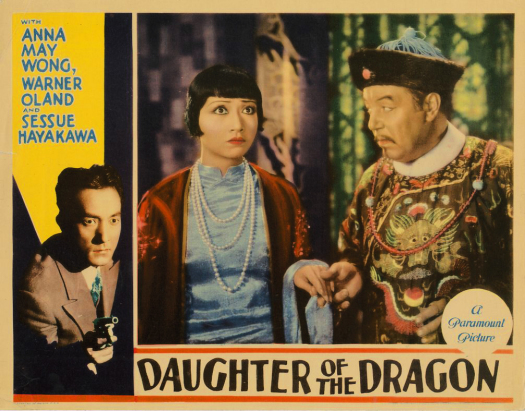
DAUGHTER OF THE DRAGON (Paramount 1931; D: Lloyd Corrigan) – Exotic Anna May Wong stars as Princess Ling Moy, an “Oriental dancer” and daughter of the infamous Dr. Fu Manchu (Warner Oland)! When Fu dies, Ling Moy takes up the mantle of vengeance against the Petrie family, tasked with killing surviving son Ronald. Sessue Hayakawa (BRIDGE ON THE RIVER KWAI)…

View original post 827 more words

The Fabulous Forties #18: The Chase (dir by Arthur Ripley)


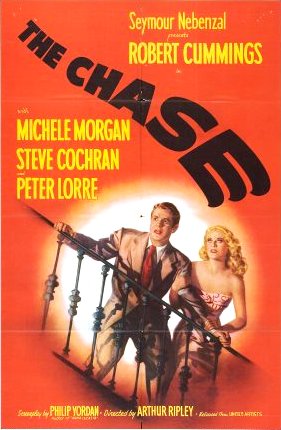
The_Chase_1946_posterThe 18th film in Mill Creek’s Fabulous Forties box set was 1946’s The Chase, which turned out to be a pretty nifty little film noir.  Did I actually just use the word nifty in a film review?  Yes, I did but then again, everyone should use the word “nifty” at least once in their lives.

The Chase tells the story of Chuck Scott (Robert Cummings), whose life is anything but nifty.  When we first meet him, he’s standing outside in the rain, staring into a restaurant, and enviously watching the people eating inside.  Chuck is a returning serviceman.  He helped to win World War II but he’s now returned to a society that has changed in his absence.  He has no money, he has no home, and he suffers from what we would today call PTSD.

Things change for Chuck when he finds the wallet of a man named Eddie Roman (Steve Cochran).  He returns the wallet, discovering that Eddie not only lives in a mansion but he also has a sinister henchman named Gino (Peter Lorre!).  Eddie is so impressed that Chuck returned the wallet and didn’t try to steal any of the money that he offers to put Chuck on the payroll.

Soon, he is working as Eddie’s driver.  Of course, Eddie has an accelerator installed in the backseat, so that he can control how fast the car is going.  Eddie enjoys freaking Chuck out by randomly speeding up the car.  Along with being a spectacularly bad passenger, Eddie also turns out to be a gangster.

When Chuck meets the mysterious Lorna (Michele Morgan), it’s love at first sight but there’s a big problem.  Lorna happens to be married … to Eddie!  Chuck and Lorna flee to Cuba, with Eddie and Gino in pursuit…

Or do they?

Chuck, it turns out, has been suffering from nightmares since he returned from the war.  Often times, he wakes up with amnesia.  Are Eddie, Gino, and Lorna real or are they just figments of Chuck’s dream state?  Is Chuck really living in a film noir or is he just dreaming that he is?

The Chase is an effectively dark little film noir, one that will keep you guessing.  Steve Cochran appears to be having a lot of fun as the cheerfully sociopathic Eddie (and it’s interesting to note that, in the same year as The Chase, Cochran had a supporting role in another film about the struggles of returning servicemen, the Oscar-winning Best Years Of Our Lives) and, of course, Peter Lorre is great as Gino.  Michele Morgan is both sympathetic and enigmatic as Lorna and Robert Cummings does a good job of playing a man who is never quite sure whether he’s awake or he’s asleep.

The Chase is a classic mix of film noir and psychological melodrama.  Watch it below!