18 Days of Paranoia #15: Marie (dir by Roger Donaldson)


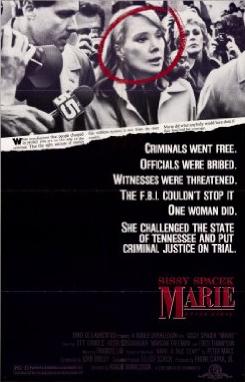
The 1985 film, Marie, tells a true story.

(In fact, the film’s official title is Marie: A True Story, just in case there was any doubt.)

The film opens in Tennessee, in the early 70s.  Marie Ragghianati (Sissy Spacek) has left her alcoholic and abusive husband and is now living with her mother and trying to raise three children, one of whom is chronically ill, on her own.  Though she manages to win a scholarship to Vanderbilt University, she quickly discovers that having a degree does not necessarily translate into getting a job.  However, while Marie was a student, she became acquainted with Eddie Sisk (Jeff Daniels), a seemingly friendly lawyer who now has a job as the counsel for the newly elected governor of Tennessee, Ray Blanton (Don Hood).  Marie goes to see Eddie and she soon finds herself working in the governor’s office.

With Eddie’s support, Marie rises up through the ranks.  Of course, he does get a little bit annoyed whenever Marie asks him why the governor is so eager to offer clemency to certain criminals.  At first, Eddie claims that it’s because the governor is against the death penalty and he doesn’t want to send anyone to die in “Old Sparky.”  Later, Eddie claims that it’s because the state has been ordered to do something about prison overcrowding.  And finally, Eddie admits that, on occasion, it’s done as a political favor.  It appears that some of the children of Tennessee’s wealthiest families have a really bad habit of getting arrested for some very serious crimes.

Eventually, there’s an opening on the state parole board and Eddie recommends that Marie be appointed the board’s new chairperson.  As Eddie explains it, the governor wants to put a Democrat on the board and he wants to appoint a woman.  (Despite the governor’s insistence that he wants to bring more women into state government, the film makes it clear that the Blanton administration was essentially a boys club.)  Marie agrees and soon, she’s making over a hundred dollars a day!  (That was apparently an unusual thing in the 70s.)

No sooner has Marie moved into her new position than she is informed that some of the governor’s aides have been selling pardons.  When Marie goes to Eddie about the situation, his charming facade disappears as he gets angry with her and accuses her of trying to ruin his career.  When rumors get out that she may have gone to the FBI, Marie becomes a pariah.  The governor demands her resignation, which she refuses to give.  She finds herself being followed by strange cars and harassed by the police.  (At one point, she is arrested for drunk driving despite being sober.)  Meanwhile, people start to show up dead.

When Blanton fires Marie on trumped-up corruption charges, she decides to take the governor to court.  Fortunately, Marie is friendly with a lawyer named Fred Thompson.  The future U.S. Senator and presidential candidate plays himself in this film and he gives such an authoritative performance that he went on to have a busy career as a character actor whenever he wasn’t running for or serving in office.

Marie is a strangely disjointed film.  On the one hand, you’ve got Sissy Spacek, Fred Thompson, and Jeff Daniels all giving excellent performances and you’ve also got an inspiring true story.  On the other hand, the film attempts to combine so many different genres that it sometimes feels as if you’re watching multiple films at once.  The film starts out as the story of a single mom trying to restart her life and then it becomes a workplace drama as Marie has to deal with gossip about her relationship with Eddie and hostile co-workers like fellow board member Charles Traughber (Morgan Freeman, in a small role that would probably be forgettable if it was filled by anyone other than Morgan Freeman).  Then it becomes a courtroom drama, with Fred Thompson cross-examining witnesses and giving final arguments.  Meanwhile, at the same time, it’s also a political thriller in which two men are brutally murdered before they can testify against the governor.  And then finally, it’s also a crime drama as detectives try to track down a career criminal who has friends in the governor’s office.  It’s a film of many good parts but those parts don’t always seem to easily fit together and the end result is somewhat awkward whole.

(Interestingly enough, some of the film’s moments that seem as if they’re most likely to be fictionalized are actually based on fact.  For instance, two men who could have brought down Blanton were mysteriously murdered at the same time that Marie was suing the state.)

In the end, Marie doesn’t really come together but it has a good cast and a good lesson: Never trust a politician.
Other Entries In The 18 Days Of Paranoia:
  1. The Flight That Disappeared
  2. The Humanity Bureau
  3. The Private Files of J. Edgar Hoover
  4. The Falcon and the Snowman
  5. New World Order
  6. Scandal Sheet
  7. Cuban Rebel Girls
  8. The French Connection II
  9. Blunt: The Fourth Man 
  10. The Quiller Memorandum
  11. Betrayed
  12. Best Seller
  13. They Call Me Mister Tibbs
  14. The Organization

Guilty Pleasure No. 15: Cocktail (dir by Roger Donaldson)


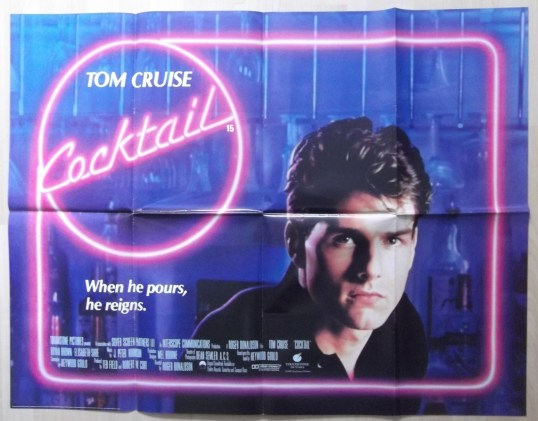
cocktail-original-uk-quad-poster-tom-cruise-elisabeth-shue-88-1229-p

For the past two months or so, Cocktail, a 1988 film that stars Tom Cruise as a bartender with big dreams, has been on an almost daily cable rotation.  A few nights ago, my sister Megan and I sat down and watched the film from beginning to end and we laughed ourselves silly.

Seriously, if there’s ever been a film that deserves to be known as a guilty pleasure, it’s Cocktail.

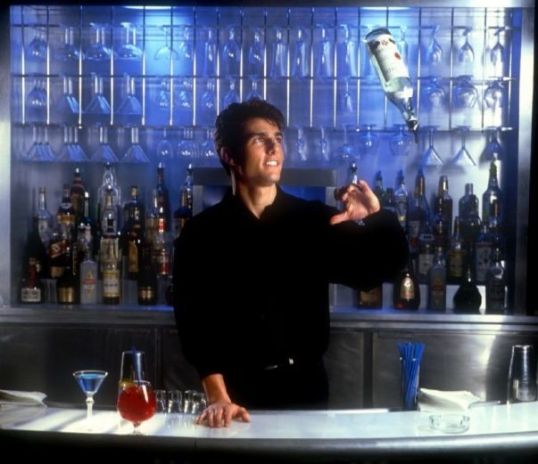
Cocktail tells the story of Brian Flanagan (Tom Cruise), an apparent sociopath who, having just gotten out of the army, is now determined to become a millionaire.  During the day, he takes business classes but at night, he and his mentor Doug (Bryan Brown) are dancing bartenders.  While customers wait for drinks, Brian and Doug do the hippy hippy shake and toss bottles up in the air.  The crowd loves them and Doug educates Brian on how to be a cynical, opportunistic bastard.  (Myself, I didn’t think Brian needed any lessons but the film insists that he did.)

When Brian and Doug get into a fight over Gina Gershon, Brian ends up in Jamaica where he eventually meets both Jordan (Elisabeth Shue) and Bonnie (Lisa Banes) and has to choose between love and money.  (Guess which one he goes for…)  Gee, if only there was a way that Brian could get both love and money…

Why is Cocktail such a guilty pleasure?  Just consider the following:

1. Cocktail is an example of one of my favorite guilty pleasure genres.  It’s a film that attempts to give an almost religious significance to a profession or activity that, in the grand scheme of things, just isn’t that important.  Hence, Tom Cruise and Bryan Brown aren’t just bartenders.  No, instead, they are the linchpin that New York nightlight revolves around.  If not for the talents of Cruise and Brown, we’re told, thousands of people wouldn’t have a good night.  And then who knows what might happen.  They might go to a different bar and they might get served by less rhythmic bartenders.  Chaos and anarchy might be break out.  The living would envy the dead.  Fortunately, the super bartenders are there to save the day.  (Just consider the film’s tagline: “When he pours, he reigns!”  Really?)

2. In the pivotal role of Brian Flanagan, Tom Cruise gives a performance that seems to hint that the character might be a sociopath.  Whenever he speaks to anyone, he flashes the same dazzling but ultimately empty smile.  Whenever he feels that anyone is failing to treat him with the respect that he deserves, he responds with child-like violence.  When he drags Elisabeth Shue out of her apartment, he looks over at Shue’s father and snaps, “It didn’t have to be like this!”  It’s a line that makes next to no sense unless you consider that Brian is a pathological narcissist who is incapable of empathy.  “It didn’t have to be like this,” Brian is saying, “except you dared to question me so now I’m going to kidnap your daughter…”

3. In the role of Doug, Brian’s mentor, Bryan Brown gives perhaps one of the most openly cynical performances in film history.  While everyone else is earnestly reciting the script’s platitudes and trying their best to sound sincere, Brown delivers every line with a hint of resignation and an ironic twinkle in his eye.  It’s as if Brown is letting us know that, of the entire cast, he alone knows how bad this film is and he’s inviting us to share in his embarrassment.  But Bryan Brown need not worry!  The movie may be bad but it’s also a lot of fun.

4.  Brian and Doug become New York nightlife sensations by doing an elaborately choreographed dance as they mix their drinks.  The other people in the bar absolutely love this, despite the fact that it seems like all the dancing would mean that it would take forever for anyone to actually get a  drink.

5.  While bartending, Brian also takes a business class that is taught by one of those insanely elitist professors who always seem to show up in movies like this.  When he returns student papers, he doesn’t just pass them out.  Instead, he literally tosses them at the students while offering up a few pithy words of dismissal.  Seriously, this guy has to be the worst teacher ever.  No wonder Brian would rather be a bartender than a student!

6. After having a fight with Doug, Brian somehow ends up working as a bartender in Jamaica where he suddenly starts speaking with a very fake Irish accent.  The Jamaica scenes serve to remind us that — despite the fact his great-great-great grandfather did come from Dublin — Tom Cruise is one of the least convincing Irishmen in the history of film.

7. In Jamaica, Brian meets and falls in love with Jordan (Elisabeth Shue) but, because he’s a sociopath, Brian cheats on her with Bonnie (Lisa Banes), who is a wealthy TV executive.  Bonnie brings Brian back to New York with her but, unfortunately, it turns out that Bonnie and Brian don’t have much in common beyond Bonnie wanting a young lover, Brian being young, Brian wanting a rich woman to take care of him, and Bonnie being rich.  What’s particularly interesting about these scenes is that the film doesn’t seem to understand that Brian is essentially coming across like the world’s biggest asshole here.  I think we’re meant to feel sorry for him but all we can really think about is how Bonnie could do so much better.

8. Around this time, Bonnie drags Brian to a museum where Brian ends up getting into a physical altercation with a condescending artist.  It’s at this point that the audience is justified in wondering if Brian has ever met anyone who didn’t eventually end up taking a swing at.

9. But guess what!  It turns out that not only does Jordan live in New York but she’s actually rich as well!  And she’s willing to forgive Brian for being a sociopathic jerk.  Unfortunately, Jordan’s father objects to his daughter running off with a sociopathic bartender so Brian — as usual — reacts by beating up a doorman and then literally dragging Jordan out of her apartment.  One scene later and Brian and Jordan are suddenly married and Brian owns a bar of his own.  Where did Brian get the money to open up his own bar?  Who knows!?  At this point, all that’s important is that the movie is nearly over and, in order for there to be a happy ending, Brian must both be married and a bar owner.  That seems to be the film’s message: “Just stay alive for two hours and the film’s script will be obligated to give you a happy ending whether it makes sense or not.”

10.  Brian is not only a bartender, he’s a poet!  And, amazingly enough, bar patrons are willing to put aside their desire to get a drink so they can listen to their bartender recite poems like this:

” I am the last barman poet / I see America drinking the fabulous cocktails I make / Americans getting stinky on something I stir or shake / The sex on the beach / The schnapps made from peach / The velvet hammer / The Alabama slammer. / I make things with juice and froth / The pink squirrel / The three-toed sloth. / I make drinks so sweet and snazzy / The iced tea / The kamakazi / The orgasm / The death spasm / The Singapore sling / The dingaling. / America you’ve just been devoted to every flavor I got / But if you want to got loaded / Why don’t you just order a shot? / Bar is open.”

Seriously, how can you not enjoy a film like Cocktail?  It’s just so totally ludicrous and melodramatic and, best of all, it seems to have absolutely no idea just how over-the-top and silly it really is.  Both Tom Cruise and Elisabeth Shue seem to take their roles so seriously that you seriously have to wonder what film they thought they were making.

Cocktail is the epitome of a guilty pleasure.

Tom Cruise In Cocktail

Previous Guilty Pleasures:

  1. Half-Baked
  2. Save The Last Dance
  3. Every Rose Has Its Thorns
  4. The Jeremy Kyle Show
  5. Invasion USA
  6. The Golden Child
  7. Final Destination 2
  8. Paparazzi
  9. The Principal
  10. The Substitute
  11. Terror In The Family
  12. Pandorum
  13. Lambada
  14. Fear


What Lisa Marie Watched Last Night: Mother, May I Sleep With Danger? (dir. by Jorge Montesi)


Last night, I watched on old movie on the Lifetime Movie Network.  The name of that movie?  Mother, May I Sleep With Danger?

Why Was I Watching It?

Mother, May I Sleep With Danger? pops up on the Lifetime Movie Network like constantly and it’s always advertised as “the cult classic: Mother, May I Sleep With Danger?”  Now, to be honest, the entire Lifetime Movie Network is something of a cult classic but Mother, May I Sleep With Danger is the only film shown on that network that is actually advertised as being “a cult classic.”  I mean, even something like Confessions of a Go Go Girl is usually advertised as if it’s a perfectly normal, totally serious movie.   Therefore, I figured, if even Lifetime realizes that Mother, May I Sleep With Danger? is a cult film then it must be the most culty cult film ever made.

Plus, just from the title, I think I was justified in assuming that at some point, someone would be heard to utter the line, “Mother, may I sleep with danger?”  In fact, beyond the whole cult film thing, that was actually my main reason for watching the movie.  I wanted to hear that line so I could clap my hands and yell, “We have a title!”

Seriously, I was really looking forward to that.

What’s It About?

 Laurel (played by Tori Spelling, who looks like a Modigliani painting in this film) is a college student who has an overprotective mother (Lisa Banes, who has a great first name) and who is recovering from an eating disorder.  Anyway, Laurel is also a competitive runner and she’s got a chance to go study abroad in China.  However, she also has a really possessive boyfriend named Kevin (played by an actor named Ivan Sergei) and soon Kevin is running her life.  Obviously, he’s dangerous and Laurel’s mother soon starts to dislike him.  Laurel gets mad at her mom before even asking if she can sleep with danger.  Anyway, Kevin eventually ends up locking Laurel up in a cabin that has 8 cross-shaped windows but ony one door.

What Worked?

The genius of this film was that nothing worked.  Absolutely nothing.  Here’s just a few of the more memorable lines from the film:

“Sex, mother!  The word is sex! Sex!”

“You will protect me from everyone and anything now, right? (giggle) Bye!”

“When I don’t see you, I bleed to death.”

“You don’t want me to climb a tower with a gun, do you?”

“I just never learned to trust love.”

“It’s gonna to take the type of time that breaks down mountains.”

And my personal favorite:

“If you’re lying to me, I’ll know by the way you make love to me.” (And let me just say, boys — nothing gets my panties on the floor quicker than hearing something like that.  Seriously, the idea of using fucking as a lie detector is one that needs to be explored.  It would certainly make daytime television more interesting.)

As the psycho boyfriend, Ivan Sergei gives a performance that would seem to indicate that somebody held a gun to his head and yelled, “ACT!  NOW!”  I mean, seriously, I’ve dated a few guys who, in retrospect, I shouldn’t have, but even silly, little naive me knows that if a guy can’t stop twitching and stammers nervously whenever you ask him about his past, chances are that the guy has some issues.  Watching Sergei’s performance here, you ask yourself, “What type of stupid moron would actually go out with this loser?”

Then you remember that this film stars Tori Spelling.  As I mentioned earlier, Tori does not look her best in this film but oh my God, I don’t even know where to begin.  I mean, I don’t want to be all catty here but seriously — when your head is that much bigger than the rest of your body, you’ve got some issues.

When we first see Tori, she’s debating Daisy Miller with a college professor and, amazingly enough, her comments about Daisy Miller’s fate manages to neatly parallel what happens in the movie.  It’s amazing how that happens.  Anyway, once English class is finished, Tori goes running across campus in the most horrid combination of black running capris and purple sports bra ever.  Now, I have to admit that I started running a few months ago.  It helps with my asthma and it’s something that I’ve grown to really enjoy but I always feel a little insecure while running because I’m also something of a klutz.  However, seeing Tori Spelling — with her gigantic head and her stick-like body — running around in that tacky purple outfit with her chicken-like arms and spindly legs flying all over the place, it filled me with all sorts of confidence.  From now on, if I feel insecure, I’ll be able to say, “At least I don’t look like Tori Spelling in Mother, May I Sleep With Danger.”

The mother of the title is played by Lisa Banes.  Her best moment comes when she finds out that Tori is planning on spending the summer in Guatemala with Ivan Sergei instead of studying abroad in China.  She bulges her eyes and literally spits out the line, “GUATEMALA!?  WHAT ABOUT CHINA!?”

What Didn’t Work?

Not once did Tori Spelling or Ivan Sergei say, “Mother, may I sleep with Danger?”  Not once!  Seriously, I sat there for 2 hours waiting to hear that said so that I could clap and cheer and be all cute about it.

“Oh my God!” Just Like Me Moment

There’s a scene where Tori is running across campus and she almost knocks over a few extras with her flying arms.  Back when I was dancing, I did the same thing a few times.  Though in my defense, if those other people hadn’t been in my way, they wouldn’t have gotten kicked.

Lessons Learned

There were several lessons learned.  One of them was that if you’re boyfriend twitches constantly, lies about his identity, and responds to questions about his day by breaking plates, don’t agree to go to an isolated cabin with him.  If you do, however, make sure that isolated cabin has a random canoe sitting nearby.  Seriously, that canoe is important.

The main lesson, I learned, however is not to ever allow myself to be filmed while running because, 20 years later, some snotty little bitch might see the footage and write a blog post making fun of me.