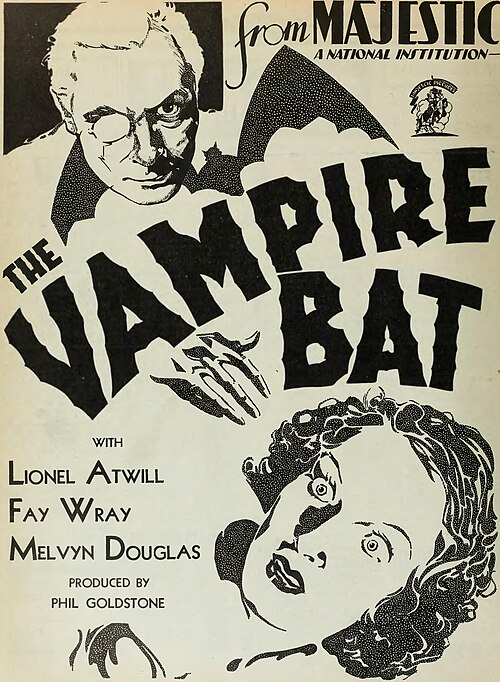
Horror Film Review: The Vampire Bat (dir by Frank R. Strayer)


In 1933’s The Vampire Bat, people are dying in a small German village, victims of blood loss.  A woman named Martha Mueller (Rita Carlisle) was recently attacked by a bat, leading to rumors of a vampire.  When the local town eccentric, a twitchy man named Hermann Glieb (Dwight Frye), argues that bats are actually harmless and admits that he likes bats because they are “soft” and “nice,” people start to suspect that he might be the vampire.  Another man named Kringen (George E. Stone) claims that he was attacked by a vampire and insinuates that it was Glieb.  Glieb may seems like a strange man who likes to collect bats but could he be something even more sinister?

Two town leaders have opposite feelings about the claim that a vampire is attacking the town.  Karl Brettschneider (Melvyn Douglas) is the local police inspector and he deals with facts.  He doesn’t believe in superstition and he initially scoffs at the idea that a vampire is attacking the village.  Meanwhile, Dr. Otto von Niemann (Lionel Atwill) is the town’s doctor.  He’s been treating the victims of the bat attacks and he’s even be letting some of his patients live at his home.  Everyone knows that Dr. von Neimann is a kindly man of science.  Karl is even dating Ruth (Fay Wray), one of Otto’s boarders.  But is the doctor as benevolent as everyone assumes?

When answering that question, consider these four facts:

  1.  Dr. von Neimann is the one who encouraged Kringen to spread stories about a vampire haunting the town, despite the fact that Kringen himself said that he didn’t want to start a panic.
  2. Dr. van Niemann is played by Lionel Atwill.
  3. Glieb is played by Dwight Frye.
  4. Karl is played by Melvyn Douglas.

Indeed, for horror fans, the casting of Lionel Atwill gives the game away.  Lionel Atwill appeared in a number of horror films and it was rare that he wasn’t cast as the villain.  (One of his non-villainous role was as the one-armed Inspector Krogh in The Son of Frankenstein.)  From the minute the viewer sees Atwill, he seem to give off sinister vibes and it’s not really a surprise when he turns out to be less than trustworthy.

As for Dwight Frye, horror fans love him for playing a number of unhinged weirdos, like Renfield in the Lugosi-version of Dracula and the torch-bearing servant in Karloff’s Frankenstein.  Frye was good at playing twitchy types but one thing that all of Frye’s characters had in common is that they were pretty much destined to be victims.  Even when Frye played an unlikeable character,  like in Frankenstein, it was obvious that he was going to end up getting killed at the hands of the Monster.

Finally, Melvyn Douglas was the epitome of propriety in every film in which he appeared.  If Douglas thinks that there is something more going on than just a vampire attacking people, there probably is.  And since we know Douglas can’t be the main bad guy, that pretty much just leaves Lionel Atwill.

The Vampire Bat is a short and enjoyable B-movie that puts an interesting spin on the typical vampire legend.  Though the budget may be low, the cast of Atwill, Douglas, Frye, and Wray can’t be beat and all of them give fully committed performances.  Dwight Frye, in particular, gives one of his best performance as the unfortunate Glieb.  As always, Lionel Atwill makes for an entertaining villain.  At its best, The Vampire Bat comments on the power of hysteria.  Convinced that there is a vampire in their midst, the town goes mad and it directs its anger towards those who are seen as being on the outside, men like Glieb.

The Vampire Bat is more than worthy of your Halloween viewing.

Horror On The Lens: Son of Frankenstein (dir by Rowland V. Lee)


son_of_frankenstein_movie_poster

For those who might have a hard time keeping their Universal monster films straight, 1939’s Son of Frankenstein is the third Frankenstein film, following the original and Bride of Frankenstein.  It’s the first one to have been directed by someone other than James Whale.  It’s the one that features the one-armed policeman.  It’s the one that features Bela Lugosi as a vengeful grave robber named Ygor.  It’s also the final film in which Boris Karloff would play the monster.

And, on top of all that, it’s also a pretty good movie, one that holds up as both a sequel and stand-alone work!

Son of Frankenstein opens decades after the end of Bride of Frankenstein.  (How many decades is open for debate.  I’ve read that the film is supposed to be taking place in 1901 but there’s a scene featuring a 1930s-style car.  Let’s just compromise and say that the film is taking place in 1901 but someone in the village owns a time machine.  I think that’s the most logical solution.)  Henry Frankenstein is long dead, but his name continues to strike fear in the heart of Germans everywhere.  Someone has even tagged his crypt with: “Heinrich von Frankenstein: Maker of Monsters.”

Needless to say, everyone in the old village is a little uneasy when Henry’s son, Wolf von Frankenstein (Basil Rathbone) shows up at the castle.  In fact, they’re so uneasy that the local constable, Krogh (Lionel Atwill), pays Wolf and his family a visit.  Krogh explains that, when he was a child, the Monster ripped his arm out “by the roots.”  AGCK!

(That said, that really doesn’t sound like the Frankenstein Monster that we all know and love, does it?  I suspect there’s more to the story than Krogh is letting on…)

Wolf explains that he has no plans to bring the Monster back to life.  He then sets out to do just that.  Wolf wants to redeem Henry’s reputation and the only way to do that is to prove that Henry was not misguided in his quest to play God.  Helping Wolf out is Ygor (Bela Lugosi).  Ygor is a former blacksmith who was due to be hanged but, because of a malfunction with the gallows, he just ended up with a disfigured neck.

It turns out that Ygor happens to know where the Monster’s body is being hidden.  When Wolf brings the Monster back to life, he quickly discovers that Ygor’s motives weren’t quite as altruistic as Wolf originally assumed.  It turns out that Ygor wants revenge on the jury that sentenced him to death and now, he can use the Monster to get that revenge.

As for the Monster, he no longer speaks.  Instead, he just angrily grunts and he kills.  Whatever kindness he developed during the previous film was obviously blown up with Elsa Lanchester at the end of Bride of Frankenstein.  On the one hand, it’s fun to see Karloff as the monster.  On the other hand, it’s impossible not to regret that he doesn’t get to do much other than stumble around, grunt, and strangle people.  There are only two scenes where Karloff gets to show any real emotion and, in both cases, he does such a great job that you can’t help but regret that the monster is such a one-dimensional character in Son of Frankenstein.

But no matter!  Regardless of how the film uses (or misuses) the Monster, it’s still an entertaining 1930s monster film.  Basil Rathbone does a great job as the imperious but ultimately kindly Wolf von Frankenstein.  And Bela Lugosi’s natural theatricality makes him the perfect choice for Ygor.  To be honest, I actually think Lugosi does a better job as Ygor than he did as Dracula.  I know that’s blasphemy to some but watch the two films side-by-side.  Lugosi is clearly more invested in the role of Ygor.  Considering that Lugosi reportedly felt that he was mistreated in Hollywood, it’s tempting to wonder if some of his own anger informed his performance as the perennially mistreated and bitter Ygor.

Son of Frankenstein closed out the Karloff Frankenstein trilogy.  When Frankenstein’s Monster made his next appearance, he would be played by the same actor who later took over the role of Dracula from Lugosi, Lon Chaney, Jr.

(And interestingly enough, Lugosi would subsequently take over the role of the Monster from Chaney.  But that’ll have to wait for a future review…)

Horror Film Review: Frankenstein (dir by James Whale)


frankenstein_poster_1931

Pity poor Frankenstein.

No, not Victor von Frankenstein, though he certainly suffered greatly for playing God.  How much he suffered depends on which version of the story you see or read.  If you’ve read the book, you know that Victor lost his family, his love, his mentor, his best friend, and eventually his own life.  Victor is usually a bit more resilient in the films.  For instance, if you go by what we’ve seen in the Hammer films, Baron Frankenstein was pretty much indestructible.  The only thing he lost was his sanity, sacrificed as he continually insisted on making the same mistake over and over again.

And when I say “Pity poor Frankenstein,” I’m not referring to the monster either, though he certainly deserves some sympathy as well.  The monster never asked to be brought to life.  He may have destroyed castles and killed people and tossed little girls into a lake but Frankenstein’s Monster rarely seemed to mean any harm.  He was just scared, confused, and often abused.

Instead, when I say pity poor Frankenstein, I’m referring to the 1931 film.  It’s a classic horror film, one that, after 85 years, still holds up remarkably well.  It’s probably the best directed of all the Universal horror films, with James Whale bringing his own dark wit and idiosyncratic style to the film.  As was often the case with films of the era, some of the performances are better than others but no one can find fault with Boris Karloff’s definitive portrayal of Frankenstein’s monster.

And yet, for a lot of filmgoers, Frankenstein will always just be that movie where Colin Clive rants, “It’s alive!  IT’S ALIVE!”  That scene is justifiably famous but it always bothers me when it shows up as an isolated clip, devoid of context.  I’ve seen it used in documentaries.  I’ve seen it used on snarky news programs where it’s almost always used to poke fun at someone.  I’ve even seen it used in a car commercial.

You’ve seen it too.  It’s one of those scenes that everyone has seen, regardless of whether or not they’ve sat through the entire movie:

When you watch this scene without any context, it’s easy to smirk.  You might assume that the entire film is Colin Clive ranting and Dwight Frye snorting.  It’s only after you’ve seen the entire film that you appreciate Clive’s performance.  Throughout the entire first part of the film, Colin Clive plays Henry Frankenstein as being unstable but also rather withdrawn.  He’s almost vampiric, hiding inside of his laboratory all day and only coming out at night to rob graves with the hunchbacked Fritz (Dwight Frye).  He’s almost a recluse, which is why his fiancée, Elizabeth (Mae Clarke) asks his best friend, Victor (John Boles), and his mentor, Dr. Waldman (Edward Van Sloan, who also played Van Helsing in Dracula) to check in on him.

When the monster does move its hand and Clive shouts, “It’s alive!,” it’s the first sign of true emotion that Frankenstein has shown through the entire film.  He’s spent a lifetime dreaming of playing God and, now that he has, it overwhelms his mind.  Much like poor Ralph Norton in The Mummy, Clive sees something that defies all reason and he has a breakdown.

I have to admit that, for me, the first third of the film drags.  That may not have been as much of a problem in 1931, when audiences were seeing the story for the first time and didn’t already know what was going to happen.  In 1931, the slow start undoubtedly helped to build up suspense.  But, when seen today, there is a temptation to say, “Get on with it!”

(Of course, I tend to say that with all Frankenstein movies, because I’m impatient and there always seems to be an endless number of scenes people digging graves and stealing brains until we finally get to the good part.  If anything, the 1931 Frankenstein doesn’t take as long to get going as some of the later Hammer films, many of which treated the monster as almost an afterthought.)

Fortunately, Frankenstein does get on with it.  When the monster finally comes to life and Colin Clive has his moment of divine madness (“This is what it feels like to be God!”), the film shifts in tone.  If anything it becomes a bit of a dark comedy.  Henry (who is noticeably more subdued after his outburst, a bit like a drug addict who is only now starting to come down after being awake for a week) and his friends now have to not only hide the monster but try to figure out how to deal with it.  Every few minutes, it seems like another villager or Frankenstein relative is dropping by the castle.  Having created life, Henry now has no idea what to do with it.  Being God isn’t as easy as it looks.  Having created life, all Henry can now do is keep the doors locked and attempt to go back to living a relatively normal life.  In this case, that means preparing for his wedding.

It’s not until the sadistic Fritz torments the frightened monster with a torch that this horror classic truly becomes a horror film.  And it’s significant that the true monster here is not Frankenstein’s Monster but instead Fritz.  When the monster kills Fritz, he does it out of self-defense.  When he strangles Dr. Waldman, it’s because Waldman was about to cut into him with scapel.

And then there’s the little girl.  How this scene must have shocked audiences in 1931!  It’s still shocking today, because we’re not used to children dying in movies, not even horror movies.  Of course, the monster doesn’t mean to hurt the girl.  The girl is the first person to show the monster any sort of kindness.  It’s just that the monster doesn’t understand that the girl won’t float like the flowers.

The sequence where the girl’s father carries her body into the town square is perhaps one of the most devastating ever filmed.   Not only does the father’s grief contrast with the happiness of the villagers but it also contrasts with the attitude of Henry and Elizabeth who are busy preparing from their wedding, ignorant of what Henry’s creation has done.

Or, at least, they are until the monster confronts Elizabeth in her bedroom.

karloff-boris-frankenstein_11

I love that dress.

It all ends, of course, with a confrontation between Henry and his monster and a windmill being set aflame.  There’s also a happy coda that, in the best tradition of horror, feels a bit tacked on.  Fortunately, those of us who know our film history know that the story didn’t end with this film.  It continued with The Bride of Frankenstein, which I’ll be reviewing tomorrow.

As for Frankenstein, it’s a classic and it’s pretty much required viewing for any film lover.  Boris Karloff’s performance as the confused and often child-like monster is both poignant and menacing.  Watching the film, you just wish that the world had been nicer to him.

(Then again, that approach didn’t exactly work out well for the little girl with the flowers…)

Frankenstein is so much more than just Colin Clive shouting, “It’s alive!”  If you haven’t actually sat down watched the entire movie from beginning to end, you owe it to yourself to do so today.

http://www.youtube.com/watch?v=McUce_xwxeA

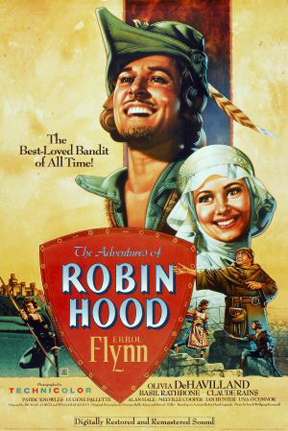
Cleaning Out The DVR #23: The Adventures of Robin Hood (dir by Michael Curtiz)


(For those following at home, Lisa is attempting to clean out her DVR by watching and reviewing 38 films by this Friday.  Will she make it?  Keep following the site to find out!)

Robin_hood_movieposter

Flamboyant.  Athletic.  Joyous.  Determined.  Handsome.  Outspoken.  Bigger than life.  Revolutionary.  Anarchist.  Sexy.  Libertarian.  Is there any doubt why Errol Flynn remains the definitive Robin Hood?

And. for that matter, is there any doubt why the 1938 film The Adventures of Robin Hood remains not only the definitive Robin Hood film but also one of the most influential action films in history?

The Adventures of Robin Hood tells the story that we’re all familiar with.  The King of England, Richard The Lionhearted (Ian Hunter), is captured while returning from the Crusades.  His brother, King John (Claude Rains, in full autocratic villain mode), usurps the throne while Richard is gone and immediately raises taxes.  He claims that he’s only doing this to raise the money to set Richard free.  Of course, the real reason is that John is a greedy tyrant.

The only nobleman with the courage to openly oppose John is Sir Robin of Locksely (Errol Flynn).  Sir Robin protects his fellow citizens from John’s main henchman, Sir Guy of Gisbourne (Basil Rathbone, also in full autocratic villain mode).  In fact, Robin is so brave that, on multiple occasions, he even enters Sir Guy’s castle so that he can specifically tell King John and Sir Guy that he has no use for their laws.  This, of course, always leads to Robin having to make a dramatic escape while arrows flies and swords are unsheathed all around.

And through it all, Robin Hood keeps smiling and laughing.  He’s a wonderfully cheerful revolutionary.  He may be fighting a war against a ruthless and unstoppable enemy and he may be the most wanted man in England but Robin is determined to have fun.  One need only compare Robin to his humorless foes to see the difference between freedom and bureaucracy.

(We could use Errol Flynn’s Robin Hood today, though I suspect our government would just blow him up with a drone and then issue a statement about how, by stealing money from the rich and giving it to the poor, Robin was keeping the government from being able to rebuild bridges and repair roads.)

When Robin isn’t exposing the foolishness of organized government, he’s hanging out in Sherwood Forest.  He’s recruiting valuable allies like Friar Tuck (Eugene Pallette) and Little John (Alan Hale, Sr.)  He’s playing constant pranks and promoting revolution and, to his credit, he’s a lot more fun to listen to than that guy from V For Vendetta.  He’s also romancing Maid Marian (Olivia de Havilland) and good for him.  Two beautiful people deserve to be together.

Even better, he’s doing it in glorious Technicolor!  There’s a lot of great things about The Adventures of Robin Hood.  The action scenes are exciting.  The music is thrilling.  The film is perfectly cast.  Errol Flynn may not have been a great actor but he was a great Robin Hood.  But what I really love about the film is just the look of it.  We tend to take color for granted so it’s interesting to watch a film like The Adventures of Robin Hood, one that was made at a time when color film was something of a novelty.  For those of us who spend a lot of time talking about how much we love old school black-and-white, The Adventures of Robin Hood is a film that says, “Hey, color can be great too!”

But what I mostly love about The Adventures of Robin Hood is just the pure joy of the film.  Just compare this Robin Hood to the grimly tedious version played by Russell Crowe.

(True, nobody in The Adventures of Robin Hood shouts, “I declare him to be …. AN OUTLAAAAAAAAAAAAWWWWWWWW!”  Actually, now that I think about it, Ridley Scott’s Robin Hood would have worked much better if Oscar Isaac and Russell Crowe had switched roles.)

The Adventures of Robin Hood was nominated for best picture and it probably should have won.  However, the Oscar went to Frank Capra’s You Can’t Take It With You.

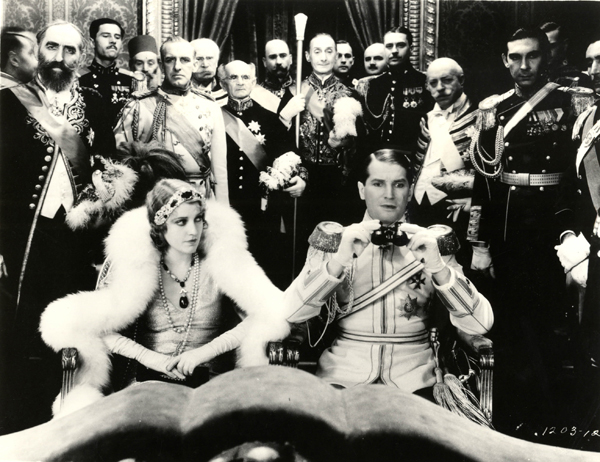
Lisa Reviews An Oscar Nominee: The Love Parade (dir by Ernst Lubitsch)


Love_Parade

Recently, as a part of TCM’s 31 Days of Oscar, I watched the 1929 musical The Love Parade.

Now, I have to admit that this was one of those movies that I started watching with a lot of pre-conceived notions.  While I happen to enjoy movies from all eras, I sometimes have a hard time adjusting to the style of the films that were made in the early days of the sound era.  Often times, it’s obvious that these films were made by directors and actors who were still struggling to make the transition from silent to sound cinema.  As a result, it’s not uncommon for films of this era to come across as being stiff and stagey.

But I needn’t have worried.  While The Love Parade does have its occasionally stagey moments, it actually holds up remarkably well.  For a film that was made 89 years ago, The Love Parade is still a lot of fun and surprisingly entertaining.  It helps, of course, that The Love Parade was made before the adoption of the infamous Production Code and, as such, it’s allowed to show off a racy sense of humor that keeps the film from feeling too dated.

As for the film itself, it deals with Queen Louise (Jeanette MacDonald), the young ruler of the European kingdom of Sylvania.  Despite the fact that Louise is a capable ruler, her subjects worry that she has yet to get married.  When her advisors inform her that she is running the risk of never marrying, Louise dismisses their concerns in a very Pre-Code way.  She lifts up her skirt, shows off her left leg, and says that there’s only one other leg as perfect as her left leg.  She then extends her right leg.  Since I basically do the same thing every single day, that was the moment when I realized that she might be the Queen and I might just be an outspoken redhead but I could still totally relate to Louise.

After showing off her legs, Louise deals with the issue of Count Alfred (Maurice Chevalier), a diplomat at Sylvania’s Paris embassy.  Apparently, Alfred ended up having an affair with every woman at the embassy (including the ambassador’s wife) and he has been recalled to Sylvania.  After reading the details of his sexual exploits, Louise decided that she has to meet Alfred for herself.

(And again, we’re reminded that this is a Pre-Code film.)

Alfred and Louise meet, fall in love, and marry.  However, Alfred has a hard time dealing with the fact that, as Queen, Louise has all the power in their marriage.  Even his attempts to draw up an economic plan are dismissed by the Queen’s advisors.  Feeling emasculated, Alfred sings a song called Nobody’s Using It Now.

Three guess what “it” is.

Can this marriage be saved?  Louise’s maid (Lillian Roth) and Alfred’s servant (Lupino Lane) are determined to make sure that it can be!

If the plot description and my review of The Love Parade sounds in any way similar to my review of The Smiling Lieutenant, that’s because both films were directed by Ernst Lubitsch.  In fact, The Love Parade was Lubitsch’s first sound film and, in many ways, his assured direction here played a huge role in helping Hollywood make the transition from the silents to the talkies.  Both Jeanette MacDonald and Maurice Chevalier give assured (and sexy) performances that hold up well today and the film’s opulent sets and costumes remain a visual delight.  The end result feels like a wonderfully entertaining fairy tale.

The Love Parade was nominated for best picture but it lost to the far more grim All Quiet On The Western Front.  But, regardless of what awards it won or did not win, The Love Parade is a delightful little film that works both as a historical document and a terrifically entertaining musical comedy.