Horror Film Review: Oasis of the Zombies (dir by Jesus Franco)


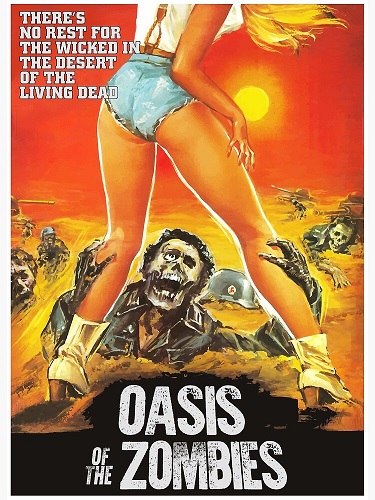
1982’s Oasis of the Zombies opens with two girls in a jeep who just happen to be driving through the middle of a desert in Africa.  When they come across an oasis, they decided to stop so that they can walk around and allow the camera to focus on their rear ends as they explore the area while wearing short shorts.  Unfortunately, it turns out that they’re not very good when it comes observing details because they totally miss the skulls and the pieces of metal that have been decorated with swastikas.  One girl thinks that the oasis is creepy.  The other wants to keep exploring.  Decayed hands suddenly rise out of the ground and attack both of them.

(Oddly enough, the girls reminded me of myself and my BFF, Evelyn.  I called Evelyn after I watched the movie and we both agreed that getting attacked by desert zombies is definitely something that will probably happen to us in the near future.)

After the two girls are zombied, the film cuts to an old man named Captain Blabert (Javier Maiza) telling another man named Kurt Meitzell (either Henri Lambert or Eduardo Fajardo, depending on which version of the film you see) about a shipment of Nazi gold that, for the past few decades, has been sitting in the middle of an oasis in the desert.  Kurt kills Blabert and then heads off with his wife (Myriam Landson or Lina Romay, again depending on which version of the film you see) to track down the gold.

We then cut to London, where college student Robert Blabert (Manuel Gelin) receives not only a message informing him of the death of his father, Captain Blabert, but also a journal that leads to several flashbacks of Captain Blabert serving in Africa during World War II and getting involved with the Nazis and a sheik.

Eventually, Robert and several of his friends end up going to Morocco, where they randomly meet two filmmakers and everyone decides to head into the desert to search for the oasis and the gold.  Fortunately, the oasis and the gold are both easy to find.  However, the oasis is still defended by the Nazis who were assigned to transport the gold.  Of course, the Nazis are all zombies now!

Oasis of the Zombies is a Jesus Franco film and, like many of his later films, it’s more than a little disjointed.  The film’s scenes don’t always seem to follow any sort of conventional narrative logic.  Instead, the scenes often feel as if they’ve been randomly assembled and the end result is a low-budget zombie film that plays out like a fragmented dream, one that seems to feature more stock footage than actual plot.  Franco himself frequently seems as if he’s having trouble concentrating on just what exactly Oasis of the Zombies is supposed to be about.  Random zoom shots are mixed in with shots of a spider building its web and, more than once, the action comes to a stop so the film can turn into an extended travelogue.  As was so often the case with Franco’s later films, some of the shots are striking.  There’s a shot of a man standing on a roof announcing the call to prayer that achieves a surreal grandeur and, as bad as the zombie makeup is, the shots of the living dead silhouetted in the desert are effective.  But for every effective shot, there’s shots of people looking straight at the camera.  Franco was director who could both frame a memorable shot and also be remarkably sloppy.  As such, his aesthetic transcends conventional definitions of good and bad.  Viewers either get him and his semi-improvised excursions into existential horror or they don’t.

Myself, I thought there were enough good shots in Oasis of the Zombies to make it worth watching.  Certainly, it’s not comparable to Franco’s better films, like The Awful Dr. Orlof or Faceless.  But it’s also not quite as bad as its online reputation might suggest.  The zombies relentlessly emerging in the desert are creepy and, in its better moments, the film does capture the feeling of being stranded in the middle of nowhere.  One could argue that the film actually does have a deeper meaning, with the Nazi zombies representing the fact that, for all of its defeats, the hate that fueled the Nazis is still alive and still dangerous.  In the end, it’s a zombie flick, featuring less than impressive zombie makeup and some adequate gore and it’s undoubtedly a Jess Franco film.  There’s no mistaking Franco’s vision for anyone else’s.

Finally, there are two versions of the film.  The French-language version features Henri Lambert and Myriam Landson as Kurt and his wife.  The Spanish-language version features Franco regulars Eduardo Fajardo and Lina Romay as the couple.  Other than the scenes with Kurt, the two versions of Oasis of the Zombies are pretty much the same.  As far as I know, the French-language version is the only one that is available in the States.  That’s the one that I watched for this review.
International Film Review: Revenge in the House of Usher (dir by Jess Franco)


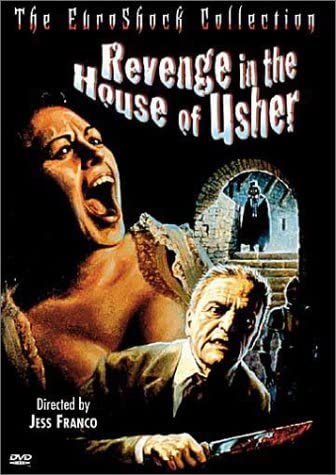
In the 1982 Spanish horror film, Revenge in the House of Usher, Antonio Mayans plays Dr. Alan Harker.  Harker receives an invitation to visit the estate of his former mentor, Prof. Eric Usher (Howard Vernon).  Usher is elderly and in poor health.  He’s attended to by several mysterious servants, including his physician, Dr. Seward (Daniel White).  While trying to figure out what has led to Prof. Usher’s current state, Harker discovers that….

Well, here’s where it gets confusing, as things tend to do whenever one tries to discuss the later films of director Jess Franco.  There are actually three different versions of Revenge In the House of Usher and each one of them tells a totally different story.  In the first version, Usher is revealed to have been a decadent, Giles de Rais-style serial killer who has murdered hundreds of women through the years and who is now being haunted by their vengeful ghosts.  Apparently, that version didn’t go over well when it made its debut at the 1983 Festival Internacional de Madrid de Cine Imaginario y de Ciencia-ficción.  The audience booed and laughed and Franco couldn’t convince any distributors to purchase the film from him.

So, Franco filmed thee more scenes that established that Usher wasn’t just a serial killer but that he was also a vampire!  (This explains why two characters in this Edgar Allan Poe adaptation were suddenly given names from Dracula.)  This reception of this version was not considered to be much of an improvement on the reception of the version where Vernon was just a serial killer.

With the backing of Eurocine, Franco then put together a third version of the film.  This time, he turned it into another Dr. Orlof film, though Howard Vernon’s character was still referred to as being Prof. Usher.  In this version, Harker discovers that Usher and his elderly servant Morpho (Olivier Mathot) have spent years abducting women from the village and using their blood to keep Usher’s daughter alive.  This leads to a solid 15 minutes of flashbacks to Usher’s past activities, all of which are taken directly from The Awful Dr. Orlof.  Just as in the other two version of the film, Usher is haunted by the ghosts of his victims.  As his mental state deteriorates, so does his castle.

As far as I know, the third version of the film is the only one that currently exists.  The first version is now considered to be lost.  For his part, Franco claimed that the first version was a misunderstood masterpiece but he was still willing to turn it into another Orlof film so that he could at least make some money off of it.  Franco may have been an often frustrated artist but he was also a pragmatist.

Considering its production history, it’s not surprising that Revenge in the House of the Usher is a bit of a disjointed film.  It’s only 91 minutes long (and 15 of those minutes is taken up with black-and-white footage from The Awful Dr. Orlof) but this film still feels like it has several false endings.  There were so many times that I thought the film had to be over, just for it to keep going.  Watching the film, one can sense that Franco is willing to try almost anything to finally wrap the film’s somewhat incoherent story up.  That said, Howard Vernon brings the right amount of haughty decadence to the role of the decaying Usher and Franco’s decision to film in an actual castle (and to largely utilize natural light) does give the film perhaps a bit more atmosphere than one would expect.  This is a lesser Franco film but it does do a good job of capturing the bizarre logic of dreams.  The film is, at times, so incoherent that it’s actually rather fascinating.

Following this film, Vernon would play Dr. Orloff one final time, in Franco’s surprisingly entertaining Faceless.

The Fabulous Forties #45: Love Laughs At Andy Hardy (dir by Willis Goldbeck)


LLAAH

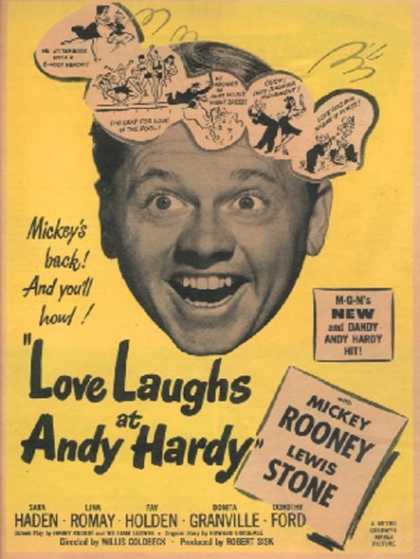
I cringed a little when I saw that the 45th film in Mill Creek’s Fabulous Forties box set was 1946’s Love Laughs At Andy Hardy.  

This was because I had never seen an Andy Hardy film before but I did know enough to know that, starting in the 1930s, MGM made a series of films that featured Mickey Rooney in the role of a “nice, young man” named Andy Hardy.  Andy was a well-meaning kid who grew up in Middle America under the watchful eye of his father, Judge Hardy (Lewis Stone).  What little I had heard of the Andy Hardy films led me to suspect that they were very much a product of their time and had not aged particularly well.

Having now watched Love Laughs At Andy Hardy … well, I can confirm that it is a product of its time.  And it is definitely an uneven film, though perhaps I would have felt differently if I had seen any of the other Andy Hardy films.  (Love Laughs was the 15th film about Andy Hardy and it pretty much assumes that the viewer already knows who Andy and all of his friends and family are.)  But I will say this: Mickey Rooney was a really good actor.  In fact, as I watched Love Laughs At Andy Hardy, I was shocked by just how good a performance Rooney gave.  When I think of Mickey Rooney — well, to be honest, it’s rare that I ever do.  But when I do, it’s usually in relation to the exploitation films he made after he was a star.  These were movies like The Manipulator or Silent Night Deadly Night 5, all of which feature an elderly and obviously unwell Mickey acting up a storm.  In contrast to those film, in Love Laughs At Andy Hardy, Mickey gives a totally empathetic and, at times, even subtle performance.   Even by contemporary standards, his performance feels real and, as I watched, I started to understand how there actually could have been 16 separate films about Andy Hardy.  You really do find yourself caring about the little guy,

As for this film, it opens with Andy returning from serving in World War II.  Apparently, he left college to enlist in the army.  Now that he’s back in America, he’s ready to return to college and ask his old girlfriend, Kay (Bonita Granville) to marry him.  However, to Andy’s shock and disappointment, Kay has moved on and has other plans.  Why, it’s almost enough to make Andy want to drop out of school, give up his dreams of becoming an attorney, and try to find work as an engineer in South America!

Fortunately, Judge Hardy is there to talk some sense into his son.

It’s all fairly predictable and, as I said before, definitely uneven.  I get the feeling that a lot of the scenes in Love Laughs At Andy Hardy were meant to serve as call backs to previous films in the series.  Watching this film without a context can lead to a lot of confusion.  But, again, it’s all saved by Mickey Rooney’s performance.  While I can’t really give this film a strong recommendation, I imagine if you’re fan of Rooney’s or the Andy Hardy films, you’ll enjoy it.

Perhaps the best scene in the film comes when Andy is set up on a blind date with a girl named Coffy (Dorothy Ford).  When Andy goes to Coffy’s dorm to pick her up, he can’t understand why all the other girls keep looking at him and laughing.  However, once Coffy shows up, it quickly becomes obvious.  Coffy is 6’2 while Andy is a full foot shorter.

However, when Andy and Coffy arrive at the college dance, they defy all the laughs and the snide remarks.  Instead of surrendering to the expectations of snarky society, they perform a dance to end all dances and I’m going to conclude this review by sharing it below.

Enjoy!

Embracing the Melodrama Part II #34: Nightmares Come At Night (dir by Jess Franco)


nightmarescome2big For the past two weeks, I’ve been in the process of reviewing 126 cinematic melodramas.  Embracing the Melodrama Part Two started in 1927 with a look at Sunrise and now, 33 reviews later, we’ve finally reached the 70s.  And what else can I say about that other than to exclaim, “Yay!”

Seriously, a lot of good films were released in the 1970s.

We begin the 70s by taking a look at a film from the iconic and (to some people) infamous Spanish director Jess Franco.  Over the course of 54 years, director Jesus Franco Manera was credited with directing 203 films.  In all probability, the workaholic Franco directed a lot more than he’s been credited with.  As I wrote about Franco in my previous review of Female Vampire: “Among critics, Franco is usually either dismissed as a total hack (and/or pervert) or embraced as the living embodiment of the auteur theory.  Though no one’s quite sure how many films Franco has directed, Franco himself has estimated that he’s directed more than 200 films and, for the most part, he has financed and distributed them all on his own.  Franco has worked in every genre from thriller to comedy to hardcore pornography, but he is probably best known for directing low-budget, occasionally atmospheric erotic horror films.”

Now, I have to admit that I feel a little guilty about using a paragraph from an old review in a new review.  (And, as you may have noticed, I reviewed Female Vampire before Franco passed away in 2013.)  But, then again, it feels somewhat appropriate because Franco was famous for and unapologetic about taking bits and pieces of old and unfinished films and inserting them into new films.  That’s certainly the case with his 1970 film Nightmares Come At Night.

Nightmares Come At Night opens with Anna (Diana Lorys) living in an atmospheric mansion with her lover, Cynthia (Colette Giacobine).  Anna is haunted by frequent nightmares where she sees herself killing strange men with a spear.  Cynthia arranges for Anna to talk to an enigmatic doctor (Paul Muller).  Anna tells the doctor about how she was once a famous erotic dancer until she met Cynthia.  At this point, we get several lengthy flashbacks of Anna dancing in an oddly desolate club, all of which adds to the film’s ennui-drenched atmosphere.

Talking to the doctor doesn’t do Anna much good and she continues to have her nightmares except now the nightmares also seem to feature men giving lengthy monologues.  It soon becomes obvious that the neurotic Anna is being held as a virtual prisoner in the house by the dominating Cynthia.

(It’s a bit like a Lifetime movie, except everyone’s naked for 85% of the film’s running time.)

Meanwhile, we occasionally get shots of two people staring out of an unrelated window.  Eventually, we realize that they’re supposed to be Cynthia’s neighbors.  One of them is played by Franco’s frequent muse, Soledad Miranda.  (Miranda would tragically die in an automobile accident in 1970.)  Anyone who is familiar with Franco’s work will immediately notice that Miranda’s look in Nightmares was later duplicated by Lina Romay in Female Vampire.  The neighbors are obsessed with Anna.  As the film progresses, we discover that, when not looking out the window, they spend most of their time lying on a filthy mattress.  At one point, the camera zooms in for a close-up of the graffiti that’s been written on the wall over the mattress.

LIFE IS ALL SHIT, it reads.

To a certain extent, it’s pointless to say that Nightmares Come At Night is a disjointed film because almost all of Franco’s films were disjointed.  That’s actually what gave even the weakest of his films an odd and memorably dreamlike feel.  But Nightmares Come At Night is even more disjointed than usual.  That’s because Nightmares Come At Night was made out of a mix of footage shot for other films.  The scenes with Soledad Miranda were for an earlier, unfinished film.  Those scenes were combined with the footage of Anna, Cynthia, and the doctor.  The end result is a film that doesn’t necessarily much sense but you still have to admire Franco’s refusal to let any footage go to waste.

Ultimately, as with so many Franco films, Nightmares Come At Night is less about plot and all about atmosphere.  This is a film that is full of ennui and existential decadence.  It’s not one of Franco’s best films but, much like last year’s underrated California Scheming, it’s a bit of a minor existential classic when taken on its own terms.

(Please note: the trailer below is mildly NSFW.  Watch at your own risk.)

The Daily Grindhouse (Horror Edition): Female Vampire (dir. by Jess Franco)


My wonderful and loyal readers, I fear that I have failed you.  How is it, with my love of both grindhouse and Eurosleaze cinema, that I have yet to review a Jess Franco film on the site?  Halloween seems to be the perfect time to correct that oversight by taking a look at Franco’s infamous 1973 horror film, Female Vampire.

To truly “appreciate” a film like Female Vampire, it helps to know a little something about Jess Franco.  Working under a variety of pseudonyms, Spanish-born Jesus Franco Manera has been making films for over 60 years.   Among critics, Franco is usually either dismissed as a total hack (and/or pervert) or embraced as the living embodiment of the auteur theory.  Though no one’s quite sure how many films Franco has directed, Franco himself has estimated that he’s directed more than 200 films and, for the most part, he has financed and distributed them all on his own.  Franco has worked in every genre from thriller to comedy to hardcore pornography, but he is probably best known for directing low-budget, occasionally atmospheric erotic horror films like Female Vampire.

The opening of Female Vampire pretty much epitomizes everything that people love and hate about Jess Franco as a director.  The film begins with a series of ominous shots of a misty forrest.  The forest feels both beautiful and desolate at the same time and Franco’s camera lingers over the fog, building up an atmosphere of both mystery and melancholy.  Suddenly, we see one lone figure walking through the forest.  Irina (played by frequent Franco star Lina Romay) emerges from the fog, naked except for a cape and a belt.  The camera follows Irina as she walks through the mist.  When Irina stops and faces the audience, the camera zooms in to a close-up of her face and her body.  While Franco’s aim here is obviously to cater t0 the sexual fantasies of his predominately male audience, it’s still a remarkably strong scene because Romay faces the camera with such confidence that her nudity feels less like exploitation and more like empowerment.  (Romay was, like me, a self-described exhibitionist.)  Once Franco’s camera zooms away from Irina, she then starts to confidently approach the camera (and the audience as well).  She gets closer and closer to the camera until finally … she accidentally bumps her head on the lens.

That, for lack of a better example, totally sums the aesthetic of Jess Franco.  When you watch a Franco film, you’re left with the impression that Franco simply turned on the camera and recorded whatever happened to happen in front of it.  Occasionally, he managed to capture something unique and dramatic and just as often, he filmed someone bumping into the equipment or staring straight at the camera.  Whether he liked the spontaneity that came from an unexpected mistake or he just didn’t have enough money in his budget to do a second take, Franco would more often than not include these mistakes in his final film.

As for the rest of Female Vampire, it’s eventually established that. along with being a vampire, Irina is a countess and also a mute.  (At one point, we do hear her inner thoughts, a monologue in which she tells us, “I earnestly wish an end would come to this bloody race I am forced to run.”)  Several different cuts of Female Vampire have been released over the years and depending on which version you see, Irina either has to either regularly drink blood or drink semen in order to survive.  (“It was as if his potency was sucked out of him,” as the coroner puts it.)

While Irina spends all of her time wandering around a depressing resort town and seducing various victims, a poet (Jack Taylor) searches for her.  This poet — who spends a lot of time staring off into the distance and delivering inner monologues about walking down this road we call life — is determined that he and Irina are meant to be together.

There are many different version of Female Vampire currently in circulation.  For instance, a heavily-edited version was released in the U.S. as The Bare-Breasted Countess.   While Franco’s director’s cut lasts close to two hours, there are other versions that barely clock in at 70 minutes.  There’s a hard-core version, a soft-core version, and even a version that features close to no sex at all.  The version I saw was the DVD released by Image Entertainment.  That version is reportedly close to Franco’s original.

As is typical for a Franco film, not much happens in Female Vampire and what does happen doesn’t make much sense.  But, oddly enough, that actually worked in the film’s favor.  By ignoring things like plot and logic and by focusing on the film’s visuals, Franco made a film that literally feels like a dream.  Every scene is filled with an atmosphere of pure ennui and, when coupled with charisma of Lina Romay and Jack Taylor,  the end result is a film that’s strangely compelling.