Retro Television Review: Money to Burn (dir by Robert Michael Lewis)


Welcome to Retro Television Reviews, a feature where we review some of our favorite and least favorite shows of the past!  On Sundays, I will be reviewing the made-for-television movies that used to be a primetime mainstay.  Today’s film is 1973’s Money To Burn!  It  can be viewed on YouTube.
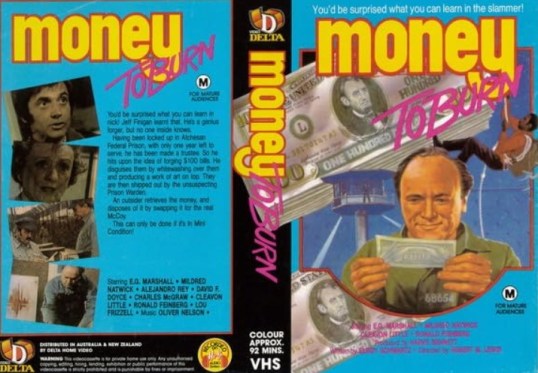
For someone who has spent the past few years in prison, Jed Finnegan (E.G. Marshall) sure is a nice old man!  He runs the prison print shop and all of the other prisoners love him.  The guards trust him.  The warden (David Doyle) is really impressed with Jed’s watercolors and is interested in helping Jed launch a career as an artist after he gets out of prison.  Every weekend, Jed’s wife, Emily (Mildred Natwick), comes up to the prison with a picnic basket and she has lunch with her husband.  Jed admits that his wife is not a particularly good cook but it’s obvious that he really looks forward to her visits.

Emily’s sweet nature keeps a lot of people from noticing that she is just as cunning and clever a criminal as Jed ever was.  She knows that Jed had printed up one million dollars in counterfeit bills and she is looking forward to helping him exchange the fake money for real money.  Jed’s plan is to steal the payroll of the local army base and just leave the fake money in place of the real money.  However, Jed’s been in prison for so long that he doesn’t know that the military no longer pays anyone in cash.  Everyone’s paying everyone by check!

(This film is very much from the 70s.  While Jed and Emily were shocked to discover that people were no longer being paid in cash, I was shocked to discover that they were being paid by check.)

Working with two recently released ex-cons (played by Cleavon Little and Alejandro Rey), Emily tries to find a new way to switch out the money.  She discovers that there’s an incinerator nearby where the government burns the currency that it no longer needs.  But it won’t be easy to break in and make sure that the right money get burned….

And that’s not even mentioning the trouble of getting the fake money out of the prison in the first place!

Money to Burn is likable mix of comedy and (very mild) action.  It’s a film about criminals but they’re very likable criminals who go out of their way not to hurt people.  Emily is even happy about the idea of not only stealing a million dollars but also helping the government out by taking the old currency off their hands.  Marshall, Natwick, Little, and Rey all give such warm and cheerful performances that you can’t help but hope that they get away with their scheme.  The film, which deftly balances comedy and drama, clocks in at a brisk 73 minutes and it has an absolutely wonderful twist ending.  This is definitely a heist film that deserves to be better known.
Retro Television Reviews: Death Sentence (dir by E.W. Swackhamer)


Welcome to Retro Television Reviews, a feature where we review some of our favorite and least favorite shows of the past!  On Sundays, I will be reviewing the made-for-television movies that used to be a primetime mainstay.  Today’s film is 1974’s Death Sentence!  It  can be viewed on YouTube!

There’s been a murder!

A young woman has been strangled in her own home.  The nosy neighbor (Hope Summers) testifies that the woman often argued with her woman and that she heard the woman yelling on the night of the murder.  The husband, John Healy (Nick Nolte), is found in a neighborhood bar and, when he’s brought back to his house, his drunken reaction to seeing his dead wife doesn’t do much to keep him from looking totally guilty.

However, the viewer knows that John is innocent because the viewer has already seen that the woman was murdered by Don Davies (Laurence Luckinbill), the man with whom she was having an affair.  She demanded that he leave his wife for her and Don, realizing that his cheating was about to revealed, responded by strangling her.

Don’s wife is Susan Davies (Cloris Leachman), who knows that she and Don have been going through a rough patch but who certainly had no idea that Don was cheating on her.  Shortly after the murder, Susan is called up for jury duty.  She’s placed on the jury and told that she will be an important part of a major trial.  As a result, she and the other jurors will be sequestered in a hotel….

And who is the defendant in this trial?  John, of course!

As opposed to the other members of the jury, who are ready to convict John even before the first bit of testimony is heard, Susan pays attention to what is said in the courtroom.  She listens to Lubell (Alan Oppenheimer), the prosecutor.  She listens to Tanner (William Schallert), the defense attorney.  She comes to believe that John is innocent but will she be able to hold her own against the rest of the jury?  And will she ever figure out that the murder was actually committed by her husband?

It’s an intriguing premise, even if it is a bit far-fetched.  I mean, it really is an amazing coincidence that Susan just happened to end up on the jury for a case involving a murder that was actually committed by her husband.  However, this is a made-for-television movie and, as soon as “Produced by Aaron Spelling” appears on the screen, most viewers should be savvy enough to know what they’re getting into.  Instead, the main problem with the film is that it opens by showing us who the murderer is.  Therefore, there’s really zero suspense as to who actually committed the crime.  Instead, the viewer spends the entire movie waiting for Susan to catch up.  Since the majority of the film takes place in court, it’s a very talky film but there’s no joy to be found in paying close attention to every word said and picking up on the details that will allow you to solve the crime for yourself.  This is a case where the film spoils its biggest twist and, despite good performances from Leachman and Luckinbill, it’s a bit dull.

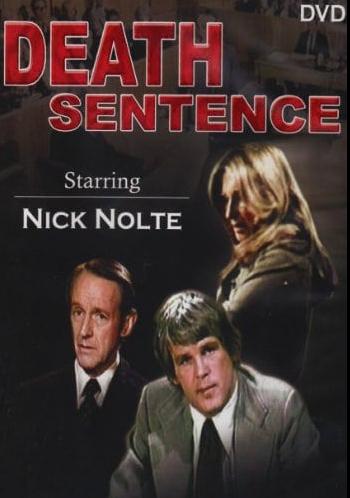
(Nick Nolte, for his part, spends most of the movie silently sitting in the courtroom.  He’s not bad and his look of anguish is believable but it’s hardly a starring role, regardless of what the film’s video packaging might otherwise claim.)

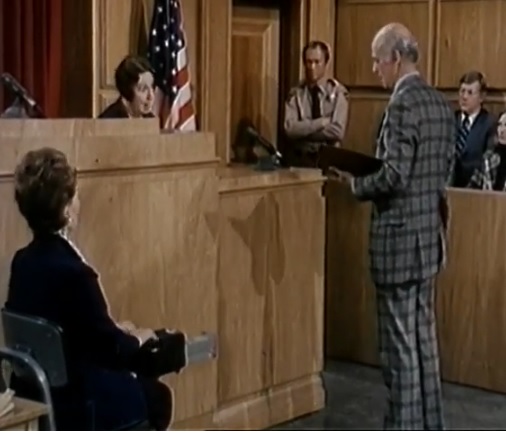
In the end, what I’ll mostly remember about Death Sentence were the atrocious fashion choices made by the prosecutor.  Seriously, would you trust a man wearing this suit?