Today, the Shattered Lens wishes a happy birthday to Oscar-winner Robert Downey, Jr.
This scene that I love comes from 1987’s Less Than Zero. It features Downey as the self-destructive drug addict, Julian. Downey has said that this role wasn’t too far from his real life at the time. Julian’s father is played by the great character actor, Nicholas Pryor.
Happy birthday to Robert Downey, Jr! I’m thankful that, unlike Julian, he got a second chance.
Today, the Shattered Lens wishes a happy birthday to actor and now-Oscar winner Robert Downey, Jr!
Today’s scene that I love comes from 1987’s Less Than Zero. Long before he played Iron Man, Downey played Julian, a young, self-destructive drug addict in Los Angeles. In this scene, Julian talks to his father, played by the great character actor, Nicholas Pryor.
Downey has said that playing Julian was not a huge stretch for him as he was dealing with his own growing drug addiction while making Less Than Zero. (Considering how heavy-handed the film was in its anti-drug message, it’s interesting that both Downey and Andrew McCarthy have talked about first experimenting with cocaine while making the film.) It’s been quite a turn-around for Downey, who went from being a poster boy for self-destruction to a beloved pop cultural icon. Just last month, Downey won an Oscar for his performance in Oppenheimer. He deserved every minute of the applause he received.
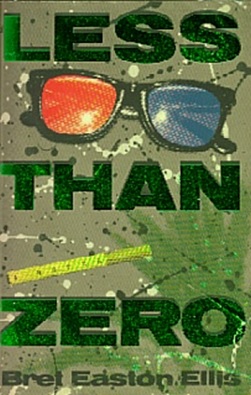
After having watched the film version a few hundred times, I figured that it was time for me to sit down and actually read Bret Easton Ellis’s Less Than Zero.
First published in 1985 (and written when Ellis was only 19 years old and still a college student), Less Than Zero tells the story Clay. Clay is a rich college student who returns home to Los Angeles for winter break. It’s his first time to be back home since starting college and he quickly discovers that all of his old friends are, for the most part, hooked on drugs and self-destruction. Clay’s friend Rip deals drugs and buys underage sex slaves. Clay’s former best friend, Julian, is now a heroin addict who has sex for money. Clay’s other best friend, Trent, is a model who watches snuff films. Meanwhile, Clay’s girlfriend, Blair, isn’t even sure that she likes Clay. Clay goes to therapy and the therapist tries to sell his screenplay. Clay struggles to tell apart his two sisters and he rarely speaks to his mother or his father. He’s haunted by memories of his grandmother slowly dying of cancer. As winter break progresses, Clay finds himself growing more and more alienated from everyone and everything around him. He feels less and less.
I had often heard that the film version was dramatically different from the book but nothing could prepare me for just how different. In the film, Clay is an anti-drug crusader who reacts to everything that he sees in Los Angeles with self-righteous revulsion. In the book, Clay simply doesn’t care. Clay’s narration is written in a flat, minimalist style, one that makes Clay into a dispassionate observer. Over the course of the narrative, there are times that Clay obviously know that he should probably feel something but he just can’t bring himself to do it. Even when he objects to Rip buying a 12 year-old sex slave, Clay doesn’t do anything to stop Rip or to help his victim. Clay is the epitome of someone who has everything but feels nothing. Most of the memorable things that happen in the movie — Julian begging his father for forgiveness and money, Clay and Blair being chased by Rip’s goons, Julian dying in the desert — do not happen in the book. They couldn’t happen in the book because all of those scenes require the characters to have identifiably human reactions to the things that they’re seeing around them.
It’s not necessarily a happy book but, fortunately, it’s also a frequently (if darkly) funny book. Bret Easton Ellis has a good ear for the absurdities of everyday conversation and some of the book’s best moments are the ones that contrast Clay’s lack of a reaction to the frequently weird things being discussed around him. Even more importantly, it’s a short book. Just when you think you can’t take another page of Clay failing to care that everyone around him will probably be dead before they hit 30, the story ends. Ellis writes just enough to let the reader understand Clay’s world and then, mercifully, the reader is allowed to escape.
Just as the movie is definitely a product of its time, the same can be said of the original novel. Reading Less than Zero is a bit like stepping into a time machine. It’s a way to experience the coke-fueled 80s without actually traveling to them.
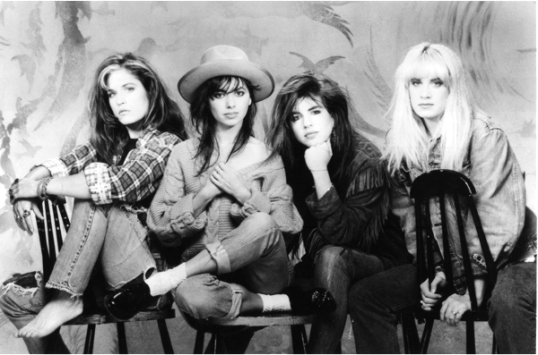
Another song from my youth during the 80’s is the classic rock song from the all-girl rock band The Bangles. It makes an appearance in a later episode of Netflix’s Stranger Things, but it’s better known as the unofficial anthem for the drug-fueled drama Less Than Zero starring a very young (and rumors abound of being very drugged out) Robert Downey, Jr.
Less Than Zero was adapted from a novel written by the 80’s agent provocateur Bret Easton Ellis. It definitely was part of the list of 80’s films that all the teens wanted to see. It being rated-R meant double the temptation. It was a film that both celebrated and condemned the Reagan-era yuppie culture that was fueled by excess amount of drugs, alcohol and sex.
The song “Hazy Shade of Winter” would become part of the film’s soundtrack and The Bangles had been tasked with covering the Simon & Garfunkel song of the same title. Where the former was more attuned to the duo’s folk sensibilities, the cover by The Bangles would put a harder edge to the song which made for a nice complement to the rough edges of the film.
Oh, I still have a major crush on Sussana Hoffs to this very day.
Hazy Shade of Winter
Time, time, time See what’s become of me…
Time, time, time See what’s become of me While I looked around For my possibilities I was so hard to please
Look around Leaves are brown And the sky Is a Hazy Shade of Winter
Hear the Salvation Army Band Down by the riverside It’s bound to be a better ride Than what you’ve got planned Carry a cup in your hand
Look around Leaves are brown And the sky Is a Hazy Shade of Winter
Hang onto your hopes my friend That’s an easy thing to say But if your hopes should pass away Simply pretend That you can build them again
Look around Grass is high Fields are ripe It’s the springtime of my life
Seasons change with their scenery Weaving time in a tapestry Won’t you stop and remember me
Look around Leaves are brown And the sky Is a Hazy Shade of Winter
Look around Leaves are brown There’s a patch of snow on the ground Look around Leaves are brown There’s a patch of snow on the ground Look around Leaves are brown There’s a patch of snow on the ground
It’s time for another edition of Let’s Second Guess the Academy! This time, we’re taking a second look at the race for Best Picture of 1987.
Can you remember which film won Best Picture for 1987? Don’t feel bad if you can’t because Bernardo Bertolucci’s The Last Emperor is one of the lesser known Oscar winners. The film’s relative obscurity leads to one natural question: was it truly the best film released in 1987?
Or should the Oscar have gone to one of the other films nominated — Broadcast News, Hope and Glory, Fatal Attraction, or Moonstruck?
Let your voice be heard by voting below!
After voting for which nominated film you think should have won, give some thought to some of the 1987 films that were not nominated. Was Moonstruck truly a better film than Near Dark or Full Metal jacket? Ask yourself what would have happened if The Last Emperor hadn’t been released in the United States or what if Fatal Attraction hadn’t been a huge box office smash. What if none of the five best picture nominees had been eligible to be nominated in 1987? Which five films would you have nominated in their place?
Let us know by voting below. As always, you can vote for up to five alternative nominees and write-ins are accepted!
Last night, I ended up watching the 1987 anti-drug propaganda piece, Less than Zero.
Why Was I Watching It?
Last night, I was hanging out with Jeff, our friend Evelyn, and Evelyn’s friend Steven and we were flipping stations, trying to find something that we could use for background noise. When we came across an announcement on FMC that Less Than Zero was about to start, I made the mistake of admitting that despite having read Bret Easton Ellis’s novel and heard a good deal about this film, I had never actually sat down and watched Less Than Zero.
Well, after everyone got finished making fun of me (boo hoo), it was agreed that we simply had to watch Less Than Zero.
“But,” I started, “isn’t Gone With Wind starting over on TCM…”
“Fuck Gone With The Wind,” someone (I think it was Evelyn because she’s a meanie) said, “you’ve never seen Less than Zero before.”
What’s It About?
It’s about rich kids in Los Angeles doing drugs. Clay (played by Andrew McCarthy, who my cousin Jessica met once and who she says was a really nice guy) is a college student who comes home to L.A. and discovers that his ex-girlfriend Blair (Jami Gertz) and best friend Julian (Robert Downey, Jr.) are addicted to cocaine and that Julian owes a lot of money to a drug dealer named Rip (James Spader).
(Personally, I would never buy drugs from someone named Rip — with the possible exception of Rip Torn.)
Anyway, Clay takes it upon himself to try to save the soul of everyone in California.
What Worked?
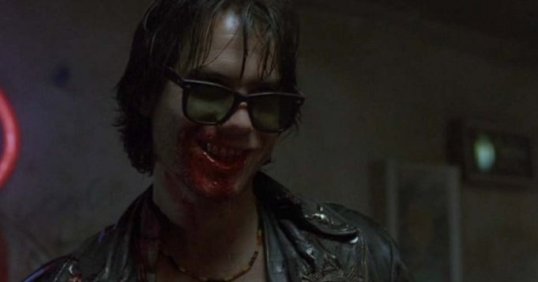
Downey and Spader are both great in this film. From what I’ve read, the general assumption seems to be that Downey was just playing himself here but whether or not he was, he still gives an excellent performance. Spader, meanwhile, turns Rip into a great villain by making evil sexy.
The film, full of garish neon and defiantly tacky pastels, looks great in its decadent, shallow way. The same thing can be said of the music.
What Didn’t Work?
Everything else. Less Than Zero really doesn’t work as an anti-drug film because the character of Clay seems so boring when compared to Julian and Rip.
If I had to choose between the three of them, I’d probably hang out with Rip because 1) he always seems to be having a good time, 2) he’s apparently not a drug addict himself, and 3) he’s got the most money of all of them. That therefore makes him preferable to both Julian, who is having a good time but is also a drug addict, and Clay who isn’t a drug addict yet appears to be miserable throughout the entire film.
“Oh my God! Just like me!” Moments
One night, years ago, I found myself making out with an ex-boyfriend in a convertible while one jagged bolt of lightning split the night sky above us and hundreds of scary guys on motorcycles drove past us. As is often the case, the memory was better than the ex.
 Through the Shattered Lens