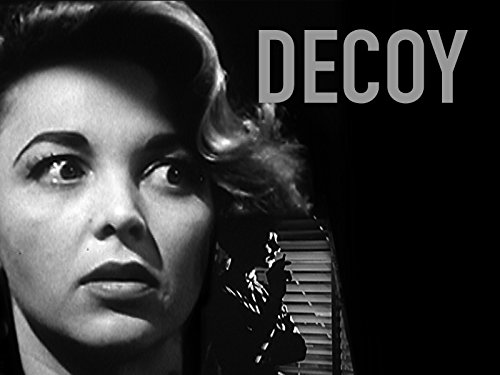
Welcome to Retro Television Reviews, a feature where we review some of our favorite and least favorite shows of the past! On Thursdays, I will be reviewing Decoy, which aired in Syndication in 1957 and 1958. The show can be viewed on Tubi!
Episode 1.13 “My Brother’s Killer”
(Dir by Stuart Rosenberg, originally aired on January 6th, 1958)
Anne (Barbara Barrie) goes to the police because her boyfriend, Victor Bernard (Bernard Kates), has been acting strangely and refuses to let her into his apartment. At first, the police point out that there’s nothing they can do about this but then Casey, in what can only be described as a miraculous feat of deductive reasoning, guesses that Victor Bernard’s last name might have originally been Bernardino and he might be the brother of wanted robber, Frank Bernardino.
A look at a picture of Victor reveals that he does look a lot like Frank. However, as Casey discovers when she goes over to Victor’s apartment, Frank is dead. But his partner, Hal Bishop (Sy Travers), is still alive. Hal promptly takes Casey and Victor hostage and heads for the Canadian border.
Once you accept that Casey’s miracle hunch (and, seriously, it takes some effort), this is an intense episode. I’m not really a fan of shows in which people are held hostage — the confined narrative tends to get tedious pretty quickly — but this episode featured a typically good performance from Beverly Garland and an absolutely terrifying one from Sy Travers. It also features what seems like a surprising amount of violence for a 1950s television show. Imagine gathering the family in front of the television in 1958 and being immediately confronted by Sy Travers as Hal Bishop pointing a gun at an innocent man’s head and pulling the trigger. A lot of people get shot over the course of this episode, including Hal Bishop himself. Casey survives but there are no smiles or celebrations. There’s just the weary look of someone who has been confronted with the worst that humanity has to offer.
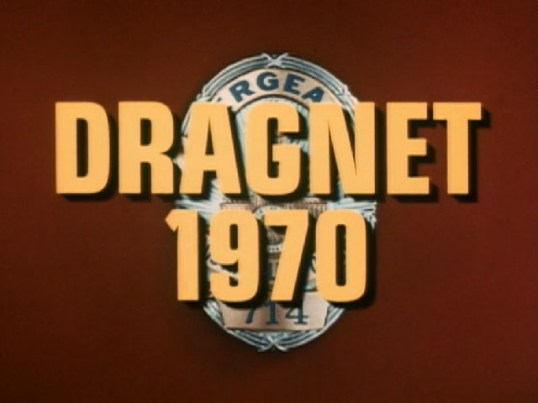
Dragnet began as a radio program in 1949 before making it’s way over to television in 1951. Each episode starred (and the majority were directed by) Jack Webb, who played a no-nonsense cop named Joe Friday. Friday narrated every episode, dropping trivia about the history of Los Angeles while also showing viewers how the cops went about catching criminals. Despite what is commonly believed, Joe Friday never said, “Just the facts, ma’m,” but he did investigate each case with the cool determination of a professional who kept his emotions under control. The majority of Dragnet’s episodes were based on actual cases that were worked by the LAPD, hence the opening declaration of, “The story you are about to see is true.”
On television, Dragnet originally ran from 1951 to 1959, during which time Dragnet also became the first television series to be adapted into a feature film. Jack Webb decided to relaunch Dragnet in 1966 and he produced a made-for-television movie that followed Friday and his latest partner, the far more talkative Bill Gannon (Harry Morgan), as they worked multiple cases over the course of one long weekend. That made-for-television movie led to a series that ran from 1967 to 1970.
The second television series is the best-remembered version of Dragnet, beloved for its scenes of Friday and Gannon debating the issues with a motely collection of hippies, campus radicals, and pipe-smoking academics. Jack Webb viewed Friday as being the voice of the common American, who supported the troops, supported the president, and who wanted to spend the weekend grilling in peace. Friday was the middle-aged suburbanite who wanted to the kids to stay off the grass, whether it was on his front lawn or being sold on a college campus. These episodes were often campy. It’s hard not to smile while listening to Friday and Gannon deadpan their way through conversations with flakey long-haired hippies. It was often obvious that the writers of Dragnet had never actually had any experiences with the hippies, beyond what they saw on the evening news. And yet, as silly as things often were, the show is an interesting time capsule of the era in which it was made. If nothing else, it’s a chance to see the turbulent 60s through the eyes of the other side.
Last year, I shared my favorite episode of Dragnet. For the new year, I’m sharing my second favorite, an episode that originally aired on March 19th, 1970. In Night School, Joe Friday is attending a night class where he and his classmates sit in a circle and just “rap” about the issues of the day. No one knows that Joe is a cop but Joe feels that he is still on duty and when he sees that the guy sitting across from him has a baggie of weed in his notebook, Friday makes an arrest. The professor, who says “There’s nothing wrong with marijuana, I smoke it myself!,” attempts to kick Sgt. Friday out of his class. “Would you rather be known as good ol’ friendly Joe, the class narc?” the professor asks. Joe fights for his right to get an education and a man with an eyepatch emerges as an unlikely voice of reason.
Why do I like this episode? There’s something undeniably entertaining about seeing straight-laced, deadpan Joe Friday attending a class with at least three hippies. It always amuses me that, on this show, Joe Friday loosening up just means that Joe trades his suit for a sweater. Also entertaining is Leonard Stone’s over-the-top performance as the villainous professor. And how can you not smile at Bill Gannon’s weary claim of “I just knew there was no way you could get a B sitting around talking?” Or Jack Webb’s delivery of the line, “That’s my thing, keeping the faith, baby?” Or Jack Curtiss’s hyperactive performance as campus drug pusher Jerry Morgan? “Hey, that’s just oregano!” Whatever you say, Jerry.
Today’s blast from the past certainly does feel like a trip in a time machine. Step on in and take a look at California in 1970!
Welcome to Retro Television Reviews, a feature where we review some of our favorite and least favorite shows of the past! On Sundays, I will be reviewing the made-for-television movies that used to be a primetime mainstay. Today’s film is 1971’s Terror In The Sky! It can be viewed on YouTube.
On a flight heading from Minneapolis to Seattle, several passengers suddenly start to get ill.
Luckily, there’s a doctor on the plane. Sporting sideburns and wearing a turtleneck, Roddy McDowall is quite chic in the role of Dr. Baird, the dedicated medical professional who comes to realize that the passengers are suffering from food poisoning. As Dr. Baird explains it to head flight attendant Janet Turner (Lois Nettleton), everyone who had the chicken for dinner is about get severely ill. Uh-oh …. both of the pilots had the chicken!
Is there anyone on the plane who has any flying experience? George Spencer (Doug McClure) flew a helicopter in Vietnam but, as George explains, it’s an entirely different type of flying all together. George has no confidence about his ability to land the plane but he’s the only chance the passengers have.
On the ground, gruff Marty Treleavan (Leif Erickson) has been summoned to the airport so that he can help to talk George through the landing. Marty explains what all of the instruments do to George. He tells George that he needs to stay in the air for a few hours so that he can get comfortable with the plane. But the people on the plane are getting more ill and George says that he might be ding things up a little but he’s going to land this plane!
Does this sound familiar to anyone?
As I watched this film last night, I found myself saying, “Oh my God, this is just a serious version of Airplane!”
And actually, it is. Terror In The Sky was based on Zero Hour, the 1957 film that also served as the basis for Airplane! (The directors of Airplane! even bought the rights to Zero Hour so that they freely borrow whatever they wanted to from the film.) Indeed, much of the dialogue in both Zero Hour and Terror In The Sky also shows up in Airplane! Even the musical cues in Terror In The Sky and Airplane! are similar.
Terror In The Sky is not a bad film. It’s an efficient made-for-TV film that features several made-for-television veterans, including Keenan Wynn and Kenneth Tobey. Doug McClure grimaces heroically in the role of George Spencer and Roddy McDowall is as likable as ever as the doctor who hates to fly. It’s a very earnest movie about a group of people doing everything that they can to save hundreds of lives. They’re doing the right thing!
But it’s also totally impossible to take the film seriously because you spend the entire movie waiting for Roddy McDowall to say, “Don’t call me Shirley,” or for Leif Erickson to say that he picked the wrong week to stop sniffing glue. Every moment and every line makes the viewer think of something funny from Airplane!
Personally, I think they bought their tickets. They knew what they were getting into. I say …. well, you get the idea.
And yes, I did rewatch Airplane! as soon as I finished up Terror In The Sky.
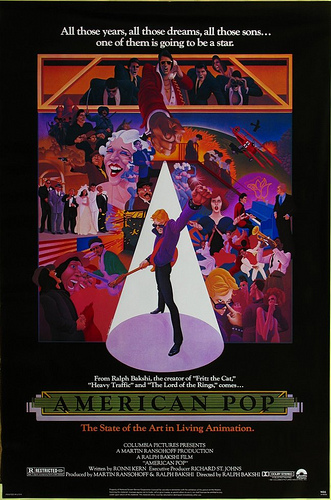
Long before South Park, The Simpsons, and Pixar, there was Ralph Bakshi. At a time when animation was considered to only be good for children, Bakshi shocked audiences and critics with animated films that dealt with mature themes and were definitely meant for adults. His first two films, Fritz the Cat (1972) and Heavy Traffic (1973), was the also the first two animated films to receive an X-rating. Bakshi satirized racism in the controversial Coonskin (1975) and Bakshi’s adaptation of The Lord Of Rings (1978) beat Peter Jackson’s by 23 years. It was after the critical and commercial disappointment of the heavily flawed but interesting Lord of the Rings that Bakshi decided it was time to make a film that would be more personal to him. The end result was American Pop.
American Pop tells the story of four generations of a family of Jewish immigrants and how music affects their lives. In typical Bakshi fasion, this animated film deals with issues of violence, sexuality, drug abuse, and poverty. American Pop may be animated but it is definitely a film meant for adults.
In the 1890s, Zalmie (Jeffrey Lippa) and his mother escape from Russia after Zalmie’s father, a rabbi, is killed by the Cossacks. Zalmie grows up in New York and after his mother is killed in the Triangle Shirtwaist Factory fire, he is raised by a vaudeville comedian named Louie (Jerry Holland). Zalmie wants to be a singer but is shot in the throat during World War I. His voice ruined, Zalmie marries a stripper named Bella (Lisa Jane Persky) and manages her career. His partnership with the mobster Nicky Palumbo (Ben Frommer) leads to Bella dying and Zalmie going to prison.
Zalmie’s son, Benny (Richard Singer), is a jazz pianist who, as a favor to his father, marries Nicky’s daughter. Benny has a son named Tony and tries to pursue his career without using his father’s influence. Then World War II breaks out.
Benny enlists in the army, seeking redemption from the crimes of his father and father-in-law. Serving in Europe, he misses his piano and, when he finds one in a bombed-out house in Nazi Germany, he plays a few bars of As Time Goes By. When a Nazi walks in on Benny, Benny plays Lili Marleen. For a few seconds, Benny and the Nazi share the common bond of music. “Danke,” the Nazi says before shooting Benny dead.
Growing up without his father, Tony (Ron Thompson) becomes a beatnik and eventually runs away from home. He ends up in Kansas, where he has a one-night stand with a waitress and becomes a songwriter for Frankie Hart (Marya Small), a stand in for Janis Joplin. Both Tony and Frankie start using heroin and Frankie dies of an overdose right before she is supposed to open for Jimi Hendrix. Abandoned by Frankie’s band, Tony ends up as an addict and dealer in New York. Accompanying him is his son, Pete, the result of his hookup with the waitress.
After being abandoned by his father, Pete (also played by Ron Thompson), follows in his footsteps and becomes a successful drug dealer. He is dealing cocaine to all of the big rock bands but, after discovering punk rock, he realizes that he wants something more out of his life.
After announcing that he will no longer sell anyone cocaine unless he is given a chance to record a demo, Pete is given a band and a recording studio. With the drug-craving record company execs watching, this tough and cocky punk grabs the microphone and sings…
…BOB SEGER’S NIGHT MOVES!?
The use of Night Moves, which is one of the least punk songs ever written, is one of the few false notes in American Pop. Otherwise, this is one of Ralph Bakshi’s best films. The majority of the film’s animation was done through rotoscoping, a technique in which animation is traced over live action footage. (For the gang war scenes, scenes from The Public Enemy were rotoscoped, as was footage of the Nicholas Brothers used in the Sing Sing Sing With A Swing montage.) Seen today, the technique is crude but effective at showing the contrast between the fantasy of music and the grim reality of life. Though it has its flaws (*cough* Night Moves *cough*), American Pop is an engaging look at the history and development of American music.
For my final Netflix Noir, I watched The Mugger, a film from 1958.
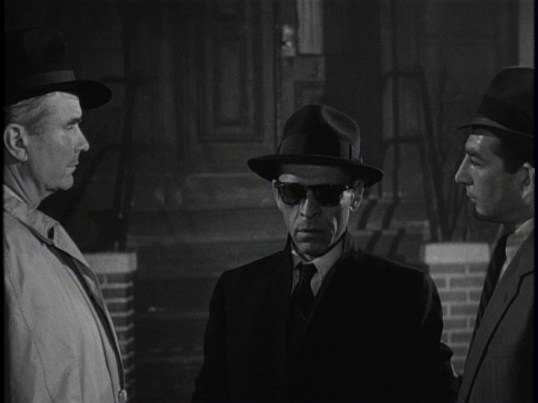
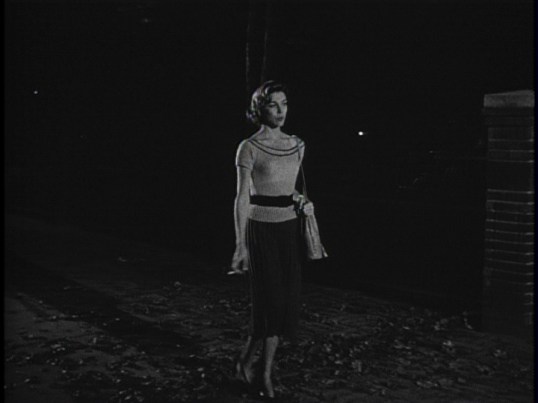
The Mugger is a police procedural. Taking place in an unnamed city, it stars Kent Smith as Dr. Pete Graham. Pete’s both a psychiatrist and a cop and, needless to say, he has a lot to deal with.
For one thing, his girlfriend, Claire (Nan Martin) is also a cop. In fact, she’s apparently the only female cop on the entire force! (“Woman cops?” another detective is heard to say, “Do we really need them?”) Claire spends most her time working undercover on the dance hall circuit. Pete wants to get married. Claire wants to solve a few more cases before making that commitment. Pete says that’s okay, as long as her plans “include me, a home, and children.”
Pete has also been forcefully recruited to counsel a Jeannie (Sandra Church), the sister-in-law of a local taxi driver. As the driver explains it, Jeannie is “about 18 and is she built!” Pete replies, “You shouldn’t get excited about a kid who wants to have a good time,” which seems like an unusually progressive attitude for a cop in the 1950s. Still, Pete agrees to try to encourage Jeannie to be a little bit less rebellious. Jeannie, by the way, is my favorite character in the film because she is never in a good mood and she gets to dismiss her older sister’s concerns by saying, “Maybe she’s getting a little old, a little jealous.”
It also turns out that Jeannie’s neighbor, Nick Greco (George Maharis), has a crush on her and apparently, just hangs out in her house all day. While this seemed rather creepy to me, the film seemed to suggest that this was just normal 50s behavior. Apparently, since nobody bothered to lock their doors back then, it was also totally appropriate to just hide in someone’s house and listen in on private conversations.
Peter’s other big problem is that there’s a mugger who is robbing women and cutting their cheek with a knife. I have to give the film some credit here because it doesn’t shy away from discussing the sexual subtext to these attacks, which I imagine was quite daring for a film in the 50s. Pete comes up with a detailed profile of the attacker, the sort of thing that would make the cast of Criminal Minds jealous. Claire goes undercover to catch the mugger and there’s a great scene where a drunk sailor tries to harass her and she threatens to shoot him in the knee caps. Again, this is not the sort of thing that we typically associate with a 50s film…
Which is not to say that The Mugger is not clearly a product of its time. For one thing, just check out the police force in this city, which is all white, all middle-aged, and — with the exception of Claire — all male. As well, this is one of those old movies where any woman who walks down a street will be leered at by every guy she passes, including the film’s heroes. One of the reasons why it was so great to see Claire threaten to cripple that soldier was because it came after 50 minutes of watching Pete and every other man in the film do a double take whenever she entered a room.
Clocking in at a little over 70 minutes and obviously low-budget, The Mugger is an undeniably obscure film. Checking with the imdb, I discovered only two reviews that had been previously written for this film and one of them was in Turkish! When I went onto YouTube to look for a trailer, I found nothing. The Mugger is forgotten and hardly a lost classic but I still enjoyed watching it. What can I say? I love my history and, if nothing else, The Mugger is definitely a time capsule.

 Long before South Park, The Simpsons, and Pixar, there was Ralph Bakshi. At a time when animation was considered to only be good for children, Bakshi shocked audiences and critics with animated films that dealt with mature themes and were definitely meant for adults. His first two films, Fritz the Cat (1972) and Heavy Traffic (1973), was the also the first two animated films to receive an X-rating. Bakshi satirized racism in the controversial Coonskin (1975) and Bakshi’s adaptation of The Lord Of Rings (1978) beat Peter Jackson’s by 23 years. It was after the critical and commercial disappointment of the heavily flawed but interesting Lord of the Rings that Bakshi decided it was time to make a film that would be more personal to him. The end result was American Pop.
 Through the Shattered Lens