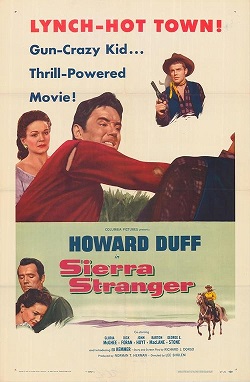
Sierra Stranger (1957, directed by Lee Sholem)


Sierra Stranger starts with a familiar western situation.  Jess Collins (Howard Duff), a penniless but honorable drifter, comes across two men tying another man to the back of a horse.  The two men claim that Sonny Grover (Ed Kemmer) is an outlaw and a claim jumper and not to be trusted. Sonny says that he’s innocent and the two men are actually the claim jumpers.  Jess does what many a western hero has done.  He sides with the underdog and saves Sonny.  To thank him, Sonny gives Jess a part of his claim.

Jess rides into the nearby town to claim his new property.  He meets and befriends Sonny’s half-brother, Bert (Dick Foran).  He also meets and falls in love with Bert’s fiancée, Meg (Gloria McGeehee).  However, soon after arriving, Jess discovers that he made a mistake and he saved the wrong man.  Sonny really is the dangerous outlaw that everyone says he is.  After Sonny robs a stagecoach and murders the driver, Jess risks his new friendship with Bert by trying to bring Sonny to justice.

Howard Duff appeared in his share of B-westerns in the 50s.  He was always a solid hero, even if he didn’t really have the screen presence of some of the other stars of the genre.  He’s pretty good in Sierra Stranger and the fact that, for once, the town is right while the drifter is wrong is an interesting twist on an otherwise standard story.  This is the rare western where the hero makes a pretty big mistake and then has to spend the rest of the movie trying to make up for it.  If you’re not a western fan, this is not the type of B-movie that’s going to change your mind.  But, for those who do like the genre, it’s an interesting twist on what we’ve been led to naturally expect.

Horror On The Lens: Pharaoh’s Curse (dir by Lee Sholem)


It’s really not Halloween without at least one mummy film!

With that in mind, here’s a 1957 film called Pharaoh’s Curse.  In this film, a team of archeologists foolishly enter a mummy’s tomb and you can probably guess the rest.  Honestly, you would think that archeologists would eventually learn that it’s never a good idea to test a curse but apparently, it never happened.

Anyway, if you’ve got an hour to kill, enjoy Pharaoh’s Curse!

http://www.youtube.com/watch?v=H6rfCo_4Atk


Film Review: Tobor The Great (dir by Lee Sholem)


Last week, along with my friends and fellow members of the Late Night Movie Gang, I watched the 1954 sci-fi film, Tobor The Great.

As you can probably tell by looking at the top of this review, Tobor came with a really great poster.  It’s a poster that promises all sorts of sci-fi thrills and chills.  It screams, “B-movie masterpiece!”  You look at that poster and you think to yourself, This film is probably extremely silly but I absolutely have to watch it!

Of course, if you know anything about the B-movie aesthetic of the 50s and 60s, you won’t be shocked to learn that the poster has next to nothing to do with the actual film.  True, there is a robot is featured in the film.  The poster is honest about that.  And Tobor actually looks just as good in the movie as he does on the poster.  And there is a subplot about space travel but, at no point, do we see Tobor walking across the surface of Neptune or Jupiter or wherever it is that Tobor is supposed to be in this poster.  Maybe he’s on one of the moons of Saturn.  Who knows?

Also, at no point, does Tobor carry around a woman.  In fact, Tobor is pretty much a film for kids.  The main character, other than Tobor, is an 11 year-old boy named Gadge (Billy Chapin).  I can only imagine how audiences reacted when they went into the film expecting to see the scene in the poster and instead, they were confronted with a movie about a little boy and his robot.

Tobor is one of those films that opens with several minutes of stock footage.  Rockets take off.  The stars shine in the sky.  Scientists and engineers do stuff.  It all looks pretty impressive but, of course, none of it was actually shot for this film.  In fact, the use of all that stock footage mostly serves to highlight how cheap the rest of the movie looks.

As for the film’s plot, it has apparently been determined that it’s too dangerous to send humans into space.  So, Professor Nordstrom (Taylor Holmes) and Dr. Harrison (Charles Drake) build a robot that is specifically designed to fly an interstellar craft.  They name their creation Tobor, because that’s robot spelled backwards.  (Tobor even points out that his name is robot spelled backwards.)  In order to help Tobor explore the universe, they design him to be able to simulate human emotions.  In fact, they’re so successful at it that Tobor ends up befriending Nordstrom’s grandson, the aforementioned Gadge.

The press and the military are all very impressed with Tobor.  Unfortunately, it’s the 1950s and that means that the communists are impressed by Tobor as well!  Can the scientists and their families keep Tobor from getting abducted by a bunch of Russian agents!?  Let’s hope so because there’s a lot of space that needs to be explored….

Anyway, Tobor The Great is silly but kind of fun.  It has its slow spots but it also has a really cool robot and it’s always fun to watch the commies get thwarted.  It’s a real time capsule film, one that not only reflects the decade in which it was made but which also has a somewhat charming innocence to it.  If nothing else, it’s nice to think that, in the days before CGI, the filmmakers actually had to make a Tobor of their own.  Apparently, Tobor is currently in a private collection and I hope whoever has him is treating him well.

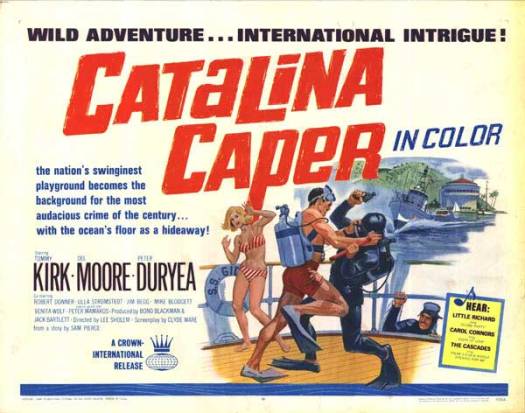
Waterlogged: CATALINA CAPER (Crown International 1967)


gary loggins's avatarcracked rear viewer

Beach Party movies had run their course by 1967, as AIP released their final entry in the surf cycle, THE GHOST IN THE INVISIBLE BIKINI, with Tommy Kirk  and Deborah Walley replacing Frankie and Annette , and nary a beach in sight. Crown International Pictures, AIP ‘s impoverished cousin (if one can imagine!), produced what is considered the last of the genre, CATALINA CAPER, also starring Kirk and a cast of dozens.

CATALINA CAPER is basically an lame excuse to get a bunch of young hardbodies on the beach and let ’em dance around to some dated rock music. Believe it or not, there’s a plot (though not a very good one) involving the theft of an ancient Chinese scroll masterminded by one of the teen’s con artist parents (Del Moore, Sue Casey) and a gangster trying to get ahold of it. There’s also a subplot (imagine that!) about Kirk torn between his bud’s sister (Venita Wolf) and a…

View original post 400 more words

Embracing the Melodrama Part II #21: Emergency Hospital (dir by Lee Sholem)


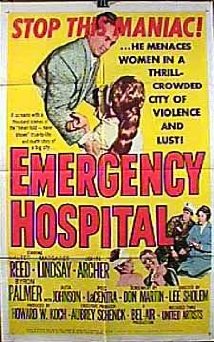
Emergency Hospital

Right now, on Netflix, you can find Emergency Hospital, a low-budget film from 1956.  Emergency Hospital, which probably was made to be the second feature on a double bill, covers the course of one night at a hospital.  Patients come in.  Crimes are investigated.  Two doctors — one a man and one a woman and since this film was made in the 50s, that leads to all sorts of confusion — deal with all of the patients.  The film manages to stuff a lot of incidents into just 61 minutes of running time.

If you look at the poster above, you’ll see that it implores us to “STOP THE MANIAC!  He menaces women in a thrill-crowded city of violent and lust!”  I’m not really sure which of the film’s many subplots that is meant to refer to.  At one point, the son of a police detective is brought in after crashing his car.  He briefly attempts to hold a nurse hostage with a scalpel but, in the end, he doesn’t turn out to be much of a maniac.

In fact, if there’s anything that really distinguishes Emergency Hospital is just how low-key it is.  For the most part, the film emphasizes the fact that everyone at the hospital is focused on doing her or his job.  The patients all come in with their own individual melodramas but, for the most part, the doctors and the police all react calmly and rationally.  It’s interesting to compare Emergency Hospital to something like Magnificent Obsession.  Whereas Magnificent Obsession truly embraces the melodrama, Emergency Hospital invites the melodrama to pull up a chair and then tells it to calm down.

Perhaps because it was such a low-budget and obscure film, Emergency Hospital gets away with taking a look at and talking about issues that you normally wouldn’t expect to be so openly explored by a film made in the 50s.  And, interestingly enough for a film made in a culturally reserved time, the doctors and nurses at Emergency Hospital take a rather open-minded and nonjudgmental approach to their patients.  An anxious mother comes in with her bruised baby and is confronted about being an abusive parent.  A teenage girl comes in after being raped and the doctors try to convince her father (who thinks his daughter’s reputation will be ruined) to call the police.

Now, make no mistake about it: Emergency Hospital is not a secret masterpiece.  It’s an extremely low-budget movie that looks like an extremely low-budget movie.  But, taking all that into consideration, it’s still a lot better than your typical 61 minute second feature.

Emergency Hospital can currently be watched on Netflix.

Netflix Noir #1: Crime Against Joe (dir by Lee Sholem)


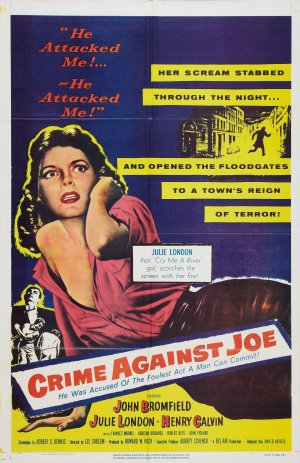
Crime_Against_Joe_poster

After watching Inherent Vice last weekend, I decided to get on Netflix and do a search for film noirs.  This led to me watching four film noirs from the 50s, all of which were previously unknown to me.

For my first Netflix Noir, I watched a little something called Crime Against Joe.  It’s a 69 minute film from 1956.  It’s about a guy named Joe.  There’s been a crime.  Oddly enough, the crime really against Joe.  Instead, he’s been wrongly accused of committing a crime against a nightclub singer named Irene.  So, perhaps a better title for this film would have been It Sucks To Be Joe.

But anyway —

Crime Against Joe was directed by Lee Sholem.  According to Wikipedia, Lee Sholem had a 40 year career as a director.  During that time, he directed over 1,300 television episodes and feature films and he finished every single one of them either on time or early.  And you can certainly see evidence of that in Crime Against Joe, a film that starts out in a rush and pretty much never slows down until the final fade out.

Joe (John Bromfeld) was voted “most likely to succeed” in high school but — surprise!  surprise! — he’s failed to live up to the expectations set for him by the 1945 yearbook.  Instead, he enlisted in the army, served in the Korean War, and was diagnosed with “battle fatigue.”  (I assume that battle fatigue was the 1950s version of PTSD.)  He spent a while in a mental hospital and it was there that he first started painting.  When he was released, he moved in with his widowed mother (Frances Morris).  While she works to support him, Joe spends his time drinking and painting.

As the movie begins, a drunken Joe has just destroyed his latest painting.  (“I can see it in my head but it doesn’t come out on canvas!” Joe shouts, which is actually a pretty good way to describe the dark feeling that all artists occasionally get.)  He wanders around town, drunk.  He talks to a waitress named Slacks (Julie London), who is obviously in love with him.  He gets some sage advice from Red (Henry Calvin), a taxi driver.   He stumbles into a nightclub where he harasses a singer (Alika Louis) before finally getting thrown out of the club.  In the parking lot, as he stumbles away, a mysterious cowboy (Rhodes Reason) glares at him.

Joe stumbles about until, around two in the morning, he runs into a young woman wearing a nightgown.  He tries to talk to her but she only stares at him, her placid face frozen in a zombie-like state.  Joe leads her to a nearby house where the woman’s father thanks him for his help and then slams the door in his face.

Later that night, the nightclub singer is found dead on the side of the road.  Found near her body is a high school pin that belonged to someone from the class of 1945.  Knowing that Joe was drunk that night and had been seen in the nightclub, Detective Hollander (Robert Keys) goes to Joe’s house.  Hollander demands to see Joe’s high school pin.  Joe says he doesn’t know where it is.  Hollander stares at Joe’s paintings.  “You always paint half-naked women?” Hollander sneers before arresting Joe for murder.

At the station, Joe says that he was leading the woman back to her house at the same time that the singer was murdered.  The woman’s father shows up at the police station.  No, he says, Joe was nowhere near his house at two in the morning.  Joe is arrested for murder…

Fortunately, Slacks is willing to risk her life to prove that Joe is innocent.  And Joe knows that the murderer had to have been someone who he went to high school with…

Crime Against Joe is one of those low-budget, obscure B-movies that actually a lot more interesting than you might think.  John Bromfeld does a good job as Joe and the character’s PSTD gives the film a bit more depth than you might otherwise expect.  Julie London is great in the role of brave and selfless Slacks (though it’s interesting that this film felt the need to give a masculine nickname to a strong female character) and Rhodes Reason is genuinely menacing as the mysterious cowboy.  Crime Against Joe is also full of unexpected and occasionally surreal details.  The most obvious example would be the zombie-like woman who Joe runs into on the night of the murder.  However, my favorite little oddity is the fact that signs reading “Corey for Councilman” keep popping up in the strangest locations.

(It eventually turns out that Joe went to high school with Corey and the scene where Joe confronts his old classmate is a fun little piece of political satire.  That said, there was a part of me that hoped the significance of the sings would just remain an odd and unexplained little detail.)

There’s actually a surprisingly subversive streak running through Crime Against Joe.  We usually tend to think of the 50s as being a time when authority figures (like the police) were viewed with blind trust.  In Crime Against Joe, however, nobody in power is portrayed positively.  The police, for instance, come across like a bunch of close-minded bullies who are prepared to convict Joe based solely on his paintings and his less-than-sterling war record.  The scenes where Hollander interrogates Joe are full of menace.  In the end, this film is on the side of those living on the margins of respectable society.  When Joe and Slacks try to prove Joe’s innocence, they’re also attempting to prove their own right to exist in a society that has rejected both of them.

Crime Against Joe may not be a well-known film but there’s a lot more going on under its surface than you might originally think.  It’s on Netflix so check it out when you’ve got 70 minutes to spare.