Airplane II: The Sequel (1982, directed by Ken Finkleman)


It isn’t the past.  It isn’t the present.  It’s the future.

The moon has been colonized and, on Earth, the Mayflower II is preparing for its first international flight.  It will be carrying passengers from Houston to the lunar station.  Test pilot Ted Striker (Robert Hays) claims that the Mayflower II is not ready to make the trip but he’s been in the Ronald Reagan Hospital For The Mentally Ill ever since he had a nervous breakdown after losing his squadron during “the war.”

Aboard the Mayflower II is Ted’s ex-wife, Elaine (Julie Haggerty), and her new boyfriend, Simon (Chad Everett).  Simon says the Mayflower II is in perfect shape but he also turns into jelly whenever things get too rough.  Piloting the Mayflower II is Captain Clarence Oveur (Peter Graves) and waiting on the Moon is Commander Buck Murdock (William Shatner).  The crew of the Mayflower II is going to have a tough flight ahead of them.  Not only is the shipboard computer making plans of its own but one of the passengers (Sonny Bono) has a bomb in his briefcase.  Also, Ted has broken out of the hospital and is on the flight, boring people with his long stories.

Every successful film gets a sequel and when Airplane! was a surprise hit in 1980, it was inevitable that there would be an Airplane II.  Robert Hays, Julie Haggerty, Lloyd Bridges, Peter Graves, and Stephen Stucker all returned.  Unfortunately, Jim Abrahams, the Zucker brothers, Robert Stack, Kareem Abdul-Jabbar, and Leslie Nielsen did not.  (The directors and Nielsen were all working on Police Squad and their absence is strong felt.)  Airplane II recreates many of the same jokes as the first Airplane! but without the first film’s good nature or genuine affection for the disaster genre.  Airplane! was made for the love of comedy.  Airplane II was made for the love of money and, while there are more than a few amusing moments, the difference is obvious and there for all to see.

Not surprisingly, Airplane II is at its funniest whenever William Shatner is on screen.  In the role of Bud Murdock, Shatner pokes fun at his own image and shows himself to be a good sport.  He’s still not as funny as Leslie Nielsen or Robert Stack in the first film but that’s because, unlike Stack and Nielsen in their pre-Airplane! days, there had always been a hint of self-parody to Shatner, even in his most dramatic roles.  If Stack and Nielsen shocked people by showing that they could do deadpan comedy, Shatner’s performance just confirmed what most suspected, that he had always been in on the joke.  Still, he’s the funniest thing in Airplane II and, whenever I rewatch this movie, I am happy he was there.

Airplane II was a box office failure, which is why the world never got an Airplane III.  Fortunately, the world did get Hot Shots and The Naked Gun.
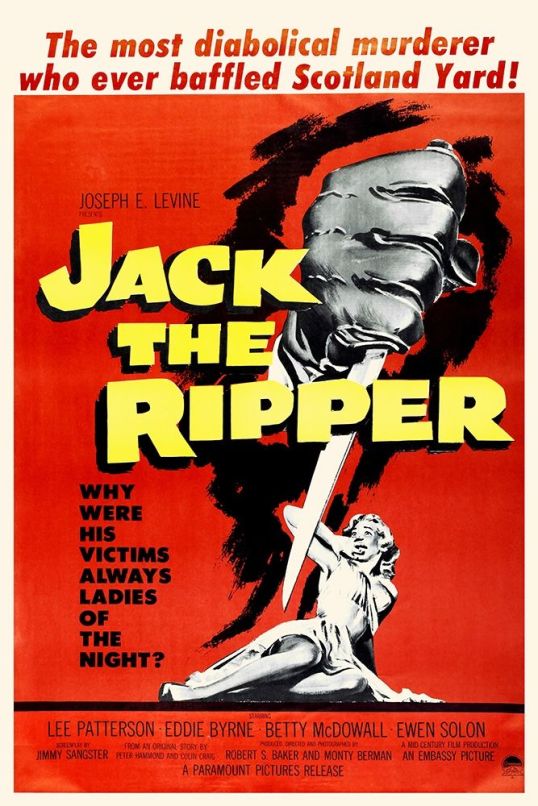
October True Crime: Jack The Ripper (dir by Monty Berman and Robert S. Baker)


The year is 1888 and London is a city in fear.

A mysterious, cloak-wearing serial killer know as Jack The Ripper is stalking the fog-strewn streets and killing prostitutes after asking them if they know the whereabouts of Mary Clark.  The newspapers are full of stories about the murders and editorials condemning the failure of Scotland Yard to capture the killer.  The citizens of London’s Whitechapel district are resorting to vigilante justice and any stranger is liable to be accused of being the Ripper.

When an American policeman named Sam Lowry (Lee Patterson) shows up in Whitechapel, he is accosted by a group of suspicious citizens.  Fortunately, before one of them can stab Sam, he’s saved by his old friend, Scotland Yard’s Inspector O’Neill (Eddie Byrne).  Sam explains that he’s come to London to not only help his old friend O’Neill catch the killer but to also study how the city of London has responded to the horror of the Ripper’s crimes.  O’Neill introduces Sam to both the world weary coroner, Sir David Rogers (Ewen Solon), and to Anne Ford (Betty MacDowell), the liberal-minded ward of Dr. Tranter (John Le Musurier).  As Anne shows Sam around London and speculates about why the Ripper has managed to avoid being caught by the police, O’Neill tries to discover the Ripper’s identity before he can strike again.

As you may have guessed from the plot description, this 1959 film doesn’t exactly stick to the historical fact when it comes to the murders of Jack the Ripper.  For instance, the names and the number of victims have been changed and, needless to say, the NYPD didn’t loan any of its detectives to Scotland Yard.  Then again, there’s very few films about Jack the Ripper that actually stick to the facts of the case.  (Murder By Decree came perhaps the closest, though it still insisted on pushing the ludicrous Royal Ripper theory.)  When one watches a Jack the Ripper film, it’s with the understanding that the story is probably going to be fictionalized.  Considering that there’s probably no chance of the Ripper’s identity ever being conclusively established, it’s to be expected.

As for the film itself, it actually has quite a few effective moments.  The heavy fog and the black-and-white cinematography creates the properly ominous atmosphere and the murders themselves are surprisingly brutal for a film from 1959, leaving no doubt that this film’s Ripper is a cruel sadist regardless of what other motives he may have.  The film itself ends with a properly macabre twist.  Patterson, Byrne, and MacDowell aren’t particularly interesting in the lead roles (and Patterson’s pompadour looks a bit ludicrous on a Victorian-era policeman) but the suspects, victims, and witnesses are all well-played by a cast of very British character actors.

There are apparently several versions of Jack the Ripper out there.  Though the film was a British production, it was filmed with an eye towards the international market and, as a result, there were several different edits depending on what the film could get away with in each country.  Apparently, one version actually switched from black-and-white to color whenever blood was spilled and certain European countries got a version that featured a few fleeting moments of nudity.  The version edited for American audiences, not surprisingly, doesn’t feature any of that but it’s still a watchable and entertaining Jack the Ripper film.

One final note: my personal opinion is that Jack the Ripper was some guy that no one has ever heard of.  He was probably not a doctor.  I doubt he was a Freemason.  He certainly was not a part of a Royal conspiracy or any of that other nonsense.  He may have been a butcher but it’s just as possible that he could have been a hatmaker or a carriage driver or a petty criminal who paid for his drinks through mugging.  He was probably never suspected at the time and I imagine he died without ever telling anyone what he had done.  People find comfort in conspiracies and elaborate cover-ups but often, the simplest solution is the correct one.

(That said, every time that Jeff and I go to London, we do the Jack the Ripper walking tour.  It’s always interesting to hear the weird theories that people come up with.)