Film Review: And The Band Played On (dir by Roger Spottiswoode)


I live in a very cynical time.

That was one of my main thoughts as I watched 1993’s And The Band Played On.

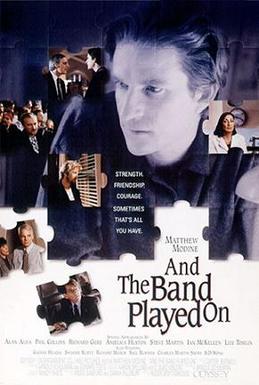
Directed by Roger Spottiswoode and featuring an all-star cast, And The Band Played On deals with the early days of the AIDS epidemic.  It’s a film that features many different characters and storylines but holding it all together is the character of Dr. Don Francis (Matthew Modine), an epidemiologist who is haunted by what he witnessed during the Ebola epidemic in Africa and who fears that the same thing is going to happen in America unless the government gets serious about the mysterious ailment that is initially called “gay cancer” before then being known as “GRID” before finally being named AIDS.  Dr. Francis is outspoken and passionate about fighting disease.  He’s the type who has no fear of yelling if he feels that people aren’t taking his words seriously enough.  In his office, he keeps a track of the number of HIV infections on a whiteboard.  “Butchers’ Bill” is written across the top of the board.

Throughout the film, quite a few people are dismissive of Dr. Francis and his warnings.  But we, the audience, know that he’s right.  We know this because we know about AIDS and but the film also expects us to trust Dr. Francis because it’s specifically stated that he worked for the World Health Organization before joining the Center For Disease Control in Atlanta, Georgia.  As far as the film is concerned, that’s enough to establish his credentials.  Of course, today, after living through the excesses of the COVID pandemic and the attempts to censor anyone who suggested that it may have begun due to a lab leak as opposed to some random guy eating a bat, many people tend to view both the WHO and the CDC with a lot more distrust than they did when this film was made.  As I said, we live in a cynical time and people are now a lot less inclined to “trust” the experts.  To a large extent, the experts have only themselves to blame for that.  I consider myself to be a fairly pragmatic person but even I now find myself rolling my eyes whenever a new health advisory is issued.

This new sense of automatic distrust is, in many ways, unfortunate.  Because, as And The Band Played On demonstrates, the experts occasionally know what they’re talking about.  Throughout the film, people refuse to listen to the warnings coming from the experts and, as a result, many lives are lost.  The government refuses to take action while the search for a possible cure is hindered by a rivalry between international researchers.  Alan Alda gives one of the best performances in the film, playing a biomedical researcher who throws a fit when he discovers that Dr. Francis has been sharing information with French scientists.

It’s a big, sprawling film.  While Dr. Francis and his fellow researchers (played by Saul Rubinek, Glenne Headly, Richard Masur, Charles Martin Smith, Lily Tomlin, and Christian Clemenson) try to determine how exactly the disease is spread, gay activists like Bobbi Campbell (Donal Logue) and Bill Kraus (Ian McKellen) struggle to get the government and the media to take AIDS seriously.  Famous faces pop up in small rolls, occasionally to the film’s detriment.  Richard Gere, Steve Martin, Anjelica Huston, and even Phil Collins all give good performances but their fame also distracts the viewer from the film’s story.  There’s a sense of noblesse oblige to the celebrity cameos that detracts from their effectiveness.  All of them are out-acted by actor Lawrence Monoson, who may not have been a huge star (his two best-known films are The Last American Virgin and Friday the 13 — The Final Chapter) but who is still heart-breakingly effective as a young man who is dying of AIDS.

Based on a 600-page, non-fiction book by Randy Shilts, And The Band Played On is a flawed film but still undeniably effective and a valuable piece of history.  Director Roger Spottiswoode does a good job of bringing and holding the many different elements of the narrative together and Carter Burwell’s haunting score is appropriately mournful.  The film ends on a somber but touching note.  At its best, it’s a moving portrait of the end of one era and the beginning of another.

Back to School Part II #13: The Last American Virgin (dir by Boaz Davidson)


The_Last_American_Virgin_movie_poster

(SPOILERS BELOW!)

For the past week, I have been doing a chronological review of films about high school, college, and teenagers.  I started things off on Monday by taking a look at Teenage Devil Dolls, a film from the 1950s.  From there, I moved on to the 60s and then the 70s and now, finally, I am now ready to start in on the golden age of teen films — the 1980s!

I started things off by watching The Last American Virgin, a low-budget film from 1982 and oh my God!  Seriously, The Last American Virgin has got to be one of the strangest films that I’ve ever seen.  I can only imagine what teen audiences in 1982 must have thought when they went to see the latest sex comedy and discovered that it was actually one of the darkest and most depressing films ever made.

Actually, The Last American Virgin is two films in one.  The first film is pretty much a typical teen comedy.  Three friends — awkward but sweet Gary (Lawrence Monoson), handsome but shallow Rick (Steve Antin), and funny fat guy Dave (Joe Rubbo) — try to get laid and survive their senior year in high school.  They pick up three girls by pretending to have cocaine.  (They offer them sweet-n-low instead, which leads to a lengthy scene of the girls snorting the artificial sweetner and then saying stuff like, “This is the best Colombian that I’ve ever had.”)  They meet a lonely housewife who had sex with two of them before her husband arrives home.  (As usual, Gary misses out.)  They have sex with a crude hooker and all end up with crabs as a result.  It’s a typically crude teen comedy, distinguished only by the fact that Monoson, Antin, and Rubbo are a lot more believable as teenagers than the usual 25 year-old actors who often starred in these films.  (According to the imdb, Monoson was only 16 when The Last American Virgin first went into production.)

But, right there in the middle of the usual teen movie shenanigans, there’s this other movie taking place.  Gary is in love with Karen (Diane Franklin, who appeared in several teen films in the 80s, including Better Off Dead) but Karen is dating Rick.  When Gary finds out that Karen has lost her virginity to his best friend, he ends up sitting alone in a diner while Just Once (“I did my best … but I guess my best wasn’t good enough…”) plays on the soundtrack.  In fact, that song shows up several times during the movie.  Basically, whenever Gary tries to do anything, we suddenly hear: “I did my best … but I guess my best wasn’t good enough….”

I mean, seriously, poor Gary!  Even the soundtrack is implying that he’s a loser!

Eventually, Karen discovers that she’s pregnant.  Rick refuses to help out and promptly leaves on a ski trip.  Gary and Karen tell their parents but they’re going on the ski trip as well but instead, they go to an empty house that once belonged to Gary’s late grandmother.  Gary points out a huge, old-fashioned radio sitting in a corner and says that Karen can listen to it if she wants.  Karen starts to cry.  Gary starts to cry and swears that he’ll never abandon her.

Karen gets an abortion.  Shots of Karen at the clinic are mixed in with scenes of Gary desperately trying to raise the money to pay for her abortion.  He begs his boss for an advance on his salary.  He pawns his stereo.  All the while, U2’s I Will Follow plays on the soundtrack.

At this point, the film had gotten so serious that I was half-expecting for Gary to come to the clinic to pick up Karen, just to be told that she had died during the procedure.  But no, Karen survives.  They go back to grandma’s house.  Karen thanks Gary for all that he’s done for her.  Gary cries and says that he loves her.  Karen invites Gary to her birthday party.

Gary goes to the birthday party, bringing with him the gift of a ring.  But, as soon as Gary steps into the kitchen, what’s the first thing he sees?

Karen hugging Rick.  Both of them have tears in their eyes.  They look back at Gary.

Gary stumbles out of the party.  He gets in his car and drives away.  We get a close-up of Gary sobbing in the car…

I did my best …. but I guess my best wasn’t good enough…

AND THEN THE MOVIE ENDS!

I mean … MY GOD, HOW DEPRESSING CAN A MOVIE BE!?

And yet, that depressing ending is what sets The Last American Virgin apart.  I mean, it’s not a happy ending but it definitely elevates this low-budget and rather crude movie.  If nothing else, it feels more realistic than having Lawrence Monoson punch out Steve Antin and then live happily ever after.  Sometimes, stories don’t end with love and smiles.  Often times, they end with an awkward teenager sobbing as he drives home.

So, that’s The Last American Virgin.  It’s an odd little movie.  It was also a remake of a film that the same director had previously made in Israel and the film’s mix of low humor and high drama feels more European than American.  This is definitely a film made by an outsider, trying to imagine what American teenagers are like.  It makes for a movie that, though it may appear to be a typical teen sex comedy, is actually something else altogether.

Seriously, this is a weird one.  I’m as surprised as anyone to say that I recommend it.

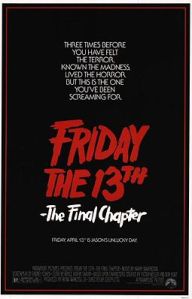
Film Review: Friday the 13th: The Final Chapter (dir. by Joseph Zito)


(spoilers below)

Today, continuing our look at the Friday the 13th horror franchise, we consider the misnamed Friday the 13th — The Final ChapterOriginally released in 1984, this film apparently was really sold as being the final chapter and Tom Savini even returned to do the gore effects because, supposedly, he wanted to kill off his most famous creation.  To be honest, that all sounds like a lot of hype and hucksterism to me but, regardless of the title’s insincerity, The Final Chapter is one of the best (some would say the best) installments in the series.

The Final Chapter begins less than an hour after the end of Part 3.  (One of the curious things about the Friday the 13th series is that the 2nd, 3rd, and fourth films all occur during the same long weekend.  It never seems to disturb anyone in the 3rd or 4th film that a bunch of people have just been murdered in the same general area.)  Jason, who was killed by the terrible Chris Higgins at the end of Part 3, is taken down to the county morgue where he promptly turns out to not be dead after all.  He kills a nurse and an orderly and then, instead of continuing to seek vengeance on Chris (with whom he was pretty much obsessed in Part 3) , he decides to go kill a whole bunch of other people who have just shown up at Crystal Lake for the weekend. 

Those other people are a group of dorky but rather likable college students who have rented a house on the lake.  This is probably the most quirky group of vacationers ever to come to Crystal Lake and it’s a credit to an unusually strong (and unsung) ensemble cast that you actually do believe that these people are friends.  In the group, we have Doug (a dreamy Peter Barton), shy virgin Sarah (Barbara Howard, who is so believable as a nice girl that I felt bad for her when she died), Paul (Alan Hayes), Paul’s slutty girlfriend Samantha (Judie Aronson), and finally heterosexual life partners Jimmy (Crispin Glover) and Ted (Lawrence Monoson).  Jimmy and Ted provide the film with its “comic relief,” the majority of which is pretty weak but Crispin Glover gives such an odd performance that he’s enjoyable nonetheless.  Eventually, our vacationers meet two twins, Tina and Terri (Camilla and Carey Moore) and then they all go back to the house to watch old nudie films and Crispin Glover does a hilariously spastic dance before losing his virginity to one of the twins.  (“Was I a dead fuck?” he asks after, with an aching sincerity.)  And then Sarah gets ready to lose her virginity to Doug but then that defender of purity, Jason (played here by Ted White), pops up and kills everyone.  Seriously, Jason had a busy weekend.

Unfortunately for Jason, Trish Jarvis (Kimberly Beck) and her little brother Tommy (Corey Feldman, who gives a pretty good performance here even if Tommy is kind of a brat when you get right down to it), happen to live next door.  Trish is prepared for Jason because she has previously met yet another camper — Rob (Erich Anderson),who specifically came up to Crystal Lake to track down and kill Jason because Jason killed his sister Sandra in Part 2.  (Of course, by the series chronology, Sandra only died two days ago so I guess Rob moves pretty quickly.)  Also unfortunate for Jason, Tommy is an aspiring makeup artist who makes himself up to look like Jason and, in the surprisingly exciting finale, uses his skills to fool Jason and then hack him up while screaming, “DIE!” all the while.

Plotwise, Friday the 13th: The Final Chapter is a pretty standard slasher film and, at times, it asks the audience to suspend its disbelief just a little bit too much.  Whenever I see the scene where Tina is pulled out the second story window, I always find myself wondering 1) how Jason managed to climb up the side of the house in the rain, 2) why did he decide to do that when, in the previous scene, he was already inside the house, and 3) why didn’t anyone inside the house hear Tina crashing into the station wagon below.  And yet, despite this, Friday the 13th: The Final Chapter is considered by many (including me) to be the best of the series. 

To me, this film succeeds because of two men — Joseph Zito and Tom Savini.    Whereas later Friday the 13th directors often times seemed to be ashamed of the films they were making, Zito was an exploitation vet who had already directed one of the most brutal slashers of all time, The Prowler.  As a director, Zito specialized in telling simple stories as brutally and efficiently as possible.  That’s certainly what he does here and the end result is a fast-paced Friday the 13th that — as opposed to Part 3 — didn’t suffer from any excessive filler.  As well, Zito also does a good job in framing and executing the film’s many tracking and p.o.v. shots, continually keeping the audience off-balance as to whether we’re seeing the camera’s point-of-view or Jason’s. Meanwhile, Tom Savini’s gore effects are just as realistic and disturbing as in the first film.  This is an undeniably bloody film that, at the same time, never slips into tedious “torture porn,” and both Zito and Savini deserve a lot of credit for that.

(Incidentally, here’s a little trivia for all of you Maniac fans — did you know that Joe Spinell’s loathsome Frank Zito was actually named after Joe Zito, who was apparently friends with William Lustig.)

Of all the Friday the 13th films, The Final Chapter probably features the strongest cast.  It certainly features one of the best “final girls”, with Kimberly Beck giving the type of strong performance  that Dana Kimmell failed to supply in Part 3.  Though only Corey Feldman and Crispin Glover would go on to any greater fame, the entire cast is likable and, as opposed to previous and future installments, no one gives a weak performance.  (Even the gimmicky twins do well enough.)  Though I know several people will laugh at this, I sincerely believe that there is an art to giving an effective performance in a film like Friday the 13th.  The key, I think, is to be likable enough that people will watch you and wish you well yet, at the same time, to be bland enough that nobody will be traumatized by your eventual death.  If anything, the cast of The Final Chapter isn’t quite bland enough.  Everyone brings almost too much life to these thinly drawn characters and, as a result,  it’s hard not to feel a little bit traumatized when they start dying.  Crispin Glover, for instance, gave such a quirky and interesting performance that I was actually pretty depressed to see him get that meat cleaver buried in his face.  As well, Peter Barton and Barbara Howard make such a cute couple that it’s upsetting that neither one of them survives to the end of the film. 

Despite the film’s title, the fourth installment of the Friday the 13th franchise was hardly the final chapter and it’s pretty obvious that it was never meant to be.  While I know that some people do complain about the cynicism behind the film’s title, I happen to love it.  It’s like a throwback to the classic old exploitation films that were always sold with sordid titles — like Too Young To Die and Arrested at 17 — that in no way reflected the actual content of the film.  Slasher films are the direct descendants of movies like Reefer Madness and Dwain Esper’s Maniac and it’s nice to see that heritage honored with the false promise of a final chapter.

Though the film’s ending was clearly set up to allow Tommy to eventually take Jason’s place (and, seriously, imagine how disturbing that could have been), Jason would eventually return.  But first, the series would take a major detour with its most over-the-top chapter yet.  We’ll talk about the infamous Friday the 13th — A New Beginning tomorrow.