Retro Television Review: 3 By Cheever 1.3 “The Five Forty-Eight”


Welcome to Retro Television Reviews, a feature where we review some of our favorite and least favorite shows of the past!  On Saturdays, I will be reviewing 3 By Cheever, which ran on PBS in 1979.  The entire show can be purchased on Prime and found on YouTube.
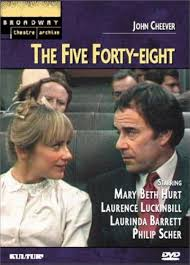
This week, we finish up 3 By Cheever with an adaption of one of his best-known short stories.

Episode 1.3 “The Five Forty-Eight”

(Dir by James Ivory, originally aired on James Ivory)

Laurence Luckinbill stars as Blake, a business executive who rides the train into the city for work and then back to the suburbs when it’s time to return to his perfect home.  One day, as Blake heads to his train, he comes to be aware that he’s being followed by his former secretary, Miss Dent (Mary Beth Hurt).  Blake is concerned because Miss Dent made quite a scene when she was fired from her job a little while ago.  Of course, a part of the reason why she was so upset was because Blake had earlier seduced her, something that he has a habit of doing when it comes to his secretaries.  On the train, surrounded by neighbors (including one that Blake can’t stand because of his long hair), Blake finds himself sitting next to Miss Dent.  She explains that she has a gun in her purse.  As the train heads for its destination, Blake’s confident facade crumbles and he is soon as humiliated by his former secretary as she was by him.  And yet, this being a Cheever story, one wonders if Blake is even capable of realizing why any of this is happening to him.

The final episode of 3 By Cheever was an adaptation of one of John Cheever’s best short stories.  As directed by James Ivory, this adaptation can feel a bit overdrawn.  The short story, for instance, opens with Blake on an elevator, already preparing to head home on the train.  Ivory’s adaptation opens with Blake at the start of his day and we see a lot of things — like Blake’s antagonistic relationship with his long-haired neighbor — that Cheever simply mentioned.  It takes a while for Miss Dent to finally sit down next to Blake and Ivory doesn’t do much to build up any sort of suspense while we’re waiting.

On the plus side, the film reveals Ivory’s skill when it comes to working with actors as both Luckinbill and Mary Beth Hurt give excellent performances.  Luckinbill goes from being oily and overconfident to being a neurotic mess by the end of the show while Hurt does the opposite, going from being meek to commanding.  Both the original short story and Ivory’s adaptation succeed in making you wonder what the future could possibly hold for either one of the two characters.  They both seem to reach a point of no return and it’s hard to imagine Blake going back to his suburban home and his train rides and his motel hook-ups but, then again, this is a Cheever story so the implication is that he does just that, untouched by the fact that he nearly lost his life due to his own behavior.  As for Miss Dent, she reclaims her self-respect by going to an extreme.

This was the last episode of 3 By Cheever.  This was an interesting series of adaptations, even if Cheever’s prose does seem to work best on the page than literally translated to film.  Next week, a new series will being in this spot.
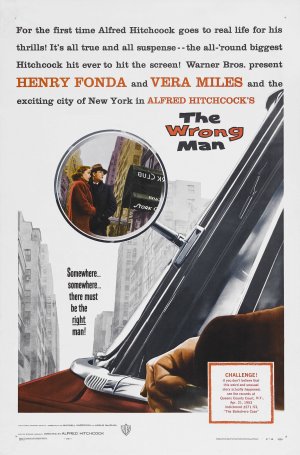
Lisa Marie Does The Wrong Man (dir by Alfred Hitchcock)


Since today is Alfred Hitchcock’s birthday, I figured why not take a few minutes to recommend one of his films that you may not have seen.  First released in 1956 but still painfully relevant today, The Wrong Man is one of Hitchcock’s best but it’s also one of his most underrated.

The Wrong Man deals with a common Hitchcock theme — i.e., an innocent man has been accused of a crime and, despite all of his efforts, cannot seem to convince anyone of his innocence.  The difference between The Wrong Man and something like Saboteur or Frenzy is that The Wrong Man is based on a true story.

Manny Ballestro (Henry Fonda) is a struggling musician.  He makes $85 a week, playing in a small jazz club.  But even though he may not be rich, he’s happy.  He loves his job.  He loves making music.  Even more importantly, he loves his wife, Rose (Vera Miles).  But Rose needs to have her wisdom teeth removed and it’s going to cost $300.  (As a sign of how much things have changed, I would have been relieved if it had only cost me $300 to get my wisdom teeth taken out.)  Desperate for money, Manny tries to borrow money on his wife’s life insurance plan.  What Manny doesn’t know is that the insurance office has been held up twice by a man who bears a vague resemblance to him.  A clerk calls the police and Manny soon finds himself being taken down to the police station.

Two detectives say that they need Manny’s help but they don’t tell him why.  But Manny knows he’s innocent of any crime and he believes that the police are on his side and he agrees to help.  When they tell him to walk into a liquor store, he does so.  When they take him to a deli, he goes in there as well.  When they demand to know why he was trying to borrow money on his wife’s life insurance, he tells them.  When they ask him about his financial difficulties, he tells them about that as well.  Why shouldn’t he?  He’s innocent and the police are just doing their job, right?  And when the cops finally ask him to copy down a few words that were used in the note that the robber slipped the clerk at the insurance company, Manny does so.  And when they then ask him to take part in a line-up, he does that as well…

And when Manny is arrested and charged with a crime … well, that’s when he finally understands that the system is not on his side.  His wife manages to hire a reputable attorney, Frank O’Connor (Anthony Quayle), to defend him but it quickly becomes obvious that the world has already decided that Manny is guilty.  When Manny and his wife try to track down some people who could provide Manny with an alibi, they discover that two of them are dead and one of them cannot be found.  For once, in a Hitchcock film, it’s not a case of conspiracy.  Instead, it’s just bad luck.

And, through it all, Rose continues to blame herself.  In fact, she is so wracked with guilt that she has a nervous breakdown.

It all leads to an amazingly disheartening courtroom scene.  As quickly becomes obvious, the judge has little interest in what’s happening in his court.  Even worse, the jury is unconcerned with the evidence.  Most of them are just annoyed at the inconvenience and punishing Manny seems like the perfect way to release their own frustrations…

It’s a bleak picture of the American justice system.  Watching The Wrong Man today, it’s tempting to say that the film is just a reflection of society in the 1950s and that things have changed today.  But really, have they?  True, the police may now be required to read someone their rights when they’re arrested.  A suspect can now ask for a lawyer.  We’ve got laws against entrapment and all the rest.  But that doesn’t matter.  We still live in a society where people are still widely presumed to be guilty, even after they’ve been found innocent in a court of law.  We still live in a society where the wrong man can have his life ruined because of one mistake.

The Wrong Man doesn’t get as much attention as some of Hitchcock’s other films.  In many ways, it’s an atypical example of his work.  Hitchcock was notorious for his dark sense of humor and his habit of waving away most plot points as just being mere “macguffins.”  With the exception of two scenes, both of which are meant to depict Manny’s mental state, The Wrong Man is filmed in a documentary style, one that occasionally seems more like Sidney Lumet than Alfred Hitchcock.  There’s next to no humor, nor are there any big or flamboyant twists.  In short, The Wrong Man finds the director of Psycho, Vertigo, and Rear Window at his most sincere.  It takes some getting used to.

But, once you do get used to it, The Wrong Man emerges as a powerful and bleak portrait of two innocent people at the mercy of a soulless system.  It’s a must see so be sure to see it!

The-Wrong-Man-poster