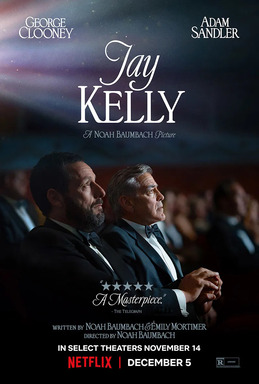
Jay Kelly features George Clooney at both his best and his worst.
Clooney plays the film’s title character, an actor who has just hit 60 and who is having an existential crisis as he realizes everything that he’s lost as a result of being rich and famous. Clooney’s best moments are when he plays Jay as being essentially a prick, a guy who might be well-meaning but who lacks the self-awareness necessary to understand just how condescending and fake he tends to come across to the people who know him. This is the Jay who insists on having a drink with Tim (Billy Crudup), a former actor who lost a key role to Jay and who has never forgiven him for it. (It starts out as a friendly drink but it eventually becomes a fight after Tim reveals that he hates Jay and Jay responds by being smug.) This is the Jay who has alienated both of his daughters (Riley Keough and Grace Edwards) and who doesn’t seem to understand that the rest of the world doesn’t travel with an entourage.
Jay is gloriously unaware in those scenes and they give Clooney a chance to show that he’s still capable of giving a sharp comedic performance. Watching him in those scenes, I was reminded of the gloriously dumb characters that he played for the Coen Brothers, in both Burn After Reading and Hail, Caesar. For that matter, I was also reminded of his burned-out hatchet man from Up In the Air, who was not a dumb character but still was someone who, like Jay Kelly, always seemed to be performing.
Unfortunately, as the film progresses, Jay himself starts to wander into flashbacks of himself as a young actor and, even worse, he starts to talk to himself about everything that he’s lost due to his fame and suddenly, he transforms into the insufferably smug Clooney who spent the earlier part of this year in greasepaint, lecturing us all about Edward R. Murrow. The flashbacks to Jay Kelly’s past often feel like stand-ins for flashbacks to George Clooney’s past (and it’s probably not a coincidence that both Kelly and Clooney are from Kentucky) but they don’t really add up to much. Jay Kelly is a character who becomes less compelling the more that one learns about him.
The characters around Jay Kelly are far more interesting than Jay himself, though I have my doubts whether that was intentional on the part of director Noah Baumbach. (An overly long and indulgent sequence on a train would seem to suggest that Jay Kelly was envisioned as being a more fascinating character than he turned out to be.) Just as he did in Baumbach’s The Meyerowitz Stories, Adam Sandler gives the film its heart, playing the role of Jay’s loyal but unappreciated manager. Sandler and Laura Dern have a few showy scenes together but Sandler’s best moments come opposite Patrick Wilson as a client who feels that he’s being neglected in favor of Jay Kelly. (For that matter, Wilson is so good in those scenes that I almost wish he had switched roles with Clooney.) One might not expect the star of Jack and Jill and That’s My Boy to emerge as one of Hollywood’s best sad-eyed character actors but that’s what has happened in the case of Adam Sandler.
With all that in mind, I have to admit that I enjoyed Jay Kelly more than I thought I would. Some of that has to do with expectations. Jay Kelly is currently getting so roasted on social media that I was expecting the film to be a self-indulgent disaster. While the film is definitely self-indulgent and about 30 minutes too long, it’s not a disaster. When Clooney’s performance works, it really works. (Unfortunately, the inverse is also true.) Adam Sandler, Billy Crudup, Riley Keough, and Stacy Keach all give performances that elevate the occasionally shallow script. Cinematographer Linus Sandgren captures some beautiful shots, especially towards the end of the film. Visually, Jay Kelly is a marked improvement on the bland imagery of Marriage Story. Like its title character, Jay Kelly is imperfect and occasionally annoying but it does hold your attention.
As for the film’s Oscar chances, the reviews are mixed but it’s a film about how tough it is to be an actor and one should not forget that the Actor’s Branch is the biggest branch of the Academy and the majority of the voters are people who are probably going to watch Jay Kelly and say, at the very least, “Hey, I know that guy!” (Few will admit, “I am that guy,” but that will still definitely be a factor in how they react to the film.) Regardless of how social media feels about the film, I imagine Jay Kelly will be remembered when the nominations are announced.

 Through the Shattered Lens