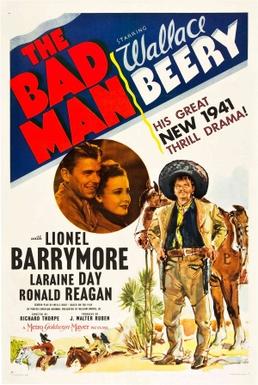
The Bad Man (1941, directed by Richard Thorpe)


Gil Jones (Ronald Reagan) lives on a ranch with his cantankerous uncle, Henry (Lionel Barrymore).  After their cattle are stolen by the notorious bandit Pancho Lopez (Wallace Beery), Gil and Henry are faced with the prospect of losing their ranch.  Banker Jasper Hardy (Henry Travers) wants to foreclose on Henry and take over the ranch but a businessman named Morgan Pell (Tom Conway) shows up and offers to pay the then-huge sum of $20,000 for the land.  Accompanying Morgan is his wife, Lucia (Laraine Day).  Lucia was Gil’s childhood love and Morgan fears that Lucia still loves Gil more than him.  Also in the mix is Gil’s comic relief best friend (Chill Wills), who has a crush on Hardy’s daughter (Nydia Westman).  Negotiations are interrupted when the flamboyant Lopez and his men return to the ranch and take everyone, but Gil, hostage.

This sepia-toned film is based on a stage play, one that had already been filmed twice.  It was Ronald Reagan’s first film for MGM and, when Reagan was running for President, he quipped that if he could survive acting opposite Wallace Beery and Lionel Barrymore than he could survive negotiating with Leonid Brezhnev.  The role of Gil is a typical Ronald Reagan role.  He’s good-natured and dependable and a little boring.  Because he once saved Lopez’s life, Lopez is willing to help him out with his problems.  Reagan is not bad in the role but he is overshadowed by Barrymore and Beery, two veteran actors who chew the scenery with gusto here.  Berry speaks in an exaggerated and not at all convincing Mexican accent while Barrymore bellows all of his lines.  Gil has so many different people yelling at him that it’s impossible not to feel sorry for him.  Morgan has ulterior motives for offering to buy the land and Tom Conway is a convincing villain.  Lopez helps out Gil and her uncle, saving not only their land but also plotting to bring Gil and Lucia back together.  It’s a stage bound mix of drama and comedy that doesn’t really work, though Beery and Barrymore are amusing and Ronald Reagan shows why he was cast in so many best friend roles.

Whether you’ll enjoy it will probably depend on how you feel about the cast because they’re really the only reason to watch.  If you’re a fan of Barrymore, Beery, or Reagan the film might work for you.  If you’re not, this stagey 70-minute western is probably not for you.

Retro Television Reviews: Fantasy Island 3.7 “The Wedding”


Welcome to Retro Television Reviews, a feature where we review some of our favorite and least favorite shows of the past!  On Tuesdays, I will be reviewing the original Fantasy Island, which ran on ABC from 1977 to 1986.  Almost entire show is currently streaming is on Youtube!

This week, Mr. Roarke gets married!

Episode 3.7 “The Wedding”

(Dir by Earl Bellamy, originally aired on November 3rd, 1979)

Helena Marsh (Samantha Eggar) and her son, Jamie (Paul John Balson), return to Fantasy Island!

The last time Helena visited the Island, she and Mr. Roarke ended up falling in love but Helena ended up leaving the Island so that she could return to the clinic that her late husband started in India.  However, Helena has now come back to the Island and she has only one fantasy.  She wants to marry Mr. Roarke!  Mr. Roarke is going to make her fantasy come true.  He’s so happy that he doesn’t even yell at Tattoo during this episode.

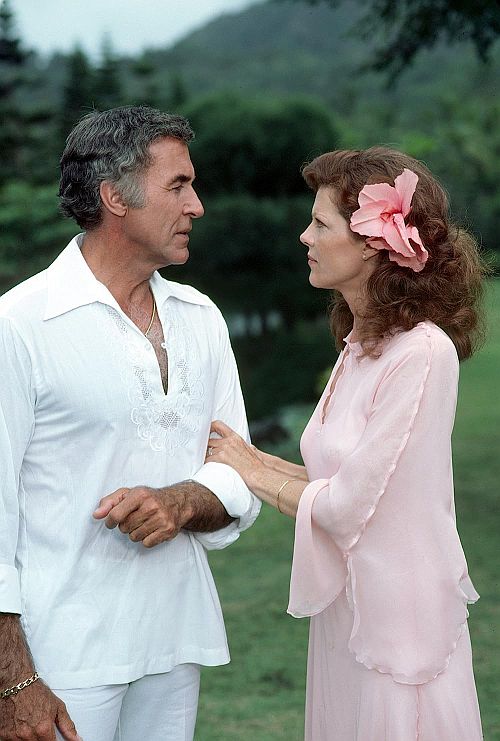
The entire Island is excited about the wedding.  However, Tattoo grows concerned when he hears Helena’s parents (played by Laraine Day and Joseph Cotten) talking about how unfair it is that Helena is dying and probably won’t even survive the honeymoon.  Tattoo goes to Mr. Roarke and discovers that Roarke knows that Helena is dying.  Mr. Roarke assures Tattoo that Helena has one of those television diseases where death comes with little to no suffering.  Unfortunately, Jamie does not yet know that his mother is ill.

The Hawaiian-style wedding goes off without a hitch.  Mr. Roarke and Helena honeymoon on the other side of the island and, for the first time since this series began, Ricardo Montalban actually gets to wear something other than a white tuxedo.  While Jaimie helps Tattoo train Chester the Chimpanzee to stop stealing things, Helena enjoys her last few days with Mr. Roarke.  Unfortunately, the honeymoon is cut short as Helena grows ill.  From his grandfather, Jamie learns that his mother is dying.  “If life were fair,” Mr. Roarke says with tears in his eyes, “there would be no need for Fantasy Island.”

Awwwww!  Seriously, what a terrifically sweet and sad episode this turned out to be.  Ricardo Montalban and Samantha Eggar had fabulous chemistry together and Montalban, in particular, really seemed to be energized by the chance to do something other than act mysterious and enigmatic.  In this episode, Mr. Roarke finally gets to show his emotions and when he cries, you’ll want to cry too.  Helena dies peacefully on the island, in the arms of Mr. Roarke.  Her final fantasy has been granted.

As for Jamie, he decides that he can’t stay on the Island.  He has to go back to school so that, someday, he can become a doctor just like his mother.

Oh my God, I’m like seriously tearing up just writing this recap.

This episode was Fantasy Island at its sentimental and emotional best.  This was a great episode, featuring outstanding performances from Ricardo Montalban and Samantha Eggar.  Would you believe that an episode of Fantasy Island could make a reviewer cry?  Well, this episode did.

Retro Television Reviews: The Love Boat 2.1 and 2.2 Marooned / The Search / Issac’s Holiday: Parts 1 & 2


Welcome to Retro Television Reviews, a feature where we review some of our favorite and least favorite shows of the past!  On Wednesdays, I will be reviewing the original Love Boat, which aired on ABC from 1977 to 1986!  The series can be streamed on Paramount Plus!

This week, the second season begins with a super-sized episode!

Episodes 2.1 & 2.2 “Marooned / The Search / Issac’s Holiday”

(Dir by Paul Stanley, originally aired on September 16th, 1978)

The second season of The Love Boat started with double-sized episode, promising twice the romance, twice the comedy, and twice the running time!

(Subsequently, this episode was split in two for syndication, hence the double numbering.)

Among the passengers on this cruise is none other than Isaac Washington (Ted Lange)!  The Love Boat’s iconic bartender has decided to spend his vacation where he works and he’s bought a ticket to sail on the Pacific Princess.  It might seem strange to want to spend your vacation at the office but in Isaac’s case, I can see the appeal.  As we saw during the first season, no one works harder than Isaac.  He somehow always manages to be behind every single bar on the ship and it often appears that he’s the only bartender on the boat!  To top it off, he’s always on call.  He’s earned a vacation and he’s earned the right to be served for once.  From the minute Isaac boards the boat, he’s playfully asking the crew to do things for him and none of them mind because he’s their friend Isaac.  One of the key reasons why The Love Boat worked was that the friendships between the members of the crew felt very real.  As such, there’s never any doubt that Isaac would want to spend his vacation with Gopher, Doc, and Julie.

(Interestingly enough, the Captain doesn’t seem to realize that Isaac’s on the boat until Isaac takes his seat at the captain’s table.)

Of course, there are some problems with Isaac’s vacation.  Isaac quickly notices that the substitute bartender, Wally (played by Norm Crosby), is a bit sullen and not very knowledgeable about his drinks.  As well, Isaac has lied to a passenger named Mara (Lola Falana), telling her that he’s a wealthy race car driver.  Bitter old Wally just can’t wait to tell Mara the truth.

Even worse, when Captain Stubing goes to visit a nearby island, Deputy Captain Cunningham (Dick Martin) is left in charge and he quickly proves himself to be thoroughly incompetent.  (The show makes a point of assuring viewers that Cunningham actually works for a different cruise line and is just training on the Pacific Princess.)  Cunningham ignores the news that a hurricane is on the way.  When the hurricane hits, it’s falls on Isaac to take charge and make sure the passengers are safe.  Of course, to do this, he has to admit that he’s not a race car driver.  He’s just a bartender who, in a just world, would probably be a captain.

Meanwhile, Stubing, Doc, Gopher, Julie, and a group of passengers (Avery Schreiber, Barbi Benton, Edie Adams, and Audra Lindley) are all being held captive on that nearby island.  Their captor is an eccentric hermit named David Crothers (played by John Astin, who was often cast as eccentric hermits).  David has a gun, one that later turns out to be full of not bullets but dirt.  Unfortunately, the hurricane that threatens the Pacific Princess also maroons everyone else on the island and they have to wait for someone to rescue them.  Injured by a falling tree, Gopher spends his time deliriously speaking to imaginary women in foreign accents.  Doc, for once, actually gets to do some medical stuff and assures everyone that Gopher will be fine.  Interestingly enough, no one seems to be that worried about being captured by a crazed hermit.  Perhaps that’s because John Astin is just too naturally friendly to be viewed as a threat.

Finally, Jeannie Carter (Donna Mills) is on the boat because she’s been told that one of the passengers is her long-lost mother.  Soap opera actor Mike Adler (David Birney) offers Jeannie the moral and emotional (and romantic) support to confront the woman but the woman (Laraine Day) turns out to be Mike’s mother as well!  Agck!

The 2nd season premiers, with its mix of melodrama, broad comedy, romance, and hurricane-strength winds, is pretty much exactly what most viewers would want out of a show like The Love Boat.  Isaac gets to save the day while John Astin hams it up and David Birney, Donna Milles, and Laraine Day wring every emotion that they can out of their soap opera-style storyline.  It’s a fun and undemanding show, one that gets by on its breezy style and the likable chemistry between the cast.

This episode is also important because it was the second episode (after the first season’s supersized episode) in which the opening credits featured video images of the guest stars as well as their names.  This would continue in every subsequent episode and eventually become of the show’s trademarks.

Next week: Julie’s parents board the boat!
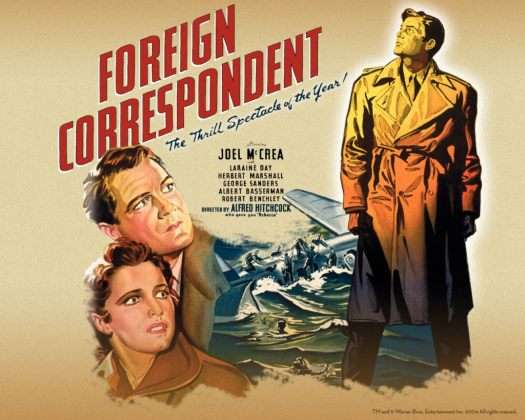
Windmills of Your Mind: Alfred Hitchcock’s FOREIGN CORRESPONDENT (United Artists 1940)


gary loggins's avatarcracked rear viewer

(When Maddy Loves Her Classic Films invited me to join in on the Alfred Hitchcock Blogathon, I jumped at the chance! I’ve just completed the Ball State/TCM 50 YEARS OF HITCHCOCK course, and have been knee-deep in his movies for a month now!)

Alfred Hitchcock’s second American film found the Master of Suspense back in the spy game with FORGEIGN CORRESPONDENT, this time with American star Joel McCrea caught up in those familiar “extraordinary circumstances” we’ve all come to love. Like REBECCA that same year, this film was nominated for Best Picture, an extraordinary circumstance indeed for a director new to these shores. Offhand I can only think of three other directors to hold that distinction – John Ford (also in ’40), Sam Wood (1942), and Francis Ford Coppola (1974). Good company, to say the least! (And please correct me if I’m wrong, any of you film fans out there).

Crime beat reporter…

View original post 644 more words

The Fabulous Forties #16: Dr. Kildare’s Strange Case (dir by Harold S. Bucquet)


Dr._Kildare's_Strange_Case_FilmPoster

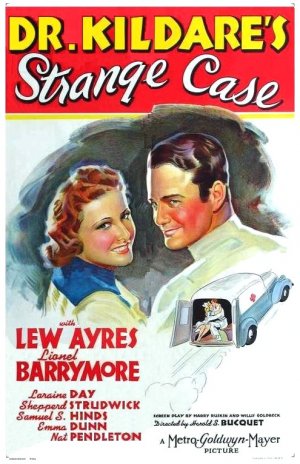
The 16th film in Mill Creek’s Fabulous Forties box set was 1940’s Dr. Kildare’s Strange Case.  It’s about a doctor who investigates a medical case and wow, is it ever a strange case.

Apparently, there was a whole series of Dr. Kildare films that were released in the 30s and 40s.  I guess the films were the cinematic equivalent of a TV show like Grey’s Anatomy or ER or Children’s Hospital or… well, every medical show that’s ever shown up on TV since the beginning of time.  Dr. James Kildare (Lew Ayres) is a passionate young doctor who may break the rules but he gets results!  His mentor is Dr. Gillipsie.  Gillipsie is played by Lionel Barrymore and since the character is cranky and confined to a wheelchair, it was impossible for me to watch him without thinking about Mr. Potter from It’s A Wonderful Life.  Whenever Kildare went to him for advise, I kept expecting Gillipsie to glare at him and say, “You once called me a warped old man…”

Anyway, Dr. Kildare works in a hospital and, when he’s not silently judging everyone else that he works with, he’s busy silently judging the wealthy Dr. Lane (Sheppard Strudwick), a brain surgeon whose patients keep dying.  Kildare and Lane are also both in love with the same nurse, Mary Lamont (Laraine Day).  Mary wants to marry Kildare but Kildare would rather be poor and single than compromise his medical principles.  Lane, on the other hand, sends her a box full of silk stockings.  Plus, he’s rich!

Seriously, how is this even a competition?  Forget Kildare and marry Lane!

Except, as I mentioned earlier, all of Lane’s patients keep dying.  Is Lane incompetent or, as Kildare suggests, is it possible that brain surgery is just really, really hard?  I imagine it was even harder in 1940, when this movie was being made.  While Kildare and Lane are operating on brains, Dr. Gillipsie is still using leeches to suck sickness out of the poorer patients.

(You don’t actually see it happen in the movie but Gillipsie comes across as being a leech man.)

Anyway, eventually, Kildare has to cure a schizophrenic and it turns out that he can do this by putting the man into an insulin coma.  As is explained in great detail, forcibly putting a patient in a coma will cause that patient’s mind to go back to a reset point.  It’s kind of like how Windows sets up a restore point before doing a major update.

And that therapy sounds so crazy that you just know it had to be based in an actual practice.  I checked with Wikipedia and I was not shocked to discover that apparently Insulin Shock Therapy used to be a thing!

Anyway, Kildare’s gets into a lot of trouble for putting his patient into a coma and attempting to erase a huge part of his mind.  Will Kildare’s results vindicate his methods or will Gillipsie have to use leeches to suck the crazy out of the patient’s brain?

Watch the film to find out!  Or don’t.  Dr. Kildare’s Strange Case was directed by Harold S. Bucquet, who did a pretty good job with The Adventures of Tartu.  His direction here is flat and uninspired, which only serves to make this entire film feel like an old TV show.  I’m tempted to recommend the movie just because of the scene where it’s explained that insulin shock therapy causes patients to devolve so that they can re-evolve but otherwise, Dr. Kildare’s Strange Case is forgettable.

If you want to see it, you can watch it below!

http://www.youtube.com/watch?v=8UPFyrlNiGM

Or you can just watch this classic episode of Children’s Hospital!

http://www.youtube.com/watch?v=dpBjqgVaEbk

Lisa Reviews An Oscar Nominee: Foreign Correspondent (dir by Alfred Hitchcock)


ForeignCorrespondent

Before watching a film like 1940’s Foreign Correspondent, it helps to know a little something about history.

Nowadays, when we think about World War II, there’s a tendency to assume that, from the minute that Hitler came to power in Germany and started to invade the rest of Europe, the entire world united against the Nazis.  The truth is actually far more complex.  The world was still recovering from World War I and throughout the 1930s, even as the Axis powers were growing more and more aggressive, respected intellectual leaders and politicians continued to argue that peace must be maintained at all costs.  Pacifism was such a popular concept that otherwise intelligent people were perfectly willing to make excuses for Hitler and Mussolini.  For five years, the UK followed a policy of appeasement towards Nazi Germany.  Even after war broke out between Britain and Germany, the U.S. remained officially neutral.  In the 1940 presidential election, President Franklin D. Roosevelt — running on a platform of neutrality — was overwhelmingly reelected over internationalist Wendell Willkie.

Foreign Correspondent, an American film made by a British director, opens before the start of World War II.  An American newspaper editor, Mr. Powers (Harry Davenport), is frustrated because none of his foreign correspondents seem to be able to understand the truth of the situation in Europe.  They all claim that there is going to be no war in Europe but Mr. Powers feels differently.  He also feels that the newspaper’s most celebrated and respected foreign correspondents are just a bunch of out-of-touch elitists.  Instead of sending another upper class academic, Mr. Powers decides to send a hard-boiled crime reporter to cover the situation in Europe.  Johnny Jones (Joel McCrea) has never been to Europe and that’s exactly why Mr. Powers decides to send him.  In one of the film’s more clever moments, he does, however, insist that Johnny write under the more distinguished sounding name of “Huntley Haverstock.”

(Foreign Correspondent‘s pointed criticism of out-of-touch elitists repeating the establishment line remains just as relevant today as it was in 1940.)

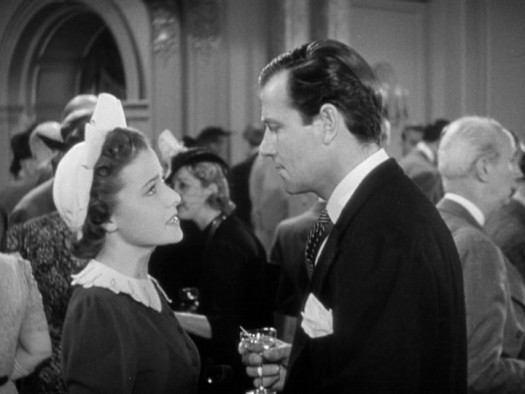
From the minute the brash and tough Johnny arrives in Europe, he finds himself caught up in a huge conspiracy.  He’s been assigned to report on a group known as the Universal Peace Party and, since this film was directed by Alfred Hitchcock, we automatically know that any organization with the word “Peace” in its name has to be up to something shady.  The Universal Peace Party has been founded by Stephen Fisher (Herbert Marshall), who appears to sincere in his desire to avoid war.  Johnny meets and falls in love with Fisher’s daughter, Carol (Laraine Day).

From the minute that Johnny witnesses the assassination of distinguished Dutch diplomat Von Meer (Albert Bassermann), he suspects that things are not how they seem.  Working with Carol and a British journalist named Scott ffolliot* (delightfully played by the great George Sanders), Johnny discovers that Von Meer was not killed at all.  Instead, a double was assassinated and Von Meer was kidnapped by a group of spies.

But who are the spies?  After nearly getting killed by one of Fisher’s bodyguards, Johnny starts to suspect that Stephen Fisher might not be as into world peace as was originally assumed.  Complicating matters, however, is the fact that Johnny is now engaged to marry Carol…

Foreign Correspondent is a wonderfully witty thriller, one that has a very serious message.  While the film is distinguished by Hitchcock’s typically droll sense of humor (eccentric characters abound and the scene where Edmund Gwenn keeps getting interrupted before he can attempt to push Joel McCrea off of a tower is both funny and suspenseful), the film’s message was that America could not afford to stay neutral as war broke out across Europe.  As the all-American Johnny Jones says at the end of the film:

“All that noise you hear isn’t static – it’s death, coming to London. Yes, they’re coming here now. You can hear the bombs falling on the streets and the homes. Don’t tune me out, hang on a while – this is a big story, and you’re part of it. It’s too late to do anything here now except stand in the dark and let them come… as if the lights were all out everywhere, except in America. Keep those lights burning, cover them with steel, ring them with guns, build a canopy of battleships and bombing planes around them. Hello, America, hang on to your lights: they’re the only lights left in the world!”

Foreign Correspondent was nominated for best picture of 1940 but it lost to another far different Hitchcock-directed film, Rebecca.

http://www.youtube.com/watch?v=LMDJnTKotxo

——

* Yes, that is how he spells his last name.  As he explains, his family dropped the capital name in his surname after an ancestor was executed by Henry II.  Since it was George Sanders doing the explaining, it somehow made perfect sense.