Doctor Who — The Leisure Hive, Meglos, Full Circle, State of Decay, Warrior’s Gate, The Keeper of Traken, Logopolis


The 18th season of Doctor Who started with the show getting a new producer, John Nathan-Turner.  Depending on who you ask, Nathan-Turner was either the best or the worst thing that ever happened to Doctor Who.  He pushed the series away from what he felt was the “silliness” of the previous season and, in doing so, he alienated both Tom Baker and Lalla Ward.  (Ward was close friends with Douglas Adams, whom Nathan-Turner blamed for turning the show silly.)  Nathan-Turner pushed for more serious stories and for better production values.  He also hated K-9, which upset a lot of younger viewers.  My personal feeling is that Nathan-Turner was not a good producer for Tom Baker’s Doctor but he was a great producer for Peter Davison’s interpretation of the character.  As for the Colin Baker and Sylvester McCoy years, let’s keep things cheery and not go there.

By the end of the 18th season, Tom Baker, Lalla Ward, and John Leeson (the voice of K-9) had left the show.  Completing my look back at Doctor Who, here are Tom Baker’s final serials.

The Leisure Hive (1980, directed by Lovett Bickford)

John Nathan-Turner hated K-9.  If there was any doubt about that, consider that his first serial as the show’s producer opens with the Doctor and Romana on holiday Brighton.  K-9, for some reason, rolls out to the ocean and explodes, taking him out of commission until the Doctor can rebuild him.

Personally, I would have been happy if this entire serial had just been Tom Baker and Lalla Ward on that beach in Brighton.  Nathan-Turner may not have been a fan of the Doctor and Romana working together by Baker and Ward but viewers like me definitely disagreed.  Alas, it is not to be.  Romana wants a real holiday (Brighton, in a reminder of just how British Doctor Who really was, doesn’t count) so she and the Doctor and the remains of K-9 go to the leisure planet of Argolis.  Unfortunately, Argolis is having financial problems and is at risk of being taken over by the Foamai.  When the Doctor is framed for a strangulation murder that was committed with a scarf, he is forced to stand trial and become an experimental test subject.

It’s an okay start for Season 18, though Tom Baker, for the first time since taking over the role of the Doctor, was starting to look disinterested.  John Nathan-Turner was eager to get away from the “silliness” of the previous season but, ironically, a story set on a leisure planet and featuring an intergalactic crime syndicate would have very much benefitted by Douglas Adams’s sense of humor.

Meglos (1980, directed by Terence Dudley)

The Doctor is asked to help broker a peace between two warring planets.  Unfortunately, Meglos — a sentient cactus — traps the TARDIS in a time loop and then plots to thwart the peace.

When viewers think of this serial, they usually remember Meglos taking on the form of the Doctor and Tom Baker wearing makeup that made him look like a humanoid cactus.  That’s because the plot is nothing special, though I do appreciate that we finally got to see what it’s like to be stuck in a time loop.  Jacqueline Hill, who played Barbara when the serial first began, appears as Lexa, a high priestess of the planet Tigella.

Full Circle (1980, directed by Peter Grimwade)

Having been ordered to return Romana to Gallifrey, the Doctor instead materializes on a swampy plant that is located where Gallifrey should be.  The TARDIS has slipped into E-Space, a small pocket universe.  As for the planet that they’ve landed on, it’s inhabited by swamp monsters, a group a humans who live around a crashed starliner, and a mad scientist.

The idea of E-Space was an interesting one and Lalla Ward gives one of her strongest performances of the series, as Romana is briefly possessed in this episode.  Unfortunately, this episode also introduced Adric (Matthew Waterhouse), an annoying child genius who became the Doctor’s newest companion.  Adric was one of the least popular of John Nathan-Turner’s additions to Doctor Who.  A few seasons later, Adric would be blown up while fighting the Cybermen and there would not be a dry eye in the house.

Tom Baker, unhappy with Nathan-Turner’s ideas and annoyed with Waterhouse decided to leave the role while filming this serial.  Waterhouse reportedly cursed at Baker while filming one scene.  They should have left the little punk behind just for doing that.

State of Decay (1980, directed by Peter Moffatt)

Still trapped in E-Space, The TARDIS materializes on a planet where the villagers live under the shadow of a dark tower. Ruled over by three cruel lords, Zargo, Camilla, and Aukon, the villagers are forced to regularly sacrifice their young to appease their rulers. The Doctor, Romana, K-9, and Adric investigate and discover that Zargo, Camilla, and Aukon are vampires! After being defeated by the Time Lords, the vampires retreated into E-Space, where they found a new planet to rule. Of course, that little tosser Adric wants to become a vampire. Why Romana and the Doctor didn’t leave Adric behind on the vampire planet, I’ll never understand.

Even the weaker seasons of Doctor Who usually featured at least one classic serial and, in the case of Season 18, it was State of Decay.  For all of the justified criticisms of John Nathan-Turner time as producer, he did make an attempt to improve the show’s production design and it paid off with this atmospheric serial that paid homage to the great vampire films while also retaining its Doctor Who identity.  Tom Baker seems to be rejuvenated by the clever script and he and Lalla Ward’s chemistry is allowed to shine.  K-9 even gets to do something other than getting kicked around.  State of Decay is a Doctor Who classic.

Warrior’s Gate (1981, directed by Paul Joyce and Graeme Haper)

Still trying to escape E-space, the TARDIS materializes on a similarly trapped spaceship that is run by Captain Rorvik (Clifford Rose).  Learning that the ship is carrying an enslaved race known as the Tharils, the Doctor set them free.  The Tharils help the Doctor reenter N-Space.  However, Romana decides to stay behind to help the Tharils.  The Doctor gives her K-9 and then leaves with Adric.  The Doctor should have left Adric behind too.

This was Lalla Ward’s final episode and both she and Romana deserved a better send-off.  Romana deciding to disobey the Time Lords, I can understand.  Leaving the Doctor, even to help the Tharils, doesn’t seem like something Romana would have done.  John Nathan-Turner finally got his wish, though.  K-9 stayed with Romana.  What are Romana and K-9 going to do in an alternative universe?  They don’t even have a TARDIS.

The only highlight of this episode was Clifford Rose’s manic performance as Captain Rorvik.  Otherwise, it was a forgettable send-off for two great companions.

The Keeper of Traken (1981, directed by John Black)

The Doctor and annoying Adric are summoned to the planet Traken, where the Master (Geoffrey Beevers) is attempting to capture a power source that will give him a new set of regenerations.  (The Master doesn’t look as badly decayed here as he did during The Deadly Assassin.)  With the help of the Keeper of Traken, Tremas (Anthony Ainley), and Tremas’s lovely daughter Nyssa (Sarah Sutton), the Doctor is able to stop the Master.  However, as soon as the Doctor leaves, the Master emerges from a long clock and somehow merges with Tremas’s body, giving him a new set of regenerations.

Despite the presence of Adric, this is not a bad story.  The Master makes his return and, in the final minutes of the serial, Anthony Ainley takes over the role.  Ainley would play The Master for the rest of the original show’s run.  While Ainley’s Master was always more cartoonishly evil than Roger Delgado’s, he still proved to be a worthy adversary for the Fourth, Fifth, Sixth, and Seventh Doctors.

Logopolis (1981, directed by Peter Grimwade)

This is it.  This is final serial to feature Tom Baker as the Doctor.  Things start with the Doctor materializing the Tardis around an actual police box in an effort to fix his chameleon circuit.  The Master then materializes his TARDIS around the Doctor’s.  It all fun and games until the universe starts to unravel and the Doctor sacrifices his life while literally holding space and time together.  Along the way, the Doctor gets two new companions, Nyssa (who has been traveling with the Master under the impression that he’s her father) and Teagan (Janet Fielding), an outspoken Australian flight attendant who entered the TARDIS thinking that it was a police call box.

Whatever else you might want to say about season 18, it gave Tom Baker a fitting send-off.  After seven years of saving civilizations and planets, the Fourth Doctor finally saved the entire universe.  Perhaps knowing how traumatized viewers would be to see the Fourth Doctor die, this episode featured Peter Davison (familiar to viewers as Tristan Sebring from All Creatures Great And Small) as the Watcher, a mysterious figure who merged with the Doctor at the end of the serial and turned out to be his Fifth Incarnation.

I had hoped to discuss some of the Fifth Doctor’s adventures this October but time has caught up with me.  (It’s a pity because Peter Davison more than made the role of the Doctor his own and several of his serials — Kinda, Snakedance, and Enlightenment to name just three — are worthy of being considered classics.)  For me, as someone who to watch Tom Baker’s Doctor on PBS while growing up, this does seem like the right place to stop.

For now.

Doctor Who — Destiny of the Daleks, City of Death, The Creature From The Pit, Nightmare of Eden, Horns of Nimon, Shada


Remember when I was writing about classic Doctor Who for Halloween?  Let’s get back to that with a look at the 17th season of the original series.  This season is a controversial one.  It featured some of the show’s worst serials but also one of its best.  Today, it’s remembered for introducing Lalla Ward as the second Romana and for featuring Douglas Adams as the script editor.

One frequent complaint about this season is that, under Adams’s influence, the season featured more comedy than before and it sometimes felt more like a version of Hitchhiker’s than Doctor Who.  There’s some truth to that but Adams’s influence also made Season 17 into a season unlike any other.  Many of Adams’s ideas didn’t work but he did give us City of Death.

Destiny of the Daleks (1979, directed by Kim Grieve)

Destiny of the Daleks will always have a place in my heart because it opens with Romana regenerating into Lalla Ward.  I will admit right now that, as a kid watching Doctor Who on PBS, I had a huge crush on Lalla Ward.  So did Tom Baker.  He ended up marrying Ward, though the marriage did not last for long.  The relationship between Baker and Ward often seemed to reflected in the relationship between The Doctor and Ward’s Romana.  Long before the Doctor Who reboot had people buzzing about the Doctor and Rose, fans of the original series knew that the Doctor and Romana were in love.

Destiny of the Daleks opens with Lalla Ward’s Romana cheerfully informing the Doctor that she’s decided to regenerate because she was bored and she’s decided to look like Princess Astra.  The Doctor points out that Princess Astra is a real person and Romana can’t just take on her appearance.  Romana then tries out several other appearances before The Doctor tells her to go with Astra.  This goes against everything that the show had established about Time Lords and regeneration but at least we end up with Lalla Ward as Romana.

It’s too bad that the rest of the serial itself isn’t that interesting, even if it does feature the first appearance by the Daleks since Genesis of the Daleks.  Davros returns as well, though he’s now more or less just another generic villain.  The Daleks have a new enemy, a group of robots called the Movellans.  The war between the Daleks and the Movellans are at a standstill because both are governed by logic.  That goes against everything we know about the Daleks.

This was Terry Nation’s final script for Doctor Who.  Reportedly, he was angered when Douglas Adams extensively rewrote the script.  Nation moved to America and later created the original MacGyver.

City of Death (1979, directed by Michael Hayes)

City of Death is a Doctor Who classic.  Romana and the Doctor visit modern-day Paris and the BBC found the money to allow the production to shoot on location.  The Doctor and Romana walk around Paris, hand-in-hand.  Count Scarlioni (Julian Glover) is actually an alien who wants to steal the Mona Lisa so that he can use it to fund his time travel experiments.  Countess Sacrlioni (Catherine Schell) is a classic femme fatale.  An American private investigator named Duggan (Tom Chabdon) wears a trench coat and solves problems by punching first and asking questions later.  John Cleese and Eleanor Bron appears as museum patrons who think the TARDIS is a work of modern art.  Douglas Adams later reworked bits of his script into Dirk Gentley’s Holistic Detective Agency.

Even people who cannot stand the rest of season 17 will agree that City of Death is one of the best of Tom Baker’s serials.  City of Death balances humor and drama and it features an excellent villain in the form of Julian Glover.  Tom Baker and Lalla Ward are at their best, the story is genuinely interesting, and — much like Jago and Lightfoot from The Talons of Weng-Chiang — Duggan deserved his own spin-off.

The Creature From The Pit (1979, directed by Christopher Barry)

This serial features the season’s first appearance by K-9, who is now voiced by David Brierley.  Though this serial was third to be aired, it was the first to be filmed.

It’s not much of a serial.  The TARDIS materializes on yet another feudal planet where Lady Adastra (Myra Frances) rules through fear.  Lady Adastra’s critics are thrown in the pit, which is said to be home to a great monster.  Instead, it’s home to a gentle blob that was sent to the planet as an ambassador.  The Doctor helps the blob gets its freedom while Romana and K-9 are briefly detained by a group of bandits.  Whatever potential the story had is short-circuited by the very unconvincing monster.

Nightmare of Eden (1979, directed by Alan Bromley and Graham Williams)

Two ships materialize in the same location and end up locked together.  Then the TARDIS materializes and the Doctor offers to find a way to unlock the two ships.  One of the ships is a luxury space liner and the passengers are soon being menaced by clawed monsters that look like stuntmen in rubber suits.  The other ship is a trade ship that the Doctor comes to suspect is involved in a drug-running operation.

Once again, the monsters were not at all convincing but the Doctor investigating the interstellar drug traffic was at least something different.  Much like City of Death, Nightmare of Eden, with its luxury spaceliner, had a few moments of satire that worked.  Unlike City of Death, the supporting characters were not that interesting and Tom Baker himself just seemed to be going through the motions.  Nightmare of Eden was better than a lot of Season 17 but it still ultimately comes across as being rather muddled.

The Horns of Nimon (1979 — 1980, directed by Kenny McBain)

The Horns of Nimon, is it terrible or is it great?  Some defend it because of its allusions to Greek mythology, its deliberate humor, and the over-the-top performance of Graham Crowden as Soldeed, the leader of the Skonnan Empire.  Others, like me, point out the turgid pacing, the bad creature effects, and the fact that the majority of the serial is just people walking around.  Based on the myth of the minotaur, The Horns of Nimon looks and feels cheap.  Crowden splits his pants at one point and I guess there was no time to stitch them back up.  The whole thing is just too slapdash.

Shada (2018, directed by Pennant Roberts and Charles Norton)

For decades, Shada was the Holy Grail of Doctor Who.  The final serial of the 17th century, Shada was in the process of filming when the BBC’s technicians went on strike.  With 50% of the serial filmed, production was suspended and eventually canceled.

Afterwards, Shada developed a legendary reputation.  It was often described as being a potential masterpiece, despite the fact that Season 17 was not one of Doctor Who‘s best.  Footage of the Doctor and Romana visiting Cambridge was widely released and even used in The Five Doctors.  The footage itself did look good but that was because it was mostly just Tom Baker and Lalla Ward relaxing and trading funny quips.  There was very little of the actual plot to be found in those scenes.

Finally, in 2017, Shada aired.  Animation was used for the unfilmed sequences and a white-haired Tom Baker even returned to shoot some new linking scenes.  Shada was finally broadcast in the U.S.  And, it wasn’t bad.  It may not have been the masterpiece that so many assumed it would be but it was certainly an improvement on The Creature From The Pit, Nightmare on Eden, and the Horns of Nimon.  

The Doctor and Romana travel to Cambridge to help out another timelord, Prof. Chronitis (Denis Carey).  After Chronitis is apparently killed, The Doctor and Romana discover that space criminal Skagra (Christopher Neame) is seeking a Time Lord named Salyavin who is somewhere on the prison planet, Shada.  Things get muddled once the Doctor actually travels to Shada but the Cambridge scenes are a definite highlight of the serial, a very British diversion for a very British show.  Much as with City of Death, the best moments are the ones where Tom Baker and Lalla Ward just get to play off of each other without having to deal with any sort of intergalactic menace.  Also, as with City of Death, Douglas Adams would borrows bits and pieces of Shada for Dirk Gentley’s Holistic Detective Agency.

Shada may not have been a masterpiece but it would have been a decent end for the seventeenth season.


Doctor Who — The Ribos Operation, The Pirate Planet, The Stones of Blood, The Androids of Tara, The Power of Kroll, The Armageddon Factor


The sixteenth season of Doctor Who featured the usual six serials but, for once, they were all a part of a much bigger story.  Season 16 would open with the Doctor being assigned to find the six segments of the Key of Time and it would end with an appearance from Lalla Ward, who would not only play one of the Doctor’s companion but who would (albeit briefly) become a companion to Tom Baker himself.

The Ribos Operation (1978, directed by George Spenton-Foster)

The Ribos Operation begins with the White Guardian (Cyril Luckham) materializing in the TARDIS.  He has come to give the Doctor (Tom Baker) and K-9 (voiced by John Leeson) a mission.  The balance of the universe is maintained by the White Guardian and the Black Guardian.  The balance is at risk of collapsing unless the Doctor can track down the six segments of the Key of Time.  Each segment has been hidden on a different planet, disguised as something native to that world.  The White Guardian gives the Doctor a locater to help him find each planet.  He also gives the Doctor a new assistant, a Time Lady named Romanadvoratrelundar (Mary Tamm).  The Doctor calls her Romana.

And so stars the Key of Time saga.  As played by Mary Tamm, Romana was a new type of assistant for the Doctor.  As a fellow Time Lord (though referred to as being a “Time Lady” because this serial was filmed in 1978), Romana has just as much knowledge as the Doctor and she does not view him with the awe that other companions viewed him.  The sophisticated and almost haughty Romana is not with the Doctor for adventure.  She is there to complete their assignment.

Their first mission takes them to the icy planet Ribos and finds them getting involved with a scheme by a human named Garron (Ian Cuthbertson) to sell the largely worthless planet to an exiled tyrant named Graff Vynda-K (Paul Seed).  (In this case, “operation” means swindle.)  When Graff discovers that he’s been cheated, he comes after both Garron and the Doctor.

The Ribos Operation is an enjoyable story.  Graff is a great megalomaniacal villain and I liked the idea of trying to trick him into buying a worthless planet.  It was the future equivalent of selling swampland.  Mary Tamm also makes a strong impression as Romana.  The Key to Time saga got off to a good start.

As for the first segment of the Key to Time, it was a piece of the fake crown jewels of Ribos.

The Pirate Planet (1978, directed by Pennant Roberts)

The Doctor and Romana are next directed to a planet called Calufrax that is known for being cold and boring.  When they land, they find themselves in an apparent paradise.  It turns out that they are actually on a hollowed-out planet called Zanak that materializes around other planets and, in the style of Galactus, plunder their resources.  Zanak is apparently controlled by the one-eyed Captain (Bruce Purchase) but the Doctor and Romana discover that it is actually the Captain’s nurse (Rosalind Lloyd) who is calling the shots.

The Pirate Planet is famous for being one of the serials written by Douglas Adams.  The loud but stupid Captain and his long-suffering assistant, Mr. Fibuli (Andrew Robertson), certainly do seem like they would be at home in one of Adams’s novels and the story overall has more humor than even the typical Tom Baker episode.  It’s a clever script, though and both Purchase and Robertson give good performances as the two pirates.

The entire planet of Calufrax turns out to be a segment of the Key to Time.  When I first saw this episode as a kid, that struck me as being very weird.  It still seems weird but that’s Doctor Who.

The Stones of Blood (1978, directed by Darrol Blake)

The Doctor, Romana, and K-9 are brought to modern-day Cornwall, where Prof. Emilia Rumford (Beatrix Lehmann) and her friend Vivien Fay (Susan Engel) are studying a stone circle.  For the first two episodes of this serial, it appears that the main villains are going to be a group of modern-day druids but it turns out that the stones are actually aliens who feed on blood, and Vivien Fay is a galactic war criminal named Cessair and that she has stolen the Great Seal of Diplos, which also happens to be the third segment of the Key of Time.

This serial sees the Doctor returning to Earth for the first time since Image of Fendahl.  The first two episodes have an almost gothic horror feel to them before the serial heads in a different, more intergalactic direction during its second half.  In a clever twist, it turns out that the “stones of blood” were actually just red herrings.  After spending four episodes convincing the viewers that the key would be one of the stones, it instead turned out to be the Great Seal of a planet that no one had ever heard of.  This was another enjoyable serial, featuring a memorable villainess and a clever story.

The Androids of Tara (1978, directed by Michael Hayes)

Romana finds the next segment within minutes of landing on the planet Tara but the Doctor wants to take a break and do some fishing.  While he is doing that, Romana is attacked by a bear and rescued by Count Grendel (Peter Jeffrey).  Grendel takes Romana back to his castle, where he soon reveals that he’s not as kind as he seems.

The Androids of Tara is an adventure story that takes place on a planet where a feudal society is matched with androids and electronic weapons.  This episode gives Mary Tamm quite a lot to do as she plays not only Romana but also the Taran Princess Strella and the android versions of Strella and Romana.  Grendel hopes to marry Romana-as-Strella and become the ruler of Grendel.  The Doctor, along with Price Reynart (Neville Jason) and the swordsmen Zadek (Simon Lack) and Farrah (Paul Lavers), works to rescue Romana.  The Doctor even fights a duel with Grendel.

The Androids of Tara is a bit silly but it’s all in good fun.  Tom Baker seems to enjoy playing the swashbuckler and Peter Jeffrey, a familiar character actor, is an appropriately melodramatic villain.  This serial allows Mary Tamm her chance in the spotlight and she makes the most of it, reminding us that Romana could be just as strong as the Doctor.

The Power of Kroll (1978-1979, directed by Norman Stewart)

The TARDIS travels to a swamp planet where a crew of humans are running a methane refinery and the planet’s inhabitants (called Swampies, by the humans) worship a giant squid named Kroll.  Kroll is giant because it ate a segment of the Key of Time.  Kroll attacks both humans and Swampies until the Doctor manages to extract the Key of Time.  Kroll explodes and, since Kroll was also the main source of methane on the planet, the refinery closes.

This serial made the mistake of focusing on Kroll.  Like so many Doctor Who giant monsters, Kroll is not at all convincing.  That and some poor acting from the guest cast and a largely humorless script all combine to make this the most forgettable part of the Key to Time saga.

The Armageddon Factor (1979, directed by Michael Hayes)

The search for the final segment leads the TARDIS to the warring plants of Atrios and Zeos.  Atrios and Zeos have both been scarred by nuclear weapons.  Princess Astra (Lalla Ward) of Atrios wants end the war but the fanatical Marshal (John Woodvine) is determined to continue the war.  A mysterious figure known as The Shadow (William Squire) steals the TARDIS and abducts Princess Astra, who is revealed to also be the sixth segment of the Key of Time.  The Shadow is working for the Black Guardian (Valentine Dyall).  In pursuing The Shadow, the Doctor meets yet another renegade Time Lord and classmate, Drax (Barry Jackson).

The Armageddon Factor is about two episodes too long and is often needlessly complicated but there were a few clever moments, like the discovery that Zeos was no longer inhabited by humans and that the missiles were being launched by a super computer.  (K-9 was able to communicate with it and broker a peace.)  For viewers of the series, The Armageddon Factor is best-remembered for introducing Lalla Ward.  Dissatisfied with the way Romana was developing, Mary Tamm announced that she was leaving at the end of the season.  When Romana regenerated in the following season, she ended up looking a lot like Princess Astra of Atrios.

The TSL’s Daily Horror Grindhouse: Vampire Circus (dir by Robert Young)


One of the greatest Hammer vampire films didn’t even star Christopher Lee.  In fact, it wasn’t even a Dracula film.  Instead, it was the story of a circus.

1971’s Vampire Circus tells the dark story of a Serbian village called Stetl.  Early in the 19th century, the children of Stetl are dying.  The superstitious villagers believe that Count Mitterhaus (Robert Tayman) might be responsible.  In fact, they suspect that Count Metterhaus might be a vampire!  Why?  Well, first off, he only seems to be around during the night.  Secondly, he lives in a big spooky castle.  Third, he’s a count and don’t all counts eventually become vampires?

Now, it would be nice to say that all this turned out to be a case of the villagers letting their imaginations get the better of them but nope.  It turns out that they’re pretty much right.  One night, the local teacher, Albert Muller (Laurence Payne), sees his own wife, Anna (Domini Blythe) leading a child towards the dark castle.  It turns out that Anna has fallen under the spell of Count Mitterhaus.  The villagers promptly drive a stake through the Count’s heart, though he manages to do two things before dying.  First off, he curses the town and announces that the blood of their children will give him new life.  Secondly, he tells Anna to escape and track down his brother.

Fifteen years later and, as one might expect, Stetl is a town under siege.  However, the town is not being attacked by vampires.  (Not yet anyway.)  Instead, the town has been hit by the plague and, as a result, it’s been isolated from the outside world.  Men with guns have surrounded the town and are under orders to kill anyone who tries to leave or enter.  Some in the village believe that this is the result of the Count’s dying curse while others just see it as more evidence of man’s inhumanity to man.  Regardless, it’s not good situation.

Fortunately, escape arrives in the form of the Circus of the Night!  That’s right, a gypsy carnival suddenly appears in town.  How did it manage to slip by the blockade?  Who knows and who cares?  What’s important is that the villagers, especially their children, need an escape from their grim existence and the Circus seems to offer something for everyone.  There are dancers.  There are acrobats.  There’s the mysterious tiger woman.  There’s a mirror that makes you see strange things.  And, of course, the are vampires….

That’s not really a shock, of course.  The name of the film is Vampire Circus, after all.  What always takes me by surprise is just how ruthless and cruel the vampires are in this film.  Even by the standards of a 1970s Hammer film, this is a blood-filled movie but, even beyond that, the vampires almost exclusively seem to target children.  Fortunately, all of Stetl’s children tend to be a bit obnoxious but it’s still a shock to see two fresh-faced boys get lured into a mirror where they are both promptly attacked by a vampire.  (And don’t even get me started on what happens when one of the vampires comes across a boarding school.)  Make no mistake, this circus is not made up of the type of self-tortured, romanticized vampires that have dominated recent films.  These vampire are utterly viscous and without conscience.  In other words, these vampires are actually frightening.

The members of the circus are, themselves, a memorable bunch.  David Prowse is the hulking strongman.  Lalla Ward and Robin Sachs are the achingly pretty, innocent-faced twin acrobats who greedily drink the blood of anyone foolish enough to wander off with them.  Some members of the circus can transform into animals.  What’s interesting is that not all of the members of the circus are vampires.  Some of them, I guess, are just groupies.

Featuring the reddest blood that you’re ever likely to see and a cast of memorably eccentric character actors, Vampire Circus often feels more like an extremely dark fairy tale than a typical Hammer vampire film.  Clocking in at 87 minutes, Vampire Circus is a briskly paced dream of carnivals and monsters.


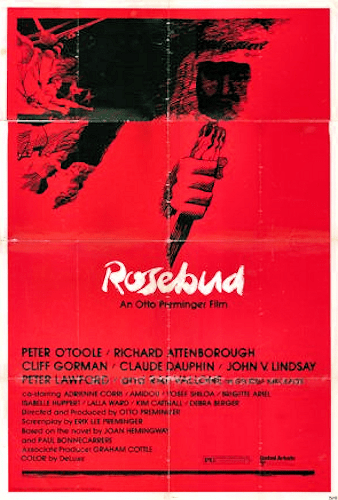
Shattered Politics #37: Rosebud (dir by Otto Preminger)


Rosebud_-_1975_-_Film_Poster

Before I review the 1975 film Rosebud, allow me to tell you about how I first discovered the existence of this particular film.

The greatest used bookstore in the world is located in Denton, Texas.  It’s called Recycled Books and it is three stories of pure literary goodness!  (Plus, there are apartments on the top floor where I attended some pretty interesting parties but that’s another story….)  When I was attending the University of North Texas, I used to stop by Recycled Books nearly every day.  One day, I happened to be searching the Film and TV section when I came across a beat-up paperback called Soon To Be A Major Motion Picture.

This book, which was written by Theodore Gershuny, told the story of how the previously acclaimed director Otto Preminger attempted to make a film about terrorism.  Starting with the attempts of Preminger’s son, Erik Lee Preminger, to come up with a workable script and then going on to detail how Peter O’Toole came to replace Robert Mitchum as the star of the film and ending with the film’s disastrous release, Soon To Be A Major Motion Picture proved to be a fascinating read.

After finishing the book, I simply had to see Rosebud for myself.  Unfortunately, at that time, Rosebud had not yet been released on Blu-ray or DVD.  So, I actually ended up ordering an old VHS copy of it.  The tape that I got was not in the best condition but it played well enough and I can now say that, unlike the majority of people in the world, I’ve actually seen Rosebud!

Which is not to say that Rosebud is any good.  It’s not the disaster that I had been led to expect.  In fact, it probably would have been more fun if it had been a disaster, as opposed to being just a forgettable film from a director who was probably capable of better.  Preminger started his career in the 30s and was considered, at one point, to be quite innovative.  He directed Laura and Anatomy of a Murder, two great films.  Unfortunately, there’s really nothing innovative about his direction of Rosebud.  In Gershuny’s book, Preminger comes across like an intelligent and thoughtful man who was too set in his ways to realize that what was shocking in 1959 was no longer that big of a deal in 1975.  (And, needless to say, it’s even less of a big deal in 2015.)

As for what Rosebud‘s about, it’s about a man named Sloat (Richard Attenborough), a former journalist who now lives in a cave in Israel and dreams of establishing a worldwide terrorist network.  Under Sloat’s direction, terrorists storm a yacht named the Rosebud and take the girls on board hostage.  The girls are wealthy and privileged.  Their fathers are judges, senators, and businessmen.  CIA agent Larry Martin (Peter O’Toole) is tasked with tracking down and rescuing the girls.  If it sounds like an action film — well, it’s not.  This is not a prequel to Taken.  Instead, it’s a very talky film that has a few isolated good moments and performances but otherwise, is fairly forgettable.

That said, the film does have an interesting cast.  Peter O’Toole seems bored by his role (and who can blame him?) but Attenborough briefly livens things up in the role of Sloat.  As for the girls being held hostage, they’re not given much to do.  One of them is played by a young Isabelle Huppert.  Long before she would play Samantha on Sex and the City, Kim Cattrall plays a hostage here.  The English hostage is played by Lalla Ward, who is now married to Richard Dawkins.

And then there’s the girl’s parents, who are played by an odd assortment of character actors.  Raf Vallone, an Italian, plays a Greek.  (His daughter, meanwhile, is played by the French Isabelle Huppert.)  Peter Lawford, looking somewhat dazed, shows up as Lalla Ward’s father.  (One of the sadder scenes in Gershuny’s book deals with Lawford’s attempts to remember his lines.)  And than, in the role of Cattrall’s father, we have a very distinguished looking man named John Lindsay.

John Lindsay was the former mayor of New York City, a man who ran for President in 1972 and, three years later, attempted to launch a new career as an actor.  Rosebud was his both his first and final film.  (Rumor has it that Martin Scorsese attempted to convince Lindsay to play Senator Palatine in Taxi Driver but Lindsay turned the role down.)  Lindsay is not particularly memorable in Rosebud.  It’s not so much that Lindsay gives a bad performance as much as it’s just the fact that he has a very bland screen presence.  That blandness probably served him well as a politician but, as an actor — well, let’s just say that John Lindsay was apparently no Fred Thompson.

And so that’s Rosebud.  It’s a film that, much like Maidstone, you can only appreciate if you know what went on behind the scenes.  I can’t really recommend Rosebud but, if you ever come across a battered old copy of Soon To Be A Major Motion Picture in a used bookstore, be sure to buy it!

Seriously, you will not be sorry.

Poll: Which Movie Should Lisa Marie Watch on March 20th?


Anyone who knows me knows that sometimes I just can’t help but love being dominated. 

That’s why, on occasion, I’ll give you, our beloved readers, the option of telling me which film to watch and review.  In the past, you’ve commanded me to watch and review Anatomy of a Murder, Eternal Sunshine of the Spotless Mind, and Logan’s Run

Well, here’s your chance to, once again, tell me what to do.  I’ve randomly selected 12 films from my film collection.  Whichever film gets the most votes will be watched and reviewed by me next Tuesday, March 20th.

Here are the films up for consideration:

1) Black Jesus (1968) — This Italian film stars Woody Strode as an African rebel leader who is captured by his country’s right-wing, American-backed dictatorship. 

2) Capote (2005) — Philip Seymour Hoffman was an Oscar for best actor for playing writer Truman Capote in this film that details how Capote came to write his true crime classic, In Cold Blood.  This film was also nominated for best picture.

3) Chappaqua (1966) — In this underground cult classic, drug addict Conrad Rooks seeks treatment in Switzerland while being haunted by a scornful William S. Burroughs.  This film features cameo from Allen Ginsberg, The Fugs, and just about every other cult figure from 1966.

4) Crazy/Beautiful (2001) — Jay Fernandez and Kirsten Dunst have lots and lots of sex.  This was like one of my favorite movies to catch on cable back when I was in high school. 🙂

5) An Education (2008) — In my favorite movie from 2008, Carey Mulligan is a schoolgirl in 1960s England who has a secret affair with an older man (played by Peter Sarsgaard), who has plenty of secrets of his own.  Co-starring Rosamund Pike, Emma Thompson, Alfred Molina, and Dominic Cooper (who is to die for, seriously).

6) Female Vampire (1973) — In this atmospheric and ennui-filled film from the infamous Jesus Franco, a female vampire spends the whole movie wandering around naked and dealing with the lost souls who want to join the ranks of the undead. 

7) Nightmare City (1980) — In this gory and fast-paced film from Umberto Lenzi, an accident at a nuclear plant leads to a bunch of blood-thirsty zombies rampaging through both the city and the countryside.  Hugo Stiglitz plays Dean Miller, zombie exterminator!  Nightmare City is probably most remembered for introducing the concept of the fast zombie and for serving as an obvious inspiration for Danny Boyle’s 28 Days Later.

8) The Other Side of Midnight (1977) — Based on a best-selling novel, The Other Side of Midnight tells the story of a poor French girl who becomes a world-famous actress and who ends up sleeping with apparently every wealthy man in the world.  Meanwhile, the man she loves ends up marrying Susan Sarandon.  Eventually, it all ends with both a hurricane and a murder.  Apparently, this film cost a lot of money to make and it was a notorious box office bomb.  It looks kinda fun to me.

9) Peyton Place (1957) — Also based on a best-selling novel, Peyton Place is about love, sex, and scandal in a small town.  Lana Turner is a repressed woman with a past who struggles to keep her daughter from making the same mistakes.  At the time it was made, it was considered to be quite racy and it was even nominated for best picture.  This film is a personal favorite of mine and it’s pretty much set the template for every single film ever shown on Lifetime.

10) Rosebud (1975) — From director Otto Preminger comes this film about what happens when a bunch of rich girls on a yacht are taken hostage by Islamic extremists.  The film’s diverse cast includes Peter O’Toole, Richard Attenborough, Cliff Gorman, former New York Mayor John Lindsay, former Kennedy in-law Peter Lawford, Raf Vallone, Adrienne Corri, Lalla Ward, Isabelle Huppert, and Kim Cattrall.

11) Valley of the Dolls (1967) — Oh my God, I love this movie so much!  Three aspiring actresses move to the big city and soon become hooked on pills and bad relationship decisions. Every time I watch this movie, I spend hours yelling, “I’m Neely O’Hara, bitch!” at the top of my lungs.

12) Zombie Lake (1981) — From my favorite French director, Jean Rollin, comes this extremely low budget film about a bunch of Nazi zombies who keep coming out of the lake and attacking the nearby village.  Some people claim that this is the worst zombie films ever made.  I disagree.

Please vote below for as many or as few of these films as you want to.  The poll will remain open until March 20th and whichever film gets the most votes will be watched and reviewed by me.

Happy voting!