Old west outlaw Frank Calder (Oliver Reed) wants to learn how to read so he and his gang ride into the nearby town and kidnap Melissa Ruger (Candice Bergen). Because he saw her reading to a group of children, Calder assumed that Melissa was a school teacher. Instead, Melissa is the wife of a brutal cattle baron and hunter named Brandt Ruger (Gene Hackman). Even after Calder learns the truth about Melissa’s identity, he keeps it a secret from his gang because he knows that they would kill her and then kill him as punishment for kidnapping the wife of a man as powerful as Brandt. Stockholm Syndrome kicks in and Melissa starts to fall in love with Calder. Meanwhile, Brandt learns that his wife has been kidnapped and, with a group of equally brutal friends, he sets out to get her back. In Brandt’s opinion, Calder has stolen his personal property. Using a powerful and newly designed rifle, Brandt kills Calder’s men one-by-one until there is a final, bloody confrontation in the desert.
Coming out two years after Sam Peckinpah redefined the rules of the western genre with The Wild Bunch, The Hunting Party owes a clear debt to Peckinpah. Much as in The Wild Bunch, the violence is sudden, brutal, and violent. What The Hunting Party lacks is Peckinpah’s attention to detail and his appreciation for the absurd. Instead, The Hunting Party is just one shooting after another and, devoid of subtext or any hint of a larger context, it quickly gets boring.
Fans of Oliver Reed, however, will want to watch The Hunting Party because it features one of his best performance. For once, Reed is actually playing the nice guy. He may be an outlaw but he still cries when a mortally wounded member of his gang begs Calder to put him out of his misery. Gene Hackman is also good, even though he’s playing one of his standard villain roles. (The less said about Candice Bergen’s performance, the better.) The Hunting Party may be dully nihilistic but Oliver Reed shines.
It’s the turn of the 20th century and the Old West is fading into legend. When they were younger, Steve Judd (Joel McCrea) and Gil Westrum (Randolph Scott) were tough and respect lawmen but now, time has passed them by. Judd now provides security for shady mining companies while Gil performs at county fairs under the name The Oregon Kid. When Judd is hired to guard a shipment of gold, he enlists his former partner, Gil, to help. Gil brings along his current protegé, Heck Longtree (Ron Starr).
On their way to the mining camp, they spend the night at the farm of Joshua Knudsen (R.G. Armstrong) and his daughter, Elsa (Mariette Hartley). Elsa is eager to escape her domineering father and flirts with Heck. When they leave the next morning, Elsa accompanies them, planning on meeting her fiancée, Billy Hammond (James Drury), at the mining camp.
When they reach the camp, they meet Bill and his four brothers (John Anderson, L.Q. Jones, John Davis Chandler, and the great Warren Oates). Billy is a drunk who is planning on “sharing” Elsa with his brothers. Gil, Judd, and Heck rescue Elsa and prepare for a final confrontation with the Hammond Brothers. At the same time, Gil and Heck are planning on stealing the gold, with or without Judd’s help.
Ride the High Country was actually Sam Peckinpah’s second film but it’s the first of his films to truly feel like a Sam Peckinpah film. (For his first film, The Deadly Companions, Peckinpah was largely a director-for-hire and had no say over the script or the final edit.) Peckinpah rewrote N.B. Stone’s original script and reportedly based the noble Steve Judd on his own father. All of Peckinpah’s usual themes are present in Ride the High Country, with Judd and, eventually, Gil representing the dying nobility of the old west and the Hammond brothers and the greedy mining companies representing the coming of the “modern” age. Ride The High Country‘s final shoot-out and bittersweet ending even serve as a template for Peckinpah’s later work in The Wild Bunch.
Much like the characters they were playing, Randolph Scott and Joel McCrea were two aging veterans on the verge of retirement. For these two aging stars, who had starred in countless westerns before this one, Ride The High Country would provide both fitting farewell and moving tribute. This would be the last chance that either of them would have to appear in a great movie and both of them obviously relish the opportunity. The best moments in the film are the ones where Judd and Gil just talk with the majestic mountains of California in the background.
Among the supporting cast, Ron Starr and Mariette Hartley are well-cast as the young lovers but are never as compelling as Gil or Judd. Future Peckinpah regulars R.G. Armstrong, L.Q. Jones, and Warren Oates all make early appearances. Seven years after playing brothers in Ride the High Country, L.Q. Jones and Warren Oates would both appear in Peckinpah’s most celebrated film, The Wild Bunch.
The elegiac and beautifully-shot Ride The High Country was Sam Peckinpah’s first great film and it might be his best.
Randolph Scott and Joel McCrea in Ride The High Country
Casino, Martin Scorsese’s epic, Las Vegas-set film from 1995, is one of my favorite films of all time. It seems to show up on cable every other week and, whenever I see that it’s playing, I always make it a point to catch at least a few minutes.
Casino opens with veteran Las Vegas bookie Ace Rothstein (played by Robert De Niro) getting into a car. He starts the engine and the car explodes. The rest of the movie is an extended flashback as both Ace and his friend and eventual rival Nicky (Joe Pesci) explain how Ace went from being the most powerful man in Vegas to getting blown up in his car.
We are shown how Ace was originally sent to Vegas by a group of mobsters who are headquartered in the far less flamboyant town of Kansas City. Ace keeps an eye on the city for the bosses and, as long as the money keep coming in, they leave Ace alone to do whatever he wants. When Ace isn’t bribing government officials (including one particularly sleazy state senator who was reportedly based on future U.S. Sen. Harry Reid) and breaking the fingers of the unlucky gamblers who have been caught trying to cheat the casino, he’s busy falling in love with the beautiful prostitute Ginger (Sharon Stone, who was nominated for Best Actress for her work in this film). Though Ginger warns Ace that she doesn’t love him and is still hung up on her manipulative pimp Lester Diamond (James Woods, who is hilariously sleazy), Ginger and Ace still get married.
Everything’s perfect except for the fact that Ace’s old friend Nicky (Joe Pesci) has also moved to Vegas. As opposed to the calm and low-key Ace, Nicky has a violent temper and soon, he starts drawing unwanted attention to both himself and Ace. When Ace attempts to control Nicky, Nicky responds by turning on his friend and soon, the two of them are fighting an undeclared war for control of the city. Meanwhile, the bosses in Kansas City are starting to notice that less and less money is making its way back to them from Las Vegas…
There are so many things that I love about Casino that I don’t even know where to begin.
First off, I love the film’s glamour. I love the way that the film celebrates the glitz of Las Vegas, presenting it as an oasis of exuberant life sitting in the middle of a barren desert that, we’re told, is full of dead people. I love seeing the tacky yet stylish casinos. I love seeing the inside of Ace’s mansion. And Ginger’s clothes are just to die for!
I love that Scorsese’s signature visual style perfectly keeps up with and comments on the natural flamboyance of Las Vegas. Consider how the film starts, with the shadowy form of Ace Rothstein being tossed through the air and then descending back down to Earth. Consider the image of Ace standing in the middle of the desert and being submerged within a thick cloud of dust as Nicky’s car speeds away from him. Consider how Scorsese’s camera glides through the casino, letting us see both the people who cheat and the people who are watching them cheat. Consider Nicky standing outside of his jewelry stare and freezing the movement of the camera with his reptilian glare. Consider the scene of cocaine being snorted up a straw, seemingly filmed from inside the straw. Casino is a film full of the type of images that all directors promise but few ever actually deliver.
I love that Casino is built around a brilliant lead performance from Robert De Niro. De Niro gives a performance that mixes both tragedy and comedy. My favorite De Niro moment comes about halfway through the film, when Ace finds himself hosting a wonderfully tacky cable access show called Aces High. Ace interviews “celebrities” like Frankie Avalon, introduces the Ace Rothstein Dancers, and even finds the time to do some juggling. De Niro makes Ace into an endearing and awkward character in these scenes, a permanent outsider who has finally managed to become something of a star.
It’s easy to compare Casino to Scorsese’s other classic mix of gangster film and social satire, 1990’s Goodfellas. Both films feature De Niro, Pesci, and Frank Vincent. (In a nice piece of irony, Casino features Vincent getting a little revenge after being attacked twice by Joe Pesci in two different Scorsese films.) Both films are based on nonfiction books by Nicholas Pileggi. Both films feature nonstop music playing on the soundtrack. Both films feature multiple narrators who explain to us how the day-to-day operations of the Mafia are conducted. When Scorsese shows us Ace and Ginger’s wedding day, it feels almost like a scene-for-scene recreation of Henry Hill’s wedding in Goodfellas.
At the same time, there are a few key differences between Goodfellas and Casino. Whereas Goodfellas was all about being a low-level cog in the Mafia, Casino is about management. Casino is about the guys who the Goodfellas made rich. Goodfellas was about the drudgery of everyday life whereas Casino is about the glitz and the glamour promised by the fantasy world of Las Vegas. Whereas Goodfellas was almost obsessively anti-romantic, Casino is a gangster film with heart. No matter what else you might say about him as a character, Ace’s love for both Ginger and Las Vegas is real. On a similar note, when Nicky turns against Ace, it’s because his feelings have been hurt. In the end, Ace and Nicky come across like children who have, temporarily, been given the keys to the world’s biggest playground.
Casino is a glossy, flamboyant film that literally opens with a bang and ends on a note of melancholy and loss. Not only is Ace reduced to being an anonymous old man working out of a nondescript office but our last two views of Vegas are of the old casinos being dynamited and an army of overweight tourists emerging from the airport like the unstoppable zombies from Dawn of the Dead. This, then, is Scorsese’s view of the apocalypse. The world isn’t destroyed by a cataclysm but instead by an invasion of terminal middle American blandness.
 Old west outlaw Frank Calder (Oliver Reed) wants to learn how to read so he and his gang ride into the nearby town and kidnap Melissa Ruger (Candice Bergen). Because he saw her reading to a group of children, Calder assumed that Melissa was a school teacher. Instead, Melissa is the wife of a brutal cattle baron and hunter named Brandt Ruger (Gene Hackman). Even after Calder learns the truth about Melissa’s identity, he keeps it a secret from his gang because he knows that they would kill her and then kill him as punishment for kidnapping the wife of a man as powerful as Brandt. Stockholm Syndrome kicks in and Melissa starts to fall in love with Calder. Meanwhile, Brandt learns that his wife has been kidnapped and, with a group of equally brutal friends, he sets out to get her back. In Brandt’s opinion, Calder has stolen his personal property. Using a powerful and newly designed rifle, Brandt kills Calder’s men one-by-one until there is a final, bloody confrontation in the desert.
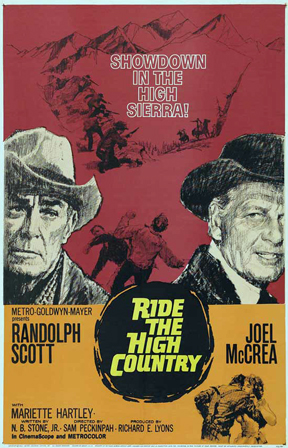 It’s the turn of the 20th century and the Old West is fading into legend. When they were younger, Steve Judd (Joel McCrea) and Gil Westrum (Randolph Scott) were tough and respect lawmen but now, time has passed them by. Judd now provides security for shady mining companies while Gil performs at county fairs under the name The Oregon Kid. When Judd is hired to guard a shipment of gold, he enlists his former partner, Gil, to help. Gil brings along his current protegé, Heck Longtree (Ron Starr).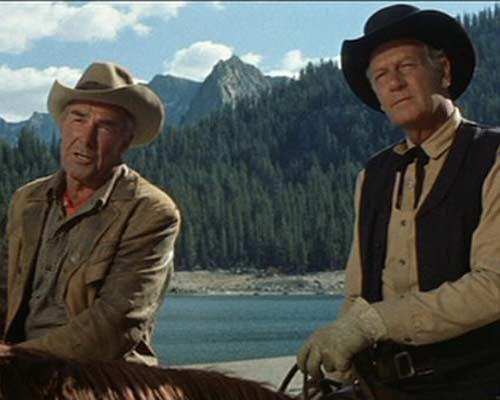

 Through the Shattered Lens