4 (or more) Shots From 4 (or more) Films is just what it says it is, 4 (or more) shots from 4 (or more) of our favorite films. As opposed to the reviews and recaps that we usually post, 4 (or more) Shots From 4 (or more) Films lets the visuals do the talking.
Today, we celebrate the 132nd birthday of Texas-born filmmaker, King Vidor! Though Vidor may no longer be a household name, he was one of the most important and idiosyncratic filmmakers of Hollywood’s Golden Age. The Crowd is regularly cited as one of the most influential films ever made. (Certainly every film that’s ever featured a shot of an anonymous office worker sitting in a room full of cubicles owes a debt to it.) Duel in the Sun went on to inspire countless spaghetti westerns. The Fountainhead is also regularly cited as a favorite by a surprisingly large number of directors.
In honor of King Vidor’s life and legacy, here are….
4 Shots From 4 King Vidor Films
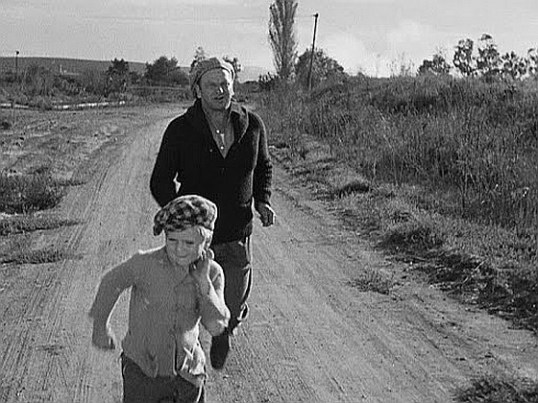
The Champ (1931, dir by King Vidor, DP: Gordon Avil)
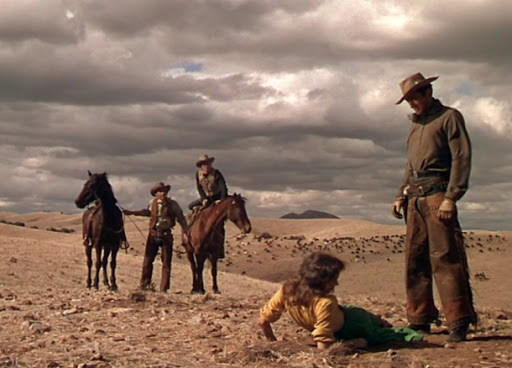
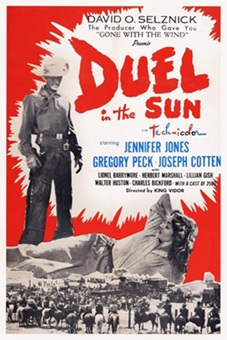
Duel In The Sun (1946, dir by King Vidor, DP: Lee Garmes)
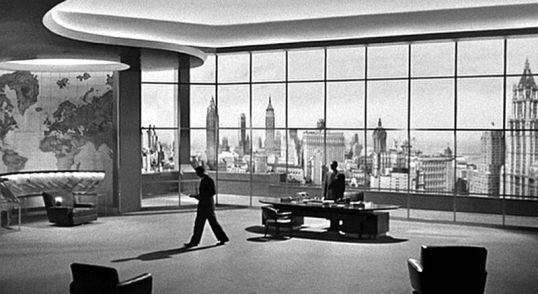
The Fountainhead (1949, dir by King Vidor, DP: Robert Burks)
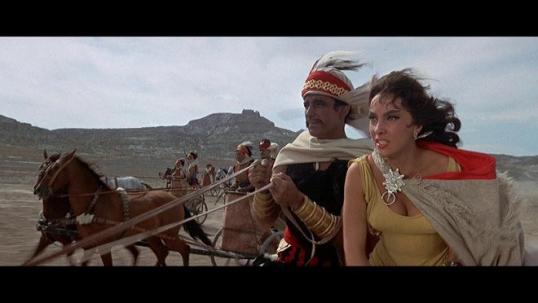
Solomon and Sheba (1959, dir by King Vidor, DP; Fred A. Young)
After her father is executed for killing her mother and her mother’s lover, “half-breed” Pearl Chavez (Jennifer Jones) is sent to live with her father’s second cousin, Laura Beth McCanles (Lillian Gish). Laura is the wife of rancher, politician, and all-around racist Senator Jackson McCanles (Lionel Barrymore). Worried that Pearl’s beauty and uninhibited manner will get her into trouble, Laura arranges for Pearl to meet with a minister known as The Sinkller (Walter Huston) who instructs Pearl on how to be a “good” girl.
Wanting to make Pearl bad and his, Lewton “Lewt” McCanles (Gregory Peck) becomes obsessed with Pearl and is soon forcing himself on her on a regular basis. When the good McCanles brother, Jesse (Joseph Cotten), leaves the ranch despite being in love with Pearl, Pearl tries to find a good husband in the form of Sam Pierce (Charles Bickford). Lewt responds by gunning Sam down and then goes on the run. It all leads to an overwrought duel in the sun as the two doomed lovers take aim at each other.
DuelInTheSun is credited to veteran director King Vidor and there are a few shots of the western landscape that do feel typical of Vidor’s work. However, DuelIn TheSun’s true auteur was its producer, David O. Selznick. Still looking to recapture his earlier success with GoneWithTheWind and eager to make his future wife, Jennifer Jones, into an even bigger star than she was, Selznick obsessed over every detail of DuelInTheSun, pushing Vidor and a host of other directors (including Josef von Sternberg, William Dieterle, William Cameron Menzies, Otto Brower, and Sidney Franklin) to make the film more steamy, more melodramatic, more violent, and more visually epic. Reportedly, while Video was trying to shoot the film’s titular duel, he had to call cut several times when Selznick ran into the scene with a water bottle to spray more “sweat” onto Jones and Peck. Today, the stiff Peck seems miscast as the black sheep of the family, the reserved Jones is even more miscast as a mestiza, and the plot is clearly too simplistic to carry the film’s epic ambitions. A few impressive shots aside, DuelInTheSun is just boring, In the 40s, though, the film’s relative openness about sex generated enough controversy to make DuelInTheSun into a box office hit. It was one of the two top-grossing westerns of the 40s, beating out Red River, My Darling Clementine, Fort Apache, The Ox-Bow Incident, and several other films that were actually good.
Unlike Jones, Peck, and even usually reliable stalwart like Lionel Barrymore and Walter Huston, Joseph Cotten at least emerges from this film with his dignity intact. Playing the good brother, Cotten gets to underplay while everyone else is overplaying and it turns out to be the right approach for him. Surviving DuelInTheSun was no easy feat but Cotten pulled it off.
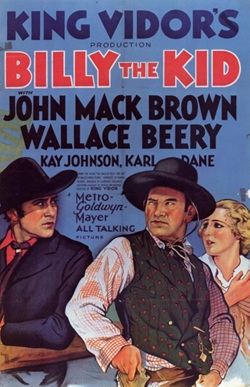
In a frontier town, land baron William P. Donavon (James A. Marcus) finds his control challenged by the arrival of a English cattleman named John W. Tunston (Wyndham Standing). Donavon orders his henchmen to gun down Tunston on the same day that Tunston was to marry the lovely Claire (Kay Johnson). Tunston’s employee, an earnest young man named Billy The Kid (Johnny Mack Brown), sets out to avenge Tunston’s murder. When Billy starts killing Donavon’s henchmen, it falls to Deputy Sheriff Pat Garrett (Wallace Beery) to arrest him. When Billy escape from jail and rides off to be with Claire, Garrett pursues him. Garrett is a friend of Billy’s and he knows that Billy’s killings were justified. But he’s also a man of the law. Will he be able to arrest or, if he has to be, even kill Billy? Or will Garrett let his friend escape?
There were two silent biopics made about Billy the Kid but neither of them are around anymore. This sound movie, directed by King Vidor, appears to the earliest surviving Billy the Kid film. It’s a loose retelling of Billy’s life and his friendship with Pat Garrett and it doesn’t bother with sticking close to the established facts but that’s to be expected. It’s an early sound film and, seen today, the action and some of the acting feels creaky. Wallace Beery was miscast as Pat Garrett but I did like Johnny Mack Brown’s performance as the callow Billy. The movie goes out of its way to justify Billy’s murders and it helps that Billy is played by the fresh-faced Brown. King Vidor shows a good eye for western landscapes, a skill that would come in handy when he directed Duel In The Sun seventeen years later.
There are better westerns but, for fans of the genre, this film is important as the earliest surviving film about one of the most iconic outlaws not named Jesse James. It’s interesting to see Brown, usually cast as the clean-cut hero, playing a killer here. The film’s ending is pure fantasy but I bet audiences loved it.
4 (or more) Shots From 4 (or more) Films is just what it says it is, 4 (or more) shots from 4 (or more) of our favorite films. As opposed to the reviews and recaps that we usually post, 4 (or more) Shots From 4 (or more) Films lets the visuals do the talking.
Today, we celebrate the 131st birthday of Texas-born filmmaker, King Vidor! Though Vidor may no longer be a household name, he was one of the most important and idiosyncratic filmmakers of Hollywood’s Golden Age. The Crowd is regularly cited as one of the most influential films ever made. (Certainly every film that’s ever featured a shot of an anonymous office worker sitting in a room full of cubicles owes a debt to it.) Duel in the Sun went on to inspire countless spaghetti westerns. The Fountainhead is also regularly cited as a favorite by a surprisingly large number of directors.
In honor of King Vidor’s life and legacy, here are….
4 Shots From 4 King Vidor Films
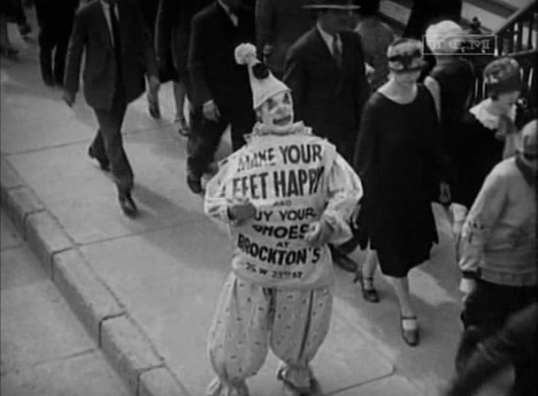
The Crowd (1928, dir by King Video, DP: Henry Sharp)
The Fountainhead (1949, dir by King Vidor, DP: Robert Burks)
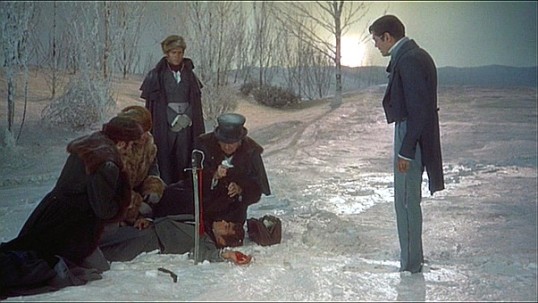
War and Peace (1956, dir by King Vidor, DP: Jack Cardiff)
Solomon and Sheba (1959, dir by King Vidor, DP; Fred A. Young)
The 1938 Best Picture nominee, The Citadel, is about a doctor who briefly loses his way but — don’t worry! — he eventually finds it again.
The film opens with the following title card:
This motion picture is a story of individual characterizations and is in no way intended as a reflection on the great medical profession which has done so much towards beating back those forces of nature that retard the physical progress of the human race.
Having gotten that out of the way, it goes on to tell the story of Dr. Andrew Manson (Robert Donat), an idealistic British doctor who serves his apprenticeship in rural England and who eventually ends up in Wales, trying to figure out why all of the miners seem to developing a mysterious cough. Along the way, he marries the always supportive Christine (Rosalind Russell, doing a lot with an underwritten role). Unfortunately, Dr. Manson discovers that being a doctor is not always an easy life. He’s frequently underpaid and underappreciated. His patients are often suspicious and argumentative and the medical establishment is hesitant to accept change. When the frustrated Dr. Manson returns to London, he discovers that he can make a fortune by working as a doctor for the type of wealthy people who are always willing to spend a little extra money on the latest fad treatment. With the encouragement of the decadent Dr. Lawford (Rex Harrison), Manson abandons his old ways and he’s finally able to make some money off of patients who will basically do anything that he tells them to do. However, a personal tragedy forces Manson to reexamine his life and consider why he became a doctor in the first place.
The Citadel is a coming-of-age film, one the follows Dr. Manson from the time when he’s a young doctor in need of a mentor until he himself is the one who is doing the mentoring. It gets off to a bit of a slow start. To be honest, I found Manson’s early apprenticeship to be almost as tedious as Dr. Manson found it to be. Things pick up a bit once Manson is on his own, fighting for the rights of miners or trying to find some sort of ethical justification for only treating the rich. If Robert Donat seems oddly hesitant during the first half of the film, he’s undeniably compelling during the second half. Though Dr. Manson has many scenes in which he rails against ignorance and injustice, Donat wisely resists the temptation to go overboard while portraying his indignation and, as a result, The Citadel never slips into melodrama. Donat doesn’t play Manson as being a crusader but instead as just being an often frustrated professional who knows that he’s being prevented from doing his best work. Director King Vidor, who made several films about thwartded visionaries, was never a particularly subtle director but Donat’s performance goes a long way towards making Vidor’s messianic tendencies tolerable.
Donat gets good support from the rest of the cast, especially Ralph Richardson in the role of his sometimes mentor. That said, Donat is still definitely the main reason to watch The Citadel, which is an uneven thought ultimately worthwhile film. The Citadel is very much a film of 1938 and it’s slow pace, earnest seriousness, and dialogue-heavy style will undoubtedly be an issue for some people watching the film in 2021. Watching a film like The Citadel today requires a willingness to adjust to the aesthetics of a past age. This is a film that will definitely be best-appreciated by those who aren’t unfamiliar with spending an entire weekend watching TCM. But you know what? It’s good to watch old movies. You can’t understand the present or prepare for the future if you’re not willing to look at the past.
The Academy nominated The Citadel for Best Picture. It was one of the first British films to be so honored (though not the first, that honor went to The Private Life of Henry VIII). However, it lost to Frank Capra’s You Can’t Take It With You. Though Robert Donat lost the Oscar for Best Actor to Spencer Tracy in Boys Town, he would be rewarded the very next year for his performance in Goodbye Mr. Chips. Among those who Donat defeated was Clark Gable, nominated for playing Rhett Butler in Gone With The Wind, a characters that Margaret Mitchell always said she envisioned as being played by Robert Donat.
4 (or more) Shots From 4 (or more) Films is just what it says it is, 4 (or more) shots from 4 (or more) of our favorite films. As opposed to the reviews and recaps that we usually post, 4 (or more) Shots From 4 (or more) Films lets the visuals do the talking.
Today, we celebrate the 127th birthday of Texas-born filmmaker, King Vidor! Though Vidor may no longer be a household name, he was one of the most important and idiosyncratic filmmakers of Hollywood’s Golden Age. The Crowd is regularly cited as one of the most influential films ever made. (Certainly every film that’s ever featured a shot of an anonymous office worker sitting in a room full of cubicles owes a debt to it.) Duel in the Sun went on to inspire countless spaghetti westerns. The Fountainhead is also regularly cited as a favorite by a surprisingly large number of directors.
In honor of King Vidor’s life and legacy, here are….
6 Shots From 6 King Vidor Films
The Crowd (1928, dir by King Video, DP: Henry Sharp)
The Champ (1931, dir by King Vidor, DP: Gordon Avil)
Duel In The Sun (1946, dir by King Vidor, DP: Lee Garmes)
The Fountainhead (1949, dir by King Vidor, DP: Robert Burks)
War and Peace (1956, dir by King Vidor, DP: Jack Cardiff)
Solomon and Sheba (1959, dir by King Vidor, DP; Fred A. Young)
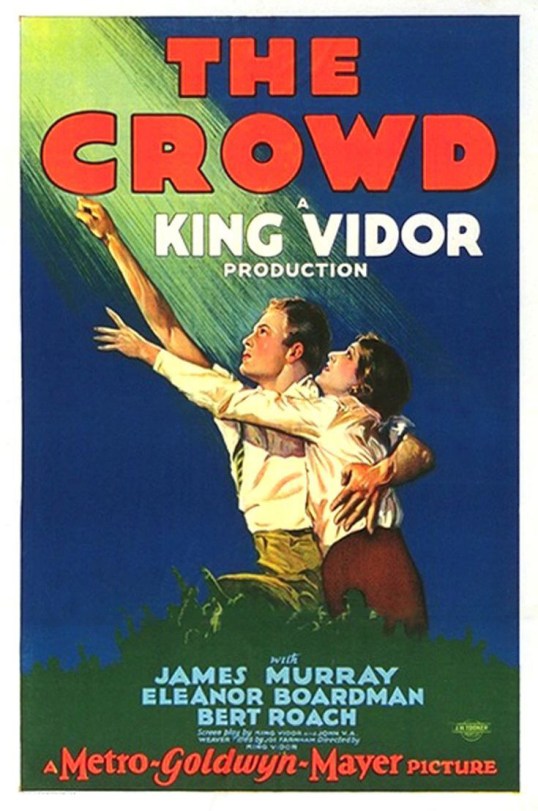
Way back when the Academy first started to hand out awards to honor the best films of the year, they actually gave out two awards for best picture. One of the awards was called Oustanding Production and it’s assumed by most Oscar historians that it was meant to go to the most “entertaining” film of the year. The other award was called Best Unique and Artistic Picture and it was meant to honor the type of films that might not make a huge amount of money at the box office but which did the most to move cinema forward as an art form.
As a result, when the very first Academy Awards were awarded at the Hollywood Roosevelt Hotel on May 16th, 1929, a popular war film named Wings was named Outstanding Production while F.W. Murnau’s Sunrise was named Best Unique and Artistic Picture. Sunrise defeated two other nominees, a documentary called Chang and King Vidor’s The Crowd.
It’s long been rumored that, when the votes were first counted, The Crowd originally won Best Unique and Artist Picture but that Louis B. Mayer insisted that the award should go to Sunrise instead. The head of MGM, Louis B. Mayer reportedly disliked The Crowd, even though it was distributed by his own studio. Mayer felt that the film was too downbeat and he also resented that King Vidor had resisted Mayer’s demand that the film have a traditionally happy ending. It’s also been suggested that, since the Academy was largely Mayer’s idea, he felt that, if an MGM film won the initial reward, it would lead to his enemies claiming that Mayer had too much influence over the organization. That may or may not be true, no one can say for sure. What we can say for sure, however, is that both The Crowd and Sunrise continue to be recognized as classics of the silent era.
The Crowd tells the story of John Sims (James Muray), who goes to New York when he’s 21, convinced that he’s destined to be someone important. Sims gets a job at Atlas Insurance, where he’s one of many faceless office workers. He meets and, after one date, marries Mary (Eleanor Broadman). They live in a tiny apartment next to an elevated track. Over the next five years, they raise a family. They fight often. Occasionally, they beak up but they always get back together. Throughout it all, John struggles to prove himself as an individual, just to be continually reminded that he’s only a member of the faceless crowd.
It’s not a particularly happy film. John starts the film as a member of the crowd and he’s still a member of the crowd when it ends. If there is anything positive to be found in the film, it’s that John’s family loves him but, even taking that in to consideration, it’s obvious that he and Mary are going to spend their entire lives struggling and that the same fate probably awaits their children. Knowing that the film was made on the verge of the start of the Great Depression makes John’s story all the more poignant. If he thinks things are bad now, they’re about to get even worse.
Seen today, The Crowd is still a visually striking film. Influenced by German expressionism (particularly the work of Sunrise‘s director, F.W. Murnau), Vidor presents New York as being a menacing and frequently surreal world of towering skyscrapers and unfriendly faces. (Vidor even used the then-unheard of technique of using a hidden camera to capture actual documentary footage of star James Murray dealing with real New Yorkers.) The Crowd is probably best remembered for the shot where the camera pans up the length of a skyscraper, finally entering the building and showing us the anonymous office workers within. It’s a shot that perfectly captures the film’s theme of being lost and ignored in an impersonal world. It’s also a shot that’s been duplicated in a countless number of films. The Crowd may be 92 years old but its legacy lives on.
Sadly, things did not turn out well for James Murray, the former extra who Vidor cast in the lead role. The success of The Crowd did not translate into success for Murray. An alcoholic, Murray ended up living on Skid Row, where he once asked King Vidor for money and reacted with anger when Vidor offered him a role in a new film. In 1936, Murray was found floating in the Hudson River. He was 35 years old.
As for the Oscar for Best Unique and Artistic Motion Picture, it was only awarded once. Starting with the second Oscar ceremony, the Academy merged the two best film awards into one. Interestingly, the idea of giving out two Best Picture awards was briefly revived in 2018 but the response to the idea was so negative that it was quickly abandoned.
I don’t know if I’ve ever seen Gary Cooper look as miserable in any film as he did in the 1949 film, The Fountainhead.
In The Fountainhead, Gary Cooper plays Howard Roark. Roark is an architect who we are repeatedly told is brilliant. However, he’s always has to go his own way, even if it means damaging his career. At the start of the film, we watch a montage of Howard Roark losing one opportunity after another. He gets kicked out of school. He gets kicked out of the top design firms. Howard Roark has his own vision and he’s not going to compromise. Roark’s a modernist, who creates sleek, powerful buildings that exist in defiance of the drab, collectivist architecture that surrounds them.
Howard Roark’s refusal to even consider compromising his vision threatens the rich and the powerful. A socialist architecture critic with the unfortunate name of Ellsworth Toohey (Robert Douglas) leads a crusade against Roark. And yet, even with the world against him, Roark’s obvious talent cannot be denied. Dominique Francon (Patricia Neal) finds herself enthralled by the sight of him working in a quarry. Fellow architect Peter Keating (Kent Smith) begs Howard to help him design a building. Newspaper publisher Gail Wynard (Raymond Massey) goes from criticizing Howard to worshipping him.
Have I mentioned that Howard Roark doesn’t believe in compromise? If you have any doubts about this, they’ll be erased about halfway through the movie. That’s when Roark responds to a company altering one of his designs by blowing up a housing project. Roark is arrested and his subsequent trial soon turns into a debate between two opposite philosophies: individualism vs. collectivism.
So, let’s just start with the obvious. Gary Cooper is all wrong for the role of Howard Roark. As envisioned by Ayn Rand (who wrote both the screenplay and the novel upon which it was based), Roark was meant to be the ideal man, a creative individualist who has no doubt about his vision and his abilities. Cooper, with his down-to-Earth and rather modest screen persona, often seems to be confused as to how to play such a dynamic (some might say arrogant) character. When Roark is meant to come across as being uncompromising, Cooper comes across as being mildly annoyed. When Roark explains why his designs must be followed exactly, Cooper seems to be as confused as the people with whom Roark is speaking. It doesn’t help that the 47 year-old Cooper seemed a bit too old to be playing an “up-and-coming” architect. In the book, Roark was in his 20s and certainly no older than his early 30s. Cooper looks like he should be relaxing in a Florida condo.
Who, among those available in 1949, could have been convincing in the role of Howard Roark? King Vidor wanted Humphrey Bogart for the role but if Cooper seemed to old for the part, one can only imagine what it would have been like with Bogart instead. Henry Fonda probably could have played the role. For that matter, William Holden would have been an interesting pick. Montgomery Clift and John Garfield would have been intriguing, though Garfield’s politics probably wouldn’t have made Ayn Rand happy. If Warner Bros. had been willing to wait for just a few years, they could have cast a young Marlon Brando or perhaps they could have let Douglas Sirk make the movie with Rock Hudson and Lana Turner. (Or, if you really wanted to achieve peak camp, they could have let Delmer Daves do it with Troy Donahue and Sandra Dee.)
If you can overlook the miscasting of Gary Cooper, The Fountainhead‘s an entertaining film. King Vidor directs the film as if it’s a fever dream. The film’s dialogue may be philosophical but the visuals are all about lust, with Pat Neal hungrily watching as a shirtless Gary Cooper breaks up rocks in the quarry and Vidor filling the film with almost fetishistic shots of phallic Howard Roark designs reaching high into the sky. If Cooper seems confused, Neal seems to be instinctively understand that there is no place for underplaying in the world of The Fountainhead. The same also holds true of Robert Douglas, who is a wonderfully hissable villain as the smug Ellsworth Toohey. Interestingly, the film ends with a suicide whereas the novel ended with a divorce because, under the production code, suicide was apparently preferable to divorce. I guess that’s 1949, for you.
Because America is currently having a socialist moment, there’s a tendency among critics to be dismissive of Ayn Rand and her worship of the individual above all else. Rand’s novels are often dismissed as just being psychobabble, despite the fact that, in some ways, they often seem to be borderline prophetic. (Barack Obama’s infamous “You didn’t build that!” speech from 2012 could have just as easily been uttered by Ellsworth Toohey or one of the many bureaucrats who pop up in Atlas Shrugged.) Here’s the thing, though — as critical as one can be of Rand’s philosophy, there’s still something undeniably appealing about someone who will not compromise their vision to the whims of the establishment. It’s goes beyond politics and it gets to heart of human nature. We like the people who know they’re talented and aren’t afraid to proclaim it. (Modesty, whether false or sincere, is a huge turn off.) We like the people who take control of situations. We like the people who are willing to say, “If you don’t do it my way, I’m leaving.” In a way, we’re all like Dominique Francon, running our hands over architectural models while trying to resist the temptation to compromise and accept something less than what we desire. We may not want to admit it but we like the Howard Roarks of the world.
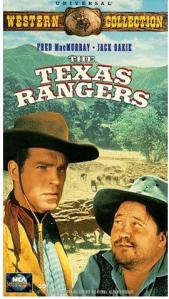
Sam (Lloyd Nolan), Jim (Fred MacMurray), and Wahoo (Jack Oakie) are three outlaws in the old west. Wahoo works as a stagecoach driver and always lets Sam and Jim know which coaches will be worth holding up. It’s a pretty good scam until the authorities get wise to their scheme and set out after the three of them. Sam abandons his two partners while Jim and Wahoo eventually end up in Texas. At first, Jim and Wahoo are planning to keep on robbing stagecoaches but then they realize that they can make even more money as Texas Rangers.
At first, Jim and Wahoo are just planning on sticking around long enough to make some cash and then split. However, both of them discover that they prefer to be on the right side of the law. After they save a boy named David from Indians, Jim and Wahoo decide to stay in Texas and protect its settlers.
The only problem is that their old friend Sam has returned and his still on the wrong side of the law.
Made to commemorate the Texas centenary (though it was filmed in New Mexico), The Texas Rangers is a good example of what’s known as an oater, a low-budget but entertaining portrayal of life on the frontier. King Vidor does a good job with the action scenes and Fred MacMuarry and Jack Oakie are a likable onscreen team. The best performance comes from Lloyd Nolan, as the ruthless and calculating Sam. Sam can be funny and even likable but when he’s bad, he’s really bad.
Jack Oakie was better known as a comedian and The Texas Rangers provides him with a rare dramatic role. Four years after appearing in The Texas Rangers, Oakie would appear in his most famous role, playing a parody of Benito Mussolini in Charlie Chaplin’s The Great Dictator.
Now, nobody actually tells 8 year-old Dink (Jackie Cooper) to shut up at the end of 1931’s The Champ. I’d like to think that I probably would have said those words if I had been sitting in the audience but, in all honestly, I probably would have been crying along with everyone else. I’m sure that a lot of people probably cried when The Champ was first released.
And really, it’s probably unfair to criticize Jackie Cooper for repeatedly wailing, “I want the Champ!” during the film’s final five minutes. It’s actually probably one of the few authentic moments in the film. It’s just unfortunate that Cooper’s voice was a bit shrill and, as a result, I found myself covering my ears.
As for what The Champ is about, it’s the story of a boy and his alcoholic father. Andy Purcell (played with loutish charm by the never particularly subtle Wallace Beery) is a boxer. He used to be the world champion and people still call him The Champ. Of course, it’s been a while since he’s been in the ring. Now, Andy just drinks and gambles and continually lets down his son. However, Dink is always willing to forgive Andy and Andy does truly love his son. He even buys him a horse, which gets named Little Champ.
It’s while at the stables that Dink meets an upper class woman named Linda (Irene Rich). What Dink does not realize is that Linda is … his mother! She was once married to the Champ but his drinking led to divorce. Linda wants to adopt Dink and perhaps she should because The Champ really is not a very good father. He even loses Little Champ in a card game.
Fortunately, the Champ has a chance to win the money needed to buy back the horse. All he has to do is reenter the ring and beat the Mexican heavyweight…
It all leads to “I want the champ!” being screamed several hundred times in a handful of minutes, enough times to make me fear that I would be deaf before the film ended…
The Champ is an old-fashioned and rather creaky melodrama, one that hasn’t aged particularly well. Director King Vidor specialized in films about the “common man” and The Champ often feels like it was adapted from the first draft of an unproduced Clifford Odets play. It’s all very sentimental and so thoroughly lacking in snark or cynicism that, for modern audiences, it’s difficult to relate to. I’ll leave it to you to decide whether that’s a good or a bad thing.
The Champ does hold a place in Oscar history. Wallace Beery won the Oscar for Best Actor but, for the first time in the history of the awards, there was a tie and Beery shared the Oscar with Fredric March, who won for Dr. Jekyll and Mr. Hyde.
The Champ was also nominated for best picture but it lost to Grand Hotel, which also features Wallace Beery.




 Sam (Lloyd Nolan), Jim (Fred MacMurray), and Wahoo (Jack Oakie) are three outlaws in the old west. Wahoo works as a stagecoach driver and always lets Sam and Jim know which coaches will be worth holding up. It’s a pretty good scam until the authorities get wise to their scheme and set out after the three of them. Sam abandons his two partners while Jim and Wahoo eventually end up in Texas. At first, Jim and Wahoo are planning to keep on robbing stagecoaches but then they realize that they can make even more money as Texas Rangers.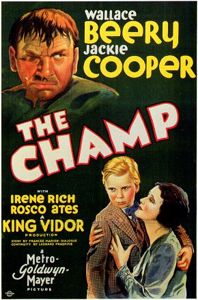
 Through the Shattered Lens