Retro Television Review: Death Takes A Holiday (dir by Robert Butler)


Welcome to Retro Television Reviews, a feature where we review some of our favorite and least favorite shows of the past!  On Sundays, I will be reviewing the made-for-television movies that used to be a primetime mainstay.  Today’s film is 1971’s Death Takes A Holiday!  It  can be viewed on YouTube.
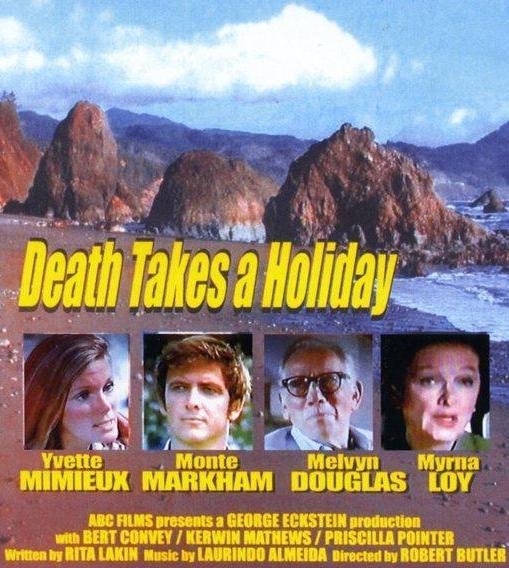
For a few days in 1971, no one dies.

The Vietnam War continues but there are no casualties.  There are natural disasters but no one loses their life.  Doctors are stunned.  World leaders start to panic.  An emergency session of the UN is called to debate what to do about living in a world where no one is dying.  One gets the feeling that the world’s leaders prefer it when people are dying in wars and disasters.

Death has taken a holiday.

Death (Monte Markham) has become confused as to why humans so desperately want to live despite the fact that the world in which they exist is not always a happy one.  He is particularly confused by the elderly Judge Earl Chapman (Melvyn Douglas), who has suffered multiple strokes and other ailments and yet has always resisted whenever Death has come for him.  Death decides to take his holiday on the isolated beach where the Judge and his family are spending their weekend.  Though Death introduces himself as being David Smith, the Judge recognizes him.  It turns out that the Judge was always aware of death lingering around him and his family.

Death, for his part, has fallen in love with the Judge’s headstrong and rebellious daughter, Peggy (Yvette Mimieux).  In fact, Peggy was meant to die on the beach but, as soon as Death saw her drowning, he decided not to take her and instead allowed her to wash up back on the beach.  Death explains to the Judge that he can only spend so much time on vacation and that soon, people will start dying again.  Death says that he’ll be taking Peggy to the afterlife after the weekend ends.  The Judge tries to change his mind but Death is in love and he wants Peggy to be with him.

An adaptation of a play that inspired both 1934’s Death Takes A Holiday and 1998’s Meet Joe Black, the 1971 version of Death Takes A Holiday is a well-acted and intelligent made-for-television movie, one that eschews heavy-handed drama in favor of being a rather low-key meditation on what it means to both live and to die.  Melvyn Douglas and, as his wife, Myrna Loy both give poignant performances and Douglas even manages to sell the potentially maudlin moment where he explains why he has always clinged to life.  Monte Markham may not be the first actor who comes to mind when you think of someone to cast as the human form of Death but he does a good job in the role and he and Yvette Mimieux have a wonderful chemistry together.  The beach scenery is lovely and the story is an interesting one.  Clocking in at just 73 minutes, this version of Death Takes A Holiday is the best of all of them.
Film Review: Barquero (1970, directed by Gordon Douglas)


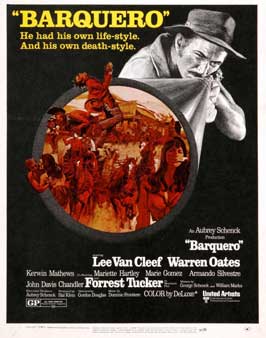
barquero-movie-poster-1970-1010695655Travis (Lee Van Cleef) is a former gunslinger who now makes his living taking settlers across a river on his small barge.  When we first meet him, he is telling a child to shut up and stop bothering him while he is guiding the barge.  He depends on the settlers on the other side of the river for his livelihood and they depend on him for transportation but he doesn’t like them and they don’t like him.  Travis only cares about two people, his Mexican lover, Nola (Maria Gomez) and an eccentric hunter named Mountain Phil (Forrest Tucker).

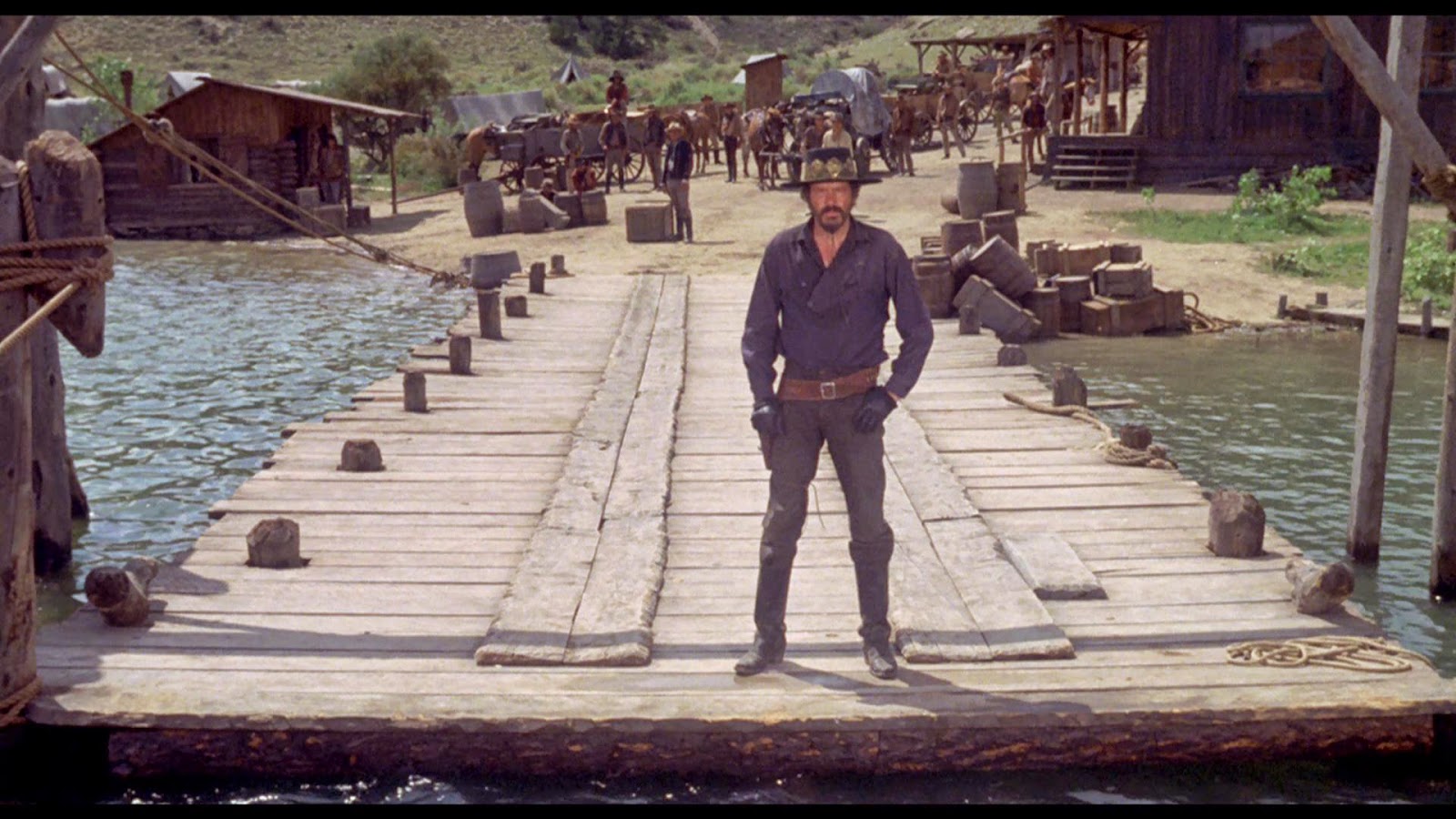
After stealing a shipment of silver, outlaw Jake Remy (Warren Oates) and his army of mercenaries need to cross the river to escape into Mexico.  To prevent anyone from following, they plan to destroy the barge afterward.  However, Travis and Phil find out that Remy is on the way and take the barge to the other side of the river.  When Jake and his gang arrive, a tense stand-off ensues, with the outlaws on one side of the river and Travis and the settlers trapped on the other.

Though Barquero was directed by the veteran American director Gordon Douglas (Douglas’s best known film is the 1950s giant ant film, Them!),  it was heavily influenced by contemporary Spaghetti Westerns and Sam Peckinpah’s The Wild Bunch.  This can be seen in both its graphic violence and in the casting of Lee Van Cleef and Warren Oates in the leading roles.

Travis was a perfect role for Van Cleef, a talented actor who was ignored by Hollywood until he found fame playing ruthless villains in European westerns.  Surly and unsmiling, Travis may seem like an unlikely hero but, like many of the best Spaghetti westerns, there are no traditional good guys in Barquero.  Travis is more interested in saving his boat than protecting the settlers.  He is a hero of circumstance.

As Jake, Warren Oates is a great villain.  In his very first scene, he and a prostitute watch as his gang massacre the citizens of a small town.  When the prostitute asks if she can come with them, Jake calmly replies, “I don’t think so” and shoots her dead.  Stuck on his side of the river, Jake smokes the local weed and starts to have violent hallucinations.  Soon, he is shooting bullets into the river.

Also doing good work are Forest Tucker as Mountain Phil and Kerwin Mathews.  Mathews, who is best remembered for starring in The 7th Voyage of Sinbad, plays the Marquette, a disgraced French nobleman who has started a second life as Jake Remy’s right-hand man.

Barquero starts with a bang but it struggles to keep up the momentum over its entire running time.  The opening shoot out is exciting but things slow down almost too much during the stand-off at the river.  It is an interesting but flawed western that deserves to be better known than it is and worth watching to see Lee Van Cleef and Warren Oates at their best.

Barquero-Oates-on-dock