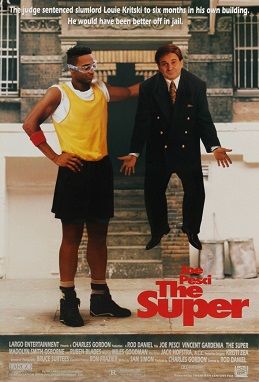
The Super (1991, directed by Ron Daniel)


You’ve just won a Best Supporting Actor Oscar for playing a psychotic gangster and you’re worried that it’s going to lead to you getting typecast as a villain.  What do you do?

If you’re Joe Pesci, you follow-up playing Tommy DeVito in Goodfellas by agreeing to play Louie Kritski, Jr. in The Super.  Louie is the son of a slumlord (Vincent Gardenia) and he’s eager to follow his old man into the family business.  But when Louie is arrested for failing to keep his buildings up to code, he’s sentenced to actually live in one of them.  Louie has to stay in a rat-infested apartment.  He has to repair the rest of the building and will not be allowed to do any work on his apartment until everyone else’s apartment is up to code.  Louie thinks that his father will use his influence to get his son out of this mess.  It turns out that Big Lou just wants to set the building on fire and be done with it.  Louie isn’t down with that.  He may be a loud-mouthed slumlord but he has his standards.

Louie becomes a better person as a result of living in a slum.  All of the tenants, from Marlon (Ruben Blades) to Tito (Kenny Blank), come to respect him.  He even plays basketball with them.  Louie finds a new girlfriend (Madolyn Smith) in the court officer who is sent to check on his progress.  Louie is still Joe Pesci, though.  He’s still a loud mouth who is quick to lose his temper and there’s always a feeling that Louie is about to snap and blow the entire building away.  Joe Pesci was always a good actor and skilled at comedy but The Super doesn’t make good use of his talents in the way that My Cousin Vinny did.  My Cousin Vinny worked because it put Joe Pesci in a place where you wouldn’t expect to find Joe Pesci, the genteel South.  The Super is a New York movie and Pesci’s wiseguy intensity means that his sudden redemption doesn’t feel true.

The Super was a box office flop and briefly derailed Pesci’s attempts to show his range.  Luckily, My Cousin Vinny was right around the corner.
Retro Television Review: Homicide: Life on Street 1.3 “Night of the Dead Living”


Welcome to Retro Television Reviews, a feature where we review some of our favorite and least favorite shows of the past!  On Sundays, I will be reviewing Homicide: Life On The Street, which aired from 1993 to 1999, on NBC!  It  can be viewed on Peacock.

This week, the Homicide Squad works the night shift on the hottest night of the year.

Episode 1.3 “Night of the Dead Living”

(Dir by Michael Lehmann, originally aired on March 31st, 1993)

On the hottest night of the year, Giardello’s homicide squad works the night shift.  Everyone comes in grumpy.  Munch has just broken up with his girlfriend.  Bolander is trying to work up the courage to call Dr. Blythe.  Bayliss is still obsessing on the Adeena Watson case and he and Pembleton are still trying to figure out how to work together.  Kay’s sister is having trouble at home.  Felton’s wife hates him.  Crosetti worries about his teenage daughter and her boyfriend.  Giardello tries to figure out why the air conditioner is only blowing out hot air on what Lewis claims is the hottest night in history.

Despite the heat and the statistics that show that most homicide occur at night, no calls come in.  Bayliss is convinced he’s cracked the Watson case when he discovers that the fingerprints on Adeena’s library book belongs to someone named James.   He sends Thorson out to arrest James.  James turns out to be a seventh grader who thinks he’s being arrested by not paying a library fine.  (James did check out the book, when he was in the fifth grade.)

A drunk man dressed as Santa Claus is brought in and later falls through the ceiling when he attempts to escape custody.  A baby is found in the station’s basement but it turns out to the cleaning lady’s baby.  She brings him to work with her to protect him from the rats that live in their apartment building.  Eventually, Bolander works up the courage to call Blythe and Bayliss and Pembleton figure out that Adeena’s body was found where it was because her killer brought the body down a fire escape.  At the end of the shift, Giardello assembles his detectives on the roof and joyfully sprays them with the water hose.

It’s an episode that feels like a play, taking place in one location and featuring a lot of monologuing.  Each member of the squad gets a their chance in the spotlight, with the episode revealing that every one of them is a bit more complex than they initially seem.  Even Munch, the misanthrope, is shown to light a candle in memory of “all those who have been killed.”  It’s one of those episodes that makes you understand why Homicide is considered to be classic while also showing you why it struggled in the ratings.  In this episode, Homicide revealed itself to be not a cop show but instead a show about people who happened to be cops.  Most shows about detectives end with an arrest.  This episode ends with Giardello showing his love for the people who work for him.  After spending an hour with everyone sweating and complaining, it’s nice to see them happy on the roof of the station house.  Yaphet Kotto’s joy in the final scene is a wonder to behold.  And yet, it’s easy to imagine how confused audiences, whose expectations had been set by more traditional crime show, would have been.

This episode was meant to be the third episode of the series.  NBC decided that it worked better as the finale of the first season and instead made it the ninth episode.  Peacock has this episode placed where it originally belonged and, with this review, that’s what I’m going with as well.