Marshals Nevada Jack McKenzie (Johnny Mack Brown) and Sandy Hopkins (Raymond Hatton) are sent to the frontier mining community of Goldville to determine who is responsible for hijacking all of the gold that should be coming out of the town. Not surprisingly, it’s all the work of another dastardly saloon owner (Kenneth MacDonald) who is planning on stealing all the gold, chasing off all the settlers, and then selling their land to the railroad company. While Sandy goes undercover as the town’s new preacher, Jack agrees to ride shotgun on a gold shipment, along with with Dan Baxter (Eddie Drew). Dan is in love with Jane Simms (Inna Gest), the daughter of honest miner Bill Simms (Kernan Cripps).
Johnny Mack Brown made a countless number of westerns for several different production companies but it seems like they always featured a crooked saloon owner and a plan to sell the land to a railroad company. Luckily, nobody watches these movies for the plots and that was probably true even when they were first released. People watch these movies for the nostalgia value of watching a movie where it’s good vs evil and good always triumphs without leaving any sort of lingering doubt about whether or not the heroes did the right thing. Johnny Mack Brown is as authentic on a horse and carrying a gun as he ever was and there’s a scene where he manages to get a gun despite being tied up that’s pretty cool. The appeal of Johnny Mack Brown was that he always seemed like he could do the things that he did in the movies in real life as well. Raymond Hatton provides comic relief, pretending to know the hymns being sung by his congregation and providing some songs of his own. There’s enough gun fights and horse chases to provide nostalgic happiness for fans of the genre and that’s the important thing.
In the 1956 film, The She-Creature, bodies are being discovered on the beach. The murderer appears to be a bizarre, humanoid creature with gills and scaly skin. It commits its dastardly crimes and then it disappears back into the ocean! What could it be? Is it a genuine monster? Is it a psycho diver in a rubber suit? Is it just some random murderer that hides in the shadows and stalks the night like a cat searching for mouse?
While bodies are showing up on the beach, Dr. Carlo Lombardi (Chester Morris), is trying to convince the world that his theories about reincarnation and the occult are correct. Usually clad in a tuxedo and accompanied by his assistant, Andrea (Marla English), Dr. Lombardi swears that everyone has lived a past life and that, when under hypnosis, people are capable of reliving all of their past lives. Dr. Lombardi theorizes that reincarnation has been going on since the beginning of time and, as a result, a hypnotized person could even relive their past life as a cave dweller or, presumably, a single-celled creature floating around in a lake. Actually, under Lomradi’s theory, I guess it’s possible that someone could have been a dinosaur in a past life.
(It’s probably best not to give that too much thought because most people would probably be disappointed to discover that they weren’t one of the cool dinosaurs but instead, they were one of those goofy green lizards that was always running out of the way of the cool dinosaurs. No matter how many times someone bangs a gong, not everyone can be a T-rex, sorry. Everyone wants to be the dinosaur that eats but no one wants to be the one that got eaten.)
The scientific community scoffs at Dr. Lombardi but when he puts Andrea under hypnosis, it’s enough for Timothy Chappell (Tom Conway) to want to go into business with him. The scientific community may scoff at Lombardi and his theories but Chappell sees him as the key to a fortune. Who cares if his powers are real or not? Well, Lombardi cares and he’s discovered that he can use hypnosis to cause Andrea to turn into a prehistoric monster who will kill his enemies!
(Actually, Dr. Lombardi is such a good hpynotist that he’s even able to convince a dog to kill his owner. Then again, maybe he just offered the dog a treat for being a good boy. Who knows how the canine mind works?)
An entertaining B-movie, The She-Creature benefits from the committed performance of veteran tough guy Chester Morris, the other-worldly beauty of Marla English (who was cast because it was correctly felt she resembled Elizabeth Taylor), and the noir-influence direction of Edward L. Cahn. The plot makes no sense but it hold your interest and the monster is a genuinely impressive creation.
On a personal note, I’ve never bought into reincarnation but if I was anyone in a past life, I was probably either Edie Sedgwick or Alice Roosevelt.
So, you want to be a rock and roll star? Then listen now to what I say: just get an electric guitar and take some time and learn how to play. And when your hair’s combed right and your pants fit tight, it’s gonna be all right.
If you need any more help, try watching these four films:
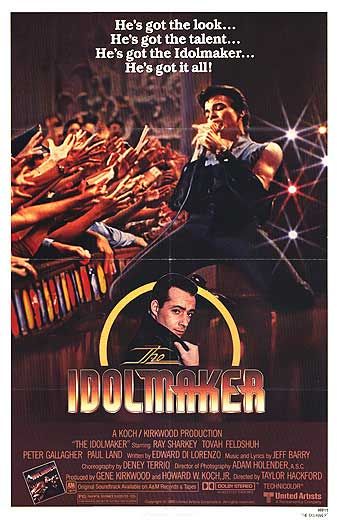
The Idolmaker (1980, directed by Taylor Hackford)
The Idolmaker is a movie that asks the question, “What does it take to be a star? Who is more interesting, the Svengalis or the Trilbys?” The year is 1959 and Vinny Vacari (Ray Sharkey, who won a Golden Globe for his performance but don’t let that dissuade you from seeing the movie) is a local kid from New Jersey who dreams of being a star. He has got the talent. He has got the ambition and he has got the media savvy. He also has a receding hairline and a face like a porcupine.
Realizing that someone who looks like him is never going to make hundreds of teenage girls all scream at once, Vinny instead becomes a starmaker. With the help of his girlfriend, teen mag editor Brenda (Tovah Feldshuh) and a little payola, he turns saxophone player Tomaso DeLorussa into teen idol Tommy Dee. When Tommy Dee becomes a star and leaves his mentor, Vinny takes a shy waiter named Guido (Peter Gallagher) and turns him into a Neil Diamond-style crooner named Cesare. Destined to always be abandoned by the stars that he creates, Vinny continually ends up back in the same Jersey dive, performing his own songs with piano accompaniment.
The Idolmaker is a nostalgic look at rock and roll in the years between Elvis’s induction into the Army and the British invasion. The Idolmaker has some slow spots but Ray Sharkey is great in the role of Vinny and the film’s look at what goes on behind the scenes of stardom is always interesting. In the movie’s best scene, Tommy performs in front of an audience of screaming teenagers while Vinny mimics his exact moments backstage.
Vinny was based on real-life rock promoter and manager, Bob Marcucci. Marcucci was responsible for launching the careers of both Frankie Avalon and Fabian Forte. Marcucci served as an executive producer on The Idolmaker, which probably explains why this is the rare rock film in which the manager is more sympathetic than the musicians.
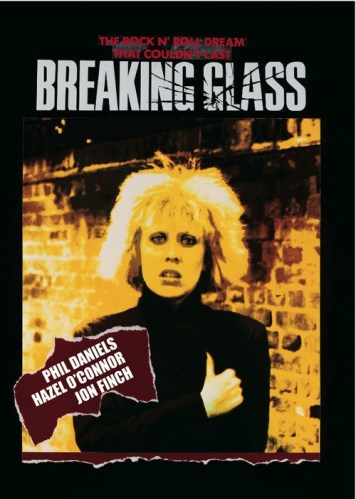
Breaking Glass (1980, directed by Brian Gibson)
At the same time that TheIdolmaker was providing American audiences with a look at life behind-the-scenes of music stardom, Breaking Glass was doing the same thing for British audiences.
In Breaking Glass, the idolmaker is Danny (Phil Daniels, who also starred in Quadrophenia) and his star is an angry New Wave singer named Kate (Hazel O’Connor). Danny first spots Kate while she is putting up flyers promoting herself and her band and talks her into allowing him to mange her. At first, Kate refuses to compromise either her beliefs or her lyrics but that is before she starts to get famous. The bigger a star she becomes, the more distant she becomes from Danny and her old life and the less control she has over what her music says. While her new fans scare her by all trying to dress and look like her, Kate’s old fans accuse her of selling out.
As a performer, Hazel O’Connor can be an acquired taste and how you feel about Breaking Glass will depend on how much tolerance you have for her and her music. (She wrote and composed all of the songs here.) Breaking Glass does provide an interesting look at post-punk London and Jonathan Pryce gives a good performance as a sax player with a heroin addiction.
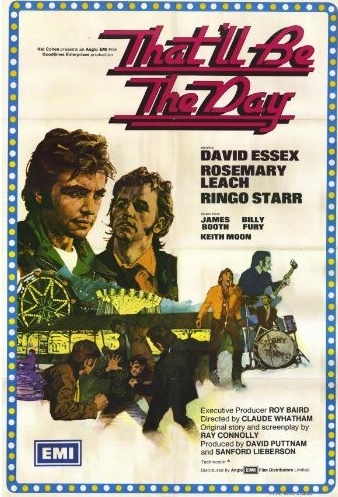
That’ll Be The Day (1973, directed by Claude Whatham)
Real-life teen idol David Essex plays Jim MacClaine, a teenager in 1958 who blows off his university exams and runs away to the Isle of Wright. He goes from renting deckchairs at a resort to being a barman to working as a carny. He lives in squalor, has lots of sex, and constantly listens to rock and roll. Eventually, when he has no other choice, he does return home and works in his mother’s shop. He gets married and has a son but still finds himself tempted to abandon his family (just as his father previously abandoned him) and pursue his dreams of stardom.
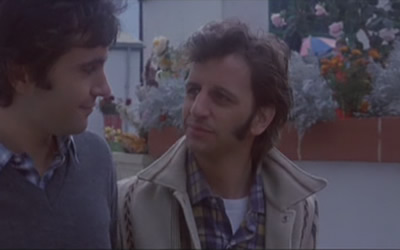
Based loosely on the early life of John Lennon, the tough and gritty That’ll Be The Day is more of a British kitchen sink character study than a traditional rock and roll film but rock fans will still find the film interesting because of its great soundtrack of late 50s rock and roll and a cast that is full of musical luminaries who actually lived through and survived the era. Billy Fury and the Who’s Keith Moon both appear in small roles. Mike, Jim’s mentor and best friend, is played by Ringo Starr who, of all the Beatles, was always the best actor.
That’ll Be The Day ends on a downbeat note but it does leave the story open for a sequel.
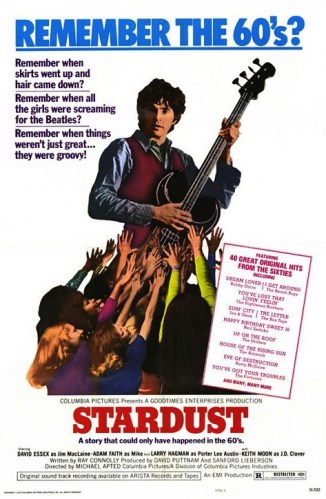
Stardust (1974, directed by Michael Apted)
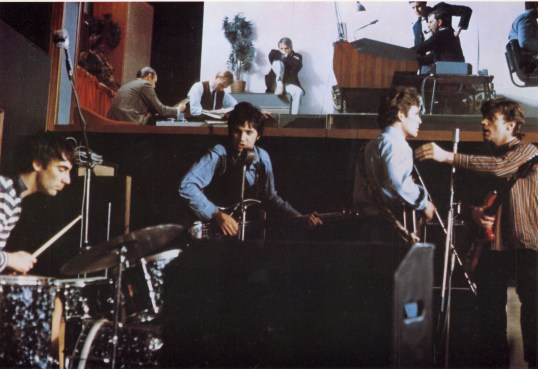
Stardust continues the story of Jim MacClaine. Jim hires his old friend Mike (Adam Faith, replacing Ringo Starr) to manage a band that he is in, The Straycats (which includes Keith Moon, playing a far more prominent role here than in That’ll Be the Day). With the help of Mike’s business savvy, The Stray Cats find early success and are signed to a record deal by eccentric Texas millionaire, Porter Lee Austin (Larry Hagman, playing an early version of J.R. Ewing).
When he becomes the breakout star of the group, Jim starts to overindulge in drugs, groupies, and everything that goes with being a superstar. Having alienated both Mike and the rest of the group, Jim ends up as a recluse living in a Spanish castle. Even worse, he gives into his own ego and writes a rock opera, Dea Sancta, which is reminiscent of the absolute worst of progressive rock. Watching Jim perform Dea Sancta, you understand why, just a few years later, Johnny Rotten would be wearing a homemade “Pink Floyd Sucks” t-shirt.
Stardust works best as a sad-eyed look back at the lost promise of the 1960s and its music. Watch the movie and then ask yourself, “So, do you really want to be a rock and roll star?”
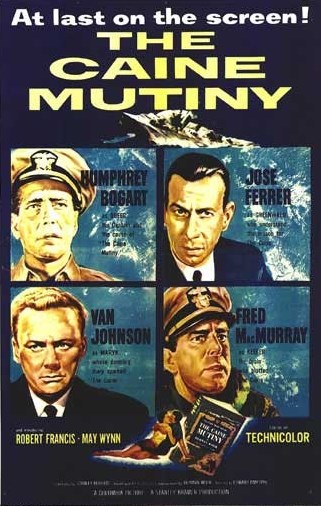
It’s the 1940s and World War II is raging. The U.S. Navy is model of military discipline and efficiency. Well, except for the U.S.S. Caine, that is. The Caine is something of a disorganized mess, where no one takes his job seriously and sailors have names like Meatball (Lee Marvin) and Horrible (Claude Akins). The men love Lt. Commander DeVriess (Tom Tully), largely because he has given up on trying to enforce any sort of discipline. However, DeVriess has recently been relieved of his command. As he leaves, Meatball gives him a new watch, a gift from all the men. DeVriess admonishes them, snapping that the gift is violation of Naval regulations. He then puts the watch on his wrist and leaves the ship.
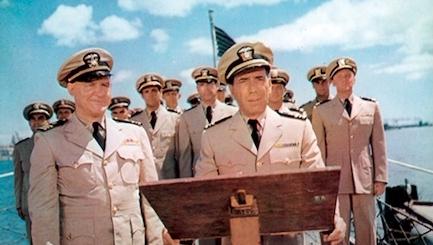
DeVriess’s replacement is Captain Francis Queeg and, at first, we have reason to be hopeful because Captain Queeg is being played by Humphrey Bogart. Surely, if anyone can get this ship into shape, it’ll be Humphrey Bogart! From the moment he arrives, Queeg announces that he’s going to enforce discipline on the Caine and if that means spending hours yelling at a man for not having his shirt tucked in, that’s exactly what Queeg is prepared to do. However, it also quickly becomes apparent that the awkward Queeg has no idea how to talk to people. He is also overly sensitive and quick to take offense. Whenever Queeg makes a mistake (and he does make a few), he’s quick to blame everyone else.
Realizing that the men are turning against him, Queeg even begs his officers for their help. He asks them if they have any suggestions. They all sit silently, their heads bowed as Queeg somewhat poignantly rambles on about how his wife and his dog both like him but the crew of the Caine does not.
Queeg’s officers are a diverse bunch, none of whom are quite sure what to make of Queeg or the state of the Caine. Ensign Willie Keith (Robert Francis) is a wealthy graduate of Princeton University who, at first, likes Queeg but quickly comes to doubt his abilities. On the other hand, Lt. Steve Marsyk (Van Johnson) has doubts about Queeg from the start but, as a career Navy man, his natural instinct is to respect the chain of command above all else.
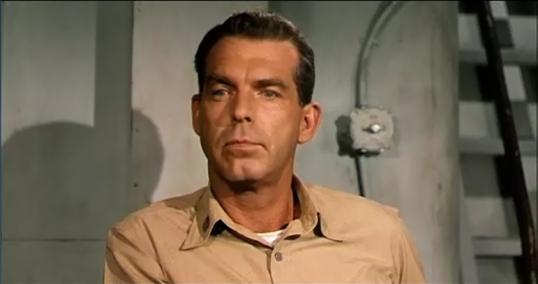
And then there’s Lt. Tom Keefer (Fred MacMurray). Keefer is a self-styled intellectual, a novelist who is always quick with a snarky comment and a cynical observation. (If The Caine Mutiny were remade as a B-horror film, Lt. Keefer’s name would probably be Lt. Sardonicus.) From the minute the viewers meet Lt. Keefer, our inclination is to like him. After all, he seems to be the only person in the film who has a sense of humor. If we had to pick someone to have dinner with, most of us would definitely pick the erudite Tom Keefer over the humorless and socially awkward Francis Queeg. As such, when Keefer starts to suggest that Queeg might be mentally unstable, our natural impulse is to agree with him.
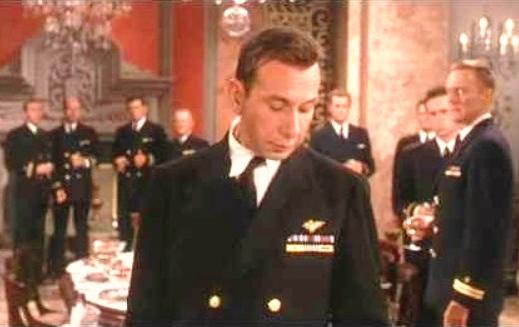
It’s Tom Keefer who first suggests that it may be necessary to take the command away from Queeg. And yet, when it comes time to take action, it’s Keith and Marsyk who do so while Keefer stands to the side and quietly watches. And, once the Caine arrives back in the U.S., it Keith and Marsyk who are court martialed. Will they be found guilty of treason or will their lawyer, Lt. Barney Greenwald (Jose Ferrer), prove that Queeg was unfit for command?
Made in 1954 and based on a novel by Herman Wouk, The Caine Mutiny is one of those big and glossy 1950s productions that holds up a lot better than you might expect. The film has its flaws. In the role of Keith, Robert Francis is a bit on the dull side and a subplot in which he courts May Wynn feels unneccessary and only serves to distract from the main story. But, for the most part, it’s an intelligent and well-directed film. Humphrey Bogart turns Queeg into a pathetic and lonely figure and you can’t help but feel sorry for him when he talks about how his dog loves him. Van Johnson also does well as Marsyk, effectively portraying a well-meaning character who is in over his head. Jose Ferrer gets a great drunk scene at the end of the film and, of course, you can’t go wrong with Lee Marvin as a smirking sailor, even if Marvin only appears for a handful of minutes.
But for me, my favorite character (and performance) was Fred MacMurray’s Tom Keefer. Technically, Keefer is not meant to be a likable character. He’s totally passive aggressive. He’s pretentious. He’s smug. At times, he’s rather cowardly. And yet, Tom Keefer remains the most memorable and interesting character in the entire film. He gets all of the good one-lines and MacMurray delivers them with just the right amount of barely concealed venom. (“If only the strawberries were poisoned…” he says as he considers dinner aboard the Caine.) It’s a great role and Fred MacMurray gives a great performance. And you know what? I don’t care how bad a character he may have been. I still want to read Tom Keefer’s book!
The Caine Mutiny was nominated for best picture of 1954. However, it lost to On The Waterfront.
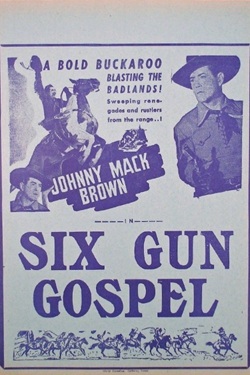 Marshals Nevada Jack McKenzie (Johnny Mack Brown) and Sandy Hopkins (Raymond Hatton) are sent to the frontier mining community of Goldville to determine who is responsible for hijacking all of the gold that should be coming out of the town. Not surprisingly, it’s all the work of another dastardly saloon owner (Kenneth MacDonald) who is planning on stealing all the gold, chasing off all the settlers, and then selling their land to the railroad company. While Sandy goes undercover as the town’s new preacher, Jack agrees to ride shotgun on a gold shipment, along with with Dan Baxter (Eddie Drew). Dan is in love with Jane Simms (Inna Gest), the daughter of honest miner Bill Simms (Kernan Cripps).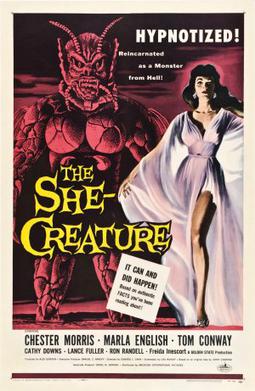
 Through the Shattered Lens