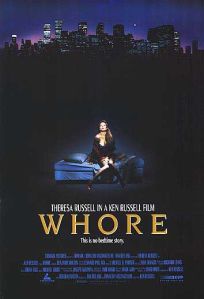
A Movie A Day #93: Whore (1991, directed by Ken Russell)


Liz (Theresa Russell) is a prostitute trying to survive on the mean streets of Los Angeles.  With the help of a homeless performance named Rasta (Antonio Fargas), Liz tries to escape from her abusive pimp, Blake (Benjamin Mouton).

To its credit, Whore was made as a response to the glamorous and irresponsible way that prostitution was portrayed in Pretty Woman but Whore had too much going against it to succeed.  It was based on a theatrical monologue, which was almost always a bad sign.  The majority of the movie was Liz talking straight to the camera, which was another red flag.  Most ominously, it was a Theresa Russell movie that was not directed by Nicolas Roeg and those never seemed to turn out well.  The director of Whore was Ken Russell but it featured none of the excess that Russell was known for.  Stuck with a low-budget and a reportedly unenthusiastic studio, Russell’s direction was uncharacteristically restrained.  (That’s a polite way of saying boring.)

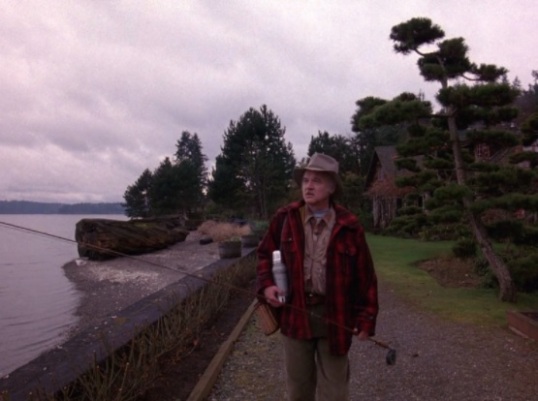
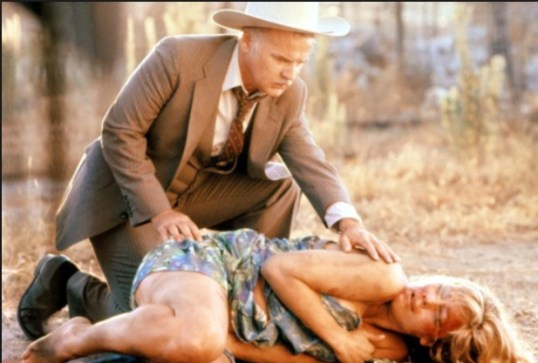
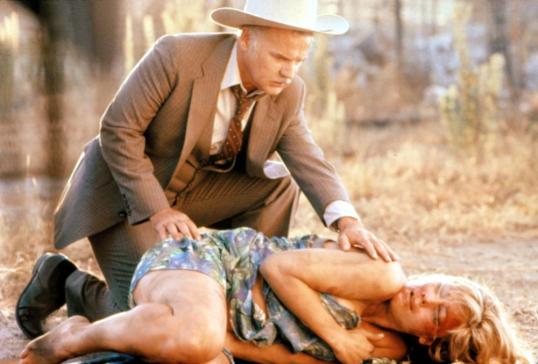
The one good thing about Whore, and the reason why I’m writing about it during this site’s look back at Twin Peaks, was the presence of Jack Nance, playing one of the few men who actually tries to help Liz.  Nance, of course, not only played fishing-obsessed Pete Martell in Twin Peaks but also starred in Eraserhead and appeared in all of Lynch’s films (with the exception of The Elephant Man) up until Nance’s mysterious death in 1996.  Literally credited as playing “Helpful passerby.” Nance only had a few minutes of screen time but made a definite impression as one of the few kind people to be found in Liz’s dark world.
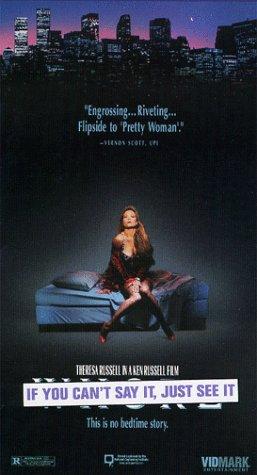
As a reflection of how much times have changed, Whore‘s title was so controversial that, in 1991, it was released in some areas under an alternative title: If You Can’t Say It, Just See It.
 

The Daily Grindhouse: The Devils (dir. by Ken Russell)


With Michael Reeves’ Witchfinder General having found some notoriety for it’s graphic depictions of the witchfinding and inquisition of suspected witches and sorcerers in ravaged England during it’s English Civil War during the 17th-century the world of film, especially the grindhouse and exploitation cinema of the day, founded a new subgenre of horror (folk horror) and also one in the niche world of exploitation. Nunsploitation would be ushered in during the late 60’s and right through the 1970’s of grindhouse cinema with films like Reeves and another which many thought was influenced heavily by the Vincent Price-starred production.

Ken Russell’s The Devils has had a recent rethinking as a film that was less exploitation and more of an arthouse film of the early 70’s which many called one of the more influential films of it’s era. No matter what recent thought on the film might have labeled Russell’s film I always thought it was one of the finer examples of nunsploitation cinema which has of late become more in tune with fetishic pornography than straight-out exploitation horror.

The film starred Oliver Reed and Vanessa Redgrave and was set in 17th-century France during the reign of King Louis XIII and the rise of his Catholic advisor in Cardinal Richelieu. Just like Reeves’ film, The Devils was based on the true historical account of the French priest Urbain Grandier of Loudon who was accused of witchcraft and subsequently executed because of these accusations.

Russell, who has mentioned that he got nothing from Reeves’ film as inspiration and actually hated the Witchfinder General, would take the graphic scenes of torture and sadism of Reeves’ film and ramp it up to the next level. He wouldn’t just include even more graphic scenes of sadistic violence in his own film, but add scenes of sex and perversion (even for the type of film it was The Devils pushed the boundaries of decency of the era) which would see Russell’s film banned from many areas in the UK. The film even split the critics of the day with some calling the film awful and debased while some would nominate the film and it’s director for prestigious film circle and festival awards.

The Devils would be heavily censored in its native UK and even in the US upon it’s release. As time went by the film began to garner new accolades as more open-minded critics began to look at Russell’s film under a new light. While more and more critics of todaycontinue to heap artistic and creative accolades upon this film that it’s begun to shed it’s exploitation roots I still believe that at it’s heart The Devils was and is still nunsploitation at it’s best.