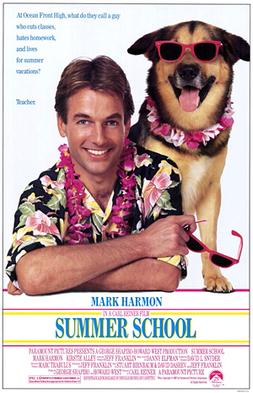
SummerSchool was the movie that made flunking out look like fun.
Freddy Shoop (Mark Harmon) is a relaxed, fun-loving gym teacher who is looking forward to spend his summer in Hawaii until he’s assigned to spend the summer teaching remedial English in summer school. (His girlfriend goes to Hawaii without him.) Freddy’s not happy about giving up his summer and he’s prepared to just spend his days taking his students to the beach, the amusement park, and the zoo. But when he finds out that he’s going to lose his job unless his students pass the big test at the end of the summer, he gets serious and discovers what teaching is supposed to be all about.
When I was growing up, SummerSchool seemed to be on television all the time. If it wasn’t on HBO, it was on one of the local stations, usually right before summer began. The summer school kids seemed to be having too much fun for kids stuck in school. I don’t think my classmates in Baltimore would have been as happy about losing their summer as the students in this film. Everyone who has seen this film remembers Dave and Chainsaw (Gary Riley and Dean Cameron) making jokes and showing everyone The Texas Chainsaw Massacre. They also remember Anna-Maria (Fabiana Udenio), the Italian exchange student who took summer school to work on her English. They remember Freddy letting one of his students move in with him, which doesn’t seem like a good idea even if she was played by Courtney Thorne-Smith. Myself, I remember Robin Bishop, the teacher next door, who was played by an extremely sexy Kirstie Alley. (This was one of the many 80s films in which Kirstie Alley made being uptight seem sexy.) Of course, Robin was dating the snobbish principal who was trying to get Freddy Shoop fired.
I’m not going to sit here and say that SummerSchool is a great film. It’s a dumb comedy with an uplifting message about what a good teacher can accomplish. However, SummerSchool is a very likable film, an enjoyable 80s teen romp that suggests summer school was the place to be in the late 80s. Mark Harmon, Kirstie Alley, and all the students give good performances. How many future horror nerds were inspired by Dave and Chainsaw? Legendary nice guy Carl Reiner directed and the movie itself is amiable and amusing enough to be watchable.
Welcome to Late Night Retro Television Reviews, a feature where we review some of our favorite and least favorite shows of the past! On Tuesdays, I will be reviewing Pacific Blue, a cop show that aired from 1996 to 2000 on the USA Network! It’s currently streaming everywhere, though I’m watching it on Tubi.
This week, Chris goes undercover.
Episode 2.8 “Undercover”
(Dir by Terrence H. Winkless, originally aired on October 13th, 1996)
A smarmy detective wants Chris to go undercover to help investigate a suspected money launderer, Tim Wakefield (Scott Plank). Palermo argues that Chris doesn’t have enough experience to work undercover but the detective asks Chris, “What do you want to do? You ready to get out of those bicycle shorts and do some real police work?”
I have to admit that line cracked me up. It really made the whole episode. Palermo got offended, as he always does whenever anyone points out that bike cops look silly with their shorts and their crisp white shirts. What was great about the line was that it was true. The detective may have been smarmy but he was right about Chris being invited to do “real police work” and he was right about bike cops not being real policemen. Everyone know it’s true! Seriously, if a bicycle cop ever tries to pull you over, just slam down on the accelerator. What are they going to do? Chase you when you’re going over 30 mph? I think not!
(Seriously, two seasons in and the show is still trying to convince us that bike cops are real cops. Sorry, Palermo, it’s not going to happen!)
That said, this episode’s main plot still ended up falling flat because Chris is not a very interesting character and her whole undercover thing wasn’t particularly credible. When she went undercover, she still came across as being just as stiff, humorless, and unlikable as when she’s riding her bike and threatening people with arrest. Tim Wakefield, of course, fell for her and Chris was supposed to be attracted to him and conflicted about her assignment and I never bought it for a second.
(As for Wakefield, he turned out to be not as bad of a guy as everyone assumed. He was arrested but his lawyer got him off and the episode ended with him sending Chris a postcard from some tropical beach. I think Chris was supposed to be wistful as she looked at the postcard but, since Darlene Vogel was apparently only capable of one facial expression, who knows for sure?)
Meanwhile, Cory dealt with being stalked by a mentally unstable ex-boyfriend, Wasn’t it just last week that Cory’s partner was being stalked by a mentally unstable woman? This show certainly does enjoy repeating itself. While Palermo worried about Chris, TC and Victor chased some roller-blading teens who were shooting random tourists with paintballs. The roller-blading scenes were kind of exciting but, unfortunately, they had to share space with all of the awkward bicycle scenes.
This episode had its moments. The roller-blading was cool. The detective making fun of Palermo was gratifying. Overall, though, the fact that the show centers around bicycles continues to be a flaw that simply cannot be overcome. There’s simply no way to make anyone riding a bicycle look impressive, I don’t care how serious they try to look.
Welcome to Late Night Retro Television Reviews, a feature where we review some of our favorite and least favorite shows of the past! On Tuesdays, I will be reviewing Pacific Blue, a cop show that aired from 1996 to 2000 on the USA Network! It’s currently streaming everywhere, though I’m watching it on Tubi.
This week, season one comes to an end!
Episode 1.13 “All Jammed Up”
(Dir by Ronald Victor Garcia, originally aired on May 25th, 1996)
Here we are at the end of the first season of the show and both Pacific Blue and Tim Palmero’s bicycle squad are still struggling to justify their existence.
There’s a couple of thieves robbing people who are stuck in traffic. The thieves ride bicycles. You can literally see Palermo light up as he realizes that he’s finally run into a criminal who can reasonably be subdued by his bike patrol. Of course, it still takes them forever to catch the guy. Whenever the bike criminal would escape and Palermo or TC would say, “We’ll get him next time,” I was reminded of Mike Brady trying to sell his terrible architectural designs in The Brady Bunch Movie and assuring his desperate boss that the next client would definitely want their gas station or restaurant to look just like the Brady house.
Meanwhile, Chris and and Cory go undercover as escorts in order to catch an arms dealer who is staying at a hotel and who has a thing for sex workers. Chris is not happy with assignment and complains about it. Normally, I would agree because it really is a degrading assignment. (The arms dealers can be identified only by a tattoo on his behind.) But Chris whines about everything so I have to admit that I didn’t have as much sympathy as I should have had.
Cory, along with her undercover work, is upset because her boyfriend (Ken Olandt) refuses to tell his parents that she’s a bike cop. Her boyfriend’s father was played by Robert Pine, the sergeant from CHiPs. That was amusing.
Meanwhile, Elvis wants to ask someone out. TC gives him advice and, in a nod to Cyrano, tells Elvis what to say. Hey, TC — there’s a crime wave going on! Or maybe you didn’t notice….
This was a pretty pointless way to end the season but …. eh, it’s Pacific Blue. It’s pretty much what I was expecting from this show. This first season was pretty bad. I can’t really think of a single episode that didn’t get on my nerves in some way. Way too much time was spent this season on people saying, “They ride bikes?” Yes, they ride bikes. They look stupid and I would be kind of angry if I was the victim of a crime and any of these losers showed up but at some point, both the show and the audience will have to accept that it is what it is. The show is about cops on bicycles. Every episode during the first season seemed to be designed to make us go, “Okay, they’re real cops!” But if you’re still having to convince the audience of that thirteen episodes in, it’s a problem.
Welcome to Late Night Retro Television Reviews, a feature where we review some of our favorite and least favorite shows of the past! On Thursdays, I will be reviewing Highway to Heaven, which aired on NBC from 1984 to 1989. The entire show is currently streaming on Tubi and several other services!
This week’s episode finds Jonathan and Mark working as physical therapists!
Episodes 1.6 and 1.7 “One Fresh Batch of Lemonade”
(Dir by Michael Landon, aired on October 24th, 1984 and October 31st, 1984)
Deke Larson, Jr. (Ken Olandt) is a high school baseball star who is being watched by the scouts, much to the joy of his father, Deke, Sr. (Jim Haynie). The elder Deke was quite an athlete in his day and his house is still full of the trophies that he won through the years. Deke, Sr. was recruited to play professional baseball but he never made it out of the minor leagues. As a result, Deke, Jr. has spent his entire life being prepared to do what his father never accomplished.
However, that dream comes to an end when Deke, Jr. has a motorcycle accident and is hit by a truck that is being driven by Richie Halbertson (Bart Conner), a gymnast who attends a rival high school. As a result of the accident, Deke, Jr. loses both his legs. Now, he spends his time at a rehab clinic, consumed by his own bitterness.
Jonathan and Mark are the clinic’s newest physical therapists. While Jonathan tries to get Deke, Jr. to accept his condition and forgive Richie, Mark tries to talk to Deke, Sr. With the help of a quadriplegic law student named Scotty (James Troesh), Deke, Jr. starts to realize that it’s better to focus on what he has instead of obsessing on what he’s lost. Deke, Jr. starts to recover from his bitterness and soon, he’s even being nice to the classmate (Samatha Paris) who has a crush on him. But when Jonathan suggests that Deke, Jr. could still compete as gymnast, will Deke, Jr. be able to accept being trained by Richie Halbertson? And will Deke’s parents be able to set aside their own anger to support their son?
If you answered no to any of those questions, you’ve obviously never seen this show before.
This two-parter is pretty much the epitome of a typical Highway to Heaven episode. It’s earnest, heartfelt, well-intentioned, and there’s isn’t a moment of cynicism to be found. It’s the type of episode where Jonathan tells two snotty teenage boys that they shouldn’t park in a handicapped spot and, when the boys ignore him and go into a nearby bookstore, God turns their car upside down. (Plus, they get a ticket!) Even the episode’s title, which refers to the old-saying about making lemonade whenever life gives you lemons, pretty sums up Highway to Heaven‘s unapologetically positive outlook. At the same time, it’s also an episode that, because it is so earnest, won’t take anyone by surprise. If you can’t guess how this episode is going to end, I can only assume that you’ve never watched television or a movie before.
Predictable as it may be, it’s still an effective episode, largely because it is so unashamed of being sentimental and heartfelt. You do have to wonder just how exactly Deke, Jr. managed to become a competition-worthy gymnast in what appears to have just been a matter of weeks but still, this is a case where the good intentions make up for the rough spots.
Next week, Jonathan and Mark help an industrialist who thinks that he is King Arthur. Who does the grail serve?
(Because of the nature of the 1986 pseudo-slasher film, April Fool’s Day, it’s impossible to really talk about the film without talking about the film’s ending. As a result, this review will have spoilers. The ending will be revealed. The entire plot will be spoiled. Do not read on if that’s going to be an issue for you.)
(Did you read the warning above?)
If not for the way that the film ends, April Fool’s Day would probably be a forgotten film. It’s a slasher film that doesn’t feature much blood, sex, or any particularly flamboyant kills (though there’s a good reason for that). Compared to most low-budget slasher films from the mid-80s, April Fool’s Day does have a surprisingly charismatic and likable cast but it’s rare that anyone watches a holiday-themed slasher film for the acting. Up until the final ten minutes or so, April Fool’s Day is professionally done but somewhat generic…
But then you hit that ending and it totally changes the whole film. It’s not a perfect ending. In many ways, it’s probably one the most imperfect endings that I’ve ever seen. It requires a massive suspension of disbelief. It makes no logical sense. But dammit, I love it. Almost despite itself, it’s a great ending and it confirms that April Fool’s Day is meant to be a satire and not a straight horror film.
For the first 80 minutes or so, April Fool’s Day plays out like the 100th variation on And Then There Were None. Heiress Muffy St. John (Deborah Foreman, giving a wonderfully odd performance) invites a group of college friends to her island mansion. They arrives on April Fool’s Day and they spend the first night dealing with Muffy’s strange sense of humor. (Actually, Muffy and I both find the same things funny but I’ve been told that I have a strange sense of humor so, therefore, I assume that Muffy must have one too.) Harvey, who prefers to be called Hal (Jay Baker), smokes an exploding cigar and discovers his bedroom has been decorated with newspaper articles about a car accident that he was involved in. Jock Arch Cummings (Thomas F. Wilson) finds steroids hidden away in a medicine cabinet. Nikki (Deborah Goodrich) comes across handcuffs in a dresser. Nan (Leah Pinset), a serious-minded drama student, hears a baby crying in the distance and is reminded of her abortion, something that she believes that only Muffy knows about.
The next day, Muffy is now wandering around in a daze and her brother, Skip (Griffin O’Neal), has vanished. Kit (Amy Steel, playing a similar role to her character in Friday the 13th Part Two) and Rob (Ken Olandt) think that they see Skip’s decaying body floating under the boathouse. As the day progresses, Arch and Nan vanish and later turn up at the bottom of a well. Harvey is found hanging from a rope. Chaz (Clayton Rohner) is castrated and, while we’re not quite sure what exactly happens to Nikki, we do see that it involves a large puddle of blood. Kit and Rob discover Muffy’s head in the basement and realize that they are being stalked by Muffy’s crazy twin, Buffy.
(Deborah Foreman is great in both of the roles. As Muffy, she delivers all of her lines with just a hint of sarcasm and constantly seems to be silently laughing at a private joke that only she understands. And when she’s Buffy — well, she’s totally batshit crazy.)
Being pursued by a knife-wielding Buffy, Kit runs through the mansion and finds herself in the drawing room. And who is waiting for her but all of Buffy’s victims? No, they’re not dead! Instead, they’re alive and they’re all in a very good mood. And Buffy is not Buffy. She’s Muffy and she’s been Muffy all along.
That’s right, it’s all a huge elaborate joke! Muffy does spend a few minutes explaining how the whole weekend was a dry run for her plan to turn her estate into a resort, one that will offer a weekend of fake horror. But, ultimately, it all comes down to the entire movie being an elaborate joke. I know, just from perusing some of the comments at the imdb, that there are some horror fans who hate the ending of April’s Fool’s Day. But, really, that’s the only “honest” way that a film like April Fool’s Day could end. If the movie was called Thanksgiving, I could understand being upset. But this is an April Fool’s Day movie! It has to be a joke.
Of course, if you think about it too much, the ending makes no sense. Muffy specifically states the no one was in on the joke until the last minute. Whenever one of her friends would wander off on their own, Muffy would grab them, explain the joke, and get them to play along. When you consider the size of the island and where, at various points, the victims are in relation to the other characters, Muffy must be a very fast explainer, as well as being very persuasive. (As well, Harvey brings a gun with him to island. Muffy jokes about nearly getting shot by him but imagine if he had been successful?) Even if you accept that all of the friends — even Arch and Harvey, who are both kinda dumbasses — would be able to play along without screwing things up, you have to wonder why Muffy thought it would be a good idea to use dark secrets from everyone’s past.
If you search far enough online, you can find all sorts of rumors about the film that April Fool’s Day was originally meant to be. In the finished film, Skip is a bit of a cipher but, in the original script, he was a much more complex character. While Muffy was busy playing her elaborate prank, Skip was planning on killing Muffy and claiming their parent’s inheritance for himself. The crying baby, the drugs, the incriminating newspaper articles; all of them were originally meant to be the work of Skip. While Skip’s subplot was dropped, the dark secrets of the past were not. As a result, Muffy comes across as being a lot more cruel than was originally intended.
Originally, the film was also meant to end with Skip killing Muffy but the ending was apparently changed at the last-minute. (Reports differ on whether or not the original ending was ever filmed.) Instead, the film now ends with Muffy stumbling into her bedroom, playing with a jack-in-the-box, and then getting a knife drawn across her throat by Nan. It’s just another elaborate practical joke and, once Muffy realizes that she’s not dying, Nan gives her a quick kiss and smiles enigmatically.
(A lot of imdb commenters — mostly males — have read a lot into that kiss, obsessing on a subtext that really isn’t there. As opposed to being the homage to Blue Is The Warmest Colour that many commenters appear to believe it to be, it’s really just a friendly kiss, a way of saying, “I got you.” Sorry, guys, that’s all there is to it.)
It’s an ending that would never be done today. Today, all horror films have to end with the promise of a sequel. Muffy might still get away with pulling an elaborate prank but Nan would definitely have killed her at the end of the film. Her little smile would have said, “Wait for the sequel.” And the modern version of that ending definitely would not be as effective. In fact, it would be so expected that it would be damn near infuriating. Instead, the ending of April Fool’s Day is good-natured and likable, which is appropriate because April Fool’s Day is a surprisingly good-natured and likable film.
After Nan’s final joke, April Fool’s Day ends with a song. And here it is! Enjoy and I hope everyone had a great April Fool’s Day!
 Summer School was the movie that made flunking out look like fun.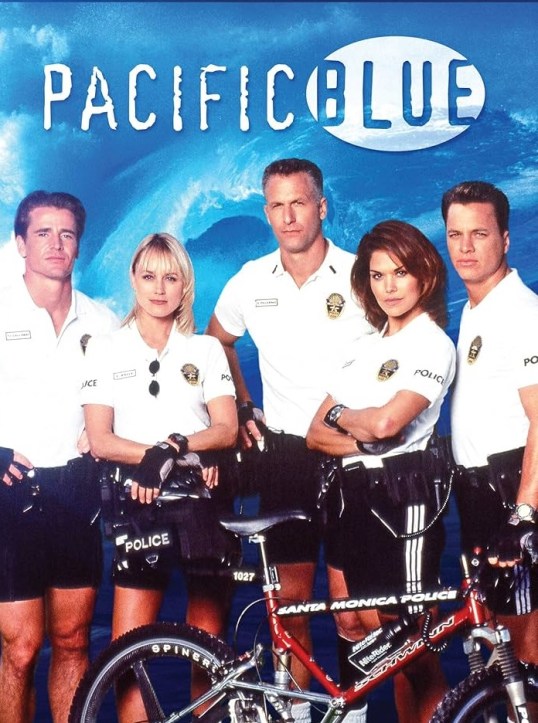

 Through the Shattered Lens