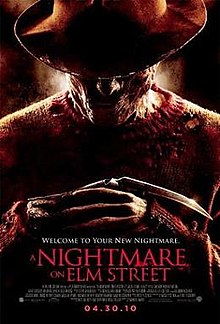
“Hey, you guys! The 2010 remake of A Nightmare on Elm Street is on TV!”
“Alright! I NEVER MISS A ROONEY MARA HORROR MOVIE!”
Indeed, way back in 2010, there a lot of hype accompanying the release of the remake of A Nightmare on Elm Street. It came out at a time when a lot of classic horror films were being rebooted for no particular reason. Halloween got a reboot. Friday the 13th got a reboot. Texas Chainsaw Massacre has gotten a reboot. So, it was just kind of expected that Nightmare on Elm Street would get a reboot, bringing the story into the modern age and making the story less problematic and blah bah blah.
And yet, for all the hype that accompanied the Nightmare on Elm Street reboot, it was pretty quickly forgotten. If I remember correctly, it failed to live up to box office expectations and, as a result, there was never a sequel to this reboot. Jackie Earle Haley never got a second chance to play Freddy Krueger and, to be honest, that’s probably for the best. Haley’s a great actor who deserves better than to be typecast as the actor who played the second best version of Freddy Krueger. No matter how good a performance Haley could have given in any of the hypothetical sequels to the Nightmare reboot, he would have been overshadowed by Robert Englund’s definitive interpretation of the character.
Today, the movie seems to be best remembered as one of the films that Rooney Mara made before she was cast in the title role of David Fincher’s rehash of The Girl With The Dragon Tattoo. Mara plays the role of Nancy, the sleep-deprived teenager whose friends are all having nightmares and dying in various grotesque ways. In Nightmare on Elm Street, Rooney Mara is even more boring than usual but then again, the same can be said of just about everyone else in the movie, with the exception of Jackie Earle Haley and Clancy Brown. The majority of the actors just go through the motions. It’s as if they decided that, since they were appearing in a horror movie, they didn’t really have to make any sort of effort to do anything interesting with their characters. One need only compare the performances of Heather Langenkamp and Rooney Mara to see why the original Nightmare On Elm Street remains a classic while the remake has been forgotten.
Of course, another reason why the reboot has been forgotten is because it’s not really that scary. The original Nightmareis still scary. The original can still give you nightmares. Robert Englund’s performance still holds up. The death of Tina is still terrifying. The scene where Nancy looks at the gray streak in her hair and says that she looks like she’s in her 20s is still funny. Nightmare on Elm Street still holds up. The reboot, however, falls flat in the scares department. I think part of the problem is that the dreams are too obvious in the reboot, In the original, the waking world would segue so effortlessly into the dream world that you were always kept off-balance. In the remake, the dreams are too easy to spot and they’re too dependent on CGI to be convincing as a actual nightmares.
The remake does do one interesting thing. There are several scenes in the film that seem to be designed to hint that maybe, in life, Freddy was actually innocent of the crimes for which was accused and that he was just set on fire because he was a convenient scapegoat. That’s an intriguing idea and it certainly would have brought a whole new dimension to Freddy and his quest for revenge. Just imagine how much of a mind-screw the film would have been if it had been revealed that Freddy had actually been framed by one of the same adults who later set him on fire. Unfortunately, after making you think that the movie might actually do something unexpected, the film then reveals that Freddy actually was guilty and the whole story becomes a bit less interesting. Revealing that Freddy was just a somewhat slow handyman who was wrongly accused would have brought some subversive life to this film but this reboot has no interest in being subversive.
With our look back at Twin Peaks now entering its final week, it’s time for me to get back to trying to clean out my DVR. When last we checked on the DVR, I had about 187 movies that I needed to watch. At the end of March, I started in on them but then I got distracted by a number of things. I put the clean-up on hold for a month and I even recorded some more films.
So, now, as April comes to a close, I have 200 movies on my DVR.
(The writer Derrick Ferguson once asked me just how much space I have on my DVR. To be honest, I’m really not sure. All I know is that I’ve got 200 movies recorded and 20% of the DVR is still free.)
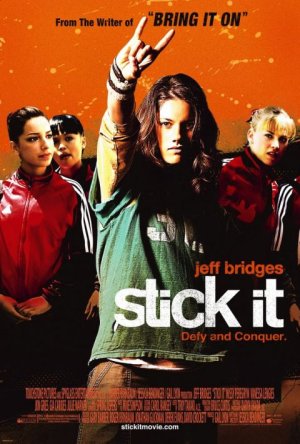
If I’m going to have my DVR cleaned out by the end of May, then I better get back to watching all of this stuff. I got things off to a good start, on Monday night, by watching a film about gymnastics in Texas, Stick It.
I think I may have actually seen Stick It when it was originally released in 2006. I can’t say for sure because I spent most of 2006 in a daze but it seems like the type of movie that I would have gone to see back then. The film itself felt familiar but that could just be because I’ve seen a lot of movies about gymnasts.
Anyway, Stick It is one of those movies that’s set in Texas but was filmed in California. This leads to several unintentional laughs. For instance, the movie opens in Plano, Texas. Plano is a suburb of Dallas. For some reason, Plano seems to show up in a lot of random movies. (When Ed Helms visits his sister and Chris Hemsworth in Vacation, we are specifically told that they live in Plano.) The movies, of course, never get Plano right. Plano is not a rural community nor is it a junior version of the Park Cities. Instead, it’s a typical suburb, one that is somewhat infamous for being home to a lot of people who have moved down to Texas from up north.
In Stick It, Plano is portrayed as being surrounded by mountains. When the action later moves down to Houston, there are even more mountains in the background. Of course, any true Texan knows that there aren’t any mountains near either Dallas or Houston. Dallas sits on the plains. Houston is known as the Bayou City. If you want to make a movie about Texas with mountains, go film in El Paso.
As for the rest of the film, it tells the story of Haley Graham (Missy Peregrym), who was one of the top ranked gymnasts in America until she walked out during the World Gymnastics Championship, costing her team a gold medal and making her one of the most hated people in America. Having abandoned gymnastics, Haley spends her time hanging out with skaters in Plano. (I used to do the same thing. Plano skaters are wild and rich.) One day, Haley and the skaters get caught breaking into an abandoned building. The judge gives Haley a choice. Either go to military school or enroll at the prestigious but tough Vickerman Gymnastics Academy. Haley picks military school so, of course, the judge sends her to VGA.
And here’s the thing. It’s easy to be dismissive of a character like Haley but Missy Peregrym gives such a sincere performance and is so committed to the role that you’re on her side even when she seems like a privileged brat. Haley’s parents are bitterly divorced and, even though they’re presented as being cartoonish caricatures, I could immediately relate to Haley. When my parents got divorced, I acted out too. I even hung out with wild skaters in Plano.
Anyway, Haley ends up in Houston. Her new coach is Burt Veckerman (Jeff Bridges) who convinces her to start competing again, just so she can win enough money to pay off all of that Plano property damage. She agrees, reluctantly. Haley may love gymnastics but she hates all of the little rules that come along with competition. Interestingly enough, that’s the way I’ve always felt about dancing. Haley might as well have just been named Lisa.
Haley returns to the competition world and, while she’s obviously talented, she struggles to prove that she’s better than her reputation. Even worse, she has to deal with judges who are obsessed with minutiae and who are biased towards their pre-determined favorites. It doesn’t matter how talented you are or how well you compete. All that matters is that you follow the rules and that you have the “right” attitude.
The movie ends with Haley taking a stand against the unfair judging system and humiliating the clueless judges. It’s a great moment, even though it would never happen in real life. For one thing, it involves convincing all the other gymnasts to give up their chance to win just so they can do the right thing. Myself, I would never go along with that. I may hate following rules but I love winning trophies.
But still, it’s a nice little fantasy. Stick It is one of those films that got terrible reviews when it was released but it’s a real crowd pleaser. This is a fun movie and, while it doesn’t tell a particularly deep story, it’s message of ignoring rules is one that’s needed in this increasingly authoritarian society. Both Missy Peregrym and Jeff Bridges gave good performances and director Jessica Bendinger did a good job of keeping the action moving quickly. (Bendiner also wrote the greatest of all cheerleading movies, Bring It On.)
How entertaining was Stick It?
Entertaining enough to survive mountains in Plano.
As I mentioned in a previous review, I’ve only got a few months left before I’m going to have to make out my list of the 16 worst and the 26 best films of 2014. With that in mind, I really need to get caught up on reviewing some of the films that might appear on those two lists. For the most part, I try to review every single movie that I see but, occasionally, a movie or two will slip through the cracks. And now, with Oscar season approaching but not quite arrived, seems like as good as time as any as to try to get caught up by reviewing two films that came out earlier this year: Renny Harlin’s The Legend of Hercules and Paul W. S. Anderson’s Pompeii.
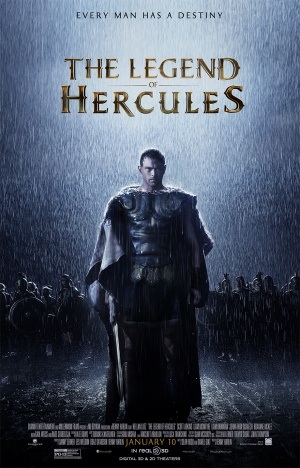
The Legend of Hercules is a film that I first saw with my BFF Evelyn way back in January. And while I meant to review it after I first saw it, I simply never got around to actually doing so. Some of that is because, when Kellan Lutz first showed up on screen, Evelyn said, “Nice tits,” and I ended up laughing so hard that I nearly fell out of my seat. This led to Evelyn spending the entire film trying to make me laugh again and, in between all of the whispering and the giggling, we undoubtedly missed out on a lot of the film.
However, I recently rewatched The Legend of Hercules on Cinemax and I was quickly reminded about the other reason that I hadn’t gotten around to reviewing it. There’s really just not that much to say about The Legend of Hercules. It’s just not a very good film but yet it’s not bad in a fun way either. It’s just boring. As played by Kellan Lutz, Hercules wanders through the ancient world and he does all the stuff that you would expect Hercules to do. Actually, he does all the stuff that you would expect any character in a rip-off of 300 to do. The film could have just as easily been called The Legend of Eammon, an Irishman in Greece.
In fact, I’d really like to see a movie called The Legend of Eammon, an Irishman in Greece. Get on it, someone.
According to Wikipedia, The Legend of Hercules had a budget of 70 million dollars, which makes it a bit odd that the film itself just looks cheap and generic. At one point, Hercules fights a lion and the CGI is so bad that, for a few minutes, the movie looks like one of those senior projects that students occasionally upload to YouTube. (I was half-expecting to see a comment apologizing for the “crappy special effects” flash across the screen.) During the film’s many fight scenes, director Renny Harlin does that thing where every punch is shown in slow motion. It gets annoying after the hundredth time.
A few words about Kellan Lutz. I happen to like Kellan Lutz. I think he’s been likable in other roles. But, in The Legend of Hercules, he really did spend the entire movie looking like he was wishing that he could be anywhere else. But can you blame him?
For a far more enjoyable trip into the past, allow me to recommend a film that came out a few months after The Legend of Hercules, Pompeii.
Now, before I review Pompeii, I should admit that, as you all know, I am a history nerd and, as you all might not know, I’ve always been fascinated by the Roman Empire. The summer after I graduated high school, I took a trip to Italy and I actually walked through the streets of Pompeii. My two main memories of Pompeii: while we were touring an ancient brothel, an Australian man lay down on one of the slabs. My other memory is that it was a very windy day and I was wearing a skirt so I can legitimately say that not only have I visited Pompeii but I’ve flashed Pompeii as well.
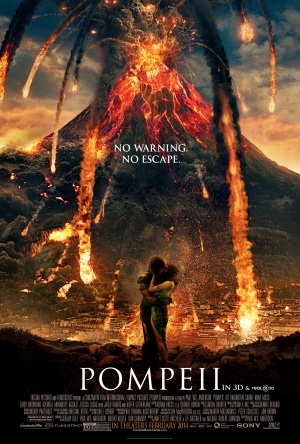
Anyway, Pompeiithe Movie tells the story of the final days of Pompeii the City. A Celtic slave and gladiator named Milo (Kit Harrington) is sent to Pompeii where he, in quick order, meets and romances the noble Cassia (Emily Browning), establishes a friendly rivalry with fellow gladiator Atticus (the always intimidating Adewale Akinnuoye-Agbaje), spots the evil Roman General (Kiefer Sutherland) who killed Milo’s mother, and then eventually has to run for his life as a cloud of ash and a river of lava crashes down on Pompeii.
Pompeii is a lot of fun. Harrington and Browning have a lot of chemistry, all of the actors are obviously having a good time with their melodramatic dialogue, and Kiefer Sutherland was born to play an evil Roman. As opposed to the Legend of Hercules, Pompeii looks good and the eruption of Mt. Vesuvius is genuinely impressive. Perhaps best of all, the film actually allows things to play out to their natural and logical conclusion. For once, history is not changed just to force a happy ending on the viewers and Pompeii is all the better for it!
So, in conclusion: forget about The Legend of Hercules and give Pompeii a chance. Actually, you’ve probably already forgotten about The Legend of Hercules so just try not to suddenly remember it. But seriously, Pompeii is better than you might think.
“Harry Potter is about confronting fears, finding inner strength and doing what is right in the face of adversity. Twilight is about how important it is to have a boyfriend.” – Stephen King
I have a problem with the notion that says you have to have someone in your life in order for your life to be considered perfect or grand. I’m of the mind that you step into the world alone and leave it the same same way. Even if you are surrounded by your nearest and dearest friends when you pass, you’re still the only one making that trip. And while I love the notion of Romance, I don’t believe it needs to translate to “Omigod, if you’re not near me, I’m going to jump off this building, I swear it because I can’t talk about you without stammering.” or the other obsessive notions that Twilight seems to bring up. This doesn’t mean I outright hate everything that Twilight is, but I’m not totally fond of the overall message it conveys. Perhaps I’m just emotionally cold that way.
And yet, I may know more about Twilight than any other guy in the known universe. It’s an enigma, I know.
A little background on why I, a guy, am writing a review for The Twilight Saga: Breaking Dawn, which is pretty much geared for girls. Note that I’ll refer to the film just as Breaking Dawn, because I really don’t see Twilight as a Saga by any means.
In the early 90’s, I hit a “Vampire Phase”. Between playing games of Vampire: The Masquerade and reading every Vampire Chronicle novel that Anne Rice wrote up until Tale of the Body Thief, I was pretty involved. I grew up with Vampires that were monsters to be feared (and sometimes admired), and dodged the sun more or less. I even owned two vampire encyclopedias. Somewhere between Mark Danielewski’s “House of Leaves” (a book I still haven’t finished) and Andrew Davidson’s “The Gargoyle”, I picked up a hardcover copy of Stephenie Meyer’s “Twilight” from Barnes & Noble. I didn’t think much of the books, save that they were quick reads. Meyer and her vampires were far from Rice and her universe lacked the erotic flair of Laurell K. Hamilton’s earlier books in the Anita Blake series. They were more or less books for teens, but they had vampires in them, so I pretty much inhaled all four books (Twilight, New Moon, Eclipse, and Breaking Dawn) twice in Hardcover. I even went so far to read Meyer’s “The Host” and have seen all of the other Twilight films in the theatre. While they all seem to be really close to the source material, there’s something strange in the translation. What made sense on paper really didn’t on screen (Sparkling Vampires jump to mind), but I guess that’s for an Editorial.
So, when it came to reviewing Breaking Dawn, we at the Shattered Lens drew straws. While we hold to the tenet that any movie can be reviewed by anyone even if the movie was previously reviewed by anyone else (for alternate viewpoints), this was a film that was pretty much off our collective radars. I think we all secretly wanted Lisa or Erin to take it, but both Lisa and my cousin gave the argument that I could probably give a different perspective on the film than all of the girls who planned to see it, most of whom would sprout something like the following:
“I love Edward so much, and that he took his time with Bella was just so heartfelt that I wanted to cry. I felt so bad for Jacob that he could haven’t have her. He deserves better than that!! If anyone doesn’t like what I’m saying, then I will come to their houses and stab them with rusty blades in their beds because no one – I mean no one – gets in the way of my Twilight Love!! You haters could suck it! Team Edward/Jacob Forever!!!!”
So, here I am, writing this. Let’s see what becomes of it, shall we?
For those of you who managed to avoid the Twilight books and movies like they were Sutter Cane novels, here’s everything you’ll ever need to know.
Twilight is the story of Isabella Swan (Kristen Stewart) who moves from Arizona (where Meyer lives) to Forks, Washington to live with her Sheriff father, Charlie (Billy Burke). While in school, she meets an interesting but strange fellow in Edward Cullen (Robert Pattinson). After being saved from a near fatal car crash in an impossible fashion by Edward, Bella becomes intrigued with who and what he may be. A little big of Googling and book buying leads her to discover that Edward is in fact, a Vampire. He explains he’s dangerous. She doesn’t care. He states he’s a killing machine. She loves the danger. He steps into the sunlight to show he doesn’t burn, he just sparkles. She’s just mesmerized.
The original Twilight was Bella’s introduction to The Cullens (who are more or less Vegetarians in that they don’t go after humans, but animals instead):
Carlyle (Peter Facinelli) – Father figure and Doctor. He recruited the rest of the family.
Esmee (Elizabeth Reaser) – Carlyle’s Wife and Mother Figure.
Emmett (Kellan Lutz) – The Muscle of the Family and companion to Rosalie.
Rosalie (Nikki Reed) – Emmett’s Companion and is pretty much opposed to Bella up until Breaking Dawn, for reasons she explains in Eclipse.
Alice (Ashley Greene) – Companion to Jasper and has the ability to see the decisions that others make before they make them.
Jasper (Jackson Rathbone) -The newest vampire of the group and companion to Alice. Has the ability to manipulate the emotional tides of others.
In Twilight, Bella and the Family run into a trio of vampires, one of which decides he has to hunt down and kill Bella (because she’s food). The family is able to kill the vampire and get on with their undead lives, not before a final parting shot showing the vampire’s girlfriend and her desire to kill Bella in return. Bella decides it’s in her best interests to become a vampire and tries to persuade Edward to change her, but he refuses, citing she has many years ahead of her worth living.
In New Moon, Edward decides to celebrate Bella’s birthday at his place. After an accident occurs that leaves her bleeding, Jasper loses it and attacks her. The family is able to save her, but this convinces Edward that it just won’t work out and the entire family leaves town. Left on her own, Bella spends the next four months crying and screaming in her sleep over Edward until her father convinces her to hang out with her friends. She ends up spending more time with Jacob Black (Taylor Lautner), a friend who lives on a nearby reservation that clued her into what the Cullens really were. They get closer as friends and eventually, she discovers that Jacob and his family are actually Werewolves. While cool, she also learns that the Werewolves don’t get along with Vampires and despise the Cullens. They haven’t killed the vampires because of a Treaty that was enacted long ago. Werewolves stay on their side, Cullens on the other and no humans get hurt. Victoria (the girlfriend of that dead vampire in Twilight) returns to town to kill Bella, but she’s protected by the Wolves. She ends up doing a little cliff diving, which catches Alice’s attention and she manages to reunite with the family, though learns that Edward plans to kill himself. Edward believes she died when she jumped off the cliff, volunteering himself to death by the Vampire Congress known as the Volturri.
Alice and Bella fly to Italy and intercede, rescuing Edward from his fate and meeting the Volturri. As Bella knows too much, the Volturri leader demands that within a year she has to becomes a vampire. This of course, excites Bella and annoys Edward, who throws in a “Let’s get Married First” clause into the works. The idea of this is to help give closure to all the humans in Bella’s life. She reluctantly agrees to it. Jacob catches wind of this and spends the next book & film, Eclipse, trying to convince Bella that she should live and that he’s the better choice of a love interest.
Okay, Eclipse. Victoria knows that she can’t get to Bella on her own without dealing with both the Werewolves and the Vampires. She finds a resident of Forks in Seattle named Riley Biers and changes him to a Vampire, convincing him that the Cullens are bad and killed her friend. He builds an army and they attack the Cullens en masse, but somewhere along the line, Victoria forgot to mention there may be giant dogs in the area. The Cullens and Werewolves join forces and defeat the newborns with ease. In the process, Bella learns more about the Wolves and their ability to “Imprint”, meaning they basically obsess over one person for the rest of their lives (much like whales, I suppose). Luckily, Jacob hasn’t Imprinted on Bella yet. Edward eventually dispatches Riley and Victoria, leaving the romance to continue. In Eclipse, the Cullens explain to Bella how they came to be, partially to help her what she has to look forward to, positive or negative.
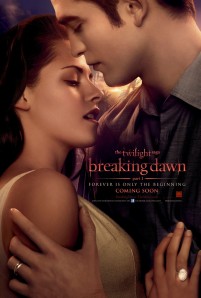
And all that brings us to Breaking Dawn, Part I.
Of the Twilight movies, I still feel Eclipse was the strongest one. Breaking Dawn covers everything the 1st half of the book does and manages to do it without stepping past the PG-13 bounds it created. The film starts off with Edward and Bella’s Wedding, with different reactions from everyone. Jacob hates it, wolfs out and runs to Canada. The Cullens are ecstatic. Charlie manages to deal with it. The wedding ceremony is done well, and gives some screen time to all of the high school friends (who we won’t be seeing after the wedding). Stephenie Meyer herself even has a cameo here (and eerily looks like my mother). Even the honeymoon is done better than I thought it would. Anyone expecting Bella and Edward’s honeymoon to look like something out of a late night Cinemax series may be disappointed, but the romance is nice to see and there were some laughs in the audience. Again, it’s Twilight. I’m not expecting Jane Eyre or Sense & Sensibility romance levels. At least, that’s what the snoring mother sitting next to me who brought her kids felt, I think.
After the married couple’s wild honeymoon, Bella discovers she’s miraculously pregnant and even worse, the unborn child is sucking the very life from her. The wolves find out about this and feel that she needs to be eliminated, along with the rest of the Cullens, as it breaks the Treaty. Bella is rushed home while the Cullens try to find a way to save both the baby and the mother. Will Bella make it? Will the Wolves pounce on the vampires? Those are some of the questions brought to the table.
Jacob finds himself taking sides with the Cullens, which causes him to recall his Alpha Status in his wolf pack and stand alone (or nearly alone) against his family. In the book, this was done pretty well, but translated to the screen the scene with wolves telepathically yelling at one another seemed a little cartoonish. Just change back to people and talk it over. I guess it was done that way to show how animals have the whole Alpha / Omega relationship, and remains one embarrassing moment in a sea of scenes that were okay.
Visually, Eclipse was a serious step up from both Twilight and New Moon. Breaking Dawn seemingly returns to the look and feel of the original Twilight, right down to Carter Burwell’s score. With the exception of the Bella’s Lullaby theme (which worked incredibly well, especially at the last two minutes of the film), the music felt a little weak to me. I actually preferred Howard Shore’s score to Eclipse. Don’t get me wrong, the movie goes where it’s supposed to, but you’d expect things to look a little better as it goes along. It would be nice if they improved on that.
One other thing I’ll give this (and that’s all of the Twilight mess) is the audience. I live for seeing audiences react to what they’re seeing on the screen, and I can’t remember a more reactive audience set since Captain America. Some of the girls who go to see this really go wild over it, and some of the guys grumble loudly. My theatre was packed, right down to the front seats where you have to crane your neck up to see everything. It’s the closest to a Midnight Movie experience you could have at a Matinee.
The big problem Breaking Dawn Part II will have will be trying to be exciting, because there isn’t a lot that occurs in the second half of the story that’s worthy of stretching it out to nearly two hours. It’ll be interesting to see what they do with that.
Overall, Breaking Dawn doesn’t really break any new ground in Vampire myths or anything like that. For anyone unfamiliar with the Twilight movies or books, it may feel slow and even a little boring at times. For it’s target audience (readers of the book), it gives them just about everything they wanted.

 Through the Shattered Lens