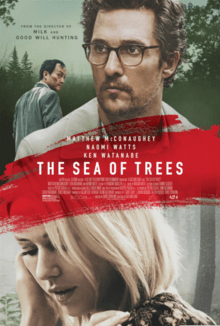
Film Review: The Sea of Trees (dir by Gus Van Sant)


The_Sea_of_Trees

Nobody wants to admit it but there was a time when all of us self-styled award divas were convinced that Gus Van Sant’s latest film, The Sea of Trees, would be a huge Oscar contender.

Can you blame us?

Sure, you can!  But, before you do, look at it from our point of view.  Gus Van Sant is an acclaimed director who has split his time between Oscar-baity mainstream movies (Good Will Hunting, Milk) and deliberately obscure art films (Elephant).  Two of Van Sant’s films have been nominated for best picture and he has twice been nominated for best director.  The Sea of Trees stars two Oscar nominees (Naomi Watts and Ken Watanabe) and an Oscar winner (Matthew McConaughey).  Much like the 2003 best picture nominee Lost in Translation, The Sea of Trees dealt with an American in Japan.

Yep, The Sea of Trees definitely looked like a contender but then it premiered at the Cannes Film Festival and everything went downhill.  The audience laughed.  The critics booed.  The negative reaction to the film quickly became legendary.  Suddenly, it looked like this former Oscar contender would be lucky to even get an American release.  Both Lionsgate and Roadside Attractions acquired the U.S. distribution rights and both companies dropped the film.

As a result, I found myself growing fascinated with The Sea of Trees.  How bad could it be, I wondered.  The fact that I might never get a chance to actually see the movie only added to my interest.

Well, fortunately, A24 eventually acquired the distribution rights to The Sea of Trees and they have now given the film a limited release in the States.  I saw it last night and…

Meh.

Seriously, after all the publicity and drama, I was expecting that The Sea of Trees would be a total and complete fiasco, one of those train wreck movies that you just can’t look away from.  But, to be honest, The Sea of Trees is not an artistic fiasco in the style of Batman v Superman, nor is it unintentionally amusing like April Rain.  Instead, it’s just a really boring film.

When I heard the plot of the film, I thought it would be an unofficial companion piece to Van Sant’s acclaimed Death Trilogy.  In many ways, the plot sounded a lot like the plot of Gerry.  Arthur Brennan (Matthew McConaughey) is a widowed professor who goes to Japan and visits Aokigahara Forest, the famous suicide forest at the foot of Mt. Fiji.  Brennan is planning to end his life but he’s distracted by a Japanese man, Takumi Nakamura (Ken Watanabe), who claims to be lost in the forest.  However, Nakamura has deep cuts on his wrists.

Brennan tries to help Nakamura find his way out of the forest but soon, the two of them discover themselves to be lost.  Brennan spends a lot of time talking about life philosophy and I have to admit that I had a hard time following what he was saying because I was bored out of my mind.  (It doesn’t help that McConaughey delivers his dialogue in the same style that he used for his infamous car commercials.)  Nakamura doesn’t say much at all.

We also get several flashbacks to Brennan’s former life with his wife (played by Naomi Watts).  The scenes all have a definite Nicholas Sparks feel to them.  And yet, the flashbacks were the best part of the film because of the chemistry between McConaughey and Watts.  The flashbacks are openly and unapologetically sentimental, without any of the pretension that mars the scenes between Brennan and Nakamura.

On a positive note, the film’s cinematography is often striking and the opening, with Brennan walking past random corpses while looking for the perfect place to end his life, is nicely done.  Otherwise, almost the entire film is a misfire.  Matthew McConaughey is one of those actors who is naturally so full of life that it’s hard to buy him as a suicidal academic and the film, which is already overlong at nearly two hours, drags.  This is one of those films that has about a dozen false endings before the final credits finally roll.  Meanwhile, as the action slowly plays out, the original score pounds you over the head.  Important Important Important, the score demands even as the film fails to deliver.

And so, that’s The Sea of Trees.  

It’s not exactly a fiasco but it is unforgivably forgettable.
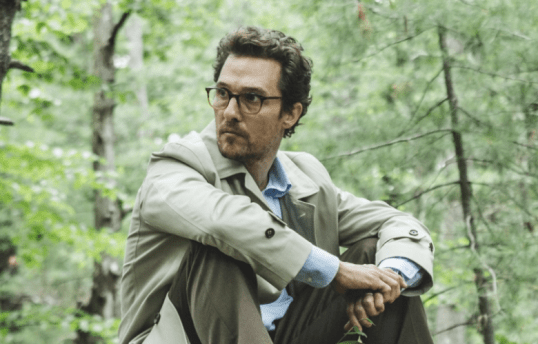
You gotta keep livin', man! L-I-V-I-N!

You gotta keep livin’, man! L-I-V-I-N!
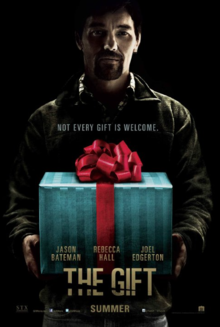
Film Review: The Gift (dir by Joel Edgerton)


The_Gift_2015_Film_Poster1

Because of the nature of The Gift, this post is going to contain minor spoilers.  There’s no way to talk about what makes the film work so brilliantly without giving away a few plot points.  Such is the nature of the beast and all that.  So, if you don’t want to deal with spoilers, allow me just to say this: Go see The Gift.  See it tonight.  See it tomorrow.  See it this weekend.  But, definitely — go see it!

(And if anyone tells you that The Gift is not worth seeing than that person is not really your friend and you need to start hanging out with a better class of people.)

Ryan has already reviewed The Gift and, having watched the film earlier today, I agree with everything that he had to say.  That’s why I am happy to add my voice to his and encourage you to see The Gift.  With this week pretty much dominated by ruminations on the colossal failure of The Fantastic Four and the upcoming weekend guaranteed to be dominated by the release of both Straight Outta Compton and The Man From UNCLE, there’s a definite risk that The Gift is going to get lost in the shuffle.

And that’s unfortunate.  Much like the thematically similar UnfriendedThe Gift comes disguised as a conventional thriller but, once you start to unwrap it, you discover that there are layers and layers of subtext and The Gift is actually one of the best and most thought-provoking films of the year.

Like many great Lifetime films, The Gift opens with a married couple living a deceptively wonderful life.  Simon (Jason Bateman) is friendly and charming and appears to be on the verge of getting a big promotion at work.  He and his wife, Robyn (Rebecca Hall), appears to be happy and in love.  They have also got a friendly dog named Mr. Bojangles and they’ve just moved into a beautiful new house.  After spending the last few years in Chicago, they’ve relocated to Simon’s home state of California.  They’re looking forward to starting a family.  Everything’s perfect.

And then, while out shopping for furniture, they run into Gordo (Joel Edgerton).  Gordo explains that he went to high school with Simon.  (At first, Simon swears to his wife that he doesn’t even remember Gordo but that soon proves to be false.)  The socially awkward Gordo starts to send Simon and Robyn progressively more and more extravagant gifts.  After Simon tells Robyn that Gordon was known as Weirdo in high school, Robyn starts to feel sorry for Gordo and insists that Simon try to be friendly towards him.  Simon, however, remains weary of Gordo and his intentions.  At first, it seems like Simon is just being cautious but, as the film unfolds, we discover that Simon has his own reasons for wanting to avoid his old classmate.

The more Gordo tries to insert himself into Simon and Robyn’s life, the more we start to see the cracks behind their “perfect” marriage.  Robyn, it turns out, had previously suffered a miscarriage and has a history of abusing prescription medicine.  Meanwhile, it’s revealed that, behind Simon’s fast smile, there lies a condescending control freak.  (Gordo mentions that Simon ran for senior class president on a “Simon says” platform.)

There’s more to Simon and Gordo’s relationship than either one of them is initially willing to admit.  In high school, Simon was a bully and Gordo was his number one victim.  That Gordo wants revenge on Simon should not be surprising.  That’s obvious from the trailer.  No, the genius of the film is to be found in the way that it subtly reveals that, as an adult, Simon is still as much of a jerk and a bully as he was in high school.  He’s just gotten a lot better at hiding it. The same traits that made Simon a bully in high school have helped him to find material success in the real world.   When Gordo reeneters his life, Simon can no longer hide who he really is.  Gordo is not just his former victim.  Gordo is proof of what lies underneath Simon’s perfect facade.  When Robyn finally convinces Simon to apologize to Gordo, Simon cannot do so convincingly because he’s not so much sorry as he’s just inconvenienced.  When Gordo refuses to accept the apology, Simon’s mask falls away and he reveals his true nature, setting up the film’s devastating conclusion.

(I’m not going to spoil how the film ends but I will tell you that it left me breathless and stunned.  It’s not a happy ending but it is absolutely the right ending for the story that’s being told.  As both the film’s director and writer, Joel Edgerton deserves a lot of credit for staying true to the movie’s theme.)

Rebecca Hall is well-cast as Robyn but, ultimately, the film is dominated by the performances of Jason Bateman and Joel Edgerton.  (Interestingly enough, both Bateman and Edgerton are made up so that they superficially resemble each other, allowing Gordo to literally become the personification of Simon’s ugly side.)  Edgerton transforms Gordo into a character who is both scary and pathetic at the same time.  Meanwhile, Jason Bateman — oh, where to begin?  For the longest time, it’s been impossible for me to look at Bateman without flashing back to that scene in Juno where he hit on Ellen Page.  Now, however, I don’t think I’ll ever be able to look at Jason Bateman without hearing him yell, “Accept my apology!”  Jason Bateman has played a lot of less-than-sympathetic characters but Simon … well, Simon may be the worst.  As an actor, Jason Bateman deserves a lot of credit for not shying away from revealing the truth about Simon.  It takes courage to play such an unlikable character and talent to make that character compelling even when the viewer can’t stand him.

The Gift is an excellent and thought-provoking thriller, the type of film that will both make you jump with fright (I screamed during a certain shower scene and that’s all I’ll say about that) and leave you with much to think about after the end credits roll.

It’s a film that you need to see now.