Late Night Retro Television Reviews: Gun 1.1 “The Shot”


Welcome to Late Night Retro Television Reviews, a feature where we review some of our favorite and least favorite shows of the past!  On Tuesdays, I will be reviewing Gun, an anthology series that ran on ABC for six week in 1997.  The entire show is currently streaming on Tubi!

Produced by filmmaker Robert Altman, Gun was an anthology series that followed one gun from person-to-person.  Each week would feature a new cast and a new story.  The show itself didn’t catch on but, because of Altman’s prestige, is still managed to attract some prominent and interesting guest stars during it’s 6-episode run.

The first episode, for instance, brings the gun together with Daniel Stern, Ed Begley, Jr., and model Kathy Ireland.

Episode 1.1 “The Shot”

(Dir by James Foley, originally aired on April 12th, 1997)

The first episode of Gun opens with an unnamed dumbass purchasing a pearl-handed, .45 semi-automatic pistol.  When he takes it home, his kids are impressed but his wife threatens to kick him out if he ever fires the gun in the house.  Next thing you know, the dumbass is pretending to be Robert De Niro in Taxi Driver and pointing the gun at the television.  The final shoot-out from The Good, The Bad, and The Ugly leads to the TV getting shot.  The dumbass returns the gun.  Later, that night, someone breaks into the gun store and steals the gun.

Who stole it?  It turns out that it was just a guy who spends his time holding up convenience stores.  Unfortunately, his next attempt at a convenience store robbery does not go well, largely due to one aggravated customer.  Harvey Hochfelder (Daniel Stern) is already in an agitated state before the robbery even begins.  He just wants to leave Los Angeles for Virginia but, before he can leave, he had to stop off at the slowest convenience store in L.A.  Harvey loses it as soon as he realizes that the robbery is going to mean his escape to Virginia is going to be even further delayed.  When Harvey’s wife (Kathy Baker) enters the store, the robber is startled into first shooting at Harvey and then dropping the gun.  The robber runs outside and tries to steal Harvey’s car, with Harvey’s son and dog in the back seat.  Harvey grabs the gun and chases the robber down.  The robber crashes the car and Harvey holds him at gun point until the police arrive.

Harvey becomes a celebrity.  He even appears on the cover Newsweek, with the simple headline, “American Hero.”  Hollywood wants to make a made-for-TV movie about what happened in the convenience store, with Harvey playing himself and Kathy Ireland playing his wife.

Unfortunately, the friends of the robber are not happy that Harvey “fingered our homie” (yes, that’s actual dialogue) and they decide that they want to get revenge on Harvey.  When they force his car off the road and then pull guns of their own on him, Harvey diffuses the situation by offering them roles the movie.  Everyone wants to be a star!

Finally, the day of filming has arrived.  Under the guidance of the film’s director (Ed Begley, Jr.), Harvey prepares to climb into bed with a lingerie-clad Kathy Ireland….

Suddenly, Harvey is back in the convenience store, getting shot multiple times by the robber and expiring as a security camera records his final moments.  His entire time as a Hollywood star was just a dying fantasy which, honestly, was kind of obvious just by how cartoonish all of the Hollywood scenes were.

Well, as far as first episodes are concerned this was really, really …. bad.  Anthology shows are always a bit hit-and-miss and this episode was definitely almost all miss and no hit.  As good a character actor as he may be, Daniel Stern overacts to such an extent in this episode that it’s difficult to really have much sympathy for Harvey and the episode’s final twist largely fell flat.

The first episode of Gun is an almost entire …. dare I say it? …. misfire.
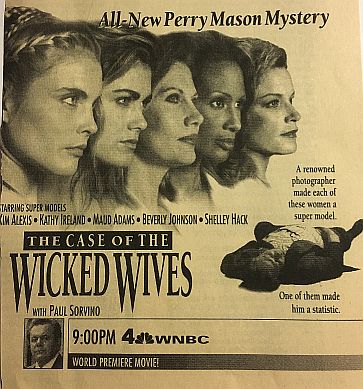
A Perry Mason Mystery: The Case Of The Wicked Wives (1993, directed by Christian Nyby II)


Famed fashion photographer David Morrison (Eric Braeden) has fallen on hard times but things are looking up.  The American Museum of Art wants to do a retrospective of his work.  He just has to get the permission of his current wife, Dee (Kathy Ireland), and his four ex-wives (Shelley Hack, Kim Alexis, Maud Adams, and Beverly Johnson).  All of them are super models who owe their careers to David but four of them hate his guts and Dee isn’t happy when she sees evidence that he has been cheating on her.  When David turns up dead, Dee is arrested.  She claims that she’s innocent but the prosecution is sure that they have an airtight case.

This sounds like a case for Perry Mason!

However, Perry’s out of town so it falls to Perry’s never previously mentioned best friend, Tony Caruso (Paul Sorvino), to solve The Case of the Wicked Wives!  With the help of Perry’s tireless associates, Della Street (Barbara Hale) and Ken Malansky (William R. Moses), Caruso works to solve the case and prove the Dee is innocent.  He also prepares many pasta dinners and frequently sings.

So, where was Perry?  As everyone knows, Raymond Burr played Perry Mason for 9 seasons in the 50s and the 60s.  20 years after the show aired its final episode, Burr returned to the role in a series of highly rated, made for television movies.  Unfortunately, Burr died in 1993 with several movies left to be filmed.  In his will, Burr specifically requested that production on the remaining films continue so that the cast and crew wouldn’t lose their jobs.  Since the role of Mason obviously could not be recast that soon after Burrs’s death, it was decided that the remaining movies would feature guest lawyers.  Enter Paul Sorvino.

The Case of the Wicked Wives was the first Perry Mason film to be made after Burr’s death.  As his replacement, Tony Caruso has much in common with Mason, including the ability to make the guilty confess in open court.  Unlike Mason, Caruso is also obsessed with cooking elaborate spaghetti dinners and singing operatic arias.  This movie came out just a year after Sorvino left Law & Order to specifically pursue his opera career.  Sorvino sings a lot in The Case of the Wicked Wives, sometimes in court.  Unfortunately, a love of singing and pasta are the only two personality traits that are really given to Caruso.  Through no fault of Paul Sorvino’s, Caruso is never as compelling a character as the coolly calculating Mason.  Mason could trick anyone into confessing through perfectly asked questions.  Caruso is more into courtroom stunts that would get most lawyer disbarred.

Because the mystery itself is a dud, the main reason to watch The Case of the Wicked Wives is for the wives.  Who wouldn’t want to keep Kathy Ireland from being wrongly convicted?  All of the wives get at least one big moment to shine and tear up the scenery.  You’ll guess who the murderer is long before anyone else in court.

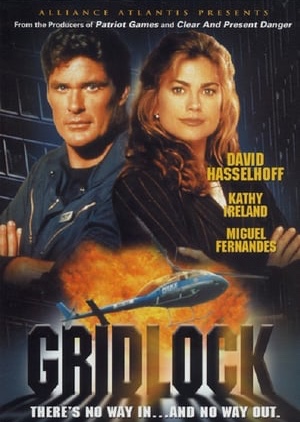
Film Review: Gridlock (dir by Sandor Stern)


Jake Gorsky is a tough New York cop who flies a helicopter and who gets results …. HIS WAY! He’s also played by David Hasselhoff and, as a result, you never look at him and really buy the idea that he’s a tough New York cop who gets results …. HIS WAY! Instead, you just assume that he’s the Hoff, cheerfully making his way through yet another silly made-for-TV movie.

In Gridlock, criminals have blown up all of the bridges leading out of Manhattan! The entire borough is gridlocked! Why would they do this? Are they hoping to make a quasi-philosophical statement, like Bane in The Dark Knight Rises? No, of course not. (That, to be honest, didn’t even make sense when Bane did it.) Instead, it’s all a part of a plot to rob the Federal Reserve. How are they going to escape if they’ve blown up all the bridges out of town? That question is never really answered, or if it was, I was too blinded by the Hoffness of it all to notice. I assume that Mr. One (Miguel Ferandes) and Mr. Two (Gotz Otto) have a plan. I assume that there’s also a reason why almost all of the bad guys are bald. For that matter, many members of the police are bald as well. You know who isn’t bald? The Hoff.

Anyway, it turns out that the Hoff’s girlfriend, Michelle (Kathy Ireland), works in the Federal Reserve. She gives tours to tourists who presumably flock to New York to see “where they keep all the money.” Michelle is trapped in the building while the robbery is taking place. It’s up to the Hoff to sneak into the building, rescue Michelle, and prevent the robbery. This leads to a scene where the Hoff uses two bags of nickels to take out some henchmen. Woo hoo!

Of course, while watching this film, you have to wonder how the crooks possibly thought they could get away with robbing the Federal Reserve. I mean, let’s just ignore the fact that they blew up all the bridges out of town. How are you going to launder that much money? We’ve all seen Breaking Bad. We all know Walter White ended up with a pile of money that he essentially could never touch. It’s hard not to feel that it would have been smarter for these crooks to just rob an ordinary bank. It also seems like there should have been a simpler way to commit their crimes than to blow up every bridge in Manhattan. How can these criminals be so smart and so dumb at the same time?

That said, you’re not really watching a film like this for the criminals or even the plot. You’re watching it because it features David Hasselhoff doing his thing. I wouldn’t exactly describe David Hasselhoff as being an actor with a particularly wide range but, when it comes to projecting an odd combination of earnest sincerity and mocking self-awareness, it’s hard to think of anyone who does it better. Much like William Shatner, the Hoff always leaves you wondering whether or not he’s actually in on the joke. Did David Hasselhoff realize he was appearing in a silly Die Hard rip-off (“Die Hard in an office building …. wait a minute, that’s just Die Hard!”) or did he earnestly call his agent and say, “Baywatch isn’t challenging anymore. I want to play a copy who doesn’t always follow the rules!” One gets the feeling that both possibilities are true.

Anyway, Gridlock is a made-for-TV movie from the 90s, which means no blood and no cursing. A lot of guns are fired but hardly anyone gets shot. I’ll give it a 6 out of 10, just for the Hasselhoff of it all.

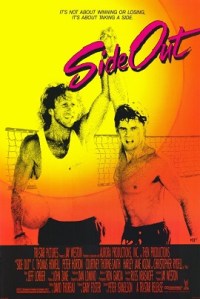
A Movie A Day #71: Side Out (1990, directed by Peter Israelson)


Monroe (C. Thomas Howell) is a young lawyer who moves to California and gets a job working for his Uncle Max (Terry Kiser).  Max wants Monroe to concentrate on evicting beach bums.  Monroe wants to play beach volleyball.  Together, they solve crimes.  No, actually, Max orders Monroe to evict Zack (Peter Horton), a former volleyball champion who was once “king of the beach.”  Zack agrees to coach Monroe and his goofball friend, Wiley (Christopher Rydell) in a volleyball tournament.  But when Zack misses a match because he is having underlit, PG-13 sex with his ex-wife (Harley Jane Kozak), uncoached Monroe accidentally breaks Wiley’s arm.  Now, Zack has to step in as Monroe’s partner and reclaim his status as king of the beach!

When I was a kid, Side Out was a HBO perennial, which is not the same thing as being a good movie.  There have not been many movies made about beach volleyball and Side Out shows us why.  Beach volley ball is just not that exciting to watch, especially when the main competitors are two out of shape actors.  All the jump cuts and close-ups in the world can’t disguise the fact that neither actor looks like he could get the ball over the net, never mind playing for over ten minutes without getting out of breath.  In Side Out, beach volleyball teamwork comes down to a lot of yelling and whenever Monroe yells at either Wiley or Zack, he sounds just like the “Put him in a body bag, Johnny!” guy from The Karate Kid.

At least Kathy Ireland has a small role.  Also, in the role of Zack’s friend, keep an eye out for Duke himself, the great Tony Burton!

What are you doing here, Duke!?