Made-For-TV Horror: The Initiation of Sarah (dir by Robert Day)


Oh, poor Sarah.

Sarah (Kay Lenz) is attending college with her sister, Patty (Morgan Brittany).  Patty is pretty and popular and everyone wants to be her friend.  Sarah is withdrawn and a bit moody and people seem to go out of their way to avoid her.  Sarah, however, has a secret.  She can move and break things with her mind.  When a guy on the beach tries to force himself on Patty, Sarah uses her powers to push him away.  Later, when Sarah’s upset, she stares at a mirror until it cracks.

When Patty and Sarah visit their mother’s old sorority, Patty is a hit but Sarah is less popular.  The bitchy president of the Sorority, Jennifer Lawrence (Morgan Fairchild), is happy to invite Patty to join but she doesn’t want Sarah to be anywhere near her.  Sarah ends up joining the outcast PDE sorority.  Jennifer, however, remains obsessed with humiliating and destroying Sarah.  And Sarah, when she gets angry, has a tendency to cause things to happen….

This film, which aired in 1978, probably sounds like a rip-off of Carrie and, in many ways, it is.  For whatever reason, Sarah’s bullies seem to be obsessed with making her as miserable as possible.  In Carrie, one reason you hated the bullies was because Sissy Spacek gave such a heart-breaking, vulnerable and empathetic performance as Carrie White.  The bullies were terrible to begin with but then to pick on someone as fragile as Carrie?  It sucked William Katt had to die but there’s still a reason why the prom inferno makes as many people applaud as scream.  In The Initiation of Sarah, Kay Lenz is not particularly sympathetic as Sarah.  Even before the bullies start picking on her, Sarah comes across as being angry and bitter about …. well, everything.  Patty goes out of her way to take care of her sister but Sarah never seems to appreciate it.  Bullies still suck, of course.  There’s no excuse for being a bully and Jennifer really does go overboard when it comes to going after Sarah.  But Sarah herself still doesn’t necessarily come across as being someone you would want to join your sorority.

What sets The Initiation of Sarah apart from other Carrie rip-offs is the character of Mrs. Hunter (Shelley Winters).  Mrs. Hunter founded PDE when she was a student and now, as the school’s resident expert on paganism, she’s the housemother of PDE.  As soon as Sarah joins, Mrs. Hunter starts to talk about how Sarah is destined to lead PDE to glory.  When another member of PDE, Mouse (Tisa Farrow), takes a look in Mrs. Hunter’s room, she discovers a Satanic altar that is guarded by a fierce looking dog….

That’s right!  This isn’t just a rip-off of Carrie.  It’s a rip-off of The Omen as well!

Kay Lenz might be a bit on the dull side as Sarah but this film is worth watching for the performance of Morgan Fairchild and, especially, Shelley Winters.  As played by Fairchild, Jennifer is more than just a bitch.  She’s a sociopath with great hair.  Meanwhile, Shelley Winters — especially once the 70s started — was never a particularly low-key or subtle actress.  When you cast her as an overbearing housemother who happens to be the high priestess of a cult, you know that you’re going to get something worth watching.  Winters attacks the role with a ferocity that is occasionally over-the-top and almost funny but always entertaining.

The Initiation of Sarah is an enjoyable made-for-TV movie.  Watch it the next time you’re feeling nostalgic for college life.
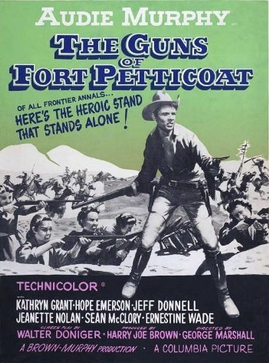
The Guns of Fort Petticoat (1957, directed by George Marshall)


During the waning days of the Civil War, Lt. Frank Hewitt (Audie Murphy) is a man without a country.  A Texan, he joined the Union Army even as his home state was voting to secede from the United States.  In the Army, Hewitt is viewed with distrust by his autocratic superior, Col. John Chivington (Ainslie Pryor).  When Hewitt learns that Chivington has ordered a surprise attack on an unarmed local Indian tribe in order to drive them into Texas where they will attack the nearest settlement for revenge, Hewitt deserts the Army to warn the people left in his hometown.

When Hewitt arrives, he discovers that all of the men in town have left to join the Confederate Army.  Only their wives, mothers, and sisters remain.  Though Hewitt is, at first, accused of being a traitor, he sticks around and trains the women on how to fight not only the incoming Comanches but also any outlaws who ride into town looking to take advantage of the situation.

The Guns of Fort Petticoat is an interesting B-western that holds up well today.  Even though the film ends with a Comanche attack, it’s made clear that the attack would not have happened if not for the actions Col. Chivington.  Chivington, who doesn’t care that the victims of his actions would not be Confederate soldiers but instead just helpless woman and children, is the film’s true villain, even if he only appears in the first and final scenes.  Audie Murphy, who was America’s most decorated World War II veteran, not only starred in but produced the movie.  Murphy was a stiff actor but he looked believable in uniform and obviously knew how to convincingly shoot a rifle and that’s all this role really demands of him.  Kathryn Grant plays the woman who goes from distrusting Hewitt to falling in love with him and she and Murphy work well together.  The final battle between the women and the Comanches is exciting and well-shot by veteran western director George Marshall.  The movie’s final scene may not be totally believable but it’s still very satisfying.

Fans of the western genre and Audie Murphy will find much to enjoy about The Guns of Fort Petticoat.

West-Teen Angst: GUNMAN’S WALK (Columbia 1958)


gary loggins's avatarcracked rear viewer

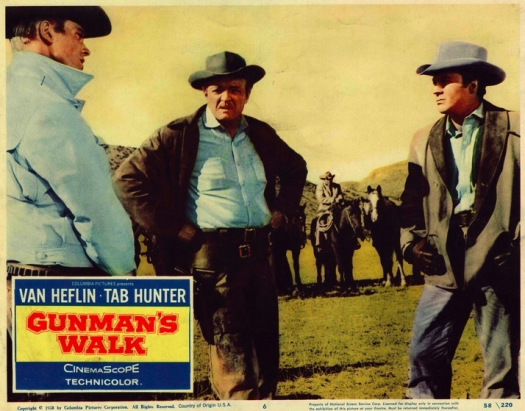
GUNMAN’S WALK may not be a classic Western like THE SEARCHERS or HIGH NOON, but it was entertaining enough to hold my interest. That’s due in large part to a change of pace performance by All-American 50’s Teen Idol Tab Hunter as a sort-of Rebel Without A Cause On The Range, an unlikable sociopath with daddy issues, aided and abetted by Phil Karlson’s taut direction and some gorgeous panoramic Cinemascope shots by DP Charles Lawton Jr.

Boisterous cattle rancher Lee Hackett (Van Heflin) is one of those Men-Who-Tamed-The-West types, a widower with two sons. Eldest Ed (Hunter) is a privileged, racist creep who’s obsessed with guns, while younger Davy (played by another 50’s Teen Idol, James Darren) is more reserved. The Hacketts are about to embark on a wild horse round-up, and enlist two half-breed Sioux, the brothers of pretty young Clee (Kathryn Grant,  young wife of crooner Bing Crosby).

View original post 404 more words

Shattered Politics #11: The Phenix City Story (dir by Phil Karlson)


PhenixCityPoster

If A Man Called Peter was the epitome of a stereotypical 1950s film, The Phenix City Story is the exact opposite.  Like A Man Called Peter, The Phenix City Story was released in 1955.  And like A Man Called Peter, The Phenix City Story is based on a true story.  However, beyond that, A Man Called Peter and The Phenix City Story might as well have been taking place on different planets.

And, in many ways, they were.  The Phenix City Story not only takes place in Phenix City, Alabama but it was filmed there as well and featured a few actual citizens in the cast.  Not only was The Phenix City Story telling a true story but the story was being told by some of the same people who actually lived through it.  That makes The Phenix City Story brutally realistic, with brutal being the key word.

And, just in case we have any doubt about the film’s authenticity, it actually opens with a 15 minute documentary in which Clete Roberts (who was an actual news reporter) interviews several citizens of the town.  All of them, speaking in thick Alabama accents and nervously eyeing the camera, assure us that what we are about to see is true.  Quite a few of them also tells us that they still live in fear of losing their lives as a result of everything that happened.

What’s amazing is that, once the actual film does get started, it manages to live up to all of that build up.  The Phenix City Story is a shocking film that remains powerful even 60 years after it was initially released.

As the film opens, we’re informed that Phenix City, Alabama is home to some of the most dangerous and violent criminals in the state.  From his club, crime boss Rhett Tanner (Edward Andrews) runs a shadowy organization that not only controls Phenix City but the entire state of Alabama as well.  The police ignore his crimes.  The majority of the town’s citizens are too scared to stand up to him.  When a returning veteran of the Korean War, John Patterson (Richard Kiley), tries to stand up to Tanner, the result is even more violence.  A young black girl is kidnapped and murdered, her body tossed on John’s front lawn as a warning.  John’s best friend is killed but Tanner uses his influence to have the death ruled accidental.

Finally, John and a group of other reformers convince John’s father — Albert Patterson (John McIntire) — to run for Attorney General.  Albert runs on a reform platform and exposes both the corruption of Phenix City and how Tanner’s power extends through the rest of the state as well.  When Albert wins the Democratic primary, he’s gunned down in the street and it’s up to John to avenge his death…

To say that The Phenix City Story is intense would be an understatement.  As directed by Phil Karlson, there’s not a single frame of The Phenix City Story that’s not full of menace and danger.  The stark black-and-white cinematography is full of shadows and the camera moves almost frantically from scene to scene, occasionally catching glimpses of dark figures committing acts of violence and cars speeding away from who knows what outage.  It’s a dark film but, ultimately, it’s also a hopeful one.  It suggests that evil will triumph when good men do nothing but that sometimes you can depend on good men — like Albert and John Patterson — to actually step up.

The Phenix City Story shows up on TCM occasionally and you should keep an eye out for it.  It’s one of the best B-movies ever made.