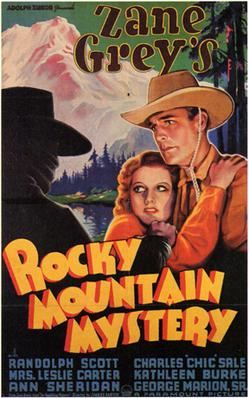
Rocky Mountain Mystery (1935, directed by Charles Barton)


Larry Sutton (Randolph Scott) is an engineer who has been sent to take over operations at a radium mine that is owned by the Ballard family.  Previously, Larry’s bother-in-law was in charge of the mine but he has disappeared and is suspected of having murdered the foreman at the Ballard Ranch.  With Jim Ballard (George F. Marion) on his deathbed and being cared for by the foreman’s wife (Caroline Dudley, credited as Mrs. Leslie Carter), Ballard’s nieces (Ann Sheridan and Kathleen Burke) and nephew (Howard Wilson) have come to the ranch to find out about their inheritance.

Soon, a cloaked figure starts to murder Ballard’s heirs, one-by-one.  Working with eccentric Deputy Sheriff Tex Murdock (Chic Sale), Larry tries to discover the identity of the killer and keep the mine from falling into the wrong hands.

Rocky Mountain Mystery is unique in that it is a Randolph Scott western that takes place in what was then modern times.  Even though both Larry and Tex prefer to ride horses, the murderer tries to escape in a car, people use phones, and the entire plot revolves around a radium mine.  The film mixes the usual western tropes of grim heroes, eccentric lawmen, and valley shoot-outs with a dark mystery that actually holds your attention while you’re watching the film.  Always ideally cast in these type of films, Randolph Scott is both tough and intelligent as Larry Sutton.  He may be a cowboy but he’s a detective too.  Scott gets good support from a cast of familiar faces.  Ann Sheridan is especially good as the niece who knows how to handle a rifle.

These B-westerns can be a mixed bag but Rocky Mountain Mystery held my attention with a plot that was actually interesting and a strong performance from Randolph Scott.  Watch it and see if you can guess who the identity of the Ballard Ranch murderer.

Lisa Reviews An Oscar Nominee: The Lives of a Bengal Lancer (dir by Henry Hathaway)


http://www.youtube.com/watch?v=qVe9y1en6Kc

The 1935 adventure film, The Lives of a Bengal Lancer, is a film that probably could not be made today.

Of course, that’s true of a lot of films from the 30s.  In some cases, that’s a good thing and, in some cases, that’s a bad thing.  The Lives of Bengal Lancer is an entertainingly old-fashioned adventure story but it’s also a shameless celebration of the British Empire.  The fact that it was made in Los Angeles and featured all-American Gary Cooper in the lead role doesn’t diminish the fact that it’s pretty much a celebration of British colonialism.

Gary Cooper plays Lt. Alan MacGregor, a Scottish-Canadian who serves in British Calvary.  He’s a member of the Lancers and is currently serving in India, which, at the time that this movie was set (and made), was still under British control.  When the film begins, MacGregor is greeting the new arrivals.  Among those arrivals are Lt. John Fosythe (Franchot Tone) and Lt. Donald Stone (Richard Cromwell).  Lt. Forsythe is an experienced officer who has been sent to India as a replacement for another officer who managed to get himself killed while out on a patrol.  Meanwhile, Lt. Donald Stone is a newly commissioned officer who is desperate to win the approval of his father (and McGregor’s superior), Col. Tom Stone (Guy Standing).  Unfortunately, Donald quickly discovers that winning the approval of his father isn’t going to be easy.  Col. Stone, after all, has a lot to deal with.

For instance, there’s Mohammed Khan (Douglas Dumbrille).  Kahn is a local prince and he boasts that he has got an Oxford education.  He pretends to be an ally of the British but instead, he is plotting a revolution.  The first step in that revolution is to intercept a convoy of British weapons but how can Kahn discover the convoy’s route?  Maybe he could kidnap a lancer who is close to the unit’s commanding officer?  With the help of a Russian femme fatale named Tania (Kathleen Burke), Khan is able to capture Donald.  When MacGregor and Forsythe defy the colonel’s orders and attempt to rescue Donald on their own, they end up getting captured as well!

“We have ways to make men talk!” Khan declares and soon, the three men are having their fingernails ripped out and the skin underneath burned with fiery bamboo.  It’s a shocking act of sadism, one that caught me by surprise in 2020.  I can only imagine how audiences in 1935 reacted to Gary Cooper and Franchot Tone being so graphically tortured on the big screen.  Though the men swear that they will not reveal the location of the convoy, how much torture can they take before they break?

As I said at the start of this review, The Lives of a Bengal Lancer is an old-fashioned film and, with its depiction of savage rebels and heroic colonizers, it would probably cause a riot if it were released today.  However, if you can set aside the whole pro-imperialist theme of the film, this is a fairly entertaining film.  It gets off to a slow start and, to modern eyes, some of the acting is bit creaky but Gary Cooper is, not surprisingly, well-cast as the film’s hero and he’s ably supported by Tone and Cromwell.  Douglas Dumbrille and Kathleen Burke are entertainingly campy villains and the film’s final battle is well-done.

A box office success, The Lives of a Bengal Lancer was nominated for Best Picture but it lost to an even bigger hit (and a film that was a bit more critical of the British Empire), Mutiny on the Bounty.

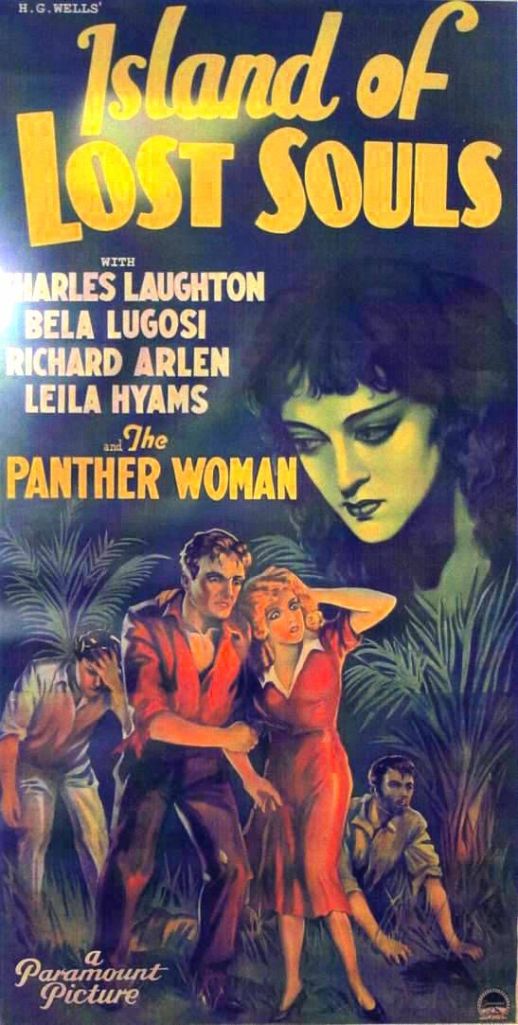
Halloween Havoc!: ISLAND OF LOST SOULS (Paramount 1932)


gary loggins's avatarcracked rear viewer

Universal Pictures kicked off the horror trend of the early 30’s with DRACULA and FRANKENSTEIN , and soon every studio in Hollywood, both major and minor, jumped on the terror train. Paramount was the first to hop on board with an adaptation of Stevenson’s DR. JEKYLL & MR. HYDE , earning Fredric March an Oscar for his dual role. Soon there was DR. X (Warners), THE MOST DANGEROUS GAME (RKO), FREAKS and THE MASK OF FU MANCHU (both MGM), and THE MONSTER WALKS and WHITE ZOMBIE from the indies. Paramount released ISLAND OF LOST SOULS at the end of 1932, a film so shocking and perverse it was banned in Britain for over a quarter century, and still manages to frighten even the most jaded of horror fans today.

Based on the novel The Island of Dr. Moreau by H.G. Wells, the film begins with shipwrecked Edward Parker being rescued…

View original post 818 more words

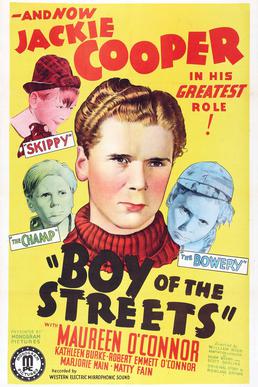
Cleaning Out The DVR: Boy of the Streets (dir by William Nigh)


Welcome to New York City, circa 1937!

It’s a place where the extremely wealthy carefully avoid the districts dominated by the extremely poor, like the Bowery.  In the Bowery, families live in tenements and worried mothers can only cry as they watch their sons join street gangs and their daughters settle for a life of abuse and loss.  Sure, there’s a few do-gooders.  Occasionally, there’s a cop who is convinced that no boy is a lost cause.  Sometimes, you’ll run into a doctor who is determined to provide adequate medical care to the inhabitants of the Bowery.  In fact, you might even see a rich person who is determined to spread about some charity.  But, for the most pat, life in the Bowery is just one hopeless day after another.

14 year-old Chuck Brennan (Jackie Cooper) lives in the Bowery.  He’s got a gang of boys who will do anything that he tells them to do and, despite the fact that Chuck is obviously smarter than almost everyone else around him, he has no interest in being a role model or decent citizen or anything else of that matter.  Chuck lives in a shabby apartment with his mother (Marjorie Main) and his father (Guy Usher).  Chuck looks up to his father who apparently knows important people and is often out of town on “business.”  However, when Chuck discovers that his father is actually a low-level hood who works for the local political machine, Chuck is not only disillusioned but also inspired to go find some gangsters to team up with himself.

The system says that Chuck is a hopeless case but not everyone agree.  Officer Rourke (Robert Emmett O’Connor) thinks that there’s hope for Chuck, he just needs something or someone to straighten him out.  (Like maybe a stint in the Navy….)  And then there’s Nora (Maureen O’Connor), the sweet Irish girl who lives in Chuck’s building and who is often heard singing to her deathly ill mother.

In the end, it’s all up to Chuck.  Will he pursue a life of crime or the life of an honest man?  Will he be a man like his father or will he end the cycle of crime and desperation?

Boy of the Streets is a low-budget, black-and-white film from 1937.  It was produced by Monogram Pictures and, much like Dead End (which came out the same year and featured a superficially similar storyline), it’s a film that mixes social commentary with a bit of gangster action.  The film’s low-budget doesn’t do it any favors and there’s nothing particularly surprising to be found in the film’s plot but child actor Jackie Cooper is convincingly cocky as the swaggering Chuck and Marjorie Main does a good job as his anguished mother.  (Interestingly, Main also played Humphrey Bogart’s mother in Dead End.)

Boy of the Streets is a good example of a film that I never would have seen if not for TCM.  (I recorded it off of TCM way back in June.)  That’s one reason why I’ll always be thankful for TCM.  At a time when so many people seem to be determined to destroy history, TCM is celebrating it.

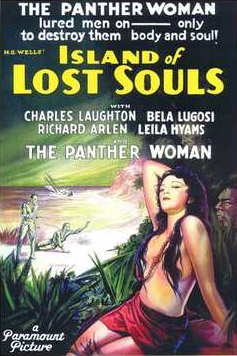
Horror Film Review: Island of Lost Souls (dir by Erle C. Kenton)


islandoflostsouls

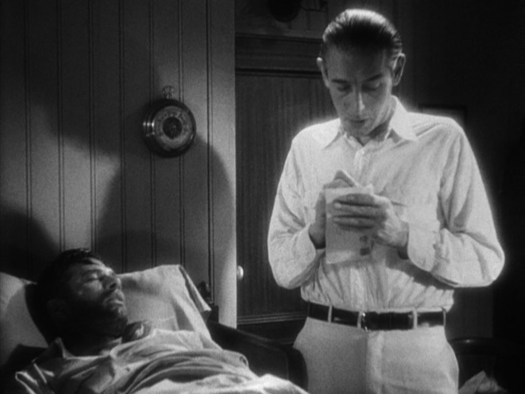
In the 1932 film Island of Lost Souls, Ruth Thomas (Leila Hyams) has reason to be concerned.  She’s on the island of Samoa, awaiting the arrival of her fiancée, Edward Parker (Richard Arlen).  When Parker’s boat doesn’t show up, it can only mean one thing.  He’s been shipwrecked!  Did he survive or was he lost at sea?

Well, Ruth need not worry.  Parker did survive being shipwrecked.  He was picked up by a freighter carrying a wide selection of animals to an isolated island.  Unfortunately, when Parker complained about the way that Parker was abusing some of his admittedly odd-looking passengers, the captain responded by dumping Parker on that island as well.

On the island, Parker becomes the guest of Dr. Moreau (Charles Laughton) and his assistant, Montgomery (Arthur Hohl).  Parker also meets and finds himself becoming attractive to the seemingly naive Lota (Kathleen Burke).  Though Moreau seems to be a good host, Parker grows suspicious of him.  It turns out that there’s a room in Moreau’s compound, a room that Lota calls “the house of pain.”  At night, Parker can hear horrifying screams coming from the room.

Initially believing the Moreau is torturing the island’s natives, Parker soon discovers an even more disturbing truth.  Moreau has been experimenting with trying to transform animals into humans.  Lota, it turns out, was once a panther and the woods surrounding the compound are full of other Moreau creations.  Though Moreau claims that his intentions are benevolent, he rules his island like a dictator.  The animal-men are kept in line by the Sayer of the Law (Bela Lugosi) and any transgressions are punished in the House of Pain…

The Island of Lost Souls was the first cinematic adaptation of H.G. Wells’s The Island of Dr. Moreau.  (Perhaps the most famous adaptation came out in 1996 and is the subject of Lost Souls, a fascinating documentary that, I believe, can still be found on Netflix.)  I watched it last night on TCM and I have to admit that I had a mixed reaction to it.  On the one hand, the film’s atmosphere of mystery and danger is palpable and Charles Laughton’s performance definitely set a standard for all misguided scientists to follow.  The human-animals are fantastic creations and  the film’s ending still has some power.  Bela Lugosi’s performance of the Sayer of the Law was superior to his work as Dracula.  (As shown by both this film and Ninotchka, Lugosi was an outstanding character actor.)  Kathleen Burke also does a great job as Lota, which makes it all the more interesting that she was apparently cast as a result of winning a contest that was sponsored by Paramount Pictures.

(On a personal note, I always find it amusing that pre-code films always feature at least one scene of an actress removing her stockings, even if the scene itself has next to nothing to do with the rest of the film.  In this case, the legs belong to Leila Hyams.)

On the negative side, Richard Arlen is not a particularly interesting hero and, from a contemporary point of view, Island of Lost Souls is a rather slow-moving film.  Watching it today requires modern audiences to make a bit of an adjustment to their expectations.

With all that in mind, I still recommend Island of Lost Souls.  Watch it for Charles Laughton and Bela Lugosi.  Watch it as a valuable piece of cinematic history.