Wolf (1994, directed by Mike Nichols)


Will Randall (Jack Nicholson), the editor-in-chief of a New York Publishing house, doesn’t get much respect, not from his wife (Kate Nelligan), not from his boss (Christopher Plummer), and certainly not from Stuart Swinton (James Spader), the sleazy executive who is plotting to steal his job and destroy his marriage.  But then, one night, Will runs over a black wolf on a country road.  When he tries to helps it, the wolf bites him.  Soon after, Will starts to feel different whenever the moon is full.

I remember that, when Wolf came out in 1994, some people said that casting Jack Nicholson as a werewolf seemed like typecasting.  Nicholson apparently understood this as well so he actually downplays his usual mannerisms for the first part of the movie and gives a convincing performance as a harried executive who is worried he’s about to lose his job.  It’s only after he is bitten that Will Randall starts to come alive.  Not only does he develop the predator instinct necessary to survive in New York City but he also, without fear, pursues his boss’s daughter, Laura (Michelle Pfeiffer, at her most beautiful).  Typecast or not, Jack Nicholson is excellent in Wolf.  Equally good is James Spader as Will’s business rival, who starts to show some predator-like aspects of his own.

Director Mike Nichols was not normally a horror director and, around the midway point, his direction falters and there are times when he just seems to be going through the motions.  He gets good performances from his cast but doesn’t know how to craft a good jump scare.  The best parts of the movie are when Wolf uses lycanthropy as a metaphor for petty office politics, with Will “marking” his territory while talking to Stewart and showing a renewed killer instinct.  Wolf works better as a social satire than as a horror movie.

Fans of Frasier will be happy to see David Hyde Pierce in a small but key role.  He delivers the film’s best line.  Fans of Friends may also notice David Schwimmer in a small role.  He says nothing worth remembering.  Their presence, though, is a reminder of just how much American culture changed in 1994.  By the end of the year, both went from small roles in Wolf to co-starring in the two of the most popular sitcoms in America.

Fatal Instinct (1993, directed by Carl Reiner)


Ned Ravine (Armand Assante) is a cop who is also a lawyer.  His shtick is to make an arrest and then defend that person in court.  He’s married to Lana (Kate Nelligan), who is having an affair with a mechanic named Frank (Christopher McDonald).  Lana has taken out a life insurance policy on Ned, one that has a triple indemnity clause.  If he’s shot on a northbound train and then falls off and drowns in a nearby stream, Lana and Frank will make a lot of money.  However, Lana and Frank are not the only people who want to kill Ned Ravine.  One of Ned’s former clients, Max Shady (James Remar), has just been released from prison and is seeking revenge.  The main reason why Ned hasn’t figured out that everyone is trying to kill him is because he’s been distracted by the seductive Lola (Sean Young), a client who asked him to look over some legal papers and who has an improbable connection to Lana.

As you might guess by the plot and Carl Reiner’s directorial credit, Fatal Instinct is a spoof of detective movies, with the majority of the jokes being inspired by Basic Instinct, the remake of Cape Fear, Double Indemnity, and Body Heat.  How much you laugh will depend on how well you know those films.  There’s a scene in Ned’s office where Ned notices that Lola isn’t wearing panties.  He helpfully produces a pair from inside his desk and hand them to her.  In 1994, that scene was funny because Basic Instinct and whether or not Sharon Stone was aware of how her famous interrogation scene was being filmed were still a huge part of the pop cultural conversation.  Today, it might just seem weird.

Carl Reiner has always been an uneven filmmaker and that trend continues in Fatal Instinct, where he tries to do to erotic thrillers what Mel Brooks did to westerns and Airplane! did to disaster films.  Unfortunately, Reiner often gets bogged down by the film’s plot, which should really be the last thing anyone should be worried about when it comes to a spoof like this.  Some of the jokes are funny and some of them aren’t but, because Reiner doesn’t duplicate the joke-every-minute style of a film like Airplane!, there’s a lot more time to think about the jokes that fall flat.

Fatal Instinct does have a good cast, featuring a lot of actors who probably should have become bigger stars than they did.  I especially liked Kate Nelligan’s and Christopher McDonald’s performances as the two triple indemnity conspirators.  Sherilyn Fenn plays Ned’s loyal secretary and seeing her give such a fresh and likable performance in this otherwise uneven film makes me regret even more that, outside of Twin Peaks, she never really got the roles that she deserved.

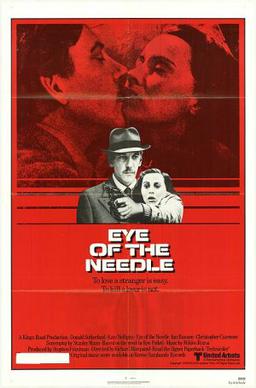
A Movie A Day #340: Eye of the Needle (1981, directed by Richard Marquand)


The time is World War II, shortly before D-Day.  Lucy Rose (Kate Nelligan) lives on an isolated island with her crippled husband, David (Christopher Cazenove), their young son, and a sheep herder named Tom (Alex McCrindle).  Embittered by the accident that left him in a wheelchair, David is abusively violent and emotionally shut off.  One night, during a sudden storm, a man who says his name is Henry Faber (Donald Sutherland) turns up on the island.  Henry claims that the storm caught him by surprise and left him stranded.  David doesn’t trust him and it turns out that, for once, David is right.  Faber is actually a semi-legendary German spy, code-named The Needle because his preferred instrument of murder is a stiletto.  Faber has discovered the plans for the Allied Invasion of Normandy.  He’s only on the island because he is waiting for a German u-boat to arrive and take him back to Berlin.  Complicating matters is that a romance has developed between Faber and Lucy.
Based on a novel by Ken Follett, Eye of the Needle is an old-fashioned spy thriller, distinguished by Kate Nelligan’s sensual turn as Lucy and Donald Sutherland giving what might be his career best performance in the role of Henry Faber.  Until he meets Lucy, Faber is a remorseless sociopath who is willing to kill anyone who discovers the truth about his identity.  For the majority of the film, it is left ambiguous whether Faber loves Lucy or if he’s just using her and Sutherland plays the role as if Faber himself is not really sure.  The final confrontation between Faber and Lucy is both suspenseful and exciting and will convince you to never stick your hand through a window unless you’re sure about what’s on the other side.  Eye of the Needle is a World War II thriller that deserves to be better known.

Following the success of this film, Richard Marquand was hired to direct Return of the Jedi.a film that is light years away from the gloomy world portrayed in Eye of the Needle.  He later directed another well-regarded thriller, Jagged Edge, before passing away from a stroke in 1987 at the age of 49.

Horror Film Review: Dracula (dir by John Badham)


I have to admit that, when I first sat down to watch the 1979 version of Dracula, I wasn’t expecting much.  I hadn’t even heard of the film until I came across it on Encore and, when I considered that it was made in 1979, I immediately assumed it would be a disco Dracula film.

And, let’s be honest — a disco Dracula film sounds kinda fun.  But still, it’s Halloween.  Dracula is an icon of horror.  And somehow, the idea of watching disco Dracula just was not appealing.  It would be appealing in November or September.  BUT THIS IS OCTOBER!

Well, despite my misgivings, I watched the film and I quickly discovered that it wasn’t a disco Dracula at all.  This Dracula takes place in 1913 and there’s actually very little about it that would lead you to suspect that it had been made in the 1970s.  Instead, it feels more like a tribute to the colorful and lushly erotic Dracula films that Hammer produced in the 60s.  Except, oddly, the Hammer films were far more bloody than the 1979 version.  Oh, don’t get me wrong.  There’s a few gory scenes in 1979’s Dracula.  Towards the end of the film, there’s a rather bloody impaling.  Dracula graphically breaks another character’s neck as we watch.  But, even with those scenes in mind, the 1979 Dracula feels oddly restrained at times.

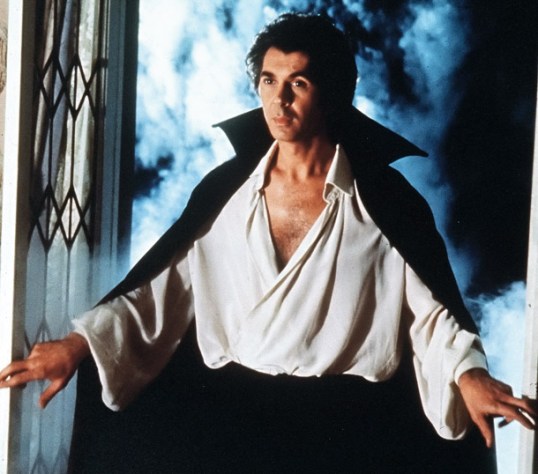
In this version of Dracula, the title character is played by a youngish Frank Langella.  I have to admit that it was a bit odd to see Langella playing someone other than a corrupt authority figure.  Dare I say it, Langella is almost sexy in this film and his somewhat feral features are perfect for a character who considers wolves to be “the children of the night.”  Langella’s performance falls between the haughty charm of Bela Lugosi and the animalistic fury of Christopher Lee.  And while Langella’s performance never quite reaches the heights of those two actors, he’s still effectively cast.

As for the film itself, it starts with a shipwreck near a local asylum.  One of the passengers on that ship is the charming but mysterious Count Dracula.  Dracula introduces himself to the head of the asylum, Dr. Jack Seward (Donald Pleasence, stealing almost every scene in which he appears).  There’s an immediate attraction between Dracula and Seward’s daughter, Lucy (Kate Nelligan).  That does not amuse Lucy’s fiancee, Jonathan Harker (Trevor Eve, who is perhaps the whiniest Harker in film history).

Meanwhile, Lucy’s best friend, Mina (Jan Francis), has been taken ill and it might have something to do with the two puncture marks on her neck.  After Mina dies, her father (played by Laurence Olivier) comes to investigate.  Her father’s name?  Abraham Van Helsing.

As I said, I was not expecting much from this version of Dracula so I was actually pleasantly surprised during the first hour of the film.  This version gets off to a nice start, with director John Badham giving us a mix of lush romanticism and gothic moodiness.  I’ve already talked about Langella’s performance but  Donald Pleasence and Laurence Olivier also distinguish themselves.  It’s obvious that these veteran performers enjoyed playing opposite each other and there’s a lot of pleasure to be found from watching Pleasence and Olivier compete to see who can steal the most scenes.

Unfortunately, after that strong first hour, Dracula slows down.  Once Seward and Van Helsing know that Dracula is a vampire, the whole movie becomes about finding excuses for them to not do anything about it.  The final 40 minutes feel almost like filler and, at one point, you’re required to believe that an elderly man, who has been seriously wounded, could still find the strength to swing a hook into a much stronger person’s back.

In the end, the 1979 Dracula is more of an intriguing oddity than a definitive version.